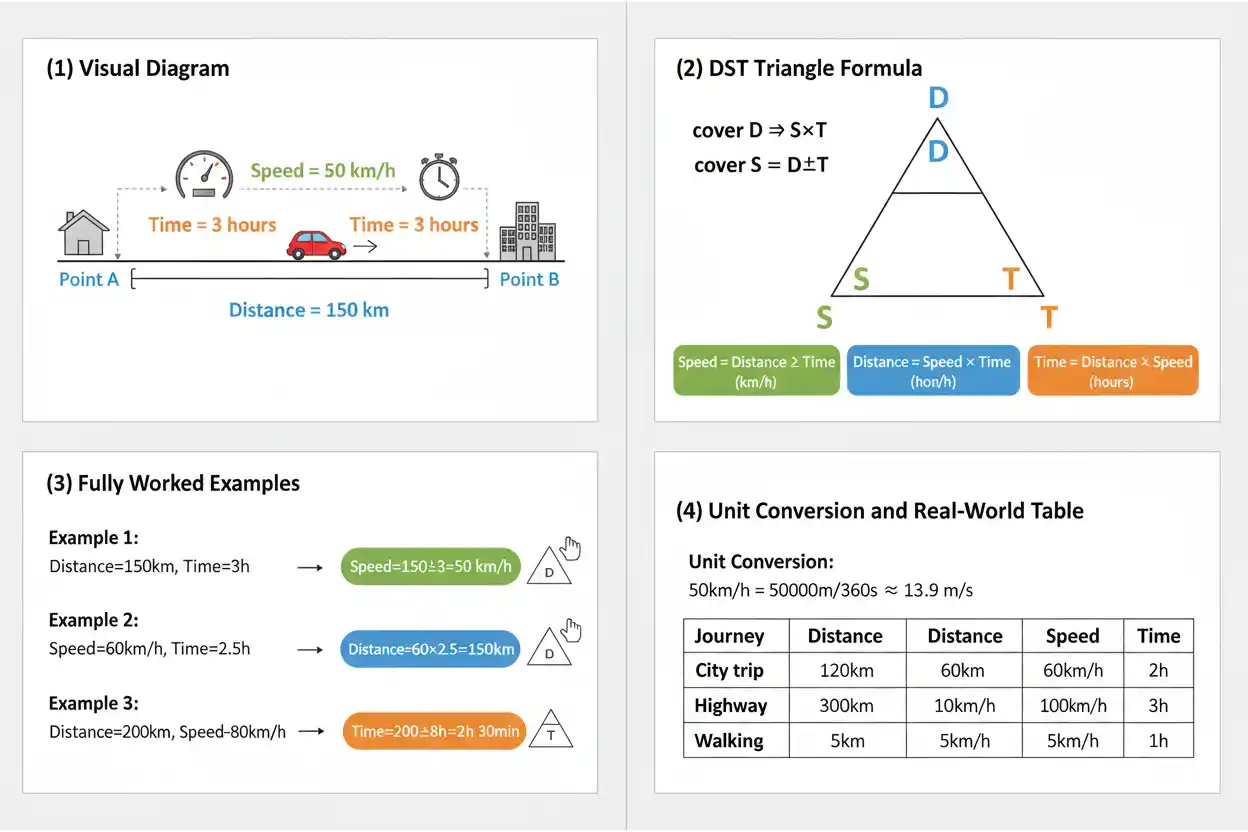

Speed, distance, and time are connected by one fundamental relationship:
Speed = Distance / Time
From this formula, the other two forms are:
Distance = Speed × Time
Time = Distance / Speed
For example, if a vehicle travels:
180 km
in:
3 hours
its speed is:
180/3
= 60 km/h
Therefore:
Speed = 60 km/h
The main challenge in speed-distance-time problems is usually not arithmetic. It is choosing the correct form of the formula, matching units, and distinguishing total or average quantities from single-stage motion.
Speed Distance Time Formula
Let:
s = speedd = distancet = time
Then:
s = d/t
Rearranging gives:
d = st
and:
t = d/s
These three equations describe the same relationship.
How to Choose the Correct Formula
If the problem gives distance and time:
s = d/t
If it gives speed and time:
d = st
If it gives distance and speed:
t = d/s
A useful first step in any step-by-step math solving problem is to identify what is known and what must be found before substituting numbers.
What Is Speed?
Speed measures distance traveled per unit of time.
The general form is:
Speed = Distance / Time
Examples of speed units include:
km/h
m/s
miles/hour
m/min
The units themselves reveal the formula because they represent:
distance unit / time unit
Speed is therefore a type of unit rate.
What Is Distance?
Distance measures how much path has been traveled.
From:
s = d/t
multiply both sides by t:
st = d
Therefore:
Distance = Speed × Time
For example, traveling at:
72 km/h
for:
2.5 h
gives:
d = 72 × 2.5
= 180 km
Therefore:
Distance = 180 km
What Is Time?
Time is the duration required to travel a distance at a given speed.
From:
d = st
divide by s:
t = d/s
provided:
s ≠ 0
For example:
d = 240 km
s = 80 km/h
Then:
t = 240/80
= 3 h
Therefore:
Time = 3 hours
Formula Triangle
The relationship is sometimes remembered using:
D
above:
S and T
This represents:
D = S × T
Covering D leaves:
S × T
Covering S leaves:
D/T
Covering T leaves:
D/S
The triangle is only a memory aid. All three formulas come from the same algebraic equation:
d = st
Example: Find Speed
A cyclist travels:
45 km
in:
2.5 hours.
Use:
s = d/t
Substitute:
s = 45/2.5
= 18
Therefore:
Speed = 18 km/h
Example: Find Distance
A train travels at:
110 km/h
for:
4 hours.
Use:
d = st
Then:
d = 110 × 4
= 440
Therefore:
Distance = 440 km
Example: Find Time
A vehicle travels:
315 km
at:
70 km/h.
Use:
t = d/s
Then:
t = 315/70
= 4.5 hours
Therefore:
Time = 4.5 hours
That equals:
4 hours 30 minutes.
Units Must Be Consistent
Before substituting values, make sure the distance and time units match the speed unit.
If speed is:
km/h
distance should normally be in:
km
and time in:
hours.
If speed is:
m/s
distance should be in:
meters
and time in:
seconds.
Failure to align units is one of the most common errors in speed-distance-time problems.
Example: Minutes With km/h
A car travels at:
90 km/h
for:
40 minutes.
You cannot directly calculate:
90 × 40
because 90 is per hour, not per minute.
Convert time:
40 min = 40/60 h
= 2/3 h
Then:
d = 90 × 2/3
= 60 km
Therefore:
Distance = 60 km
Hours and Minutes
Useful conversions include:
1 hour = 60 minutes
1 minute = 60 seconds
1 hour = 3600 seconds
For:
1 hour 45 minutes
convert the minutes:
45/60 = 0.75 h
Therefore:
1 h 45 min = 1.75 h
Decimal Hours to Hours and Minutes
Suppose:
t = 2.4 hours
The whole-number part is:
2 hours
The decimal part:
0.4 hour
Convert to minutes:
0.4 × 60
= 24 minutes
Therefore:
2.4 hours = 2 hours 24 minutes
Convert km/h to m/s
Since:
1 km = 1000 m
and:
1 h = 3600 s
we have:
1 km/h = 1000/3600 m/s
Simplify:
1 km/h = 5/18 m/s
Therefore:
m/s = km/h × 5/18
Example: 90 km/h to m/s
Use:
90 × 5/18
Simplify:
90/18 = 5
Then:
5 × 5 = 25
Therefore:
90 km/h = 25 m/s
Convert m/s to km/h
Reverse the conversion:
km/h = m/s × 18/5
or:
km/h = m/s × 3.6
For:
20 m/s
calculate:
20 × 3.6
= 72
Therefore:
20 m/s = 72 km/h
Why the Conversion Factor Is 3.6
Start with:
1 m/s
In one hour:
3600 seconds
Distance traveled:
3600 m
Convert to kilometers:
3600/1000
= 3.6 km
Therefore:
1 m/s = 3.6 km/h
Speed as a Ratio
Speed is fundamentally a ratio of distance to time:
d:t
Numerically:
d/t
For example:
150 km : 3 h
gives:
50 km per hour.
This ratio interpretation explains why changing both distance and time by the same scale factor preserves speed.
Speed and Proportion
If speed remains constant, distance and time are directly proportional.
For:
d = st
with constant s:
d/t = s
Suppose:
120 km
is traveled in:
2 h.
At the same speed, how far in:
5 h?
Set a proportion:
120/2 = d/5
Cross multiply:
2d = 600
d = 300
Therefore:
Distance = 300 km
Direct Proportionality
At constant speed:
Distance ∝ Time
If time doubles, distance doubles.
If time triples, distance triples.
For example, at:
40 km/h
1 hour gives:
40 km
2 hours:
80 km
3 hours:
120 km
This produces a direct proportional relationship of the type developed under proportions.
Distance-Time Table
At constant speed:
60 km/h
a table might be:
| Time (h) | Distance (km) |
|---|---|
| 0 | 0 |
| 1 | 60 |
| 2 | 120 |
| 3 | 180 |
| 4 | 240 |
Every nonzero pair satisfies:
d/t = 60
Therefore speed remains constant.
Distance-Time Graph
For constant speed:
d = st
A graph of distance against time is a straight line through the origin.
Its slope is:
Δdistance / Δtime
which equals speed.
A steeper line indicates a greater speed when both axes use the same scales.
Speed-Time Graph for Constant Speed
If speed remains constant, a speed-time graph is horizontal.
The distance traveled over a time interval equals:
Speed × Time
which corresponds geometrically to the rectangular area under a constant-speed graph.
For changing speed, the relationship requires more careful treatment.
Average Speed
If motion occurs in several stages, the correct average speed is:
Average Speed = Total Distance / Total Time
It is generally not the simple arithmetic mean of the different speeds.
This distinction is critical.
Average Speed Example
A vehicle travels:
60 km at 60 km/h
then:
60 km at 120 km/h
First stage time:
60/60 = 1 h
Second stage:
60/120 = 0.5 h
Total distance:
120 km
Total time:
1.5 h
Therefore:
Average Speed = 120/1.5
= 80 km/h
So:
Average speed = 80 km/h
not:
(60+120)/2 = 90 km/h
because the vehicle did not spend equal amounts of time at each speed.
When the Arithmetic Mean of Speeds Works
If equal time intervals are spent at different speeds, the arithmetic mean can represent average speed.
For example:
1 hour at 40 km/h
and:
1 hour at 60 km/h
Total distance:
40 + 60 = 100 km
Total time:
2 h
Average speed:
100/2
= 50 km/h
This matches:
(40+60)/2 = 50 km/h
The equality occurs because the time intervals are equal.
Equal Distances at Different Speeds
For equal distances, the arithmetic mean usually does not work.
Suppose a vehicle travels the same distance at speeds:
40 km/h
and:
60 km/h.
For two equal-distance legs, average speed is:
2s₁s₂/(s₁+s₂)
Substitute:
2 × 40 × 60 / (40+60)
= 4800/100
= 48 km/h
Therefore:
Average speed = 48 km/h
not 50 km/h.
The specialized average-speed page owns this case in greater depth.
Multi-Stage Trips
For several trip segments:
Total Distance = d₁ + d₂ + … + dₙ
Total Time = t₁ + t₂ + … + tₙ
Then:
Average Speed = Total Distance / Total Time
For many stages, totals can be organized using the same additive structure as sequence sums.
The important point is to sum distances and times separately before dividing.
Example: Three Stages
A traveler covers:
40 km in 1 h
90 km in 1.5 h
70 km in 1 h
Total distance:
40 + 90 + 70
= 200 km
Total time:
1 + 1.5 + 1
= 3.5 h
Average speed:
200/3.5
≈ 57.14 km/h
Therefore:
Average speed ≈ 57.14 km/h
Speed vs. Velocity
Speed measures how fast distance is covered and has magnitude only.
Velocity also includes direction and is based on displacement.
For example, a runner may travel:
400 m
around a track and return to the starting point.
Total distance:
400 m
but displacement:
0 m
Average speed is positive, while average velocity over the full lap is:
0
The distinction is developed more specifically under average velocity.
Distance vs. Displacement
Distance is the total path length traveled.
Displacement is the directed change from starting point to ending point.
The speed-distance-time formula uses:
distance
whereas velocity formulas use displacement.
These quantities are equal only in some motion situations, such as straight movement in one direction without reversal.
Straight-Line Distance Before Finding Speed
Sometimes the travel distance must first be calculated from geometry.
Suppose an object moves from one point to another with perpendicular coordinate differences:
3 km
and:
4 km.
The direct distance is:
√(3²+4²)
= √25
= 5 km
using square roots.
If this distance is covered in:
0.5 h
then:
s = 5/0.5
= 10 km/h
Therefore:
Speed = 10 km/h
The geometric distance formula and speed-distance-time formula solve different parts of the problem.
Finding Time From an Arrival Problem
A trip is:
270 km
and average speed is expected to be:
90 km/h.
Travel time:
t = 270/90
= 3 h
If departure is:
08:30
then an uninterrupted trip would end at:
11:30
Any stops must be added separately unless they are already included in the average speed or total time definition.
Stops and Average Speed
Suppose a driver travels:
150 km
in:
2.5 hours of driving
but also stops for:
30 minutes.
If average speed for the entire trip is requested:
Total elapsed time:
2.5 + 0.5
= 3 h
Average speed:
150/3
= 50 km/h
If only driving speed is requested:
150/2.5
= 60 km/h
The time definition changes the answer.
Relative Speed: Opposite Directions
If two objects move directly toward each other at:
s₁
and:
s₂
their closing speed is:
s₁ + s₂
For example:
50 km/h
and:
70 km/h
give:
120 km/h
relative closing speed.
If they start:
360 km
apart, meeting time is:
360/120
= 3 h
Relative Speed: Same Direction
If two objects move in the same direction, with the faster one behind, closing speed is:
Faster Speed – Slower Speed
For:
90 km/h
and:
65 km/h
relative speed:
25 km/h
If the initial gap is:
50 km
catch-up time:
50/25
= 2 h
Round-Trip Problems
Suppose a destination is:
100 km
away.
Outbound speed:
50 km/h
Return speed:
100 km/h
Outbound time:
100/50 = 2 h
Return time:
100/100 = 1 h
Total distance:
200 km
Total time:
3 h
Average speed:
200/3
≈ 66.67 km/h
The average is not:
75 km/h
because equal distances were traveled for unequal amounts of time.
Significant Figures in Speed Distance Time
Measured speed-distance-time calculations should reflect the precision of their inputs using significant figures.
Suppose:
d = 125 km
with three significant figures
and:
t = 2.4 h
with two significant figures.
Calculate:
s = 125/2.4
≈ 52.0833 km/h
Report to two significant figures:
52 km/h
The unrounded value can be retained internally until the final reporting step.
Rounding Travel Time
Suppose:
t = 2.6833 hours
If a result is needed to the nearest hundredth of an hour:
2.68 h
But if the answer is wanted in hours and minutes, convert the fractional hour instead:
0.6833 × 60
≈ 41.0 minutes
So:
2.6833 h ≈ 2 h 41 min
These are different reporting formats.
Speed and Scientific Notation
Very large or small speeds may be written in scientific notation.
For example:
300,000,000 m/s
can be represented as:
3.00 × 10⁸ m/s
Scientific notation makes scale and stated precision easier to see.
Speed Problems With Proportional Change
If time remains constant:
distance is proportional to speed.
For example, if a journey lasts:
4 hours
then increasing speed from:
50 km/h
to:
75 km/h
changes distance from:
200 km
to:
300 km
The speed increased by a factor:
75/50 = 1.5
and distance increased by the same factor.
Fixed Distance and Speed-Time Relationship
If distance is fixed:
t = d/s
So time is inversely related to speed.
For:
d = 120 km
At:
60 km/h
time is:
2 h
At:
120 km/h
time is:
1 h
Doubling the speed halves the travel time only when the distance remains unchanged.
Percentage Increase in Speed Does Not Equal the Same Percentage Decrease in Time
For a fixed distance, suppose speed rises by:
25%
The new speed multiplier is:
1.25
Time becomes:
1/1.25
= 0.8
times the original.
Therefore time falls by:
20%
not 25%.
This asymmetry follows from the inverse relationship:
t = d/s
Sequence of Travel Segments
Suppose segment distances are:
10, 20, 30, 40 km
Their total distance is:
10 + 20 + 30 + 40
= 100 km
If the corresponding times are:
0.25, 0.5, 0.75, 1 h
total time:
2.5 h
Average speed:
100/2.5
= 40 km/h
The segment values may form sequences, but the governing speed formula still uses total distance divided by total time.
Infinite Shrinking Travel Segments
A theoretical trip may involve distances that shrink geometrically:
8 + 4 + 2 + 1 + …
The series convergence result gives:
Total Distance = 16
because:
a = 8
r = 1/2
and:
8/(1-1/2) = 16
If the corresponding total elapsed time is known and finite, the usual average-speed relationship can then be applied:
Average Speed = Total Distance / Total Time
The convergence calculation determines the total distance; it does not replace the speed formula.
Dimensional Check
The units provide a powerful error check.
For speed:
km / h = km/h
For distance:
(km/h) × h = km
For time:
km / (km/h) = h
If your final units do not match the requested quantity, the formula setup or unit conversion may be wrong.
Example: Unit Check
Calculate time for:
150 km
at:
75 km/h.
Use:
t = d/s
Units:
km ÷ (km/h)
Invert the denominator:
km × h/km
Cancel km:
h
So the result must be in hours.
Numerically:
150/75 = 2
Therefore:
Time = 2 h
Zero Speed
The formula:
t = d/s
requires:
s ≠ 0
If:
s = 0
an object is not covering distance at that instant.
A positive distance cannot be completed at constant zero speed in finite time.
Similarly:
d = st
with:
s = 0
gives:
d = 0
for any finite t.
Zero Time
The formula:
s = d/t
requires:
t ≠ 0
Dividing a positive distance by zero time is undefined.
An idealized instantaneous displacement would not have a finite ordinary speed under this formula.
Common Mistake: Multiplying When You Should Divide
If distance and time are given, speed is:
d/t
not:
d × t
For:
120 km in 2 h
correct:
120/2 = 60 km/h
Multiplication would produce incorrect units:
km·h
rather than:
km/h
Common Mistake: Mixing Minutes and Hours
At:
60 km/h
for:
30 minutes
do not calculate:
60 × 30
Convert:
30 min = 0.5 h
Then:
60 × 0.5
= 30 km
Common Mistake: Averaging Speeds Directly
If different speeds apply over unequal times or equal distances, simply averaging the speed numbers may be wrong.
Use:
Average Speed = Total Distance / Total Time
This formula always identifies the correct ordinary average speed for the full trip.
Common Mistake: Confusing Distance With Displacement
A round trip may have:
positive total distance
but:
zero displacement.
Speed is based on distance.
Velocity is based on displacement.
Using the wrong quantity changes the interpretation.
Common Mistake: Forgetting Stops
If the problem asks for average speed over total elapsed journey time, stopping time normally belongs in the denominator.
If it asks for average moving speed, stops may be excluded.
Read the time definition carefully.
Common Mistake: Rounding Too Early
Suppose one segment time is:
17/12 h
Do not immediately replace it with:
1.4 h
if later calculations require precision.
Keeping:
17/12
or several decimal places until the final answer reduces rounding error.
How to Check a Speed Distance Time Answer
Use the inverse relationship.
Suppose:
s = 72 km/h
t = 2.5 h
and you found:
d = 180 km
Check:
d/t = 180/2.5
= 72 km/h
The original speed is recovered.
Also check the units:
km/h × h = km
Both tests support the answer.
Frequently Asked Questions
What is the speed distance time formula?
Speed = Distance / Time
How do you calculate distance?
Distance = Speed × Time
How do you calculate time?
Time = Distance / Speed
What units are used for speed?
Common units include km/h, m/s, mph, and m/min.
How do you convert km/h to m/s?
Multiply by 5/18
How do you convert m/s to km/h?
Multiply by 18/5, or 3.6.
What is average speed?
Average Speed = Total Distance / Total Time
Is average speed always the average of two speeds?
No. The arithmetic mean works only in particular cases, such as equal time intervals.
How far do you travel at 60 km/h for 2.5 hours?
60 × 2.5 = 150 km
How long does 240 km take at 80 km/h?
240/80 = 3 hours
What is 72 km/h in m/s?
72 × 5/18 = 20 m/s
Does speed include direction?
No. Velocity includes direction; speed is a scalar magnitude.
Why must units be converted first?
The speed formula only works correctly when distance and time units are compatible with the speed unit.
Final Example
A traveler covers:
150 km at 75 km/h
then:
120 km at 60 km/h.
Find the total travel time and average speed.
First segment:
t₁ = 150/75
= 2 h
Second segment:
t₂ = 120/60
= 2 h
Total time:
2 + 2
= 4 h
Total distance:
150 + 120
= 270 km
Average speed:
270/4
= 67.5 km/h
Therefore:
Total time = 4 hours
Average speed = 67.5 km/h
Check:
67.5 × 4 = 270 km
The central relationships are:
Speed = Distance / Time
Distance = Speed × Time
Time = Distance / Speed
For multi-stage journeys, add all distances and all relevant elapsed times first, then use total distance divided by total time. Keeping units consistent is just as important as choosing the correct formula.