
Surds are exact irrational radical expressions that cannot be simplified to rational numbers.
Examples include:
√2
√3
5√7
2 + √5
The expression:
√12
contains an irrational radical but is not in simplest form because:
√12 = √(4×3)
= 2√3
So the simplified surd is:
2√3
By contrast:
√25 = 5
is not a surd because it simplifies completely to a rational integer.
Surds are useful because they preserve exact values. Writing:
√2
keeps the exact number, while:
1.414
is only a decimal approximation.
What Is a Surd?
A surd is a radical expression representing an irrational number in exact form.
Common examples are:
√2
√5
∛7
3√11
A radical is not automatically a surd.
For example:
√64 = 8
Because the radical simplifies to the rational number 8, it is not a surd in its simplified value.
Likewise:
∛27 = 3
is rational.
Surds and Square Roots
Many introductory surd problems involve square roots.
For positive integer n:
√n
is irrational when n is not a perfect square.
Examples:
√2
√6
√10
√15
are surds.
But:
√4 = 2
√9 = 3
√100 = 10
are rational and therefore are not surds.
Exact Form vs. Decimal Form
Consider:
√3
Exact form:
√3
Decimal approximation:
√3 ≈ 1.7320508
The radical form is exact.
The decimal representation is approximate because the digits continue forever without repeating.
This distinction is useful whenever later algebraic simplification is possible.
General Radical Form
A typical surd may have form:
a√b
where:
ais rational
and:
bis chosen so no perfect-square factor remains under the square root.
For example:
√72
simplifies:
√(36×2)
= 6√2
Therefore:
√72 = 6√2
The simplified radicand 2 has no perfect-square factor greater than 1.
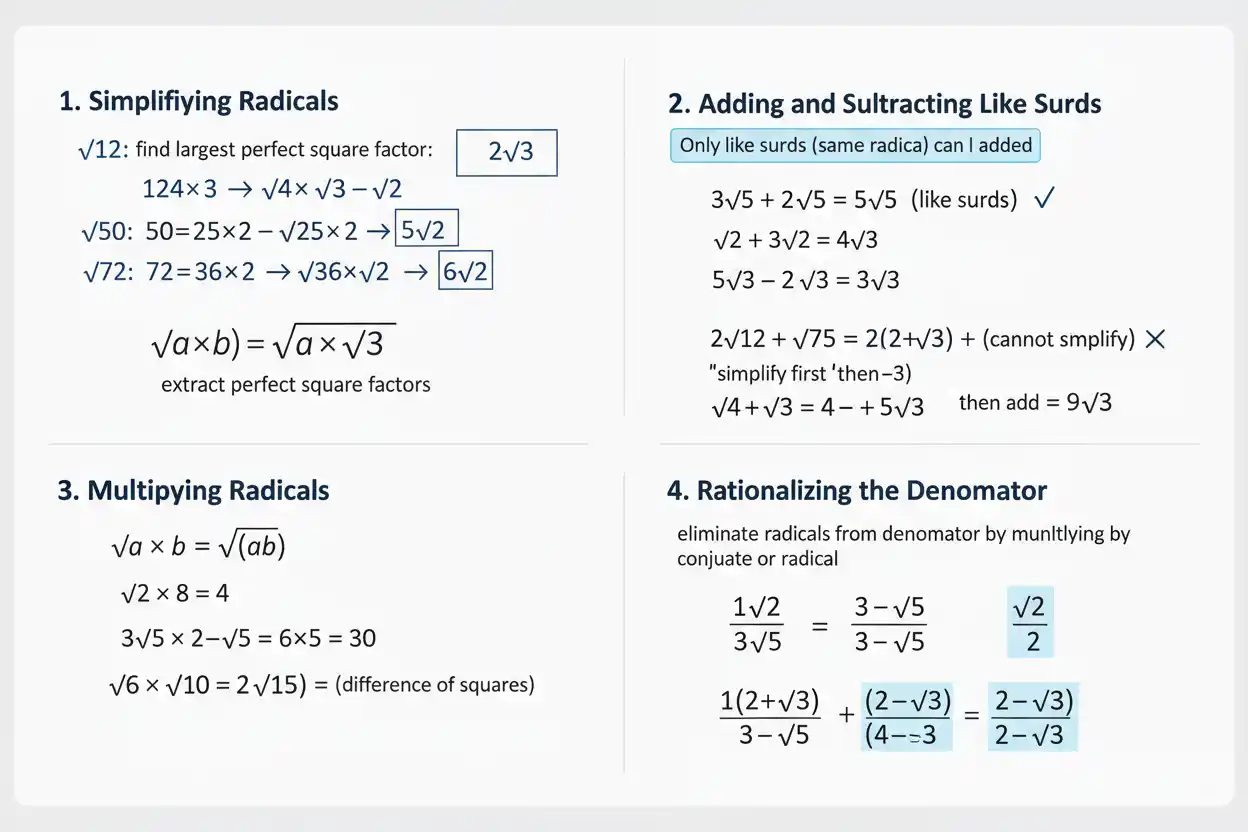
Simplifying Surds
To simplify a square-root surd:
Find the largest perfect-square factor of the radicand.
Separate the product.
Take the square root of the perfect-square factor.
Leave the remaining factor inside the radical.
For example:
√48
Use:
48 = 16×3
Then:
√48 = √16×√3
= 4√3
Therefore:
√48 = 4√3
Simplify √75
Factor:
75 = 25×3
Then:
√75 = √25×√3
= 5√3
Therefore:
√75 = 5√3
Simplify √200
Factor:
200 = 100×2
Then:
√200 = √100×√2
= 10√2
Therefore:
√200 = 10√2
Prime Factorization Method
Prime factorization provides a systematic simplification method.
Consider:
√180
Factor:
180 = 2²×3²×5
Now take one factor from each pair:
√180 = 2×3×√5
Therefore:
√180 = 6√5
Pairs matter because:
√(p²) = p
for positive prime p.
Simplifying Higher-Index Surds
The same grouping idea applies to higher roots.
For cube roots, complete groups of three factors leave the radical.
For example:
∛54
Factor:
54 = 3³×2
Then:
∛54 = 3∛2
Therefore:
∛54 = 3∛2
For fourth roots, complete groups of four leave the radical.
Like Surds
Surds are like surds when they contain the same radical part after simplification.
Examples:
3√2
and:
7√2
are like surds.
Similarly:
5√3
and:
-2√3
are like surds.
Their coefficients can be combined just as coefficients of like algebraic terms are combined.
Adding Like Surds
Use:
a√n + b√n = (a+b)√n
For example:
3√5 + 7√5
= (3+7)√5
= 10√5
Therefore:
3√5 + 7√5 = 10√5
Subtracting Like Surds
Similarly:
a√n – b√n = (a-b)√n
For:
9√3 – 4√3
we get:
5√3
Therefore:
9√3 – 4√3 = 5√3
Unlike Surds Cannot Normally Be Combined
Consider:
√2 + √3
The radicals are different.
There is no ordinary simplification to:
√5
In fact:
√2 + √3 ≠ √5
Therefore the exact expression remains:
√2 + √3
unless some other algebraic structure is present.
Simplify Before Deciding Whether Surds Are Like
Consider:
√12 + √27
Initially the radicands differ.
Simplify:
√12 = 2√3
and:
√27 = 3√3
Now they are like surds.
Add:
2√3 + 3√3
= 5√3
Therefore:
√12 + √27 = 5√3
This is why individual radicals should usually be simplified before addition or subtraction.
Another Addition Example
Simplify:
2√8 + √18
First:
√8 = 2√2
so:
2√8 = 4√2
Next:
√18 = 3√2
Then:
4√2 + 3√2
= 7√2
Therefore:
2√8 + √18 = 7√2
Multiplying Surds
For suitable nonnegative radicands:
√a × √b = √(ab)
For example:
√3 × √5
= √15
Therefore:
√3√5 = √15
If the product contains a perfect-square factor, simplify it afterward.
Multiplication Example
Calculate:
√6 × √24
Combine:
√144
Then:
√144 = 12
Therefore:
√6 × √24 = 12
Two irrational surds can therefore multiply to a rational number.
Multiplying Coefficients and Surds
Consider:
3√2 × 4√5
Multiply coefficients:
3×4 = 12
Multiply radicals:
√2×√5 = √10
Therefore:
3√2 × 4√5 = 12√10
Multiplying Like Surds
Calculate:
5√3 × 2√3
Coefficients:
5×2 = 10
Radicals:
√3×√3 = 3
Therefore:
10×3 = 30
So:
5√3 × 2√3 = 30
Squaring a Surd
For:
a√b
square the coefficient and radical:
(a√b)² = a²b
For example:
(3√5)²
= 9×5
= 45
Therefore:
(3√5)² = 45
This provides a useful checking method.
Expanding Binomials With Surds
Consider:
(2+√3)²
Use:
(a+b)² = a²+2ab+b²
Then:
2² + 2(2)(√3) + (√3)²
= 4 + 4√3 + 3
= 7 + 4√3
Therefore:
(2+√3)² = 7+4√3
Difference of Two Surds
Consider:
(√5+√2)(√5-√2)
Use the difference-of-squares pattern:
a²-b²
Therefore:
5 – 2
= 3
So:
(√5+√2)(√5-√2) = 3
The two binomials are conjugates.
Conjugate Surds
Expressions such as:
a+√b
and:
a-√b
are conjugates.
Their product removes the middle surd terms:
(a+√b)(a-√b) = a²-b
For example:
(3+√2)(3-√2)
= 9-2
= 7
Conjugates are especially useful when rationalizing denominators.
Dividing Surds
A quotient of surds may simplify using:
√a/√b = √(a/b)
when the real radicals are defined and b > 0.
For example:
√50/√2
= √25
= 5
Therefore:
√50/√2 = 5
Simplifying a Surd Quotient
Consider:
6√15 / 3√5
Simplify coefficients:
6/3 = 2
Radicals:
√15/√5 = √3
Therefore:
6√15/(3√5) = 2√3
Rationalizing a Single-Surd Denominator
A denominator containing a surd can often be rewritten so the denominator is rational.
Consider:
1/√2
Multiply numerator and denominator by:
√2
Then:
(1×√2)/(√2×√2)
= √2/2
Therefore:
1/√2 = √2/2
Both expressions are equal, but the second has a rational denominator.
Rationalize 3/√5
Multiply by:
√5/√5
Then:
3√5/5
Therefore:
3/√5 = 3√5/5
Rationalizing a Denominator With a Coefficient
Consider:
5/(2√3)
Multiply numerator and denominator by:
√3
Then:
5√3/(2×3)
= 5√3/6
Therefore:
5/(2√3) = 5√3/6
Rationalizing a Binomial Denominator
Consider:
1/(2+√3)
Use the conjugate:
2-√3
Multiply:
[1/(2+√3)] × [(2-√3)/(2-√3)]
Numerator:
2-√3
Denominator:
(2+√3)(2-√3)
= 4-3
= 1
Therefore:
1/(2+√3) = 2-√3
Another Conjugate Example
Rationalize:
1/(√5-2)
Use conjugate:
√5+2
Then denominator:
(√5-2)(√5+2)
= 5-4
= 1
Therefore:
1/(√5-2) = √5+2
This is exact.
Surds and Irrational Numbers
A simplified surd represents an irrational number when it cannot reduce to a rational value.
For example:
√2
is irrational.
So:
5√2
is also irrational because multiplying a nonzero rational number by an irrational number remains irrational.
However, surds can combine to produce rational values:
√2×√2 = 2
or:
√8/√2 = 2
The presence of radical symbols in an unsimplified expression does not guarantee the final result is irrational.
Surds and Rational Numbers
A radical expression may simplify to a rational number.
For example:
√(49/64)
= 7/8
The original notation contains a root, but its value is rational.
Therefore classification should be based on the simplified value.
Surds and Exponents
A radical can be written with a fractional exponent:
√a = a^(1/2)
and:
ⁿ√a = a^(1/n)
For example:
√7 = 7^(1/2)
and:
∛5 = 5^(1/3)
This connects surd manipulation with ordinary exponent rules.
Surd Equations
Consider:
√x = 5
Square both sides:
x = 25
Therefore:
x = 25
Check:
√25 = 5
The candidate satisfies the original equation.
Equation With a Surd Expression
Solve:
√(x+1) = 4
Square:
x+1 = 16
Subtract 1:
x = 15
Check:
√(15+1)
= √16
= 4
Therefore:
x = 15
Squaring Can Introduce Extraneous Solutions
Suppose an equation contains radicals on one side and other expressions on the other.
Squaring can remove sign information.
Therefore candidates obtained after squaring should be substituted back into the original equation.
A structured step-by-step math solving process helps keep such domain and verification checks visible.
Surds in Summation Notation
The mapped summation notation topic can include surd terms.
For example:
Σ√(2k²), from k=1 to 4
For positive integer k:
√(2k²) = k√2
Therefore:
Σk√2
Factor out:
√2 Σk
Then:
Σk, k=1 to 4 = 10
So:
Σ√(2k²), k=1 to 4 = 10√2
Exact surd form is preserved throughout the sum.
Sum of Like Surds in Sigma Form
Consider:
Σ3√5, from k=1 to 6
The term does not depend on k.
There are six terms.
Therefore:
6×3√5
= 18√5
So:
Σ3√5, k=1 to 6 = 18√5
Surds and Triangular Numbers
The nth triangular number is:
Tₙ = n(n+1)/2
If a value T is given and you want to solve for the possible index n, rearrange:
n²+n-2T = 0
Using the quadratic formula:
n = [-1 ± √(1+8T)]/2
For a positive triangular-number index:
n = [√(8T+1)-1]/2
This formula shows a direct connection with square roots and surds.
Triangular Number Example
Suppose:
T = 36
Then:
8T+1 = 289
and:
√289 = 17
Therefore:
n = (17-1)/2
= 8
So:
36 is the eighth triangular number
If 8T+1 does not have the required perfect-square structure, the corresponding expression may remain a surd rather than yielding an integer index.
Surds in Unit Rates
A unit rate can contain an exact surd.
Suppose a moving object covers:
√18 meters
in:
3 seconds.
Unit rate:
√18/3 m/s
Simplify:
√18 = 3√2
Then:
3√2/3
= √2
Therefore:
Unit rate = √2 m/s
Decimal approximation:
≈ 1.414 m/s
The exact surd form can be retained until a decimal is actually required.
Surd Ratios
Consider ratio:
√8 : √2
As a quotient:
√8/√2
= √4
= 2
Therefore:
√8 : √2 = 2:1
Two irrational quantities can have a rational ratio.
Geometry With Surds
Surds commonly appear in exact geometric lengths.
Suppose a right triangle has perpendicular sides:
1 and 1
Its hypotenuse is:
√(1²+1²)
= √2
Therefore:
Hypotenuse = √2
Writing:
1.414
would only approximate the exact geometric length.
Another Geometry Example
A rectangle has side lengths:
2 and 3.
Its diagonal is:
√(2²+3²)
= √13
Therefore:
Diagonal = √13
Since 13 has no perfect-square factor, the exact answer cannot be simplified further.
Surds as Exact Algebraic Values
Suppose an expression contains:
x = 2+√3
Using the exact form preserves relationships such as:
(2+√3)(2-√3) = 1
Replacing:
√3
with a rounded decimal may hide that exact reciprocal relationship.
For symbolic algebra, exact surd notation is often more informative than decimal approximation.
Comparing Positive Surds
For nonnegative values, compare radicands when the coefficients and root indices permit.
For example:
√7
and:
√11
Since:
7 < 11
we know:
√7 < √11
No decimal conversion is necessary.
Compare 3√2 and 2√5
Both values are positive.
Square them:
(3√2)² = 18
(2√5)² = 20
Since:
18 < 20
we have:
3√2 < 2√5
This avoids decimal approximation.
Approximate Surds
An exact surd can be converted to decimal form when needed.
For:
5√3
use:
√3 ≈ 1.7320508
Then:
5√3 ≈ 8.660254
Rounded to three decimal places:
5√3 ≈ 8.660
The exact and approximate forms should be clearly distinguished.
Significant Figures With Surds
If a surd comes from measured data, the final decimal approximation may need an appropriate precision.
Suppose:
x = √45.0
The exact expression remains:
√45.0
Simplify mathematically:
3√5
Calculator:
≈ 6.7082039
If the context requires three significant figures:
x ≈ 6.71
Do not round the radical before completing the calculation.
Surds and Real Numbers
Ordinary square-root surds such as:
√2
and:
3√7
are real numbers.
However:
√(-2)
is not a real surd under the elementary real-number definition because the square root of a negative number is outside the real-number system.
Odd-root surds may have negative radicands:
∛(-2) = -∛2
which is a real irrational value.
Common Mistake: Assuming Every Radical Is a Surd
√36 = 6
is rational.
Therefore its simplified value is not a surd.
Always simplify before classifying.
Common Mistake: Adding Unlike Surds
Incorrect:
√2 + √3 = √5
Correct:
√2 + √3
cannot normally be simplified further.
Addition does not combine radicands.
Common Mistake: Failing to Simplify Before Adding
Consider:
√8 + √18
It may look like two unlike surds.
But:
√8 = 2√2
√18 = 3√2
Therefore:
√8 + √18 = 5√2
Simplification reveals that the terms are like surds.
Common Mistake: Distributing Roots Over Addition
In general:
√(a+b) ≠ √a+√b
For example:
√(9+16) = 5
while:
√9+√16 = 7
The product rule does not extend to sums.
Common Mistake: Rationalizing Incorrectly
For:
1/(2+√3)
multiplying only the denominator by:
2-√3
changes the value.
You must multiply the entire fraction by:
(2-√3)/(2-√3)
which equals 1.
That preserves equality.
Common Mistake: Converting to Decimals Too Early
Suppose:
√12 + √27
Using approximate decimals first makes the hidden common radical less obvious.
Exact simplification gives:
2√3 + 3√3
= 5√3
This is cleaner and exact.
Approximate only after simplification if a decimal is needed.
Common Mistake: Forgetting to Check Radical Equations
If you square both sides while solving an equation, substitute all candidate solutions back into the original equation.
Squaring can allow values that satisfy the transformed equation but not the original one.
How to Check a Simplified Surd
Suppose:
√288 = 12√2
Square both positive expressions.
Left radicand:
288
Right:
(12√2)²
= 144×2
= 288
Therefore the simplification is correct.
Frequently Asked Questions
What is a surd?
A surd is an exact irrational radical expression that does not simplify to a rational number.
Is √2 a surd?
Yes.
Is √9 a surd?
No.
√9 = 3
which is rational.
Is √12 a surd?
Its value is irrational, but the radical should first be simplified:
√12 = 2√3
How do you simplify surds?
Factor the radicand and remove complete powers corresponding to the root index.
For square roots, remove perfect-square factors.
Can you add surds?
Yes, when they are like surds after simplification.
For example:
3√2 + 5√2 = 8√2
Can you add √2 and √3?
They cannot normally be combined into a single simpler surd.
How do you multiply surds?
Multiply coefficients and multiply compatible radicals, then simplify.
What is √2 × √2?
2
Why rationalize a denominator?
It rewrites an equivalent exact expression without an irrational radical in the denominator.
Rationalize 1/√3.
√3/3
What is a conjugate?
For an expression a+√b, its conjugate is a-√b, and vice versa.
Are surds exact?
Yes. A surd such as √2 is exact; a decimal such as 1.414 is approximate.
Are all surds irrational?
In the usual definition, yes: the simplified radical expression represents an irrational value.
Final Example
Simplify:
√50 + 2√8 – √18
First simplify each radical.
For:
√50
use:
50 = 25×2
so:
√50 = 5√2
Next:
√8 = √(4×2)
= 2√2
Therefore:
2√8 = 4√2
Finally:
√18 = √(9×2)
= 3√2
Now combine:
5√2 + 4√2 – 3√2
= (5+4-3)√2
= 6√2
Therefore:
√50 + 2√8 – √18 = 6√2
Decimal approximation:
√2 ≈ 1.41421356
so:
6√2 ≈ 8.48528136
Thus:
Exact answer = 6√2
Approximate answer ≈ 8.485
The core surd rules are:
Simplify radicals before combining them.
a√n + b√n = (a+b)√n
√a × √b = √(ab)
Keep exact radical form until a decimal approximation is actually needed.
Use conjugates when rationalizing binomial radical denominators.
Surds preserve exact irrational quantities in a form that remains useful for algebra, geometry, rates, summation, and later calculations.