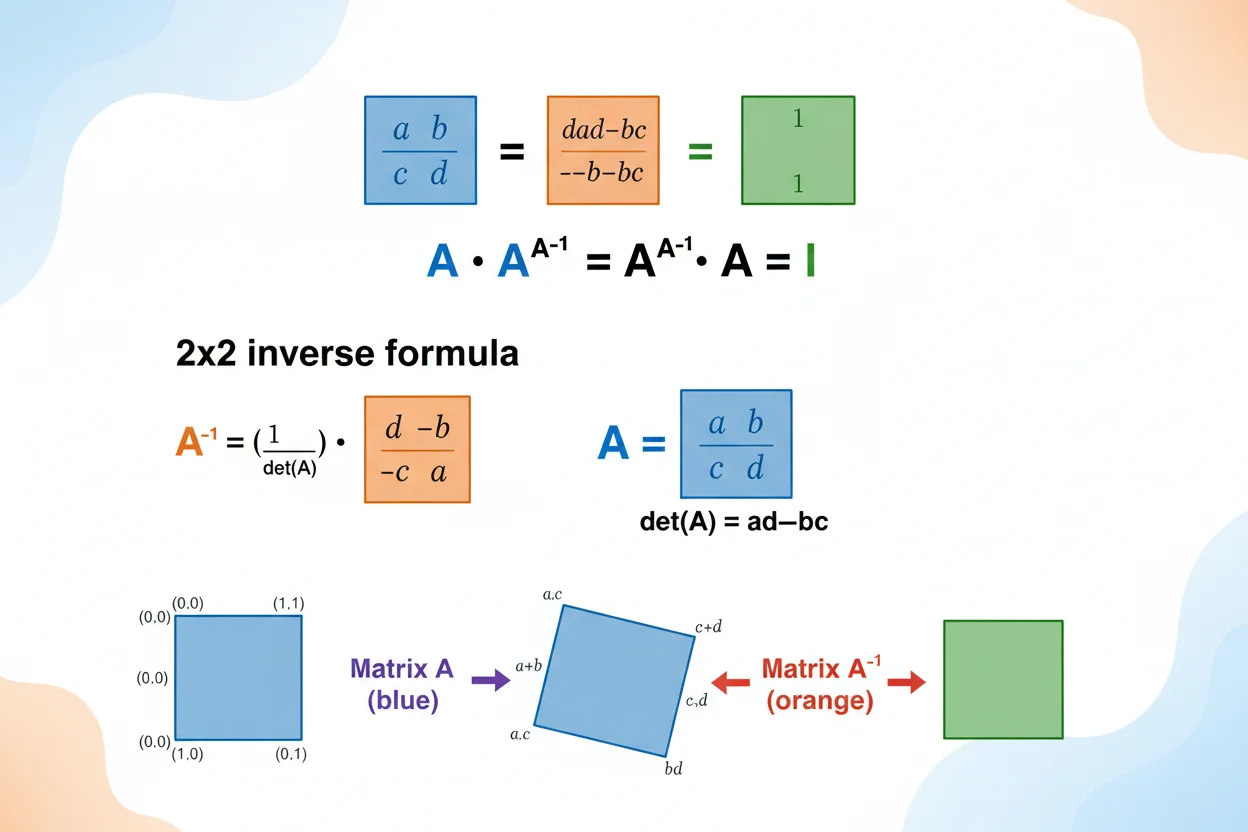

A matrix inverse is a matrix that reverses the effect of an invertible square matrix. If A has an inverse A⁻¹, then AA⁻¹ = A⁻¹A = I, where I is the identity matrix. For a 2×2 matrix A = [[a, b], [c, d]], the inverse is A⁻¹ = 1/(ad − bc)[[d, −b], [−c, a]], provided ad − bc ≠ 0. The quantity ad − bc is the matrix determinant, so a square matrix has an inverse exactly when its determinant is nonzero. Matrix inverses can be used to solve equations such as Ax = b, reverse linear transformations, and derive many structural relationships in linear algebra. Larger inverses can be found using row reduction, although explicitly computing an inverse is often unnecessary for solving large numerical systems. An inverse is unique when it exists. Matrices with determinant zero, deficient rank, or zero as an eigenvalue are singular and do not have ordinary inverses.
What Is a Matrix Inverse?
The inverse of a square matrix A is written:
A⁻¹
It satisfies:
AA⁻¹ = I
and:
A⁻¹A = I
where I is the identity matrix of the same size.
For a 2×2 matrix:
I = [ 1 0 ]
[ 0 1 ]
The inverse therefore plays a role similar to a reciprocal for ordinary nonzero numbers.
For a number a:
a · 1/a = 1
For a matrix A:
A A⁻¹ = I
However, matrix multiplication is not ordinary scalar multiplication, so the inverse has its own formula and existence conditions.
Matrix Inverse Formula for a 2×2 Matrix
Let:
A = [ a b ]
[ c d ]
First calculate the matrix determinant:
det(A) = ad − bc
If:
ad − bc ≠ 0
then:
A⁻¹ = 1/(ad − bc) [ d −b ]
[ −c a ]
The procedure is:
- swap a and d,
- change the signs of b and c,
- divide every entry by ad − bc.
If the determinant is zero, the inverse does not exist.
Basic Matrix Inverse Example
Find the inverse of:
A = [ 4 7 ]
[ 2 6 ]
First calculate the determinant:
det(A) = 4(6) − 7(2)
= 24 − 14
= 10
Since:
10 ≠ 0
the matrix is invertible.
Swap the diagonal entries:
4 and 6 → 6 and 4
Change the signs of the off-diagonal entries:
7 → −7
2 → −2
Therefore:
A⁻¹ = 1/10 [ 6 −7 ]
[ −2 4 ]
So:
A⁻¹ = [ 0.6 −0.7 ]
[ −0.2 0.4 ]
Verify a Matrix Inverse
An inverse should satisfy:
AA⁻¹ = I
Using:
A = [ 4 7 ]
[ 2 6 ]
and:
A⁻¹ = 1/10 [ 6 −7 ]
[ −2 4 ]
calculate the product.
Before dividing by 10:
[ 4 7 ] [ 6 −7 ]
[ 2 6 ] [ −2 4 ]
The entries are:
First row, first column:
4(6) + 7(−2) = 24 − 14 = 10
First row, second column:
4(−7) + 7(4) = −28 + 28 = 0
Second row, first column:
2(6) + 6(−2) = 12 − 12 = 0
Second row, second column:
2(−7) + 6(4) = −14 + 24 = 10
So:
AA⁻¹ = 1/10 [ 10 0 ]
[ 0 10 ]
Therefore:
AA⁻¹ = I
The proposed inverse is correct.
The calculation uses ordinary matrix multiplication.
When Does a Matrix Inverse Exist?
For an n×n matrix A, several conditions are equivalent.
If any one of the following holds, all of them hold:
A is invertible
det(A) ≠ 0
rank(A) = n
Ax = 0 has only the trivial solution
the columns of A are linearly independent
the rows of A are linearly independent
zero is not an eigenvalue of A
These relationships connect inverse existence with the wider structure of linear algebra.
Singular Matrices
A square matrix with no inverse is called singular.
For example:
A = [ 2 4 ]
[ 1 2 ]
The determinant is:
det(A) = 2(2) − 4(1)
= 0
Therefore:
A⁻¹
does not exist.
The second column is twice the first column, so the columns are linearly dependent.
The transformation represented by A loses information and cannot be uniquely reversed.
Why Determinant Zero Prevents an Inverse
Suppose an inverse existed.
Then:
AA⁻¹ = I
Taking determinants:
det(A)det(A⁻¹) = det(I)
Since:
det(I) = 1
we would need:
det(A)det(A⁻¹) = 1
If:
det(A) = 0
the left side would be zero regardless of det(A⁻¹), which cannot equal 1.
Therefore a zero-determinant matrix cannot have an inverse.
Inverse of the Identity Matrix
The identity matrix is its own inverse:
I⁻¹ = I
because:
II = I
For example:
[ 1 0 ]⁻¹ = [ 1 0 ]
[ 0 1 ] [ 0 1 ]
The identity represents a transformation that does nothing, so reversing it also does nothing.
Inverse of a Diagonal Matrix
A diagonal matrix is easy to invert when every diagonal entry is nonzero.
For:
D = [ a 0 0 ]
[ 0 b 0 ]
[ 0 0 c ]
the inverse is:
D⁻¹ = [ 1/a 0 0 ]
[ 0 1/b 0 ]
[ 0 0 1/c ]
provided:
a, b, c ≠ 0
Each scaling direction is reversed by multiplying by the reciprocal scale.
Diagonal Matrix Example
Let:
D = [ 2 0 ]
[ 0 −4 ]
Then:
D⁻¹ = [ 1/2 0 ]
[ 0 −1/4 ]
Check:
DD⁻¹ = [ 1 0 ]
[ 0 1 ]
The original transformation doubles one direction and multiplies the other by −4. The inverse undoes these effects.
Inverse and Linear Transformations
Suppose a linear transformation is:
T(x) = Ax
If A is invertible, then:
T⁻¹(y) = A⁻¹y
reverses the transformation.
If:
y = Ax
then:
A⁻¹y = A⁻¹Ax
= Ix
= x
Thus the inverse matrix recovers the original input from the transformed output.
Geometric Interpretation
An invertible transformation does not collapse distinct input vectors into the same output vector.
For example, if a matrix stretches the x-direction by 2 and the y-direction by 3:
A = [ 2 0 ]
[ 0 3 ]
then:
A⁻¹ = [ 1/2 0 ]
[ 0 1/3 ]
The inverse shrinks those directions by the reciprocal factors.
If the original transformation includes a rotation, shear, or other invertible linear operation, A⁻¹ precisely reverses that combined effect.
Solving Ax = b With an Inverse
Consider:
Ax = b
If A is invertible, multiply both sides on the left by A⁻¹:
A⁻¹Ax = A⁻¹b
Therefore:
Ix = A⁻¹b
and:
x = A⁻¹b
This provides a matrix form for solving a square system of linear equations.
Solving a 2×2 System With an Inverse
Solve:
2x + y = 5
x + 3y = 7
Write:
A = [ 2 1 ]
[ 1 3 ]
and:
b = [5]
[7]
The determinant is:
det(A) = 2(3) − 1(1)
= 5
Therefore:
A⁻¹ = 1/5 [ 3 −1 ]
[ −1 2 ]
Now:
x = A⁻¹b
So:
[x] = 1/5 [ 3 −1 ] [5]
[y] [ −1 2 ] [7]
Calculate:
x = 1/5[15 − 7]
= 8/5
and:
y = 1/5[−5 + 14]
= 9/5
Therefore:
x = 8/5
y = 9/5
Check the first equation:
2(8/5) + 9/5 = 25/5 = 5
and the second:
8/5 + 3(9/5) = 35/5 = 7
Why Explicit Inverses Are Not Always Used to Solve Systems
The formula:
x = A⁻¹b
is theoretically important.
However, in numerical work, explicitly forming A⁻¹ is often less efficient and can be less numerically desirable than solving the system directly through elimination or matrix factorization.
For small symbolic problems, the inverse method is useful and transparent.
For large systems, direct solution algorithms usually avoid constructing the full inverse unless the inverse itself is required.
Finding an Inverse With Row Reduction
For larger matrices, one standard method starts with the augmented matrix:
[ A | I ]
Perform elementary row operations until the left side becomes I:
[ I | A⁻¹ ]
If the left side cannot be reduced to I, the matrix is singular.
This method connects inverse calculation with row reduction and the reduced row echelon form.
It is particularly useful for 3×3 and larger matrices.
2×2 Row-Reduction Example
Take:
A = [ 2 1 ]
[ 1 1 ]
Begin:
[ 2 1 | 1 0 ]
[ 1 1 | 0 1 ]
Swap the rows:
[ 1 1 | 0 1 ]
[ 2 1 | 1 0 ]
Then:
R₂ → R₂ − 2R₁
giving:
[ 1 1 | 0 1 ]
[ 0 −1 | 1 −2 ]
Multiply row 2 by −1:
[ 1 1 | 0 1 ]
[ 0 1 | −1 2 ]
Then:
R₁ → R₁ − R₂
giving:
[ 1 0 | 1 −1 ]
[ 0 1 | −1 2 ]
Therefore:
A⁻¹ = [ 1 −1 ]
[ −1 2 ]
Check:
det(A) = 2(1) − 1(1) = 1
so the inverse exists.
Uniqueness of the Matrix Inverse
If a square matrix has an inverse, that inverse is unique.
Suppose B and C are both inverses of A.
Then:
BA = I
and:
AC = I
Now:
B = BI
Replace I with AC:
B = B(AC)
By associativity:
B = (BA)C
Since BA = I:
B = IC
B = C
Therefore two different ordinary inverses cannot exist for the same matrix.
Inverse of a Product
If A and B are invertible:
(AB)⁻¹ = B⁻¹A⁻¹
Notice the reversed order.
To verify:
(AB)(B⁻¹A⁻¹)
= A(BB⁻¹)A⁻¹
= AIA⁻¹
= AA⁻¹
= I
The order reversal is essential because matrix multiplication is generally not commutative.
Example of the Product Rule
Suppose:
C = AB
Then to undo C, you must reverse the last operation first.
If B acts first on a vector and A acts second through AB, the inverse transformation applies:
A⁻¹
and:
B⁻¹
in the reverse matrix-product order represented by:
B⁻¹A⁻¹
This is analogous to reversing a sequence of steps from last to first.
Inverse of an Inverse
If A is invertible:
(A⁻¹)⁻¹ = A
The matrix A reverses A⁻¹ just as A⁻¹ reverses A.
This follows immediately from:
AA⁻¹ = I
and:
A⁻¹A = I
Inverse of a Transpose
For an invertible matrix A:
(Aᵀ)⁻¹ = (A⁻¹)ᵀ
To see the structure, transpose:
AA⁻¹ = I
Using the reversal rule for transposes:
(A⁻¹)ᵀAᵀ = I
Thus:
(A⁻¹)ᵀ
is the inverse of Aᵀ.
Inverse of a Scalar Multiple
If A is invertible and k ≠ 0:
(kA)⁻¹ = (1/k)A⁻¹
Check:
(kA)[(1/k)A⁻¹]
= A A⁻¹
= I
This rule requires both A to be invertible and k to be nonzero.
Determinant of an Inverse
For invertible A:
det(A⁻¹) = 1/det(A)
If:
det(A) = −4
then:
det(A⁻¹) = −1/4
This follows from:
det(AA⁻¹) = det(I) = 1
and the determinant product rule.
Rank and Matrix Inverse
An n×n matrix has an inverse exactly when its matrix rank is n.
Thus:
full rank → inverse exists
rank < n → inverse does not exist
A deficient rank means at least one independent input direction is lost.
Once information has been collapsed, no ordinary inverse transformation can recover it uniquely.
Matrix Inverse and Eigenvalues
If:
Av = λv
and A is invertible, then:
λ ≠ 0
Multiply by A⁻¹:
v = λA⁻¹v
Therefore:
A⁻¹v = (1/λ)v
So if λ is an eigenvalue of A, the corresponding eigenvalue of A⁻¹ is:
1/λ
The eigenvector direction remains the same.
Example With Eigenvalues
Suppose A has eigenvalues:
2 and 5
Then A⁻¹ has eigenvalues:
1/2 and 1/5
Their products illustrate the determinant relationship.
If:
det(A) = 2·5 = 10
then:
det(A⁻¹) = (1/2)(1/5)
= 1/10
The reciprocal eigenvalues and reciprocal determinant are consistent.
The broader eigenvalues framework explains how these values describe matrix-wide scaling behavior.
Zero Eigenvalue and Singularity
If zero is an eigenvalue:
Av = 0v
for some nonzero v.
Therefore:
Av = 0
Two different inputs:
v
and:
0
are both mapped to the zero output.
The transformation is not one-to-one and cannot be uniquely reversed.
Thus a zero eigenvalue guarantees that the ordinary matrix inverse does not exist.
Matrix Inverse and Basis
An invertible matrix preserves the dimension of the space and maps a basis to another basis.
If the columns of A form a basis, then they are linearly independent.
The theory of basis and dimension therefore gives another interpretation of invertibility: no basis direction is redundant or collapsed.
A singular matrix fails this condition.
Matrix Inverse and Matrix Operations
The wider topic of matrix operations includes addition, multiplication, scalar multiplication, determinants, transposes, and inverses.
Inverse rules must be applied carefully because matrix algebra differs from ordinary scalar algebra.
For example:
(AB)⁻¹ = B⁻¹A⁻¹
but there is no general equivalent:
(A + B)⁻¹ = A⁻¹ + B⁻¹
The structure of the operation matters.
Inverse of a Sum
In general:
(A + B)⁻¹ ≠ A⁻¹ + B⁻¹
Even if A and B are individually invertible, A + B may be singular.
For example, let:
B = −A
with A invertible.
Then:
A + B = 0
The zero matrix has no inverse.
Therefore matrix addition and matrix inversion do not distribute in the ordinary way.
Matrix Inverse Versus Matrix Addition
Matrix addition combines corresponding entries of compatible matrices.
An inverse does not negate entries in the way an additive inverse does.
These are different concepts.
The additive inverse of A is:
−A
and satisfies:
A + (−A) = 0
The multiplicative matrix inverse is:
A⁻¹
and satisfies:
AA⁻¹ = I
Confusing −A with A⁻¹ is a fundamental matrix-algebra error.
Matrix Inverse Versus Reciprocal Entries
The inverse of a general matrix is not found by taking the reciprocal of every entry.
For:
A = [ a b ]
[ c d ]
it is incorrect to write:
A⁻¹ = [ 1/a 1/b ]
[ 1/c 1/d ]
The correct 2×2 inverse formula depends on the determinant and rearranges the entries.
Only special structures, such as a nonsingular diagonal matrix, allow entrywise reciprocals on the diagonal.
Matrix Division
Ordinary scalar division:
a/b
means:
a · b⁻¹
For matrices, notation such as:
A/B
is generally ambiguous and is not a universal basic matrix operation.
If an equation requires multiplication by an inverse, the order must be specified explicitly:
AB⁻¹
or:
B⁻¹A
These expressions can differ.
Matrix multiplication order cannot be ignored.
Solving AX = B
Suppose:
AX = B
and A is invertible.
Multiply on the left by A⁻¹:
A⁻¹AX = A⁻¹B
Therefore:
X = A⁻¹B
Now suppose instead:
XA = B
Multiply on the right by A⁻¹:
XAA⁻¹ = BA⁻¹
Therefore:
X = BA⁻¹
The side on which the unknown matrix appears determines where the inverse must be multiplied.
Example Solving a Matrix Equation
Suppose:
AX = B
with:
A = [ 2 0 ]
[ 0 4 ]
and:
B = [ 6 2 ]
[ 8 12 ]
Then:
A⁻¹ = [ 1/2 0 ]
[ 0 1/4 ]
Therefore:
X = A⁻¹B
Compute:
X = [ 3 1 ]
[ 2 3 ]
Check:
AX = [ 2 0 ] [ 3 1 ]
[ 0 4 ] [ 2 3 ]
= [ 6 2 ]
[ 8 12 ]
which equals B.
Left and Right Inverses for Square Matrices
For a square matrix, if a matrix B satisfies:
BA = I
then A is invertible and B is the unique inverse.
Likewise, if:
AB = I
then B is the inverse.
For finite square matrices, a one-sided inverse automatically becomes a two-sided inverse.
This property is not something to assume casually for every rectangular matrix setting.
Rectangular Matrices
A non-square matrix does not have an ordinary two-sided inverse satisfying:
AA⁻¹ = I
and:
A⁻¹A = I
with identity matrices of compatible sizes simultaneously.
Rectangular matrices can have specialized left inverses, right inverses, or generalized inverses under appropriate conditions, but those are separate concepts.
The ordinary matrix inverse discussed here belongs to square matrices.
Near-Singular Matrices
A matrix can technically be invertible while being very close to singular.
For example, a determinant may be nonzero but extremely small relative to the scale of the matrix.
Such matrices can amplify numerical errors dramatically when inverted.
This is why practical numerical linear algebra considers not only whether an inverse exists mathematically, but also how sensitive the calculation is to small changes or rounding.
An inverse-existence test alone does not measure numerical stability.
Matrix Inverse and Linear Approximation
A linear approximation can locally represent a nonlinear mapping by a linear one.
If the local derivative matrix is invertible, the local transformation preserves enough independent information to be reversed nearby under stronger mathematical conditions.
This idea becomes important in advanced multivariable calculus.
For an ordinary constant matrix, however, finding A⁻¹ is an exact algebraic operation rather than an approximation.
Matrix Inverse Within Calculus and Linear Algebra
The Calculus & Linear Algebra framework uses matrix inverses in coordinate changes, systems, transformations, differential models, and local mappings.
The core inverse workflow is still concise:
confirm the matrix is square
check invertibility
compute the inverse by an appropriate method
verify using matrix multiplication
A correct inverse must undo the entire matrix transformation, not merely resemble a reciprocal entrywise.
Common Matrix Inverse Mistakes
The most common mistake is trying to invert a matrix before checking whether:
det(A) ≠ 0
For a 2×2 matrix, another error is forgetting to swap the diagonal entries and negate the off-diagonal entries.
Students may also divide only some entries by the determinant instead of multiplying the entire resulting matrix by:
1/det(A)
A common conceptual error is confusing:
−A
with:
A⁻¹
The first is an additive inverse; the second is a multiplicative inverse.
Another frequent mistake is writing:
(AB)⁻¹ = A⁻¹B⁻¹
The correct order is:
(AB)⁻¹ = B⁻¹A⁻¹
It is also incorrect to assume:
(A + B)⁻¹ = A⁻¹ + B⁻¹
Finally, always verify an inverse through multiplication. A correct result must produce the identity matrix.
Frequently Asked Questions
What is a matrix inverse?
The matrix inverse A⁻¹ is the matrix satisfying:
AA⁻¹ = A⁻¹A = I
What is the inverse formula for a 2×2 matrix?
For:
A = [ a b ]
[ c d ]
with:
ad − bc ≠ 0
the inverse is:
A⁻¹ = 1/(ad − bc) [ d −b ]
[ −c a ]
When does a matrix have an inverse?
A square matrix has an inverse exactly when its determinant is nonzero.
What does determinant zero mean for an inverse?
It means the matrix is singular and has no ordinary inverse.
Can a rectangular matrix have an ordinary inverse?
No two-sided ordinary inverse exists for a non-square matrix. Specialized one-sided or generalized inverses are separate concepts.
How do you check a matrix inverse?
Multiply:
AA⁻¹
and:
A⁻¹A
The result should be the identity matrix.
Is the matrix inverse the same as the reciprocal of every entry?
No. A general matrix inverse is not calculated entry by entry.
Is A⁻¹ the same as −A?
No. −A is the additive inverse, while A⁻¹ is the multiplicative inverse.
What is the inverse of AB?
If A and B are invertible:
(AB)⁻¹ = B⁻¹A⁻¹
What is the determinant of A⁻¹?
det(A⁻¹) = 1/det(A)
How are eigenvalues of A⁻¹ related to those of A?
If λ is a nonzero eigenvalue of A, then:
1/λ
is the corresponding eigenvalue of A⁻¹.
How can a matrix inverse solve a system of equations?
For:
Ax = b
with invertible A:
x = A⁻¹b
How do you find the inverse of a larger matrix?
One common method row-reduces:
[A | I]
until it becomes:
[I | A⁻¹]
If the left side cannot be reduced to I, A is singular.
Why is the matrix inverse important?
It reverses invertible linear transformations, solves matrix equations, characterizes nonsingular matrices, and connects determinant, rank, eigenvalues, and systems of linear equations.