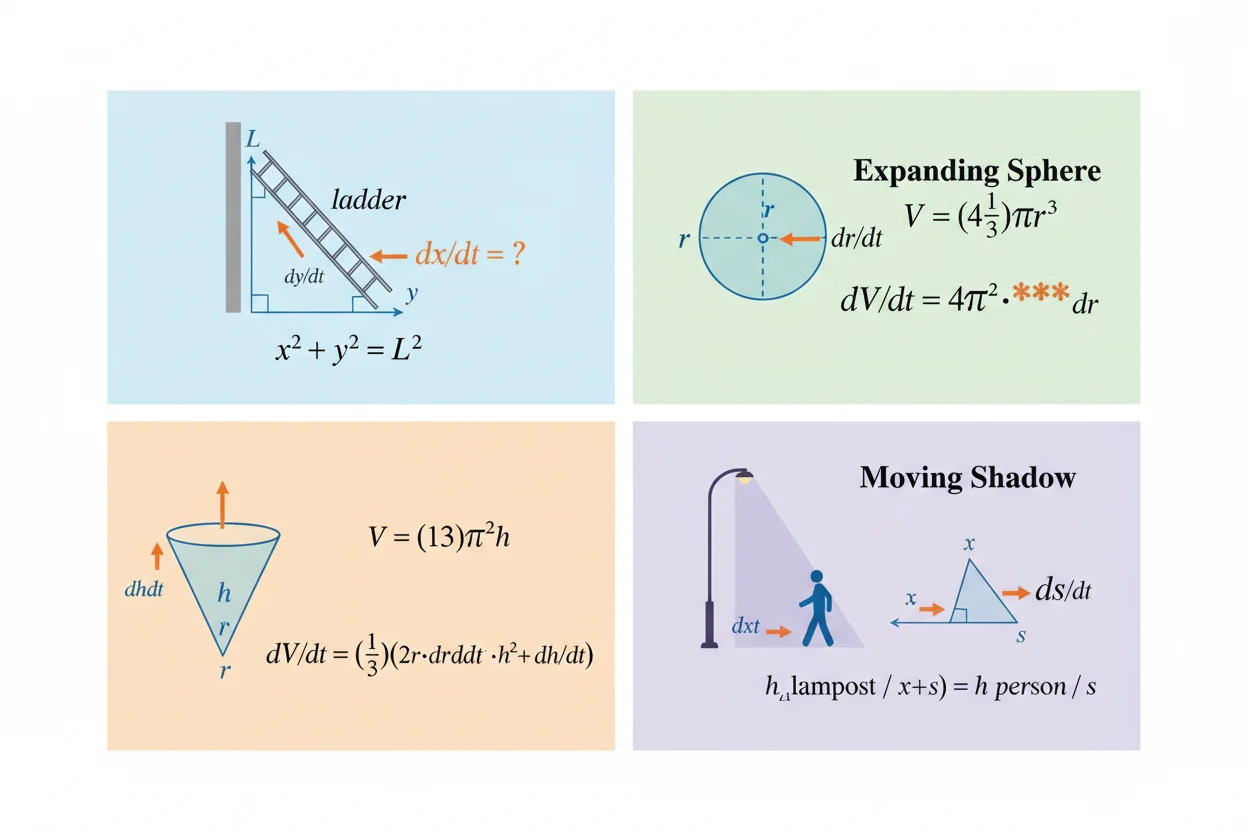

Related rates problems use derivatives to connect two or more quantities that change with time. The quantities are linked by an equation, and differentiating that equation with respect to time produces a relationship among their rates of change. If y = f(x) while both x and y depend on time t, then dy/dt = f′(x)·dx/dt. In geometric problems, the relationship may come from the Pythagorean theorem, an area or volume formula, similar triangles, or another physical constraint. The central technique is to define the changing quantities first, write an equation connecting them, differentiate with respect to time, and only then substitute the values for the instant being studied. Substituting numerical values before differentiating can accidentally treat changing quantities as constants. Signs also matter: an increasing distance has a positive rate, while a decreasing height or radius has a negative rate. Related rates are therefore an application of the chain rule to several time-dependent variables connected by the same model.
What Are Related Rates?
Suppose x and y both depend on time:
x = x(t)
y = y(t)
and they satisfy:
y = f(x)
Differentiate with respect to t:
dy/dt = f′(x) dx/dt
This is the basic related rates relationship.
The chain rule appears because x itself changes with time.
For example, if:
y = x²
then:
dy/dt = 2x dx/dt
The rate of y depends both on the current value of x and on how quickly x is changing.
Related Rates Formula
For a direct relationship:
y = f(x)
the formula is:
dy/dt = f′(x) dx/dt
For an implicit relationship:
F(x, y) = constant
differentiate with respect to time:
Fₓ dx/dt + Fᵧ dy/dt = 0
when the usual differentiability conditions apply.
This is the time-dependent counterpart of implicit differentiation.
Basic Related Rates Example
Suppose the area of a circle is:
A = πr²
and the radius changes over time.
Differentiate both sides with respect to t:
dA/dt = 2πr dr/dt
If:
r = 5 cm
and:
dr/dt = 2 cm/s
then:
dA/dt = 2π(5)(2)
= 20π cm²/s
So the area is increasing at:
20π cm²/s
at the instant when the radius is 5 cm.
Why the Current Size Matters
In:
dA/dt = 2πr dr/dt
the area rate depends on r.
A circle whose radius is growing at 2 cm/s does not gain area at a constant rate.
At:
r = 1
the rate is:
4π cm²/s
At:
r = 10
the same radial growth rate produces:
40π cm²/s
The larger circle gains more area for the same increase in radius.
General Related Rates Method
A reliable related rates calculation follows a consistent logical order.
First identify which quantities change with time and assign variables.
Then write an equation linking those quantities.
Differentiate the equation with respect to time.
Substitute the known values and known rates for the specific instant.
Finally solve for the requested rate and interpret its sign and units.
The equation should normally be differentiated before inserting the instant-specific numerical values.
Why You Differentiate Before Substituting
Suppose:
A = πr²
At the instant of interest:
r = 5
If you replace r by 5 before differentiating, you get:
A = 25π
which looks constant.
Differentiating would incorrectly produce:
dA/dt = 0
The radius equals 5 only at one instant; it is still changing.
Keep:
r = r(t)
during differentiation.
Only after obtaining:
dA/dt = 2πr dr/dt
should you substitute:
r = 5
Related Rates and the Chain Rule
When differentiating:
r²
with respect to time, remember that r is a function of t.
Therefore:
d/dt[r²] = 2r dr/dt
not merely:
2r
The extra factor:
dr/dt
comes from the chain rule.
Similarly:
d/dt[x³] = 3x² dx/dt
and:
d/dt[√x] = 1/(2√x) dx/dt
Related rates repeatedly uses this time-dependent chain structure.
Expanding Sphere Example
The volume of a sphere is:
V = 4πr³/3
Differentiate with respect to time:
dV/dt = 4πr² dr/dt
Suppose:
r = 3 m
and:
dr/dt = 0.5 m/s
Then:
dV/dt = 4π(3²)(0.5)
= 18π m³/s
Therefore the volume is increasing at:
18π m³/s
at that instant.
Surface Area of an Expanding Sphere
The surface area is:
S = 4πr²
Differentiate:
dS/dt = 8πr dr/dt
If:
r = 3
and:
dr/dt = 0.5
then:
dS/dt = 8π(3)(0.5)
= 12π
So the surface area is increasing at:
12π m²/s
The same changing radius drives different related rates for volume and surface area.
Sliding Ladder Problem
A classic related rates problem involves a ladder leaning against a wall.
Let:
x = distance of the ladder’s bottom from the wall
y = height of the ladder’s top above the ground
If the ladder has fixed length L, then:
x² + y² = L²
Differentiate with respect to time:
2x dx/dt + 2y dy/dt = 0
Divide by 2:
x dx/dt + y dy/dt = 0
Solve for the vertical rate:
dy/dt = −(x/y) dx/dt
The negative sign means the top moves downward when the bottom moves away from the wall.
Ladder Numerical Example
Suppose the ladder has length:
10 ft
At a particular instant:
x = 6 ft
Then:
6² + y² = 10²
so:
36 + y² = 100
y² = 64
y = 8 ft
Suppose the bottom moves away at:
dx/dt = 2 ft/s
Using:
dy/dt = −(x/y) dx/dt
we get:
dy/dt = −(6/8)(2)
= −12/8
= −3/2 ft/s
Therefore the top of the ladder is sliding downward at:
1.5 ft/s
Sign Interpretation
The calculated result was:
dy/dt = −1.5 ft/s
The negative sign is meaningful.
If y measures height upward from the ground, then decreasing y produces a negative derivative.
You could state either:
dy/dt = −1.5 ft/s
or:
the ladder top is moving downward at 1.5 ft/s
Avoid saying “downward at −1.5” because the word downward already communicates the direction.
Pythagorean Related Rates
Whenever two perpendicular distances and their separation are involved, a relationship of the form:
x² + y² = z²
often appears.
Differentiate with respect to time:
2x dx/dt + 2y dy/dt = 2z dz/dt
Simplify:
x dx/dt + y dy/dt = z dz/dt
This formula is useful for objects moving on perpendicular paths.
Two Moving Objects Example
Suppose one object is:
3 km
east of an intersection and moving east at:
dx/dt = 2 km/h
Another is:
4 km
north of the intersection and moving north at:
dy/dt = 1 km/h
Let z be the distance between them.
At the instant:
z = √(3² + 4²)
= 5 km
Differentiate:
x dx/dt + y dy/dt = z dz/dt
Substitute:
3(2) + 4(1) = 5 dz/dt
6 + 4 = 5 dz/dt
Therefore:
dz/dt = 2 km/h
Their separation is increasing at 2 km/h.
Moving Shadow Problem
Suppose a:
6-ft
person walks away from a:
15-ft
lamp post at:
4 ft/s
Let:
x = distance from the lamp to the person
s = shadow length
Then the distance from the lamp to the shadow tip is:
x + s
Similar triangles give:
15/(x + s) = 6/s
Cross-multiply:
15s = 6(x + s)
Expand:
15s = 6x + 6s
Therefore:
9s = 6x
so:
s = 2x/3
Shadow Growth Rate
Differentiate:
s = 2x/3
with respect to t:
ds/dt = 2/3 dx/dt
Since:
dx/dt = 4 ft/s
we have:
ds/dt = 8/3 ft/s
The shadow length is increasing at:
8/3 ft/s
The shadow tip’s distance from the lamp is:
x + s
so:
d/dt(x + s) = dx/dt + ds/dt
= 4 + 8/3
= 20/3 ft/s
Thus the shadow tip moves faster than the person.
Related Rates With Similar Triangles
Similar-triangle relationships often provide the missing equation in shadow, cone, and geometric projection problems.
The proportions should be written before differentiating.
If a ratio remains constant:
r/h = constant
then r and h are not independent changing quantities.
One can often solve:
r = kh
and substitute that relationship into an area or volume formula to reduce the number of variables.
Filling a Conical Tank
Suppose water fills a cone whose full dimensions satisfy:
radius/height = 5/15
Therefore:
r/h = 1/3
and:
r = h/3
The volume of water is:
V = πr²h/3
Substitute:
r = h/3
before differentiating:
V = π/3 · (h²/9)h
So:
V = πh³/27
Differentiate:
dV/dt = π/9 h² dh/dt
Cone Numerical Example
Suppose at an instant:
h = 6 ft
and the water height rises at:
dh/dt = 0.2 ft/min
Then:
dV/dt = π/9(6²)(0.2)
= π/9(36)(0.2)
= 0.8π ft³/min
Thus water volume is increasing at:
0.8π ft³/min
at that instant.
The similar-triangle relationship eliminates r before differentiation and makes the calculation much simpler.
Product Rule in Related Rates
Some relationships involve products of two independently changing quantities.
Suppose a rectangle has changing length x and width y:
A = xy
Differentiate with respect to time using the product rule:
dA/dt = x dy/dt + y dx/dt
Both dimensions contribute to the changing area.
It would be incorrect to write:
dA/dt = dx/dt · dy/dt
because the derivative of a product is not the product of derivatives.
Rectangle Area Example
Suppose at an instant:
x = 8 m
y = 5 m
and:
dx/dt = 3 m/s
dy/dt = −1 m/s
Then:
dA/dt = x dy/dt + y dx/dt
= 8(−1) + 5(3)
= −8 + 15
= 7 m²/s
Although the width is shrinking, the length is increasing quickly enough that the total area is still increasing.
Quotient Rule in Related Rates
Ratios of changing quantities require the quotient rule.
If:
R = A/B
where both A and B depend on time, then:
dR/dt = [B(dA/dt) − A(dB/dt)]/B²
For example, a changing average or density may be expressed as one changing quantity divided by another.
The denominator must remain nonzero at the instant being considered.
Ratio Example
Suppose:
R = A/B
and at one instant:
A = 12
B = 4
dA/dt = 5
dB/dt = 1
Then:
dR/dt = [4(5) − 12(1)]/4²
= (20 − 12)/16
= 8/16
= 1/2
The ratio is increasing at:
0.5
units of ratio per unit time.
Power Rule in Related Rates
When a geometric formula contains powers, the power rule combines with the chain rule.
For:
V = 4πr³/3
differentiate:
dV/dt = 4πr² dr/dt
The power rule changes:
r³ → 3r²
while the chain rule contributes:
dr/dt
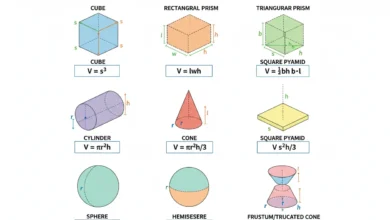
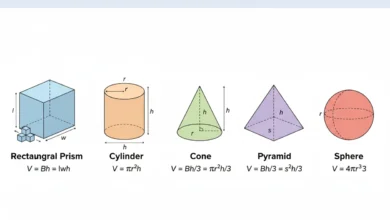
This combination appears in circle, sphere, cylinder, cone, and distance formulas.
Cylinder Volume Example
For a cylinder:
V = πr²h
If both r and h vary, use both the power and product rules:
dV/dt = π[2rh dr/dt + r² dh/dt]
or:
dV/dt = 2πrh dr/dt + πr² dh/dt
Both radial growth and height growth contribute to the volume rate.
If either r or h is fixed, its derivative is zero and the formula simplifies.
Related Rates and Implicit Differentiation
The ladder equation:
x² + y² = 100
does not solve y explicitly before differentiation.
Instead, differentiate implicitly:
2x dx/dt + 2y dy/dt = 0
This is conceptually the same as ordinary implicit differentiation except the independent variable is:
t
rather than x.
The method is especially valuable when solving the relation explicitly would introduce unnecessary roots or algebra.
Related Rates and Differentials
The differentials framework gives a closely related small-change interpretation.
If:
y = f(x)
then:
dy = f′(x)dx
Dividing by a small time interval suggests:
dy/dt = f′(x) dx/dt
in the derivative limit.
Related rates therefore converts local sensitivity:
dy/dx
into time rates by multiplying by:
dx/dt
when a direct one-variable relationship exists.
Related Rates and Linear Approximation
A linear approximation estimates small finite changes:
Δy ≈ f′(x)Δx
Related rates describes instantaneous time change:
dy/dt = f′(x)dx/dt
The formulas look similar because both use the derivative as a local conversion factor.
Linear approximation concerns small changes over a finite displacement.
Related rates concerns instantaneous rates at a particular moment.
Related Rates and Optimization
Both related rates and optimization use derivatives, but they answer different questions.
Optimization asks where a quantity is largest or smallest.
Related rates asks how quickly one quantity changes when connected quantities are changing.
For example, a rectangle problem asking for the dimensions with maximum area is optimization.
A rectangle problem giving dx/dt and dy/dt and asking for dA/dt is related rates.
Recognizing the requested quantity determines the method.
Related Rates and Derivatives
A related rates problem ultimately consists of one or more derivatives with respect to time.
The difference is that the derivative is not usually taken from a function already written solely in terms of t.
Instead, a geometric or physical relationship links several quantities, all of which implicitly depend on time.
Differentiation reveals how their rates must be related.
Finding a Missing Quantity Before Solving for a Rate
Related rates problems often give enough information to calculate an instantaneous length before solving the rate equation.
In the ladder example:
x = 6
and:
L = 10
but y was not directly given.
Use:
x² + y² = L²
first:
y = 8
Then substitute y into the already differentiated equation.
The distinction is important: using the original geometric equation to find an instantaneous value is perfectly valid even though numerical values should not replace variables before differentiation.
Units in Related Rates
Rates carry units involving time.
If:
dr/dt
is measured in:
cm/s
then:
dA/dt
for area is measured in:
cm²/s
and:
dV/dt
for volume is measured in:
cm³/s
Unit analysis can catch setup mistakes.
For example, reporting a volume rate in cm/s would indicate that a dimension has been lost.
Positive and Negative Rates
A derivative’s sign describes direction of change.
If:
dr/dt > 0
the radius is increasing.
If:
dr/dt < 0
the radius is decreasing.
If y measures height and:
dy/dt < 0
the height is falling.
A problem may phrase a rate verbally as “decreasing at 3 cm/s.” In equations, that corresponds to:
dy/dt = −3 cm/s
provided positive y points upward.
Constant Quantities
Not every quantity in a related rates equation changes.
In the ladder problem:
L = 10
is fixed.
Therefore:
dL/dt = 0
If you begin with:
x² + y² = L²
and differentiate the fully general equation:
2x dx/dt + 2y dy/dt = 2L dL/dt
the right side becomes zero because:
dL/dt = 0
Recognizing constants simplifies the derivative.
Distance Between Moving Points
Suppose moving points have coordinates:
(x₁, y₁)
and:
(x₂, y₂)
Their separation z satisfies:
z² = (x₂ − x₁)² + (y₂ − y₁)²
Differentiate with respect to time:
2z dz/dt
= 2(x₂ − x₁)(dx₂/dt − dx₁/dt)
- 2(y₂ − y₁)(dy₂/dt − dy₁/dt)
This formula handles situations where both objects move independently.
Angle Related Rates
Some problems ask how fast an angle changes.
Suppose:
tan θ = y/x
where x and y may vary.
Differentiating requires both the chain rule on tan θ and potentially the quotient rule on y/x:
sec²θ dθ/dt = [x dy/dt − y dx/dt]/x²
Then:
dθ/dt
can be isolated.
Angular related rates require radians when standard calculus derivative formulas for trigonometric functions are used.
Example With a Fixed Height
Suppose an observer stands:
100 m
from the base of a vertical object, and the object’s height y changes.
Let θ be the elevation angle.
Then:
tan θ = y/100
Differentiate:
sec²θ dθ/dt = 1/100 dy/dt
Therefore:
dθ/dt = [dy/dt]/[100 sec²θ]
The current height determines θ and therefore affects the angular rate.
Choosing the Correct Equation
The hardest part of many related rates problems is not differentiation but modeling.
A ladder suggests:
x² + y² = L²
A circle suggests:
A = πr²
A sphere suggests:
V = 4πr³/3
A cone may require both:
V = πr²h/3
and a similar-triangle relationship.
A shadow problem usually requires similar triangles.
The equation should reflect quantities that appear in the known rates and requested rate as directly as possible.
Avoid Introducing Unnecessary Variables
Suppose a cone satisfies:
r = h/3
and you need a relationship between:
V
and:
h
Substitute r before differentiating:
V = πh³/27
This is usually cleaner than differentiating:
V = πr²h/3
and carrying both:
dr/dt
and:
dh/dt
when r and h are already constrained by similarity.
Reducing the number of variables can simplify the rate equation substantially.
Related Rates Versus Matrix Row Reduction
Related rates is a calculus method involving quantities that change with time. It is not a matrix-elimination procedure such as row reduction.
Likewise, Reduced Row Echelon Form describes a canonical matrix structure, while RREF: Gauss–Jordan Elimination focuses on reducing linear systems.
A problem asking for:
dx/dt, dy/dt, dr/dt, dV/dt
or another instantaneous time rate usually belongs to related rates rather than matrix elimination.
This distinction is useful when several equations or variables make the problem initially look like a system.
Related Rates and Multiple Equations
Some related rates models contain more than one constraint.
For example, a cone problem can include:
V = πr²h/3
and:
r/h = constant
These equations should usually be combined algebraically before differentiation when doing so removes an unwanted variable.
If several derivative equations remain genuinely coupled, ordinary algebra can then solve for the unknown rates.
The presence of several equations does not automatically make the problem a row-reduction problem.
Checking a Related Rates Answer
A useful check starts with units.
A length rate should have units such as:
m/s
An area rate should use:
m²/s
A volume rate should use:
m³/s
Next inspect the sign.
Does the calculated direction agree with the geometry?
Finally, substitute the known quantities back into the differentiated relationship to verify the arithmetic.
When possible, estimate whether the magnitude is reasonable from the physical situation.
Common Related Rates Mistakes
The most common mistake is substituting the instantaneous numerical values before differentiating. Changing quantities must remain variables during differentiation.
Another frequent error is forgetting chain-rule factors such as:
dx/dt
when differentiating x² with respect to t.
If two changing quantities are multiplied, the product rule is required.
If one changing quantity is divided by another, the quotient rule may be required.
Signs must reflect whether quantities are increasing or decreasing.
A geometric quantity not explicitly provided may need to be calculated from the original relationship before solving the differentiated equation.
Students may also include variables that are unnecessary even though a geometric constraint can eliminate them.
Finally, the requested rate should be stated with both units and directional interpretation.
Frequently Asked Questions
What are related rates?
Related rates problems connect the rates of change of two or more quantities that depend on time and satisfy the same equation.
What is the basic related rates formula?
If:
y = f(x)
and both depend on t:
dy/dt = f′(x) dx/dt
Why does dx/dt appear?
Because x itself depends on time. Differentiating f(x(t)) requires the chain rule.
Should I substitute numbers before differentiating?
Usually no. Differentiate the equation while changing quantities remain variables, then substitute the values for the specified instant.
What does a negative related rate mean?
It means the quantity is decreasing relative to the chosen positive direction.
How do you solve a ladder related rates problem?
Use:
x² + y² = L²
differentiate with respect to time, then substitute the instantaneous distances and known rate.
How do related rates work with area?
For a circle:
A = πr²
so:
dA/dt = 2πr dr/dt
How do related rates work with volume?
For a sphere:
V = 4πr³/3
so:
dV/dt = 4πr² dr/dt
When is the product rule needed?
Use it when two changing quantities are multiplied, such as:
A = xy
which gives:
dA/dt = x dy/dt + y dx/dt
When is the quotient rule needed?
Use it when one changing quantity is divided by another and both depend on time.
Why are similar triangles common in related rates?
They provide a constant geometric relationship between changing lengths, allowing one variable to be eliminated or related to another.
Are related rates the same as optimization?
No. Related rates finds instantaneous rates of change, while optimization finds maximum or minimum values.
What units should a related rate have?
The units match the changing quantity divided by time, such as m/s, m²/s, or m³/s.
How can I check a related rates solution?
Verify the original geometric relationship, differentiate every time-dependent quantity correctly, check units and signs, and substitute the instantaneous values into the differentiated equation to confirm the result.