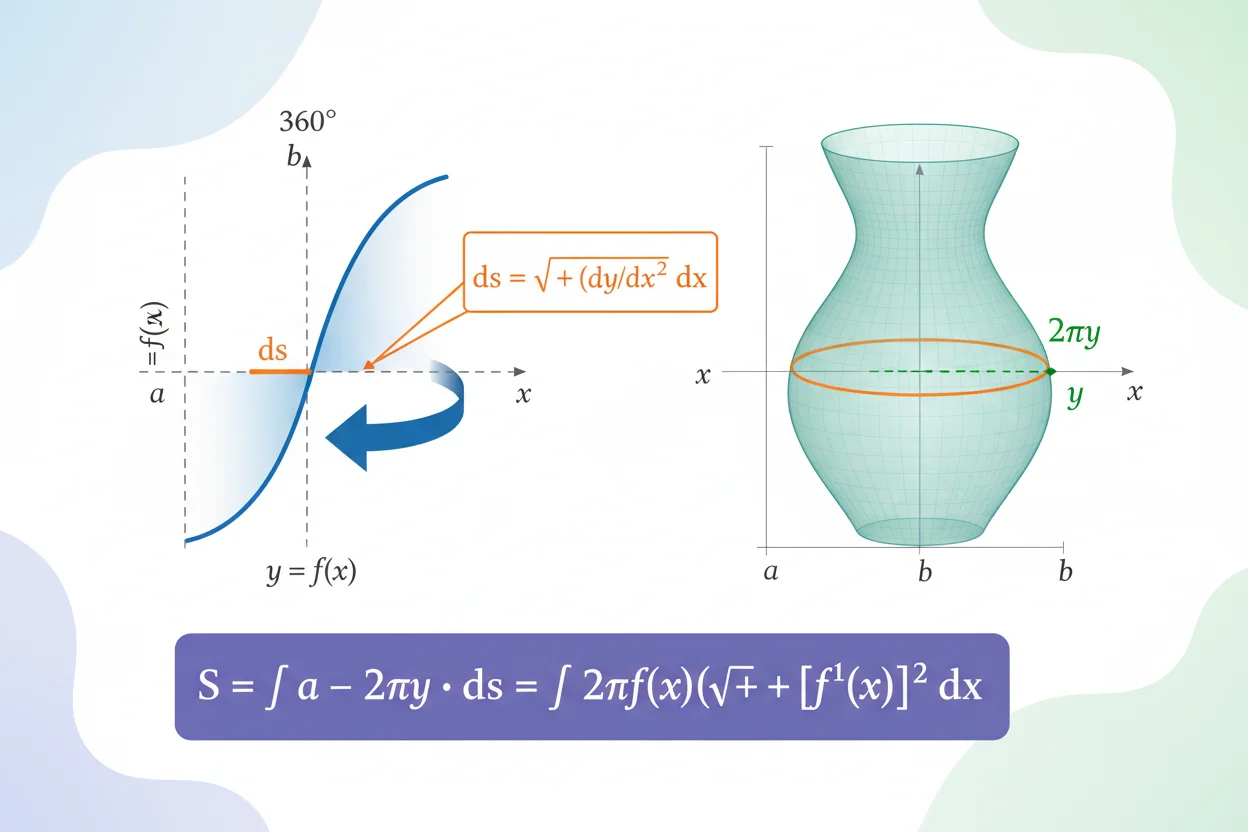

Surface area of revolution measures the area of the curved surface created when a plane curve is rotated around an axis. The central formula is S = 2π∫r ds, where r is the distance from the curve to the axis of rotation and ds is a differential element of arc length. For a curve y = f(x) rotated around the x-axis, this becomes S = 2π∫ₐᵇ |f(x)|√(1 + [f′(x)]²) dx. When the curve lies above the x-axis, |f(x)| can be written simply as f(x). For rotation around the y-axis, the radius is the horizontal distance |x|, producing S = 2π∫|x|√(1 + [f′(x)]²) dx when x is the integration variable. Correct setup therefore depends on three pieces of information: the curve, the axis of rotation, and the corresponding radius. Surface area of revolution differs from volume of revolution because it sums thin surface bands rather than cross-sectional volumes. The arc-length factor is essential because each narrow band follows the slant of the generating curve rather than merely its horizontal or vertical projection.
What Is Surface Area of Revolution?
Imagine a curve:
y = f(x)
between:
x = a
and:
x = b
Rotate that curve around an axis.
Every small piece of the curve traces a thin circular band.
Its approximate area is:
circumference × slant width
If the band’s radius is r, its circumference is:
2πr
If the curve segment has infinitesimal length ds, the band area is approximately:
dS = 2πr ds
Adding all such bands gives the general formula:
S = 2π∫r ds
This formula connects surface area directly with Arc Length Calculus.
General Surface Area of Revolution Formula
The most useful general expression is:
S = 2π∫꜀ r ds
where:
r = distance from the curve to the axis of rotation
and:
ds = differential arc length
For:
y = f(x)
the arc-length element is:
ds = √(1 + [f′(x)]²) dx
Therefore the exact radius determines the final integral.
Rotation Around the x-Axis
For:
y = f(x)
rotated around the x-axis, the radius is:
r = |y| = |f(x)|
Therefore:
S = 2π∫ₐᵇ |f(x)|√(1 + [f′(x)]²) dx
If:
f(x) ≥ 0
throughout [a, b], this simplifies to:
S = 2π∫ₐᵇ f(x)√(1 + [f′(x)]²) dx
The absolute value reflects the fact that geometric radius is nonnegative.
Rotation Around the y-Axis
For a curve:
y = f(x)
rotated around the y-axis, the radius is the distance from a point (x, y) to the y-axis:
r = |x|
Therefore:
S = 2π∫ₐᵇ |x|√(1 + [f′(x)]²) dx
If:
x ≥ 0
throughout the interval:
S = 2π∫ₐᵇ x√(1 + [f′(x)]²) dx
The curve itself remains the same, but changing the axis changes the radius factor.
Why the Arc-Length Factor Appears
A common incorrect setup for rotation around the x-axis is:
2π∫f(x) dx
This accounts for circumference but not the actual slant length of each surface strip.
A small change dx corresponds to a curve length:
ds = √(dx² + dy²)
Divide by dx:
ds = √[1 + (dy/dx)²] dx
Therefore:
ds = √(1 + [f′(x)]²)dx
The multiplier:
√(1 + [f′(x)]²)
corrects for the curve’s slope.
Without it, the surface area is generally underestimated.
Surface Area and Arc Length
The specialist Arc Length formula for:
y = f(x)
is:
L = ∫ₐᵇ √(1 + [f′(x)]²)dx
Surface area adds the circular circumference factor:
2πr
so:
S = ∫ 2πr ds
Conceptually:
arc length measures the generating curve
while:
surface area measures what that curve sweeps out when rotated
The same ds element appears in both calculations.
Basic Example: Rotate y = x Around the x-Axis
Find the surface area generated by rotating:
y = x
for:
0 ≤ x ≤ 1
around the x-axis.
The derivative is:
y′ = 1
Therefore:
√(1 + [y′]²) = √2
The radius is:
r = x
So:
S = 2π∫₀¹ x√2 dx
Factor constants:
S = 2π√2 ∫₀¹ x dx
Evaluate:
∫₀¹ x dx = 1/2
Therefore:
S = 2π√2(1/2)
= π√2
So the generated lateral surface area is:
π√2
Geometric Check of the Example
Rotating:
y = x
from x = 0 to x = 1 around the x-axis creates the lateral surface of a cone.
Its radius is:
r = 1
and its slant height is the length of the line segment from:
(0, 0)
to:
(1, 1)
which is:
√2
The cone lateral-area formula is:
πrs
Thus:
π(1)(√2) = π√2
This agrees with the integral result.
Such geometric checks are useful when the generated shape has a familiar formula.
Line Rotated Around the x-Axis
Find the surface area formed by rotating:
y = 2x + 1
for:
0 ≤ x ≤ 1
around the x-axis.
Differentiate:
y′ = 2
so:
√(1 + [y′]²) = √5
The radius is:
2x + 1
Therefore:
S = 2π∫₀¹ (2x + 1)√5 dx
Factor:
S = 2π√5 ∫₀¹(2x + 1)dx
The integral is:
[x² + x]₀¹
= 2
Therefore:
S = 4π√5
The rotation creates the curved surface of a conical frustum.
Rotation Around the y-Axis Example
Rotate:
y = x²
for:
0 ≤ x ≤ 1
around the y-axis.
The radius is:
r = x
The derivative is:
y′ = 2x
so:
ds = √(1 + 4x²)dx
Therefore:
S = 2π∫₀¹ x√(1 + 4x²)dx
This integral is well suited to Integration By Substitution.
Let:
u = 1 + 4x²
Then:
du = 8x dx
so:
x dx = du/8
The bounds become:
x = 0 → u = 1
x = 1 → u = 5
Thus:
S = 2π(1/8)∫₁⁵ u¹ᐟ² du
= π/4 · [2u³ᐟ²/3]₁⁵
Therefore:
S = π/6(5√5 − 1)
Surface Area Using x = g(y)
Sometimes the curve is more naturally written:
x = g(y)
Then:
ds = √(1 + [g′(y)]²)dy
For rotation around the y-axis, the radius is:
|x| = |g(y)|
so:
S = 2π∫ |g(y)|√(1 + [g′(y)]²)dy
For rotation around the x-axis, the radius is:
|y|
so:
S = 2π∫ |y|√(1 + [g′(y)]²)dy
The choice of x or y as the integration variable should follow whichever description makes the curve and radius simplest.
General Formula Around the x-Axis Using y
Suppose:
x = g(y)
for:
c ≤ y ≤ d
and rotate around the x-axis.
The radius is:
|y|
and:
ds = √(1 + [dx/dy]²)dy
Therefore:
S = 2π∫𝚌ᵈ |y|√(1 + [g′(y)]²)dy
If y is nonnegative on the interval:
S = 2π∫𝚌ᵈ y√(1 + [g′(y)]²)dy
General Formula Around the y-Axis Using y
For:
x = g(y)
rotated around the y-axis:
r = |g(y)|
Therefore:
S = 2π∫𝚌ᵈ |g(y)|√(1 + [g′(y)]²)dy
Again, if:
g(y) ≥ 0
the absolute value can be omitted.
Rotation Around a Horizontal Line
The axis does not have to be the x-axis.
Suppose:
y = f(x)
is rotated around:
y = k
The radius is the vertical distance:
r = |f(x) − k|
Therefore:
S = 2π∫ₐᵇ |f(x) − k|√(1 + [f′(x)]²)dx
The derivative and arc-length element are unchanged.
Only the radius changes.
Rotation Around a Vertical Line
If the axis is:
x = k
and the curve is:
y = f(x)
then the radius is:
r = |x − k|
Therefore:
S = 2π∫ₐᵇ |x − k|√(1 + [f′(x)]²)dx
This distance-to-axis interpretation is more reliable than memorizing separate formulas for every possible axis.
Radius Is Distance, Not a Signed Coordinate
Suppose a curve lies below the x-axis.
If:
y = −3
then the radius of rotation around the x-axis is:
3
not:
−3
That is why the geometrically general formula uses:
|f(x)|
Similarly, a point at:
x = −4
has radius:
4
when rotated around the y-axis.
Surface area cannot be negative.
Surface Area as a Definite Integral
Every standard surface-of-revolution formula is a Definite Integral.
The limits:
a and b
identify the exact portion of the generating curve.
Changing those bounds changes the physical surface being measured.
After the integrand is constructed correctly, the remaining task is ordinary definite integration.
The major challenge is often the setup rather than the antiderivative.
Deriving the Formula From Frustums
A tiny curve segment can be approximated by a straight line.
When rotated, that segment creates a thin frustum-like band.
The lateral area of a small frustum is approximately:
circumference × slant height
or:
2πr · Δs
Summing:
Σ2πrᵢΔsᵢ
and taking the limiting value as the segments become arbitrarily small gives:
S = 2π∫r ds
This limiting construction explains the geometry behind the formula rather than treating it as an isolated rule.
Surface Area Versus Area Under a Curve
Area Under A Curve measures a planar region, often through:
A = ∫f(x)dx
Surface area of revolution measures a two-dimensional surface embedded in three-dimensional space:
S = 2π∫r ds
The additional circumference and arc-length factors reflect the rotation.
An area-under-a-curve integral should therefore not be substituted directly for a surface-area formula.
Surface Area Versus Volume of Revolution
Rotating a region can produce a three-dimensional solid.
Rotating only its boundary curve produces a surface.
This distinction creates different formulas.
Volume By Disks typically uses:
V = π∫R² dx
while surface area around the x-axis uses:
S = 2π∫R ds
The first sums thin volumes.
The second sums thin surface bands.
Surface Area Versus Washer Method
Volume By Washers measures volume using outer and inner radii:
V = π∫(R² − r²)dx
Surface area does not subtract cross-sectional areas.
Instead, each rotating boundary curve can generate its own surface.
If a solid has both an outer and inner boundary, the surface areas may need to be calculated separately depending on what parts of the boundary are requested.
Surface Area Versus Shell Method
Volume By Shells also contains a factor:
2πr
which can make the formula look similar.
For shells:
dV ≈ 2πr · height · thickness
For surface area:
dS ≈ 2πr · ds
The shell method contains a region height and a radial thickness.
Surface area contains the slant arc-length element.
The similar circumference factor does not make the two methods interchangeable.
Surface Area and the Derivative
The derivative enters through:
ds = √(1 + [f′(x)]²)dx
A steeper curve has more arc length per horizontal change dx.
Therefore it sweeps out more surface area than a horizontal projection of the same width would suggest.
The formula translates the local slope into the actual length of the generating strip.
Example With a Horizontal Line
Rotate:
y = 3
for:
0 ≤ x ≤ 5
around the x-axis.
Since:
y′ = 0
we have:
ds = dx
The surface area is:
S = 2π∫₀⁵ 3 dx
= 6π[x]₀⁵
= 30π
Geometrically, this creates the lateral surface of a cylinder with:
radius = 3
length = 5
The familiar formula:
2πrh
gives:
2π(3)(5) = 30π
which confirms the calculus result.
Why End Caps Are Not Included Automatically
The formula:
S = 2π∫r ds
measures the surface swept out by the rotating curve.
It does not automatically include disks at the endpoints.
For the previous cylinder example, the result:
30π
is the lateral surface only.
If total closed-cylinder surface area were requested, the two circular ends would add:
2πr²
This distinction is essential when interpreting geometry problems.
Cone Example
Let:
y = (R/H)x
for:
0 ≤ x ≤ H
Rotate around the x-axis.
Then:
y′ = R/H
and:
√(1 + [y′]²)
= √(1 + R²/H²)
= √(H² + R²)/H
The surface area is:
S = 2π∫₀ᴴ (R/H)x · √(H² + R²)/H dx
Evaluate:
S = πR√(H² + R²)
If:
ℓ = √(H² + R²)
is the slant height, then:
S = πRℓ
which is the familiar lateral cone-area formula.
Surface Area and Familiar Geometry
Surface-of-revolution calculus should agree with standard geometry when the generated object is a familiar cylinder, cone, or frustum.
This provides a valuable verification method.
The calculus formula is more general because the generating curve can be nonlinear.
A parabola, logarithmic curve, or other smooth profile can generate a surface for which no elementary geometry formula exists.
Example With a Nonlinear Curve
For:
y = x²
on:
0 ≤ x ≤ 1
rotated around the x-axis:
y′ = 2x
so:
S = 2π∫₀¹ x²√(1 + 4x²)dx
Unlike the earlier rotation about the y-axis, this integral is more involved.
The setup is nevertheless complete and correct.
A surface-area problem should not be judged only by whether its final antiderivative is elementary or simple.
Correct geometry comes first.
Surface Area and Integration Techniques
After setting up:
S = 2π∫r√(1 + [f′]²)dx
the resulting integral can require substitution, algebraic simplification, trigonometric techniques, or other methods.
The surface-area formula determines the integrand.
The integrand then determines the appropriate integration technique.
This separation of setup from evaluation prevents the geometry from becoming mixed with unrelated algebraic manipulations.
Surface Area and Vector Magnitude
For a parameterized curve:
r(t) = (x(t), y(t))
the arc-length element is:
ds = |r′(t)|dt
The Vector Magnitude of the tangent vector is:
|r′(t)| = √([x′(t)]² + [y′(t)]²)
Therefore a parameterized surface-of-revolution formula can be written:
S = 2π∫ radius(t)|r′(t)|dt
This is the vector form of the same geometry.
Parameterized Example Structure
Suppose:
r(t) = (x(t), y(t))
and the curve rotates around the x-axis.
The radius is:
|y(t)|
and:
ds = √([x′(t)]² + [y′(t)]²)dt
Therefore:
S = 2π∫ |y(t)|√([x′(t)]² + [y′(t)]²)dt
This form is useful when the curve is naturally given parametrically rather than as y = f(x).
Surface Area Versus Triple Integral
A Triple Integral accumulates through a three-dimensional volume:
∭ᴱ f dV
A surface-of-revolution integral accumulates over a two-dimensional surface created from a one-dimensional generating curve.
Even though the generated object sits in three-dimensional space, the formula:
S = 2π∫r ds
does not become a triple integral.
The dimension of the quantity being measured matters more than the dimension of the surrounding space.
Surface Area Versus Differential Equations
A Separable Differential Equation also uses integration, but its purpose is to recover an unknown function from a rate relationship.
Surface area of revolution begins with a known curve and calculates the area swept out by rotating it.
Thus:
differential equation → solve for a function
while:
surface-of-revolution integral → measure a generated surface
The shared use of integrals does not make their formulas interchangeable.
Surface Area Versus Matrix Procedures
Matrix methods such as row reduction and RREF: Gauss–Jordan Elimination address linear systems through elementary row operations.
They are not used to evaluate the surface-area integral itself.
A surface-of-revolution problem is governed primarily by geometry, derivatives, arc length, and definite integration.
This distinction becomes useful in a broad calculus-and-linear-algebra setting where several very different calculation methods appear nearby.
Surface Area and the Calculus & Linear Algebra Framework
Within Calculus & Linear Algebra, surface area of revolution is an integral application.
Its structure combines:
a geometric radius
a derivative-based arc-length factor
a definite integral
The formula is therefore a good example of how differentiation and integration interact: the derivative measures local curve geometry, while integration accumulates those local surface bands over the entire interval.
Setting Up the Correct Radius
For rotation around:
x-axis → radius = vertical distance to x-axis
y-axis → radius = horizontal distance to y-axis
y = k → radius = |y − k|
x = k → radius = |x − k|
Thinking in terms of distance is safer than memorizing only the formulas for the coordinate axes.
The radius should always be nonnegative.
Choosing dx or dy
Use dx when the curve is convenient as:
y = f(x)
Use dy when it is more convenient as:
x = g(y)
The corresponding arc-length elements are:
ds = √(1 + [dy/dx]²)dx
and:
ds = √(1 + [dx/dy]²)dy
Either representation describes the same physical curve when used consistently.
The radius and integration bounds must match the chosen variable.
Bounds Must Match the Integration Variable
If the integral uses:
dx
the bounds must be x-values.
If it uses:
dy
the bounds must be y-values.
Suppose the curve runs from:
(1, 2)
to:
(4, 5)
An x-based setup might use:
x = 1 to x = 4
while a y-based setup might use:
y = 2 to y = 5
Mixing y-bounds with dx is incorrect unless those values happen coincidentally to match.
Common Surface Area of Revolution Mistakes
A common error is forgetting the arc-length factor:
√(1 + [f′(x)]²)
Another is using the wrong radius. The radius is the perpendicular distance to the axis of rotation, not automatically f(x).
Students sometimes calculate volume when the problem asks for surface area because disk, washer, shell, and surface formulas all involve π.
Another mistake is including endpoint caps automatically. The rotating-curve formula measures only the surface traced by the given curve.
Absolute values may be necessary if the generating curve lies on the negative side of an axis.
When using dy, the derivative must be:
dx/dy
rather than dy/dx.
Finally, an antiderivative error should not be confused with a setup error. Verify the geometry, radius, derivative, arc-length factor, and bounds before evaluating the integral.
Frequently Asked Questions
What is surface area of revolution?
It is the area of the surface created when a plane curve is rotated around an axis.
What is the general surface area of revolution formula?
S = 2π∫r ds
where r is the distance to the axis of rotation.
What is the formula around the x-axis?
For y = f(x):
S = 2π∫ₐᵇ |f(x)|√(1 + [f′(x)]²)dx
What is the formula around the y-axis?
For y = f(x):
S = 2π∫ₐᵇ |x|√(1 + [f′(x)]²)dx
Why is there a square root in the formula?
The factor:
√(1 + [f′(x)]²)
converts the horizontal element dx into the actual arc-length element ds along the curve.
What does r represent?
r is the perpendicular distance from the generating curve to the axis of rotation.
Do I need an absolute value for the radius?
Use it whenever the coordinate expression for radius can be negative. Geometric radius itself is always nonnegative.
Does the formula include end caps?
No. It measures the surface swept out by the rotating curve. Separate endpoint disks must be added if the problem explicitly asks for them.
Is surface area of revolution the same as volume of revolution?
No. Surface area sums thin surface bands, while volume methods sum cross-sectional areas or shells through the solid.
Can I integrate with respect to y?
Yes. Write the curve as x = g(y) and use:
ds = √(1 + [g′(y)]²)dy
with the appropriate radius.
How is surface area related to arc length?
Surface area multiplies each tiny arc-length element ds by the circumference 2πr traced as that element rotates.
Can substitution be required?
Yes. After the geometric formula is set up, the resulting integral may require substitution or another integration technique.
How can I check a surface-area answer?
Confirm the axis and radius, compute the derivative correctly, include the arc-length factor, verify the bounds and units, and compare with a familiar geometric formula when the generated surface is a cone, cylinder, or frustum.