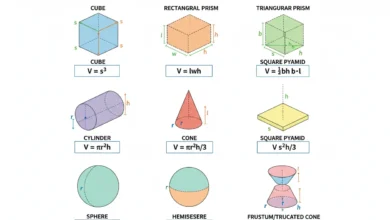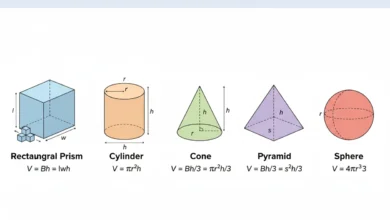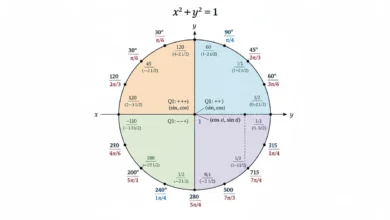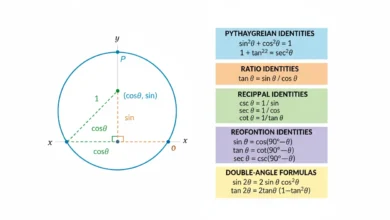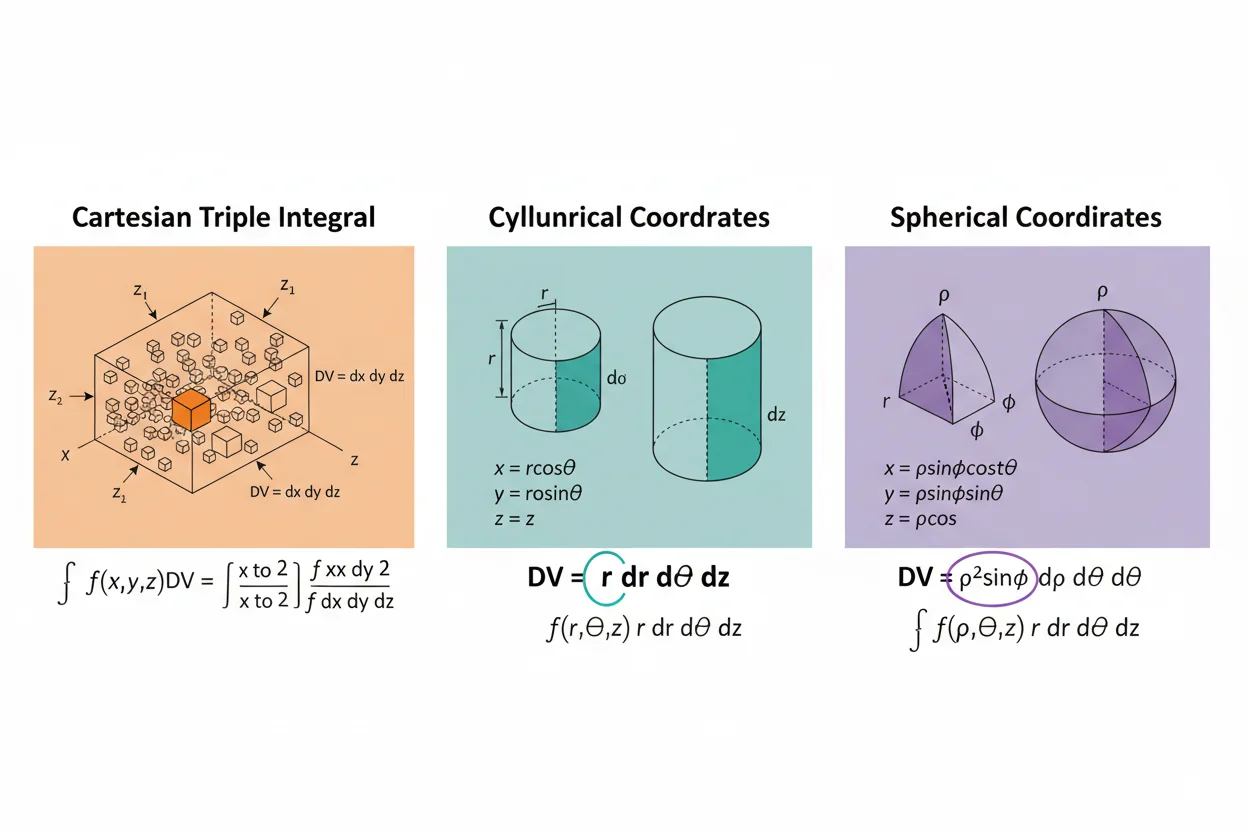
A triple integral accumulates a function throughout a three-dimensional region. It is written in the form ∭ᴱ f(x, y, z)dV, where E is a solid region and dV represents a tiny volume element. When f(x, y, z) = 1, the triple integral gives the volume of E. When f represents density, the same integral gives total mass. Triple integrals can also calculate average values, moments, probability, charge, energy, and other quantities distributed through three-dimensional space. In Cartesian coordinates, the volume element is dV = dx dy dz or another equivalent order. For cylindrical coordinates it becomes dV = r dr dθ dz, while spherical coordinates use dV = ρ² sinφ dρ dφ dθ. The integration bounds are especially important because they describe the solid itself. Most calculations convert the triple integral into three ordinary integrals evaluated one after another, making correct bounds and coordinate choice central to an efficient solution.
What Is a Triple Integral?
A double integral accumulates over a two-dimensional region.
A triple integral extends that idea into three dimensions:
∭ᴱ f(x, y, z)dV
The region E may be a box, cylinder, sphere, cone, tetrahedron, or a more complicated solid.
Conceptually, divide E into many tiny volume elements:
ΔV
Multiply each by a representative function value:
f(xᵢ, yᵢ, zᵢ)ΔV
Then add:
Σ f(xᵢ, yᵢ, zᵢ)ΔV
As the volume elements shrink, the limiting sum becomes the triple integral.
This is one of the core accumulation tools of Multivariable Calculus.
Triple Integral Formula
The general formula is:
I = ∭ᴱ f(x, y, z)dV
In Cartesian coordinates:
dV = dx dy dz
so one possible iterated form is:
I = ∫ₐᵇ ∫g₁(x)^g₂(x) ∫h₁(x,y)^h₂(x,y) f(x, y, z) dz dy dx
The inner integral is evaluated first.
Its result becomes the integrand for the middle integral.
The middle result is then integrated using the outer variable.
The exact bounds depend on the geometry of E.
Triple Integral Over a Rectangular Box
Suppose:
E = [a, b] × [c, d] × [p, q]
Then:
∭ᴱ f(x, y, z)dV
can be written:
∫ₐᵇ ∫𝚌ᵈ ∫ₚᑫ f(x, y, z) dz dy dx
Because all bounds are constants, the solid is a rectangular box.
For continuous functions, other integration orders can also be used:
dx dy dz
dy dx dz
dz dx dy
and so on.
The order may be chosen for convenience.
Basic Triple Integral Example
Evaluate:
∭ᴱ (x + y + z)dV
over:
0 ≤ x ≤ 1
0 ≤ y ≤ 1
0 ≤ z ≤ 1
Write:
∫₀¹ ∫₀¹ ∫₀¹ (x + y + z) dz dy dx
Integrate with respect to z:
∫₀¹(x + y + z)dz
= x + y + 1/2
Now integrate with respect to y:
∫₀¹(x + y + 1/2)dy
= x + 1/2 + 1/2
= x + 1
Finally:
∫₀¹(x + 1)dx
= 1/2 + 1
= 3/2
Therefore:
∭ᴱ (x + y + z)dV = 3/2
Triple Integral for Volume
To calculate the volume of a solid E, set:
f(x, y, z) = 1
Then:
V = ∭ᴱ 1 dV
usually written simply:
V = ∭ᴱ dV
For a box:
0 ≤ x ≤ a
0 ≤ y ≤ b
0 ≤ z ≤ c
we have:
V = ∫₀ᵃ ∫₀ᵇ ∫₀ᶜ dz dy dx
Evaluate the inner integral:
∫₀ᶜ dz = c
Then:
∫₀ᵇ c dy = bc
Finally:
∫₀ᵃ bc dx = abc
So the triple integral reproduces the familiar volume formula:
V = abc
Example: Volume of a 2 × 3 × 4 Box
Let:
0 ≤ x ≤ 2
0 ≤ y ≤ 3
0 ≤ z ≤ 4
Then:
V = ∫₀² ∫₀³ ∫₀⁴ dz dy dx
The z-integral gives:
4
The y-integral gives:
12
The x-integral gives:
24
Therefore:
V = 24 cubic units
The triple integral agrees with:
2 × 3 × 4 = 24
Variable Integration Bounds
Not every solid has constant boundaries.
Suppose E satisfies:
0 ≤ x ≤ 1
0 ≤ y ≤ 1 − x
0 ≤ z ≤ 1 − x − y
Then:
∭ᴱ f dV
becomes:
∫₀¹ ∫₀¹⁻ˣ ∫₀¹⁻ˣ⁻ʸ f(x, y, z) dz dy dx
The z-limit depends on x and y because the top surface is:
z = 1 − x − y
The y-limit depends on x because the projection into the xy-plane is triangular.
The bounds encode the solid’s geometry.
Volume of a Tetrahedral Region
Find the volume of:
x ≥ 0
y ≥ 0
z ≥ 0
x + y + z ≤ 1
Write:
V = ∫₀¹ ∫₀¹⁻ˣ ∫₀¹⁻ˣ⁻ʸ dz dy dx
The inner integral is:
∫₀¹⁻ˣ⁻ʸ dz
= 1 − x − y
Now integrate with respect to y:
∫₀¹⁻ˣ (1 − x − y)dy
This gives:
(1 − x)²/2
Now integrate:
V = 1/2 ∫₀¹(1 − x)²dx
Using a simple substitution or expansion:
V = 1/6
Therefore the tetrahedron has volume:
1/6 cubic unit
Understanding the Integration Order
In:
∫₀¹ ∫₀¹⁻ˣ ∫₀¹⁻ˣ⁻ʸ f(x, y, z) dz dy dx
the order is:
dz → dy → dx
The z-variable is integrated first.
During that step, x and y are treated as constants.
Then y is integrated, with x still treated as constant.
Finally x is integrated.
This nested structure is similar to evaluating a Definite Integral repeatedly, one variable at a time.
Six Possible Cartesian Orders
With three variables, the six possible integration orders are:
dx dy dz
dx dz dy
dy dx dz
dy dz dx
dz dx dy
dz dy dx
For a rectangular box, changing order usually requires only rearranging constant bounds.
For nonrectangular solids, changing the order may require completely rewriting the boundaries.
The best order is often the one that makes both the geometry and the antiderivatives simplest.
Changing the Order of Integration
Suppose a particular order produces a difficult inner integral.
A different order may transform the problem into an elementary calculation.
The process requires:
- understanding the three-dimensional solid,
- projecting it onto an appropriate coordinate plane,
- identifying the inner variable’s lower and upper surfaces,
- writing the corresponding outer bounds.
Changing order is therefore primarily a geometry problem rather than simply rearranging differential symbols.
Triple Integrals and Fubini’s Principle
For sufficiently well-behaved functions and regions, a triple integral can be evaluated as repeated one-dimensional integrals.
Conceptually:
∭ᴱ f dV
becomes:
∫∫[∫f dz]dy dx
or another suitable ordering.
This is the higher-dimensional extension of the iterated structure used for double integrals.
It allows a difficult-looking three-dimensional accumulation problem to be solved through familiar one-variable integration operations.
Triple Integral of a Separable Product
Suppose a rectangular region is:
a ≤ x ≤ b
c ≤ y ≤ d
p ≤ z ≤ q
and:
f(x, y, z) = g(x)h(y)k(z)
Then the triple integral factors:
∭ᴱ g(x)h(y)k(z)dV
= [∫ₐᵇ g(x)dx][∫𝚌ᵈ h(y)dy][∫ₚᑫ k(z)dz]
For example:
∭_[0,1]³ xyz dV
becomes:
(∫₀¹x dx)(∫₀¹y dy)(∫₀¹z dz)
= (1/2)(1/2)(1/2)
= 1/8
This factorization depends on both the product structure of the integrand and the product structure of the region.
Triple Integral for Mass
Suppose a three-dimensional object has density:
ρ(x, y, z)
Mass is:
M = ∭ᴱ ρ(x, y, z)dV
If density is constant:
ρ = ρ₀
then:
M = ρ₀∭ᴱ dV
so:
M = ρ₀V
This agrees with the elementary relationship:
mass = density × volume
The triple integral extends the formula to nonuniform density.
Mass Example With Variable Density
Consider the unit cube:
0 ≤ x, y, z ≤ 1
with density:
ρ(x, y, z) = x + 1
Then:
M = ∫₀¹ ∫₀¹ ∫₀¹ (x + 1) dz dy dx
Integrating over z and y simply contributes factors of 1.
Thus:
M = ∫₀¹(x + 1)dx
= 1/2 + 1
= 3/2
The mass is:
3/2
in the corresponding mass units.
Average Value Over a Solid
If E has volume V, the average value of f over E is:
f_avg = (1/V)∭ᴱ f dV
For the unit cube:
V = 1
so the average of:
f(x, y, z) = x + y + z
is simply:
3/2
from the earlier calculation.
For a solid with volume other than 1, divide the accumulated integral by the total volume.
Triple Integrals in Cylindrical Coordinates
Cartesian coordinates are not always the best choice.
For solids with circular or cylindrical symmetry, use:
x = r cos θ
y = r sin θ
z = z
The volume element becomes:
dV = r dr dθ dz
or another order using the same factor r.
Therefore:
∭ᴱ f(x, y, z)dV
becomes:
∭ f(r cos θ, r sin θ, z) r dr dθ dz
The extra r factor is essential.
Why Cylindrical Coordinates Include r
A small change:
dr
and a small angular change:
dθ
do not produce a Cartesian rectangle of area dr dθ.
At radius r, an angular increment dθ corresponds to arc length approximately:
r dθ
So the base area is approximately:
r dr dθ
Multiplying by:
dz
gives:
dV = r dr dθ dz
The factor reflects geometric stretching in the coordinate transformation.
Volume of a Cylinder
Find the volume of a cylinder with radius R and height H.
Use cylindrical coordinates:
0 ≤ r ≤ R
0 ≤ θ ≤ 2π
0 ≤ z ≤ H
Then:
V = ∫₀²π ∫₀ᴿ ∫₀ᴴ r dz dr dθ
Integrate with respect to z:
Hr
Then r:
H∫₀ᴿ r dr = HR²/2
Finally θ:
∫₀²π HR²/2 dθ
= πR²H
Thus:
V = πR²H
which agrees with elementary geometry.
Cylindrical Coordinates and Vector Magnitude
The cylindrical radial coordinate is:
r = √(x² + y²)
which is the Vector Magnitude of the horizontal position vector:
(x, y)
This geometric distance from the z-axis is why cylindrical coordinates are natural for circular symmetry.
Functions containing:
x² + y²
often simplify because:
x² + y² = r²
Triple Integrals in Spherical Coordinates
For spherical symmetry, use:
x = ρ sinφ cosθ
y = ρ sinφ sinθ
z = ρ cosφ
A common convention uses:
ρ ≥ 0
0 ≤ θ ≤ 2π
0 ≤ φ ≤ π
The volume element is:
dV = ρ² sinφ dρ dφ dθ
The factor:
ρ² sinφ
must be included.
Volume of a Sphere
Find the volume of a sphere of radius R.
Use:
0 ≤ ρ ≤ R
0 ≤ φ ≤ π
0 ≤ θ ≤ 2π
Then:
V = ∫₀²π ∫₀π ∫₀ᴿ ρ² sinφ dρ dφ dθ
The radial integral is:
∫₀ᴿρ²dρ = R³/3
The φ-integral is:
∫₀π sinφ dφ = 2
The θ-integral is:
∫₀²π dθ = 2π
Therefore:
V = (R³/3)(2)(2π)
= 4πR³/3
The standard sphere-volume formula follows directly.
Cartesian Versus Cylindrical Versus Spherical Coordinates
Use Cartesian coordinates when the boundaries are naturally planes such as:
x = constant
y = constant
z = constant
Use cylindrical coordinates when the region has symmetry around an axis and contains terms such as:
x² + y²
Use spherical coordinates for spheres, balls, cones centered on an axis, and functions involving:
x² + y² + z²
A good coordinate system can convert complicated bounds into simple constants.
A poor choice can make an otherwise easy problem unnecessarily difficult.
Coordinate Changes and Substitution
Changing coordinates is a multidimensional version of Integration By Substitution.
In one variable, substitution changes both:
the variable
and:
the differential factor
Likewise, converting from Cartesian to cylindrical or spherical coordinates changes the integrand and introduces a geometric scaling factor in dV.
Omitting that factor gives an incorrect integral even if the transformed bounds are correct.
Triple Integral and Vector Fields
A triple integral can accumulate scalar quantities derived from vectors.
For example, if a velocity or force field is represented using Vector Operations, scalar quantities such as magnitude, energy density, or divergence-related terms can be integrated over a volume.
The integral itself still requires a scalar integrand when producing an ordinary scalar total.
Vector-valued integrals can also be defined component by component when the application requires them.
Triple Integral Versus Line Integral
A Line Integral accumulates along a one-dimensional curve:
∫꜀ f ds
or:
∫꜀ F · dr
A triple integral accumulates throughout a three-dimensional solid:
∭ᴱ f dV
The region dimension determines the differential element:
curve → ds
volume → dV
These calculations should not be interchanged merely because both use integral notation.
Triple Integral Versus Surface Area of Revolution
A Surface Area Of Revolution calculation measures a two-dimensional surface generated by rotating a curve.
Its characteristic formula is:
S = 2π∫r ds
A triple integral instead measures or accumulates throughout a three-dimensional volume.
A surface can enclose a solid, but:
surface area
and:
volume
remain different geometric quantities.
Triple Integrals Versus Volume by Disks
Volume By Disks calculates volumes of revolution using one-dimensional cross-sectional integration.
A triple integral can calculate the same volume by describing every point in the three-dimensional solid.
The disk method is usually shorter when rotational cross-sections are simple.
Triple integration becomes more useful when density varies through all three spatial coordinates or when a more general three-dimensional quantity is needed.
Triple Integrals Versus Shells and Washers
Volume By Shells and Volume By Washers also specialize in solids of revolution.
Each reduces the three-dimensional volume problem to one ordinary integral by exploiting geometry.
A triple integral is more general:
V = ∭ᴱ dV
but generality can come with more complicated bounds.
The most efficient method depends on what information the problem actually asks for.
Triple Integrals and Partial Derivatives
A Partial Derivative measures local change along one coordinate direction.
A triple integral accumulates values throughout a volume.
These operations can appear together when a field is differentiated first and the resulting quantity is then accumulated over a region.
Their roles are opposite in spirit:
differentiation → local change
integration → accumulated quantity
Triple Integrals and Gradients
The Gradient turns a scalar field into a vector of partial derivatives:
∇f
A triple integral can then involve scalar expressions constructed from that field, such as:
|∇f|
or other quantities required by a physical model.
The calculus interpretation depends on the application, but the volume integration process itself remains:
choose E → choose coordinates → write dV → evaluate the iterated integral
Triple Integral Versus Separable Differential Equation
A Separable Differential Equation uses integration to recover an unknown function from a first-order rate law.
A triple integral instead assumes a function over a three-dimensional domain and accumulates it through that domain.
For example:
dy/dx = g(x)h(y)
calls for separation and one-variable integration.
By contrast:
∭ᴱρ(x, y, z)dV
asks for the total of a known density distribution.
The appearance of several variables does not make the two procedures equivalent.
Triple Integral Versus RREF
RREF: Gauss–Jordan Elimination belongs to linear algebra and simplifies matrices through elementary row operations.
A triple integral belongs to multivariable integration.
RREF may appear in a larger mathematical model for solving linear equations, but it does not determine three-dimensional integration bounds or replace iterated integration.
The appropriate method depends on whether the problem concerns a matrix system or accumulation over a solid.
Symmetry in Triple Integrals
Symmetry can greatly simplify a triple integral.
Suppose E is symmetric about the yz-plane and:
f(−x, y, z) = −f(x, y, z)
Then contributions from positive and negative x cancel.
Therefore:
∭ᴱ f dV = 0
provided the integral exists and the region has the required symmetry.
Similar cancellation can occur for odd behavior in y or z.
Recognizing symmetry can eliminate substantial computation.
Constant Integrands
If:
f(x, y, z) = c
then:
∭ᴱ c dV = c∭ᴱdV
Therefore:
∭ᴱ c dV = cV
where V is the region’s volume.
This simple rule is useful when a density, charge density, or other distributed quantity is uniform.
Units in Triple Integrals
The units of:
dV
are cubic units.
If x, y, and z are measured in meters:
dV has units m³
If density has units:
kg/m³
then:
ρ dV
has units:
kg
and the resulting triple integral gives mass.
Dimensional analysis is a useful check that the chosen integrand represents the intended physical quantity.
Common Triple Integral Mistakes
A frequent error is writing bounds that do not describe the intended solid.
Another is reading the differential order backward. In:
dz dy dx
integrate z first, then y, then x.
When using cylindrical coordinates, forgetting the factor:
r
is a major error.
In spherical coordinates, the required factor is:
ρ² sinφ
Using transformed bounds without the transformed volume element produces an incorrect answer.
Students may also confuse a triple integral with a surface integral or a surface-area calculation.
When changing integration order, the old bounds usually cannot simply be reordered; they must be derived again from the geometry.
Finally, always check whether symmetry, separability, or a specialized volume method can simplify the problem before starting a long calculation.
Frequently Asked Questions
What is a triple integral?
A triple integral accumulates a function over a three-dimensional region:
∭ᴱ f(x, y, z)dV
What does a triple integral calculate?
Depending on the integrand, it can calculate volume, mass, average value, probability, charge, energy, moments, and other quantities distributed through a solid.
How do you find volume with a triple integral?
Set the integrand equal to 1:
V = ∭ᴱ dV
What is dV in Cartesian coordinates?
dV = dx dy dz
or any other consistent permutation of the three differentials.
What is dV in cylindrical coordinates?
dV = r dr dθ dz
with the differential order adjusted consistently if another integration order is used.
What is dV in spherical coordinates?
dV = ρ² sinφ dρ dφ dθ
under the standard spherical convention.
In what order do you evaluate a triple integral?
Evaluate from the innermost integral outward. For dz dy dx, integrate z first, then y, then x.
Can the order of integration be changed?
Yes, under appropriate conditions, but variable bounds generally need to be re-derived from the geometry.
What is the difference between a double and triple integral?
A double integral accumulates over a two-dimensional region, while a triple integral accumulates through a three-dimensional region.
Why does cylindrical dV contain r?
The factor r accounts for the geometric stretching of polar coordinates in the xy-plane.
Why does spherical dV contain ρ² sinφ?
It is the volume-scaling factor created by spherical coordinates.
How can I check a triple integral?
Verify the solid described by the bounds, check the coordinate volume element, confirm units, and compare with a known geometric volume when the integrand is 1 and the solid has a familiar shape.