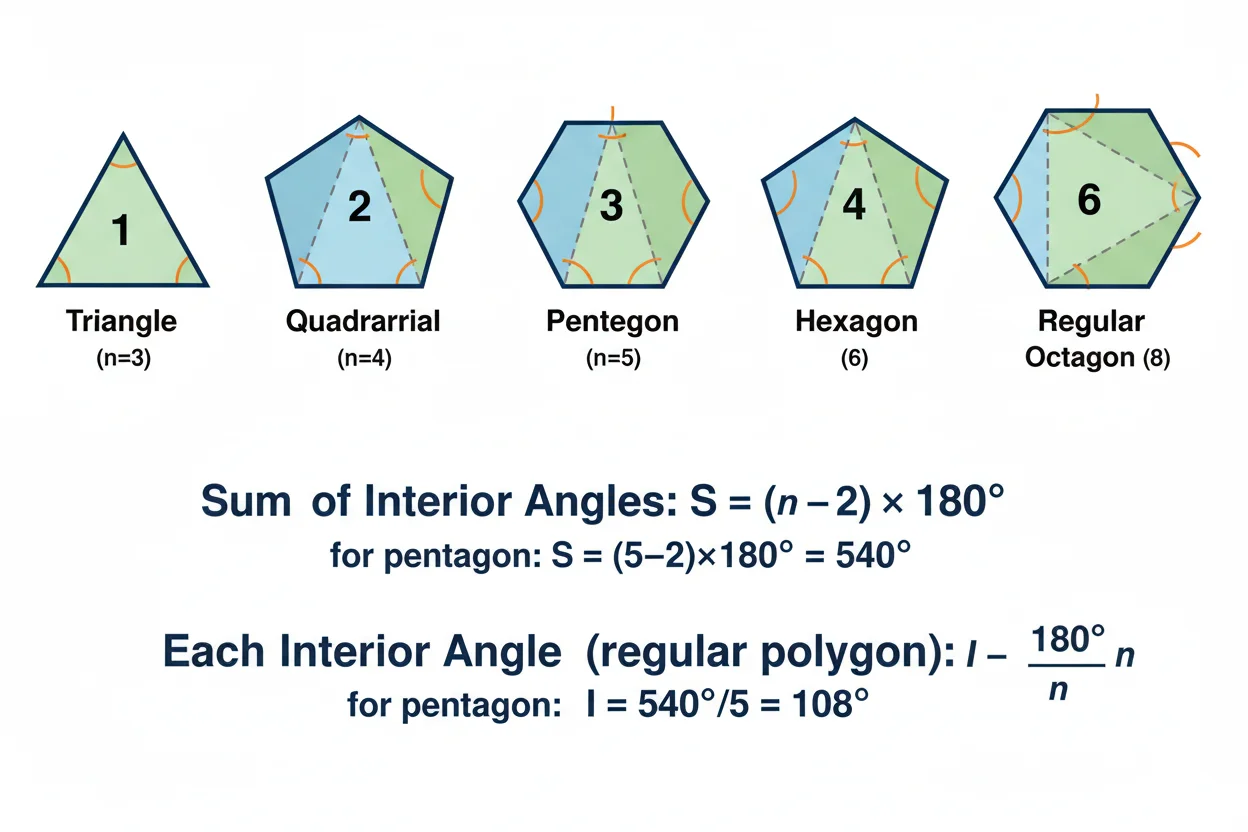

Interior angles are the angles formed inside a polygon where two adjacent sides meet. For an n-sided polygon, the sum of the interior angles is S = (n − 2)180°. If the polygon is regular, all interior angles are equal, so each interior angle is I = (n − 2)180°/n, which can also be written I = 180° − 360°/n. A triangle has an interior-angle sum of 180°, a quadrilateral 360°, a pentagon 540°, and a hexagon 720°. The formula works because an n-sided polygon can be divided into n − 2 triangles, each contributing 180°. Interior angles also connect directly with exterior angles because adjacent interior and exterior angles form a straight line and sum to 180°. These relationships make interior-angle formulas useful for finding missing angles, identifying regular polygons, solving algebraic geometry problems, and analyzing more complex figures.
What Are Interior Angles?
An interior angle lies inside a polygon at a vertex.
For example, a triangle has three vertices and therefore three interior angles.
A quadrilateral has four.
A pentagon has five.
More generally, an n-sided polygon has:
n interior angles
The number of interior angles is therefore the same as the number of vertices and sides.
The wider Geometry & Trigonometry framework uses these angle relationships throughout polygon, triangle, circle, and coordinate geometry.
Interior Angle Sum Formula
For a polygon with n sides:
S = (n − 2)180°
where:
S = sum of interior angles
n = number of sides
In radians:
S = (n − 2)π
The degree formula is one of the central polygon relationships.
Triangle Interior Angles
For a triangle:
n = 3
Therefore:
S = (3 − 2)180°
= 180°
So every ordinary Euclidean triangle satisfies:
A + B + C = 180°
The triangle can be acute, right, obtuse, scalene, isosceles, or equilateral; the total remains 180°.
Quadrilateral Interior Angles
For:
n = 4
we get:
S = (4 − 2)180°
= 360°
Therefore every simple quadrilateral has interior-angle sum:
360°
A square has:
90° + 90° + 90° + 90° = 360°
but irregular quadrilaterals can distribute the same total differently.
Pentagon Interior Angles
For:
n = 5
the sum is:
S = (5 − 2)180°
= 540°
A regular pentagon divides this equally among its five vertices:
I = 540°/5
= 108°
Therefore each interior angle of a regular pentagon is:
108°
Hexagon Interior Angles
For:
n = 6
we have:
S = (6 − 2)180°
= 720°
For a regular hexagon:
I = 720°/6
= 120°
So each regular-hexagon interior angle is:
120°
Why the Formula Uses n − 2
Choose one vertex of a convex n-sided polygon and draw diagonals from it to all nonadjacent vertices.
This divides the polygon into:
n − 2 triangles
Each triangle has angle sum:
180°
Therefore:
S = (n − 2)180°
For a pentagon:
5 − 2 = 3 triangles
so:
S = 3(180°) = 540°
For a hexagon:
6 − 2 = 4 triangles
so:
S = 720°
This triangulation explains the formula geometrically.
Interior Angles of a Regular Polygon
A regular polygon has equal sides and equal interior angles.
Since the total is:
(n − 2)180°
divide by n:
I = (n − 2)180°/n
This is the formula for each interior angle of a regular n-gon.
An equivalent form is:
I = 180° − 360°/n
The second form follows directly from the relationship with Exterior Angles.
Regular Polygon Example
Find each interior angle of a regular octagon.
Use:
n = 8
Then:
I = (8 − 2)180°/8
= 1080°/8
Therefore:
I = 135°
Check using the exterior angle:
E = 360°/8 = 45°
Then:
I = 180° − 45°
= 135°
Both methods agree.
Interior and Exterior Angles
At a vertex of a convex polygon, an interior angle I and its adjacent exterior angle E form a linear pair.
Therefore:
I + E = 180°
So:
I = 180° − E
and:
E = 180° − I
For a regular polygon:
E = 360°/n
Therefore:
I = 180° − 360°/n
This is often the fastest method when an exterior angle is already known.
Find an Interior Angle From an Exterior Angle
Suppose:
E = 24°
Then:
I = 180° − 24°
= 156°
If the polygon is regular, its number of sides is:
n = 360°/24°
= 15
Therefore a regular 15-gon has each interior angle equal to:
156°
Find an Exterior Angle From an Interior Angle
Suppose a regular polygon has:
I = 150°
Then:
E = 180° − 150°
= 30°
Therefore:
n = 360°/30°
= 12
So the figure is a regular 12-gon.
Find the Number of Sides From an Interior Angle
For a regular polygon:
I = 180° − 360°/n
Rearrange:
180° − I = 360°/n
Therefore:
n = 360°/(180° − I)
Suppose:
I = 165°
Then:
n = 360°/(180° − 165°)
= 360°/15°
Therefore:
n = 24
The polygon has:
24 sides
Find Number of Sides From Interior-Angle Sum
Starting with:
S = (n − 2)180°
divide by 180°:
S/180° = n − 2
Therefore:
n = S/180° + 2
Suppose the sum is:
1260°
Then:
n = 1260/180 + 2
= 7 + 2
Therefore:
n = 9
The polygon is a nonagon.
Missing Triangle Angle
Suppose a triangle has angles:
48°
67°
x
Since triangle interior angles sum to 180°:
48° + 67° + x = 180°
Therefore:
x = 180° − 115°
= 65°
The missing angle is:
65°
Missing Quadrilateral Angle
Suppose a quadrilateral has interior angles:
85°
110°
95°
x
The total is:
360°
Therefore:
x = 360° − (85° + 110° + 95°)
= 360° − 290°
Thus:
x = 70°
Missing Pentagon Angle
Suppose a pentagon has angles:
90°, 115°, 130°, 100°, x
Its interior-angle sum is:
540°
So:
x = 540° − 435°
Therefore:
x = 105°
The polygon need not be regular for the total-angle formula to work.
Algebraic Interior-Angle Example
Suppose a quadrilateral has angles:
x
x + 20°
2x
2x + 10°
Because the total is 360°:
x + (x + 20°) + 2x + (2x + 10°) = 360°
Combine:
6x + 30° = 360°
Then:
6x = 330°
Therefore:
x = 55°
The four angles are:
55°, 75°, 110°, 120°
Their sum is:
360°
Another Algebraic Polygon Example
Suppose a pentagon has interior angles:
x
x + 10°
x + 20°
x + 30°
x + 40°
The total is:
540°
Therefore:
5x + 100° = 540°
So:
5x = 440°
and:
x = 88°
The angles are:
88°, 98°, 108°, 118°, 128°
Regular Triangle
For a regular triangle:
n = 3
Each interior angle is:
I = (3 − 2)180°/3
= 60°
Thus every equilateral triangle has:
60°, 60°, 60°
The corresponding exterior angle is:
120°
Regular Square
For:
n = 4
we have:
I = (4 − 2)180°/4
= 90°
Therefore every square has four right interior angles.
Its exterior turning angle is also:
90°
Regular Decagon
A regular decagon has:
n = 10
Interior-angle sum:
S = 8(180°)
= 1440°
Each interior angle:
I = 1440°/10
= 144°
Its exterior angle is:
36°
and:
144° + 36° = 180°
Interior Angles in Radians
The sum formula in radians is:
S = (n − 2)π
For a regular polygon:
I = (n − 2)π/n
An equivalent form is:
I = π − 2π/n
The conversion between Degrees and Radians follows:
180° = π
so the degree and radian formulas are exactly equivalent.
Radian Example
Find each interior angle of a regular hexagon.
Use:
I = (6 − 2)π/6
= 4π/6
Therefore:
I = 2π/3
Converting:
2π/3 × 180°/π
= 120°
Triangle Angles in Radians
A triangle satisfies:
A + B + C = π
Suppose:
A = π/4
B = π/3
Then:
C = π − π/4 − π/3
Use denominator 12:
C = 12π/12 − 3π/12 − 4π/12
Therefore:
C = 5π/12
In degrees:
C = 75°
Interior Angles and Congruent Triangles
Congruent Triangles have equal corresponding interior angles.
If:
△ABC ≅ △DEF
then:
∠A = ∠D
∠B = ∠E
∠C = ∠F
Because each triangle already has total:
180°
knowing two corresponding angles are equal automatically forces the third pair to match as well.
Interior Angles and Similar Triangles
Similar Triangles also have equal corresponding angles, even though their side lengths may differ.
This is why:
AAA
proves similarity but not congruence.
The angle structure is identical, while the scale can change.
For example, 3-4-5 and 6-8-10 triangles have equal corresponding interior angles but different sizes.
Interior Angles and the Law of Cosines
When all three sides of a triangle are known, the Law of Cosines can find an interior angle.
For angle C opposite side c:
cosC = (a² + b² − c²)/(2ab)
Therefore:
C = cos⁻¹[(a² + b² − c²)/(2ab)]
Once one or two angles are known, the triangle sum:
A + B + C = 180°
can determine the remaining angle.
Example Using the Law of Cosines
Suppose:
a = 5
b = 7
c = 8
Then:
cosC = (25 + 49 − 64)/(70)
= 10/70
= 1/7
Therefore:
C = cos⁻¹(1/7)
Approximately:
C ≈ 81.79°
The other interior angles can then be found using additional side-angle relationships or the triangle-angle sum.
Interior Angles and Inverse Trigonometry
Inverse Trigonometric Functions are frequently used to recover interior angles from side ratios.
In a right triangle:
sin⁻¹(opposite/hypotenuse)
can find an angle.
Likewise:
cos⁻¹(adjacent/hypotenuse)
or:
tan⁻¹(opposite/adjacent)
can be used.
Once one acute angle is found, the other satisfies:
A + B = 90°
because the third interior angle is already 90°.
Right Triangle Example
Suppose a right triangle has:
opposite = 3
adjacent = 4
Then:
tanθ = 3/4
So:
θ = tan⁻¹(3/4)
Approximately:
θ ≈ 36.87°
The other acute interior angle is:
90° − 36.87°
≈ 53.13°
Together with the right angle:
36.87° + 53.13° + 90° = 180°
Interior Angles and Heron Formula
Heron Formula finds triangle area from three side lengths:
A = √[s(s − a)(s − b)(s − c)]
It does not require interior angles.
However, the same three sides uniquely determine the triangle’s angle measures.
Heron’s formula handles area while the Law of Cosines or inverse trigonometric functions can recover interior angles from the same side data.
Interior Angles and Kite Geometry
A kite has two pairs of adjacent equal sides.
Its symmetry can divide it into triangles whose interior angles are related by congruence.
The Kite Area often uses:
A = d₁d₂/2
when the diagonals are perpendicular.
Interior-angle information may help establish symmetry, congruent triangular pieces, or missing side relationships before area is calculated.
Kite Angle Example
Suppose a symmetric kite is split along its axis of symmetry.
The two resulting triangles may be congruent.
Corresponding interior angles on opposite sides of the axis are equal.
If one half-angle at a vertex is:
35°
the full angle bisected by the symmetry axis is:
70°
This is a congruence consequence rather than a separate kite-area formula.
Interior Angles and Regular Polygon Area
For a regular polygon, knowing each interior angle can reveal n.
Once n and geometric dimensions are known, Regular Polygon Area can be found from:
A = aP/2
where:
a = apothem
P = perimeter
Interior angles determine the polygon’s angular structure but not its area unless some length measurement is also provided.
Interior Angles and Polygon Diagonals
Once the number of sides n is known, Polygon Diagonals are counted by:
D = n(n − 3)/2
Suppose a regular polygon has:
I = 150°
Then:
E = 30°
so:
n = 12
Therefore:
D = 12(9)/2
= 54
The interior angle indirectly reveals the polygon’s diagonal count.
Interior Angles and Frustum Bases
A Frustum Volume can have regular polygonal bases rather than circular ones.
If a regular base has interior angle I:
n = 360°/(180° − I)
can identify its number of sides.
Once the base’s length dimensions are known, its area can be calculated and used in:
V = h(B₁ + B₂ + √(B₁B₂))/3
Interior-angle information identifies base structure rather than determining volume alone.
Example With a Frustum Base
Suppose a regular polygonal frustum base has:
interior angle = 135°
Then:
exterior angle = 45°
so:
n = 360°/45°
= 8
The base is a regular octagon.
Its area can then be found if its side length, apothem, or equivalent measurements are provided.
Interior Angles and Circle Geometry
A regular polygon inscribed in a circle creates central angles:
360°/n
These central angles equal the regular polygon’s exterior angles.
The interior angle is therefore:
180° − 360°/n
The relationships in Circles: Radius, Diameter, Area help connect polygon sides, chords, central angles, and circumradius.
Inscribed Regular Hexagon
For a regular hexagon inscribed in a circle:
central angle = 360°/6
= 60°
The polygon’s interior angle is:
180° − 60°
= 120°
Each side is also a chord subtending:
60°
at the circle center.
Interior Angles and Chords
For an inscribed regular n-gon, each side is a Chord Length corresponding to central angle:
θ = 2π/n
Its length is:
c = 2r sin(π/n)
Thus interior angle I can determine n, which determines the central angle and therefore the chord length when radius r is known.
Interior Angles and Distance Formula
Coordinate polygons often require both angle and length calculations.
The Distance Formula determines side lengths:
d = √[(x₂ − x₁)² + (y₂ − y₁)²]
Interior angles can then be determined from those side lengths using triangle decomposition and the Law of Cosines.
This is useful for polygons specified only by vertex coordinates.
Interior Angles of Concave Polygons
The sum formula:
S = (n − 2)180°
also applies to simple concave polygons.
A concave polygon has at least one interior angle greater than:
180°
The total is still determined entirely by the number of sides.
For example, a concave pentagon still has:
540°
of total interior angle.
The individual distribution differs, but the sum does not.
Reflex Interior Angle
An interior angle greater than:
180°
is a reflex angle.
Such angles occur in concave polygons.
For example, a concave pentagon could have one interior angle:
220°
while the remaining four angles collectively sum to:
320°
because:
220° + 320° = 540°
The polygon’s total remains unchanged.
Can a Regular Polygon Be Concave?
Under the standard definition, a regular polygon has equal sides and equal interior angles and is taken to be convex.
Its interior angles satisfy:
I < 180°
For finite n:
I = 180° − 360°/n
so I approaches 180° as n increases but never reaches it.
How Interior Angles Change as n Increases
For a regular polygon:
I = 180° − 360°/n
As n increases:
360°/n decreases
so I increases toward:
180°
Examples:
n = 3 → 60°
n = 4 → 90°
n = 6 → 120°
n = 10 → 144°
n = 20 → 162°
Many-sided regular polygons therefore appear increasingly close to a smooth circular boundary.
Interior Angle Cannot Determine Size
Knowing that a regular hexagon has interior angles of 120° does not determine its side length.
A tiny regular hexagon and a large regular hexagon have the same angles.
Angles determine shape.
A length measurement is required to establish scale.
This distinction is the same reason AAA establishes triangle similarity rather than congruence.
Common Interior Angle Mistakes
A common mistake is using:
n·180°
for the sum.
The correct formula is:
(n − 2)180°
Another error is dividing the angle sum by n for an irregular polygon. Equal division applies only to regular polygons.
Do not confuse an interior-angle sum with the exterior-angle sum of:
360°
At one convex vertex:
interior + adjacent exterior = 180°
If solving for the number of sides of a regular polygon, the result must be a whole number of at least 3.
In radians, replace 180° with π.
For triangle problems, remember that all three interior angles together—not merely the acute angles—sum to 180°.
Finally, a concave polygon can contain an interior angle greater than 180° without changing the standard total-angle formula.
Frequently Asked Questions
What are interior angles?
Interior angles are the angles formed inside a polygon where adjacent sides meet.
What is the interior-angle sum formula?
S = (n − 2)180°
What is the formula in radians?
S = (n − 2)π
What is each interior angle of a regular polygon?
I = (n − 2)180°/n
What is the equivalent regular-polygon formula?
I = 180° − 360°/n
What is the sum of triangle interior angles?
180°
What is the sum for a quadrilateral?
360°
What is the sum for a pentagon?
540°
What is the sum for a hexagon?
720°
How are interior and exterior angles related?
For adjacent angles at a convex vertex:
I + E = 180°
How do you find the number of sides from a regular interior angle?
n = 360°/(180° − I)
Does the formula work for concave polygons?
Yes, for simple concave polygons the total remains:
(n − 2)180°
Can a regular polygon have an interior angle of 180°?
No finite regular polygon does. Its interior angles approach 180° as the number of sides increases.
How can I check an interior-angle calculation?
For a regular polygon, subtract the angle from 180° to obtain the exterior angle, then verify:
n × exterior angle = 360°