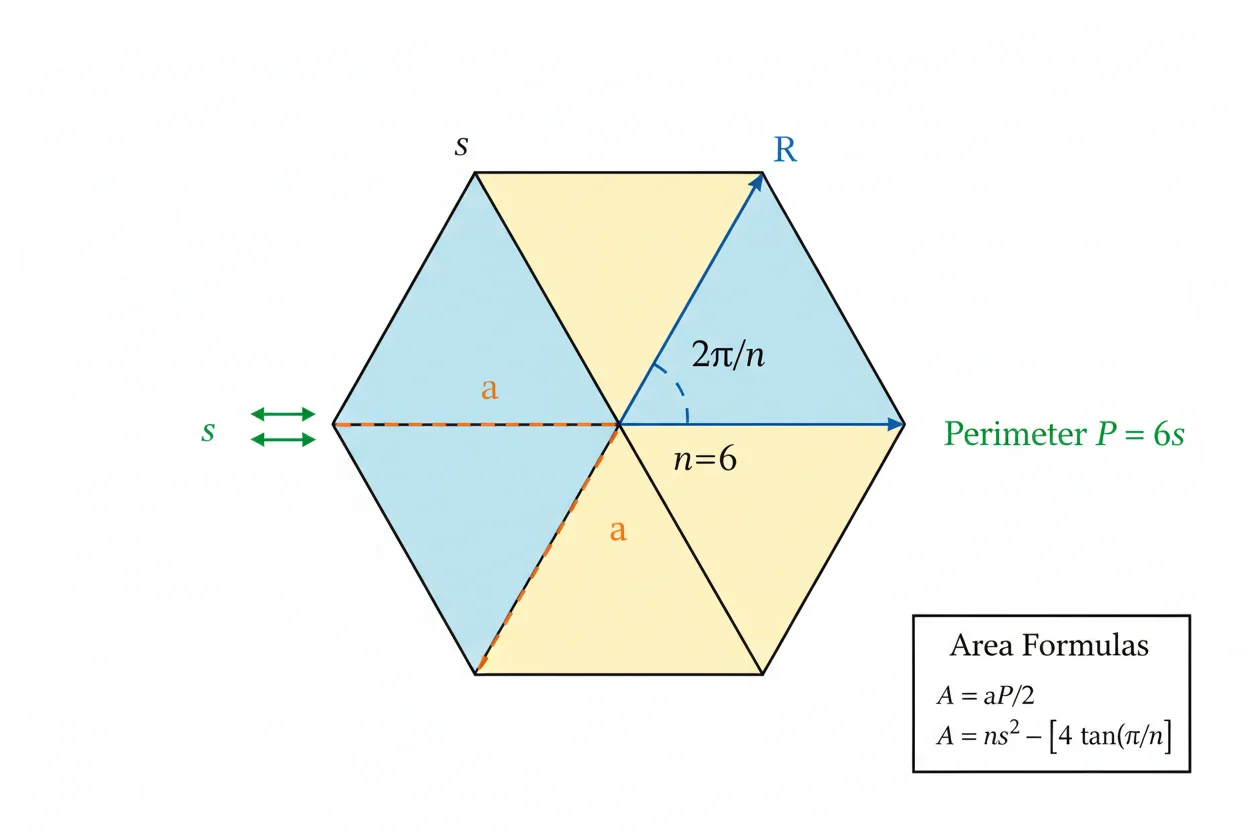

Regular polygon area measures the region enclosed by a polygon whose sides and interior angles are all equal. The most general elementary formula is A = aP/2, where a is the apothem and P is the perimeter. If a regular polygon has n sides of length s, then P = ns, so the formula becomes A = ans/2. When only n and s are known, the apothem can be eliminated to give A = ns²/[4tan(π/n)]. A regular polygon can be divided into n congruent isosceles triangles extending from the center to the vertices, which explains these formulas. Area may also be calculated from the circumradius R with A = nR²sin(2π/n)/2. Because different regular polygons use the same general structure, these formulas work for equilateral triangles, squares, regular pentagons, hexagons, octagons, and higher-sided regular polygons.
What Is a Regular Polygon?
A regular polygon has:
all sides equal
and:
all interior angles equal
Examples include:
equilateral triangle
square
regular pentagon
regular hexagon
regular octagon
A rectangle that is not a square is not regular because its side lengths are not all equal.
A rhombus that is not a square is not regular because its angles are not all equal.
Main Regular Polygon Area Formula
The most useful formula is:
A = aP/2
where:
A = area
a = apothem
P = perimeter
The apothem is the perpendicular distance from the polygon’s center to one of its sides.
For a regular polygon with n sides of length s:
P = ns
so:
A = ans/2
Basic Example
Suppose a regular hexagon has:
apothem = 3√3
side length = 6
Its perimeter is:
P = 6(6)
= 36
Therefore:
A = (3√3)(36)/2
= 54√3
Approximately:
A ≈ 93.53
square units.
Why A = aP/2
Connect the polygon center to every vertex.
This divides the regular n-gon into:
n congruent triangles
Each triangle has:
base = s
height = a
Therefore one triangle has area:
A_triangle = sa/2
There are n triangles:
A = n(sa/2)
So:
A = ans/2
Since:
ns = P
we obtain:
A = aP/2
The Apothem
The apothem extends from the polygon center to the midpoint of a side and is perpendicular to that side.
It is different from:
circumradius
which extends from the center to a vertex.
For most regular polygons:
apothem < circumradius
The apothem is the height of each central triangle used in the basic area derivation.
Regular Polygon Perimeter
For n equal sides of length s, Perimeter is:
P = ns
Therefore if:
n = 8
s = 5
then:
P = 40
If apothem is:
a = 6
area is:
A = 6(40)/2
Therefore:
A = 120
Find Area From n, s, and a
The direct formula is:
A = ans/2
Suppose:
n = 10
s = 4
a = 6.2
Then:
A = 10(4)(6.2)/2
= 124
square units.
Find Apothem From Area and Perimeter
Starting with:
A = aP/2
solve:
a = 2A/P
Suppose:
A = 150
P = 50
Then:
a = 300/50
Therefore:
a = 6
Find Perimeter From Area and Apothem
From:
A = aP/2
solve:
P = 2A/a
Suppose:
A = 216
a = 9
Then:
P = 432/9
Therefore:
P = 48
If n is also known:
s = P/n
can recover the side length.
Find Side Length From Area, Apothem, and n
From:
A = ans/2
solve:
s = 2A/(an)
Suppose:
A = 180
a = 6
n = 10
Then:
s = 360/60
Therefore:
s = 6
Area Formula Using Side Length Only
For a regular n-gon with side length s:
A = ns²/[4tan(π/n)]
This formula eliminates the apothem.
In degrees, the angle:
π/n radians
equals:
180°/n
so the formula may also be written conceptually as:
A = ns²/[4tan(180°/n)]
when the tangent is evaluated in degrees.
Deriving the Side-Length Formula
Take one of the central isosceles triangles.
Its central angle is:
2π/n
Bisect that triangle.
The resulting Right Triangle has:
opposite leg = s/2
adjacent leg = a
angle at center = π/n
Therefore:
tan(π/n) = (s/2)/a
Solve:
a = s/[2tan(π/n)]
Substitute into:
A = ans/2
Then:
A = ns²/[4tan(π/n)]
Square Area From the General Formula
For a square:
n = 4
Then:
A = 4s²/[4tan(π/4)]
Since:
tan(π/4) = 1
we obtain:
A = s²
This matches the familiar Rectangle Area formula for a square.
Equilateral Triangle From the General Formula
For:
n = 3
we have:
A = 3s²/[4tan(π/3)]
Since:
tan(π/3) = √3
we get:
A = 3s²/(4√3)
Rationalizing:
A = √3s²/4
which is the familiar equilateral-triangle area formula.
Regular Pentagon Area
For:
n = 5
the side-length formula is:
A = 5s²/[4tan(π/5)]
Since:
π/5 = 36°
this can be evaluated numerically for any side length.
Suppose:
s = 8
Then:
A = 5(64)/[4tan36°]
Approximately:
A ≈ 110.11
square units.
Regular Hexagon Area
For:
n = 6
the general formula gives:
A = 6s²/[4tan30°]
Since:
tan30° = 1/√3
we obtain:
A = 3√3s²/2
This is the familiar regular-hexagon formula.
Regular Hexagon Example
Suppose:
s = 4
Then:
A = 3√3(16)/2
Therefore:
A = 24√3
Approximately:
A ≈ 41.57
Regular Octagon Area
For a regular octagon:
n = 8
The area formula can be simplified to:
A = 2(1 + √2)s²
For:
s = 5
we get:
A = 50(1 + √2)
Approximately:
A ≈ 120.71
This specialized formula is equivalent to the general tangent form.
Area From Circumradius
Let R be the circumradius, the distance from the center to any vertex.
Each central triangle has:
two sides R
and included angle:
2π/n
Its area is:
A_triangle = R²sin(2π/n)/2
With n congruent triangles:
A = nR²sin(2π/n)/2
This is the regular polygon area formula using circumradius.
Circumradius Example
Suppose a regular hexagon has:
R = 6
Then:
n = 6
2π/n = π/3
Therefore:
A = 6(36)sin(π/3)/2
= 108(√3/2)
Thus:
A = 54√3
This matches the side-length formula because a regular hexagon’s side equals its circumradius.
Apothem and Circumradius
The apothem, half-side, and circumradius form a right triangle:
R² = a² + (s/2)²
Using the Pythagorean Theorem:
a = √[R² − (s/2)²]
or:
R = √[a² + (s/2)²]
This relationship lets one regular-polygon dimension be recovered from the others.
Apothem Example
Suppose:
R = 5
s = 6
Then:
a = √[25 − 9]
= 4
If the polygon has:
n = 5
then:
P = 30
and:
A = 4(30)/2
Therefore:
A = 60
For an actual regular pentagon, however, R = 5 and s = 6 are not mutually consistent; all dimensions must satisfy the polygon’s central-angle geometry. The Pythagorean relation alone describes the local right triangle, while regularity also constrains n.
Consistent Dimensions Matter
For a regular n-gon:
s = 2R sin(π/n)
and:
a = R cos(π/n)
Therefore R, s, a, and n cannot be chosen independently.
If three supplied measurements contradict these relationships, they cannot describe one regular polygon.
Side Length From Circumradius
From:
s = 2R sin(π/n)
Suppose a regular octagon has:
R = 10
Then:
s = 20sin(π/8)
Approximately:
s ≈ 7.65
This side length can then be used to find perimeter and area.
Apothem From Circumradius
The central right triangle gives:
a = R cos(π/n)
For a regular hexagon:
n = 6
so:
a = R cos30°
= R√3/2
If:
R = 8
then:
a = 4√3
Area From Circumradius and Apothem
Each central triangle can also be viewed as having base s and height a.
Because perimeter:
P = ns
we have:
A = aP/2
If R and a are known, side length follows from:
s = 2√(R² − a²)
Then:
P = 2n√(R² − a²)
and area follows.
Find Number of Sides From Exterior Angle
For a regular polygon, each Exterior Angle is:
E = 360°/n
Therefore:
n = 360°/E
Once n is known, perimeter or side-based area formulas can be used.
Exterior-Angle Example
Suppose:
E = 45°
Then:
n = 8
If:
s = 6
regular polygon area is:
A = 8(36)/[4tan(π/8)]
= 72/tan22.5°
Approximately:
A ≈ 173.82
square units.
Find n From Interior Angle
For a regular polygon:
I = 180° − 360°/n
Therefore:
n = 360°/(180° − I)
Suppose:
I = 150°
Then:
n = 360/30
= 12
If side length is known, the dodecagon area can then be calculated with the general formula.
The Interior Angles page handles those angular relationships in detail.
Polygon Diagonals and Area
If the number of Polygon Diagonals is known:
D = n(n − 3)/2
can determine n.
For:
D = 20
we find:
n = 8
If side length, apothem, circumradius, or another scale measurement is also known, area can then be calculated.
Diagonal count alone does not determine area.
Why Side Count Alone Is Not Enough
A regular pentagon with side length:
1 cm
and another with side length:
100 cm
both have:
5 sides
and:
5 diagonals
but their areas are vastly different.
The number of sides determines shape proportions.
A length measurement determines scale.
Both are required for numerical area.
Regular Polygon and Circle Geometry
A regular polygon can be inscribed in a circle.
All vertices lie at equal circumradius R from the center.
The central angle between consecutive vertices is:
2π/n
Each polygon side is therefore a chord of that circle.
This connects regular polygon area with Chord Length and circle geometry.
Side as a Chord
For central angle:
θ = 2π/n
the side length is:
s = 2R sin(θ/2)
Therefore:
s = 2R sin(π/n)
This formula provides the bridge between circumradius and side length.
Regular Polygon Versus Circle Area
As n becomes increasingly large while circumradius R remains fixed, a regular n-gon approaches a circle.
The area formula:
A = nR²sin(2π/n)/2
approaches:
πR²
The Circle Area formula therefore emerges as the limiting area of increasingly many-sided regular polygons.
Inscribed Polygon Area
A regular polygon inscribed in a circle of radius R always has area less than the circle:
A_polygon < πR²
for finite n.
As n increases, the gap decreases.
This was historically an important geometric approach to approximating π.
Circumscribed Regular Polygon
A regular polygon can also be drawn around a circle so the circle is tangent to every side.
Then the circle radius equals the polygon apothem:
a = r
If the polygon perimeter is P:
A_polygon = rP/2
This gives a simple area formula for circumscribed regular polygons.
Apothem and Sector Comparison
The central triangles of a regular polygon resemble sectors of the circumcircle.
Each triangle has area:
R²sinθ/2
where:
θ = 2π/n
The corresponding Sector Area is:
R²θ/2
Since:
sinθ < θ
for:
0 < θ < π
the triangle area is smaller than the sector area.
Summing these differences explains why an inscribed polygon has less area than its circumcircle.
Regular Polygon Coordinates
A regular n-gon centered at the origin can be represented using Polar and Rectangular Form.
For circumradius R:
θₖ = θ₀ + 2πk/n
and:
xₖ = R cosθₖ
yₖ = R sinθₖ
for:
k = 0,1,…,n−1
These coordinates can be used with a polygon-area determinant as an alternative to the standard formulas.
Coordinate Hexagon Example
For a regular hexagon with:
R = 2
and first vertex at:
θ = 0
the vertices occur every:
60°
The side length is:
2
Area:
A = 3√3(2²)/2
Therefore:
A = 6√3
The coordinate determinant produces the same result.
Regular Polygon Area With the Shoelace Formula
If ordered coordinates are known:
(x₁,y₁), …, (xₙ,yₙ)
area is:
A = 1/2 |Σxᵢyᵢ₊₁ − Σyᵢxᵢ₊₁|
with the final vertex connected back to the first.
This method works for irregular polygons too.
For a regular polygon, the specialized formulas are usually simpler when symmetry measurements are available.
Regular Polygon and Rhombus Area
A Rhombus Area may use:
A = d₁d₂/2
A rhombus is regular only when it is a square.
Therefore a general rhombus should not be inserted into regular-polygon formulas based on equal central angles and a common circumcenter unless it satisfies square geometry.
Equal sides alone are not enough for regularity.
Rectangle and Regular Polygon Distinction
A general Rectangle Area is:
A = lw
A rectangle becomes a regular polygon only if:
l = w
making it a square.
The regular polygon formula then gives:
A = s²
as expected.
This distinction prevents the word “regular” from being confused with merely familiar or symmetric-looking quadrilaterals.
Regular Polygon Base in Prism Volume
A regular polygon can serve as the base of a Prism Volume problem.
First calculate:
B = aP/2
Then:
V = Bh
Therefore:
V = aPh/2
where h is the perpendicular prism height.
Prism Example
Suppose a regular base has:
a = 6
P = 40
Then:
B = 120
If prism height is:
10
then:
V = 1200
cubic units.
The regular polygon calculation supplies the base area.
Regular Polygon Base in Pyramid Volume
A regular polygon can also be a Pyramid Volume base.
Use:
B = aP/2
and:
V = Bh/3
Therefore:
V = aPh/6
Pyramid Example
Suppose:
a = 8
P = 60
h = 15
Base area:
B = 240
Pyramid volume:
V = 240(15)/3
Therefore:
V = 1200
cubic units.
Right-Triangle Structure Inside Regular Polygons
Every regular polygon can be decomposed into right triangles by connecting:
center to vertices
and:
center to side midpoints
One right triangle has:
hypotenuse R
adjacent side a
opposite side s/2
and angle:
π/n
Therefore:
sin(π/n) = (s/2)/R
cos(π/n) = a/R
tan(π/n) = (s/2)/a
These relationships provide most of the regular polygon formulas.
Using Tangent to Find Apothem
From:
tan(π/n) = (s/2)/a
we obtain:
a = s/[2tan(π/n)]
Suppose a regular octagon has:
s = 5
Then:
a = 5/[2tan(π/8)]
Approximately:
a ≈ 6.04
Perimeter:
P = 40
Area:
A ≈ 6.04(40)/2
≈ 120.71
Using Sine to Find Circumradius
From:
sin(π/n) = (s/2)/R
solve:
R = s/[2sin(π/n)]
For a regular hexagon:
n = 6
sin30° = 1/2
Therefore:
R = s
This is the familiar result that a regular hexagon’s side length equals its circumradius.
Using Cosine to Relate a and R
From:
cos(π/n) = a/R
we obtain:
a = R cos(π/n)
and:
R = a/cos(π/n)
These relationships are especially useful when a circumcircle or incircle radius is given.
Regular Polygon Area From Inradius
For a regular polygon, the apothem is also the inradius r.
Therefore:
A = rP/2
If:
r = 7
P = 60
then:
A = 210
square units.
This is simply the apothem formula using different terminology.
Find Side Length From Apothem
From:
tan(π/n) = (s/2)/a
solve:
s = 2a tan(π/n)
Suppose:
n = 6
a = 3√3
Then:
s = 2(3√3)tan30°
= 6
This recovers the regular hexagon side length.
Find Circumradius From Apothem
Use:
R = a/cos(π/n)
For:
n = 4
and:
a = 5
we get:
R = 5/cos45°
= 5√2
This is half of a square’s diagonal when its side length is:
10
Scaling Regular Polygon Area
If every length is multiplied by scale factor k:
s → ks
a → ka
R → kR
Then:
A_new = k²A_old
Regular polygon area therefore follows the standard two-dimensional scaling law.
Scaling Example
Suppose a regular pentagon has area:
50
A similar regular pentagon has side lengths twice as large.
Then:
A_new = 2²(50)
Therefore:
A_new = 200
Perimeter and Area Scaling
For similar regular polygons:
P₂/P₁ = k
while:
A₂/A₁ = k²
If perimeter doubles:
area becomes four times as large
provided the polygons remain similar.
Compare Polygons With Equal Perimeter
Among regular polygons with the same perimeter, area generally increases as the number of sides increases.
The polygon becomes more circle-like.
For a fixed perimeter, a regular triangle encloses less area than a square, while many-sided regular polygons approach the area of a circle having the same circumference.
This is a geometric consequence of distributing the same boundary more evenly around a center.
Units of Regular Polygon Area
Area uses square units.
If:
a = 5 cm
and:
P = 40 cm
then:
A = 5(40)/2
= 100 cm²
The multiplication gives:
cm × cm = cm²
Converting Area Units
Since:
1 m = 100 cm
then:
1 m² = 10,000 cm²
A regular polygon with area:
2.4 m²
has:
24,000 cm²
Area conversion factors must be squared.
Exact Versus Approximate Answers
Many regular polygon formulas produce radicals or trigonometric expressions.
For a regular hexagon with side s:
A = 3√3s²/2
is exact.
For:
s = 4
the exact area is:
24√3
Approximately:
41.57
Keep exact forms until a decimal result is required.
Common Regular Polygon Area Mistakes
A common mistake is using:
A = aP
instead of:
A = aP/2
Another is confusing apothem with circumradius.
The apothem reaches a side midpoint.
The circumradius reaches a vertex.
Do not use:
P = ns
unless all side lengths are equal.
The side-length formula:
A = ns²/[4tan(π/n)]
requires a regular polygon.
When using degrees instead of radians, evaluate:
tan(180°/n)
rather than interpreting the number in the wrong angle mode.
If n is derived from an interior or exterior angle, verify that n is a valid whole number of at least 3.
Polygon diagonal count can identify n but does not determine scale.
When using coordinate methods, list vertices around the boundary in order.
Finally, report square units rather than linear or cubic units.
Frequently Asked Questions
What is the main regular polygon area formula?
A = aP/2
What is a?
a is the apothem, the perpendicular distance from the center to a side.
What is P?
P is the polygon perimeter.
How do you find perimeter?
For n sides of equal length s:
P = ns
What is the area formula using n, s, and a?
A = ans/2
What is the formula using only n and side length?
A = ns²/[4tan(π/n)]
What is the formula using circumradius?
A = nR²sin(2π/n)/2
How do you find the apothem from side length?
a = s/[2tan(π/n)]
How do you find circumradius from side length?
R = s/[2sin(π/n)]
How do you find side length from circumradius?
s = 2R sin(π/n)
How do you find number of sides from exterior angle?
n = 360°/E
Can polygon diagonal count identify n?
Yes:
D = n(n − 3)/2
can be solved for n.
Is every rectangle a regular polygon?
No. Only a square is a regular rectangle.
Is every rhombus a regular polygon?
No. Only a square is both a rhombus and a regular polygon.
How is regular polygon area used in prism volume?
First find base area B, then:
V = Bh
How is it used in pyramid volume?
V = Bh/3
How does regular polygon area scale?
If every length is multiplied by k:
area is multiplied by k²
How can I check a regular polygon area answer?
Verify that the polygon is actually regular, confirm the apothem is perpendicular to a side, check P = ns, calculate A = aP/2, and compare with the side-length or circumradius formula when enough information is available.