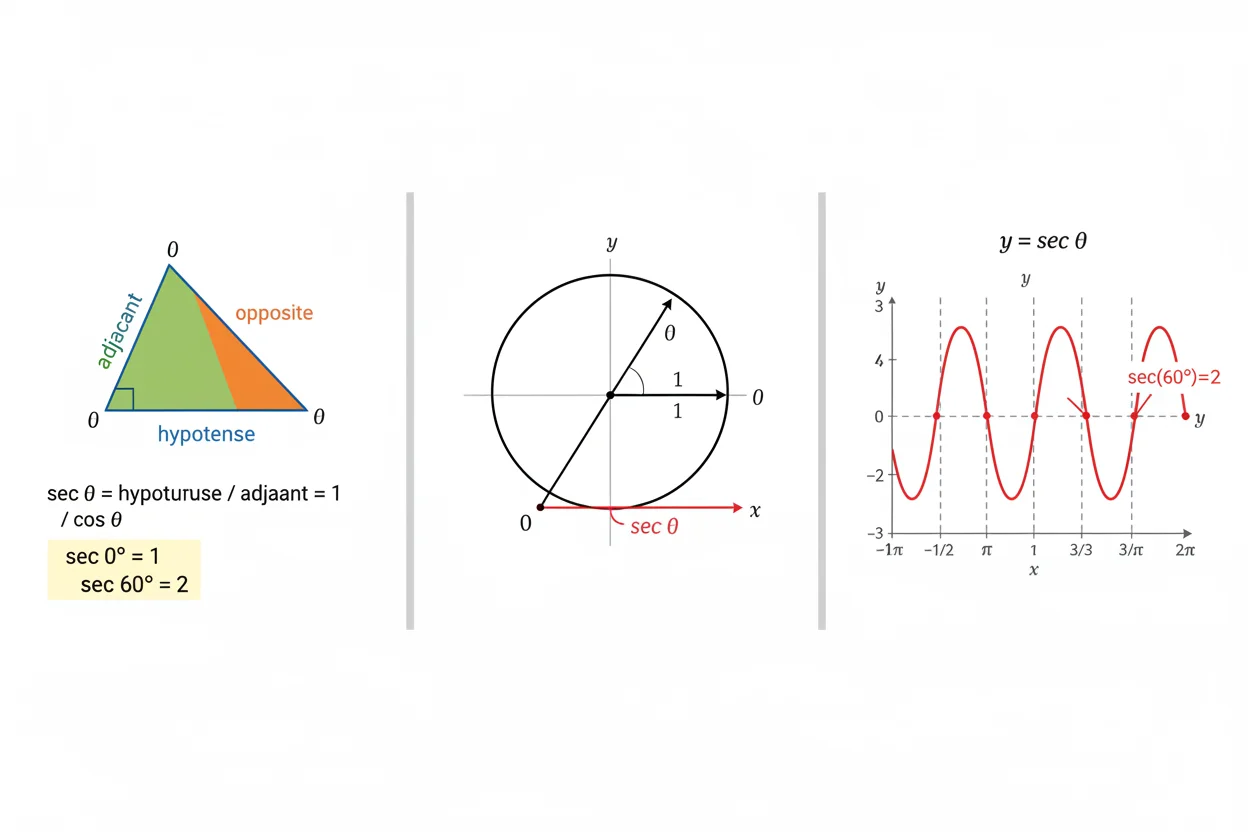
Secant is a trigonometric function defined as the reciprocal of cosine. Its fundamental formula is secθ = 1/cosθ. In a right triangle, secθ = hypotenuse/adjacent for an acute angle θ. Because cosine can equal zero, secant is undefined wherever cosθ = 0, including θ = 90° + 180°k or θ = π/2 + kπ for any integer k. The real range of secant is secθ ≤ −1 or secθ ≥ 1, because the reciprocal of a cosine value between −1 and 1 cannot have magnitude between 0 and 1. Secant is positive where cosine is positive and negative where cosine is negative. It is related to tangent through the identity sec²θ = 1 + tan²θ, and its graph has repeating U-shaped and inverted-U-shaped branches separated by vertical asymptotes.
What Is Secant?
Secant is written:
secθ
and defined by:
secθ = 1/cosθ
provided:
cosθ ≠ 0
It is one of the six standard trigonometric functions.
The six are:
sine
cosine
tangent
cosecant
secant
cotangent
Secant contains the same underlying information as Cosine, but expressed reciprocally.
Secant in a Right Triangle
For an acute angle θ in a Right Triangle:
cosθ = adjacent/hypotenuse
Take the reciprocal:
secθ = hypotenuse/adjacent
Therefore:
secθ = hypotenuse/adjacent
This right-triangle interpretation is valid for acute triangle angles.
Basic Secant Example
Suppose a right triangle has:
adjacent = 4
hypotenuse = 5
Then:
secθ = 5/4
Since:
cosθ = 4/5
we can also calculate:
secθ = 1/(4/5)
= 5/4
The two definitions agree.
5-12-13 Triangle Example
Let θ be the acute angle adjacent to the side of length:
12
in a:
5-12-13
triangle.
Then:
secθ = 13/12
The corresponding cosine is:
cosθ = 12/13
Their product is:
secθ cosθ = 1
Find the Hypotenuse Using Secant
Starting with:
secθ = hypotenuse/adjacent
we obtain:
hypotenuse = adjacent × secθ
Suppose:
adjacent = 8
secθ = 5/4
Then:
hypotenuse = 8(5/4)
Therefore:
hypotenuse = 10
Find the Adjacent Side
Rearrange:
adjacent = hypotenuse/secθ
Suppose:
hypotenuse = 15
secθ = 5/3
Then:
adjacent = 15/(5/3)
= 9
Find Secant From Cosine
The reciprocal definition is:
secθ = 1/cosθ
If:
cosθ = 3/7
then:
secθ = 7/3
If:
cosθ = −4/5
then:
secθ = −5/4
The sign is preserved because taking the reciprocal does not change whether a nonzero number is positive or negative.
Find Cosine From Secant
Likewise:
cosθ = 1/secθ
If:
secθ = 2
then:
cosθ = 1/2
If:
secθ = −3
then:
cosθ = −1/3
This reciprocal conversion is often the simplest way to solve secant equations.
Secant Is Not Inverse Cosine
The notation:
secθ
means the reciprocal of cosine.
The expression:
cos⁻¹x
normally means inverse cosine, or arccosine.
These are different operations.
For example:
sec60° = 2
while:
cos⁻¹(1/2) = 60°
The Inverse Trigonometric Functions recover angles; secant returns a trigonometric value.
Reciprocal Trigonometric Functions
The reciprocal pairs are:
secθ = 1/cosθ
cscθ = 1/sinθ
cotθ = 1/tanθ
The Cosecant function is therefore to sine what secant is to cosine.
Exact Secant Values
Some standard values are:
sec0° = 1
sec30° = 2/√3 = 2√3/3
sec45° = √2
sec60° = 2
Secant is undefined at:
90°
because:
cos90° = 0
Secant at 0°
Since:
cos0° = 1
we get:
sec0° = 1
This is the smallest positive secant value.
Secant at 30°
Since:
cos30° = √3/2
then:
sec30° = 2/√3
Rationalizing:
sec30° = 2√3/3
Approximately:
sec30° ≈ 1.1547
Secant at 45°
Because:
cos45° = √2/2
then:
sec45° = 2/√2
Therefore:
sec45° = √2
Secant at 60°
Since:
cos60° = 1/2
then:
sec60° = 2
This is also visible in a 30-60-90 right triangle where the hypotenuse is twice the side adjacent to 60°.
Secant at 90°
Because:
cos90° = 0
the expression:
sec90° = 1/0
is undefined.
This creates a vertical asymptote in the secant graph at:
90°
or:
π/2
Secant in Radians
The same relationships hold in radians.
Examples:
sec0 = 1
sec(π/6) = 2√3/3
sec(π/4) = √2
sec(π/3) = 2
sec(π/2) is undefined
The Degrees and Radians conversion does not change the trigonometric value associated with a physical angle.
Domain of Secant
Secant is undefined whenever:
cosθ = 0
Cosine equals zero at:
θ = π/2 + kπ
where k is any integer.
In degrees:
θ = 90° + 180°k
Therefore the domain is all real angles except those values.
Why Those Values Are Excluded
At:
π/2
3π/2
and their coterminal angles, the unit-circle x-coordinate equals zero.
Because:
secθ = 1/cosθ
these points would require division by zero.
That is why the secant graph has vertical asymptotes there.
Range of Secant
Cosine satisfies:
−1 ≤ cosθ ≤ 1
and secant is its reciprocal.
Therefore real secant values satisfy:
secθ ≤ −1
or:
secθ ≥ 1
Interval notation:
(−∞, −1] ∪ [1, ∞)
There are no real secant values strictly between:
−1 and 1
Why |secθ| ≥ 1
For any nonzero cosine value:
|cosθ| ≤ 1
Taking the reciprocal gives:
|1/cosθ| ≥ 1
Therefore:
|secθ| ≥ 1
This provides a quick validity test.
A claimed real value such as:
secθ = 0.6
cannot be correct.
Period of Secant
Cosine has period:
2π
Therefore:
cos(θ + 2π) = cosθ
Taking reciprocals:
sec(θ + 2π) = secθ
So secant also has period:
2π
or:
360°
Is Secant an Even Function?
Cosine is even:
cos(−θ) = cosθ
Therefore:
sec(−θ) = 1/cos(−θ)
= 1/cosθ
Thus:
sec(−θ) = secθ
So secant is also an even function.
Its graph is symmetric about the y-axis.
Secant Signs by Quadrant
Because secant has the same sign as cosine:
Quadrant I → positive
Quadrant II → negative
Quadrant III → negative
Quadrant IV → positive
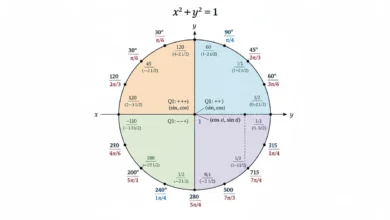
This follows from the x-coordinate behavior of the Unit Circle.
Unit Circle Definition
On the unit circle:
point = (cosθ, sinθ)
Therefore:
secθ = 1/x
when:
x = cosθ ≠ 0
This makes secant geometrically dependent on the horizontal coordinate.
When x approaches zero, secant magnitude grows without bound.
Unit Circle Example
At:
θ = 60°
the unit-circle point is:
(1/2, √3/2)
Therefore:
sec60° = 1/(1/2)
= 2
At:
θ = 120°
the point is:
(−1/2, √3/2)
so:
sec120° = −2
Reference Angles
Suppose:
θ = 120°
The reference angle is:
60°
Since secant is negative in Quadrant II:
sec120° = −sec60°
Therefore:
sec120° = −2
Reference-angle reasoning makes many exact values straightforward.
Secant at 225°
The reference angle is:
45°
The angle lies in Quadrant III, where secant is negative.
Therefore:
sec225° = −√2
Because:
cos225° = −√2/2
the reciprocal confirms the same result.
Secant Graph
The secant graph is derived from:
y = 1/cosx
It contains separate curved branches.
Vertical asymptotes occur wherever:
cosx = 0
So:
x = π/2 + kπ
Between asymptotes, branches either open upward from:
y = 1
or downward from:
y = −1
Why the Graph Has U-Shaped Branches
Near:
x = 0
cosx is close to:
1
so secx is close to:
1
As x approaches:
±π/2
cosx approaches zero from the positive side.
Therefore:
secx → +∞
This produces an upward branch with minimum:
(0,1)
Negative Branches
Near:
x = π
we have:
cosπ = −1
so:
secπ = −1
As x approaches:
π/2
or:
3π/2
from within that interval, cosine approaches zero through negative values.
Therefore secant falls toward:
−∞
on both sides, producing a downward branch with maximum:
−1
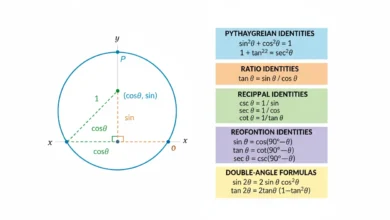
Secant and Tangent Identity
A fundamental Trigonometric Identities relationship is:
sec²θ = 1 + tan²θ
Equivalently:
sec²θ − tan²θ = 1
This comes from the Pythagorean identity:
sin²θ + cos²θ = 1
Deriving sec²θ = 1 + tan²θ
Start with:
sin²θ + cos²θ = 1
Divide every term by:
cos²θ
Then:
sin²θ/cos²θ + 1 = 1/cos²θ
Therefore:
tan²θ + 1 = sec²θ
So:
sec²θ = 1 + tan²θ
Find Secant From Tangent
From:
sec²θ = 1 + tan²θ
we obtain:
secθ = ±√(1 + tan²θ)
The sign depends on the quadrant.
Suppose:
tanθ = 3/4
and θ lies in Quadrant I.
Then:
secθ = √(1 + 9/16)
= √(25/16)
Therefore:
secθ = 5/4
Quadrant Sign Example
Suppose:
tanθ = 3/4
but θ lies in Quadrant III.
Then cosine is negative, so secant is negative.
Therefore:
secθ = −5/4
The squared identity determines magnitude; quadrant information determines sign.
Find Tangent From Secant
Rearrange:
tan²θ = sec²θ − 1
Therefore:
tanθ = ±√(sec²θ − 1)
Suppose:
secθ = 13/12
Then:
tan²θ = 169/144 − 1
= 25/144
So:
|tanθ| = 5/12
The sign again depends on the quadrant.
Right-Triangle Interpretation of the Identity
If:
secθ = c/b
and:
tanθ = a/b
then:
sec²θ − tan²θ
becomes:
c²/b² − a²/b²
= (c² − a²)/b²
From:
a² + b² = c²
we have:
c² − a² = b²
Therefore:
sec²θ − tan²θ = 1
The identity is simply the Pythagorean theorem expressed as side ratios.
Secant and Right Triangles
The broader Right Triangles framework shows that if a right triangle has:
adjacent = b
hypotenuse = c
then:
secθ = c/b
Because:
c ≥ b > 0
for an acute angle:
secθ ≥ 1
This agrees with the positive portion of the general secant range.
Right-Triangle Example From Secant
Suppose:
secθ = 5/3
Use:
secθ = hypotenuse/adjacent
Choose a proportional triangle:
hypotenuse = 5
adjacent = 3
The missing opposite leg is:
√(5² − 3²)
= 4
Therefore:
tanθ = 4/3
sinθ = 4/5
cosθ = 3/5
The one secant ratio determines all six trigonometric values up to quadrant signs.
Finding an Angle From Secant
If:
secθ = k
then:
cosθ = 1/k
Therefore:
θ = cos⁻¹(1/k)
for an appropriate principal angle.
For example:
secθ = 2
gives:
cosθ = 1/2
so the principal angle is:
θ = 60°
Solving secθ = 2 Over One Revolution
Start with:
secθ = 2
Then:
cosθ = 1/2
Cosine is positive in Quadrants I and IV.
On:
0° ≤ θ < 360°
the solutions are:
θ = 60°
and:
θ = 300°
The reciprocal conversion reduces a secant equation to a familiar cosine equation.
Solving secθ = −2
Convert:
cosθ = −1/2
Cosine is negative in Quadrants II and III.
Therefore on:
0° ≤ θ < 360°
the solutions are:
θ = 120°
and:
θ = 240°
General Secant Equation
For:
secθ = k
a real solution requires:
|k| ≥ 1
Then:
cosθ = 1/k
Solve the resulting cosine equation over the specified interval.
If:
|k| < 1
there is no real solution.
No-Solution Example
Suppose:
secθ = 1/2
Then:
cosθ = 2
But real cosine cannot exceed:
1
Therefore there is no real θ satisfying the equation.
This is equivalent to recognizing that secant’s real range excludes values between −1 and 1.
Secant Equations With Algebra
Suppose:
2secθ − 3 = 1
Then:
2secθ = 4
so:
secθ = 2
Thus:
cosθ = 1/2
The solutions can then be found according to the requested interval.
Example With sec²θ
Solve:
sec²θ = 4
Then:
secθ = ±2
Therefore:
cosθ = ±1/2
On:
0° ≤ θ < 360°
the solutions are:
60°, 120°, 240°, 300°
Squaring can produce both positive and negative secant values.
Secant and Similar Triangles
Similar Triangles have equal corresponding angles and proportional corresponding sides.
For a fixed acute angle θ:
hypotenuse/adjacent
has the same value in every similar right triangle.
Therefore secθ depends on angle, not on overall triangle size.
Similarity Example
Triangle 1 has:
adjacent = 3
hypotenuse = 5
Triangle 2 is twice as large:
adjacent = 6
hypotenuse = 10
In both:
secθ = 5/3
The scale factor cancels from the ratio.
Secant and Sector Geometry
A Sector Area problem can create right triangles when radii, chords, tangents, or perpendicular distances are introduced.
Secant may appear when a hypotenuse-like radial segment and adjacent projection are known.
The sector itself still uses circular formulas such as:
A = r²θ/2
for θ in radians.
Secant provides an angular ratio rather than the sector area directly.
Secant and Rhombus Geometry
A Rhombus Area problem can be divided by its diagonals into right triangles.
If a half-diagonal is adjacent to an angle and the rhombus side is the hypotenuse:
secθ = side/half-diagonal
This may help recover an angle or a missing diagonal before area is found.
Rhombus Example
Suppose a half-diagonal is:
5
and rhombus side is:
13
Then:
secθ = 13/5
The other half-diagonal is:
√(13² − 5²)
= 12
so the full diagonals are:
10 and 24
Area:
A = 120
Secant and Regular Polygon Geometry
A Regular Polygon Area can be divided into central right triangles.
For circumradius R and apothem a:
cos(π/n) = a/R
Therefore:
sec(π/n) = R/a
So:
R = a sec(π/n)
Secant provides a direct ratio between circumradius and apothem.
Regular Polygon Example
For a regular hexagon:
n = 6
Therefore:
π/n = π/6
and:
sec(π/6) = 2√3/3
If apothem is:
a = 3√3
then:
R = 3√3(2√3/3)
Therefore:
R = 6
This agrees with the fact that a regular hexagon’s circumradius equals its side length.
Secant and Polar Coordinates
In Polar and Rectangular Form:
x = r cosθ
If:
cosθ ≠ 0
then:
r = x secθ
This relationship is useful when converting certain vertical-line equations to polar form.
Vertical Line in Polar Form
Suppose:
x = a
Since:
x = r cosθ
we have:
r cosθ = a
Therefore:
r = a secθ
For example:
x = 3
becomes:
r = 3secθ
This is a direct coordinate application of the secant function.
Why r = a secθ Represents a Vertical Line
Multiply:
r = a secθ
by:
cosθ
Then:
r cosθ = a
But:
r cosθ = x
Therefore:
x = a
The polar equation and rectangular line equation describe the same set of points wherever the polar expression is defined.
Secant and Point-Slope Geometry
A line making angle θ with the positive x-axis has:
slope = tanθ
Secant does not directly give the slope, but the identity:
tan²θ = sec²θ − 1
can determine its magnitude when secθ is known.
The Point-Slope Form can then construct the line once the correct tangent sign and one point are known.
Line Example
Suppose:
secθ = 5/4
and θ is in Quadrant I.
Then:
tanθ = √(25/16 − 1)
= 3/4
A line through:
(2,1)
with this direction is:
y − 1 = (3/4)(x − 2)
Secant and Slope
Because:
m = tanθ
and:
sec²θ = 1 + tan²θ
we obtain:
sec²θ = 1 + m²
Therefore:
|secθ| = √(1 + m²)
The sign depends on the chosen direction angle’s cosine.
This connects secant with Slope geometrically.
Secant From a Direction Vector
Suppose a direction vector is:
(a,b)
Its magnitude is:
√(a² + b²)
If θ is measured from the positive x-axis and a > 0:
cosθ = a/√(a² + b²)
Therefore:
secθ = √(a² + b²)/a
This is the vector version of:
hypotenuse/adjacent
Direction Vector Example
For vector:
(4,3)
magnitude:
5
Therefore:
cosθ = 4/5
and:
secθ = 5/4
The corresponding slope is:
3/4
Secant and the Pythagorean Theorem
The identity:
sec²θ = 1 + tan²θ
is ultimately another form of:
a² + b² = c²
Divide the Pythagorean equation by the square of the adjacent leg:
a²/b² + 1 = c²/b²
Then:
tan²θ + 1 = sec²θ
This makes the connection between secant and right-triangle geometry explicit.
Inverse Secant
The inverse secant function is often written:
arcsec x
or:
sec⁻¹x
It returns an angle whose secant is x, subject to a chosen principal range.
Because secant’s range is:
x ≤ −1
or:
x ≥ 1
inverse secant has real domain:
(−∞,−1] ∪ [1,∞)
A practical computational relationship is:
arcsec x = arccos(1/x)
with the appropriate principal-range convention.
Inverse Secant Example
Find:
arcsec 2
Use:
cosθ = 1/2
Therefore:
θ = 60°
or:
π/3
under the common principal-range convention.
Another Inverse Secant Example
For:
arcsec(−2)
we need:
cosθ = −1/2
The common principal result is:
θ = 120°
or:
2π/3
The exact convention for inverse secant’s range should be checked when a course or calculator defines it explicitly.
Derivative of Secant
In calculus:
d/dx(sec x) = sec x tan x
This derivative combines the function with tangent.
It can be derived from:
secx = 1/cosx
using differentiation rules.
Derivative Outline
Write:
secx = (cosx)⁻¹
Differentiate:
d/dx(secx) = −(cosx)⁻²(−sinx)
Therefore:
= sinx/cos²x
Rewrite:
= (1/cosx)(sinx/cosx)
Thus:
d/dx(secx) = secx tanx
Antiderivative of Secant
A standard integral is:
∫ secx dx = ln|secx + tanx| + C
This is a notable result because the antiderivative is not an elementary-looking reciprocal-cosine expression.
The derivative of:
ln|secx + tanx|
simplifies back to:
secx
where defined.
Secant Graph Transformations
For:
y = a sec[b(x − h)] + k
the parameters affect the graph similarly to transformed cosine.
The vertical asymptotes occur where the cosine inside equals zero.
The parameter a changes vertical stretch and reflection.
The parameter b affects period.
The parameters h and k shift the graph horizontally and vertically.
Period of a Transformed Secant
For:
y = sec(bx)
the period is:
2π/|b|
For:
y = sec(2x)
the period is:
π
because:
2π/2 = π
The asymptotes also occur twice as frequently as for ordinary secant.
Example of Shifted Secant
For:
y = sec(x − π/4)
the graph of secx shifts:
π/4
to the right.
Vertical asymptotes occur when:
x − π/4 = π/2 + kπ
so:
x = 3π/4 + kπ
Secant Versus Cosecant Graphs
Secant is reciprocal cosine.
Cosecant is reciprocal sine.
Therefore their asymptotes occur at different locations.
For secant:
cosx = 0
For cosecant:
sinx = 0
The branch shapes are similar, but their horizontal positions differ.
Exact Versus Approximate Values
Suppose:
sec30° = 2√3/3
This exact value is preferable when symbolic manipulation follows.
Approximately:
1.1547
A decimal is useful for measurement problems, but exact radicals preserve precision.
Common Secant Mistakes
A common mistake is confusing secant with inverse cosine.
Remember:
secθ = 1/cosθ
while:
cos⁻¹x = arccosx
Another mistake is reversing the right-triangle ratio incorrectly. Secant is:
hypotenuse/adjacent
not:
adjacent/hypotenuse
Secant is undefined wherever cosine equals zero.
A real secant value cannot lie strictly between:
−1 and 1
When using:
sec²θ = 1 + tan²θ
remember that taking a square root introduces a positive or negative possibility determined by the quadrant.
For secant equations, convert to cosine and solve over the complete requested interval rather than keeping only one inverse-function result.
Finally, confirm the calculator’s degree or radian setting whenever numerical angles are involved.
Frequently Asked Questions
What is secant?
Secant is the reciprocal of cosine:
secθ = 1/cosθ
What is secant in a right triangle?
secθ = hypotenuse/adjacent
Is secant the same as inverse cosine?
No.
How do you find secant from cosine?
Take the reciprocal:
secθ = 1/cosθ
How do you find cosine from secant?
cosθ = 1/secθ
What is sec0°?
1
What is sec45°?
√2
What is sec60°?
2
What is sec90°?
Undefined.
Where is secant undefined?
θ = π/2 + kπ
or:
90° + 180°k
for integer k.
What is the range of secant?
secθ ≤ −1
or:
secθ ≥ 1
What is the period of secant?
2π
or:
360°
Is secant even or odd?
Secant is even:
sec(−θ) = secθ
What is the main secant identity?
sec²θ = 1 + tan²θ
How do you find secant from tangent?
secθ = ±√(1 + tan²θ)
with the sign determined by the quadrant.
How do you solve secθ = k?
Convert to:
cosθ = 1/k
then solve the cosine equation over the required interval.
What is inverse secant?
Inverse secant returns an angle from a secant value and can be computed through:
arcsec x = arccos(1/x)
using the chosen principal-range convention.
How can I check a secant answer?
Take its reciprocal to recover cosine, verify the sign from the quadrant, confirm |secθ| ≥ 1, and substitute the resulting angle back into secθ = 1/cosθ.