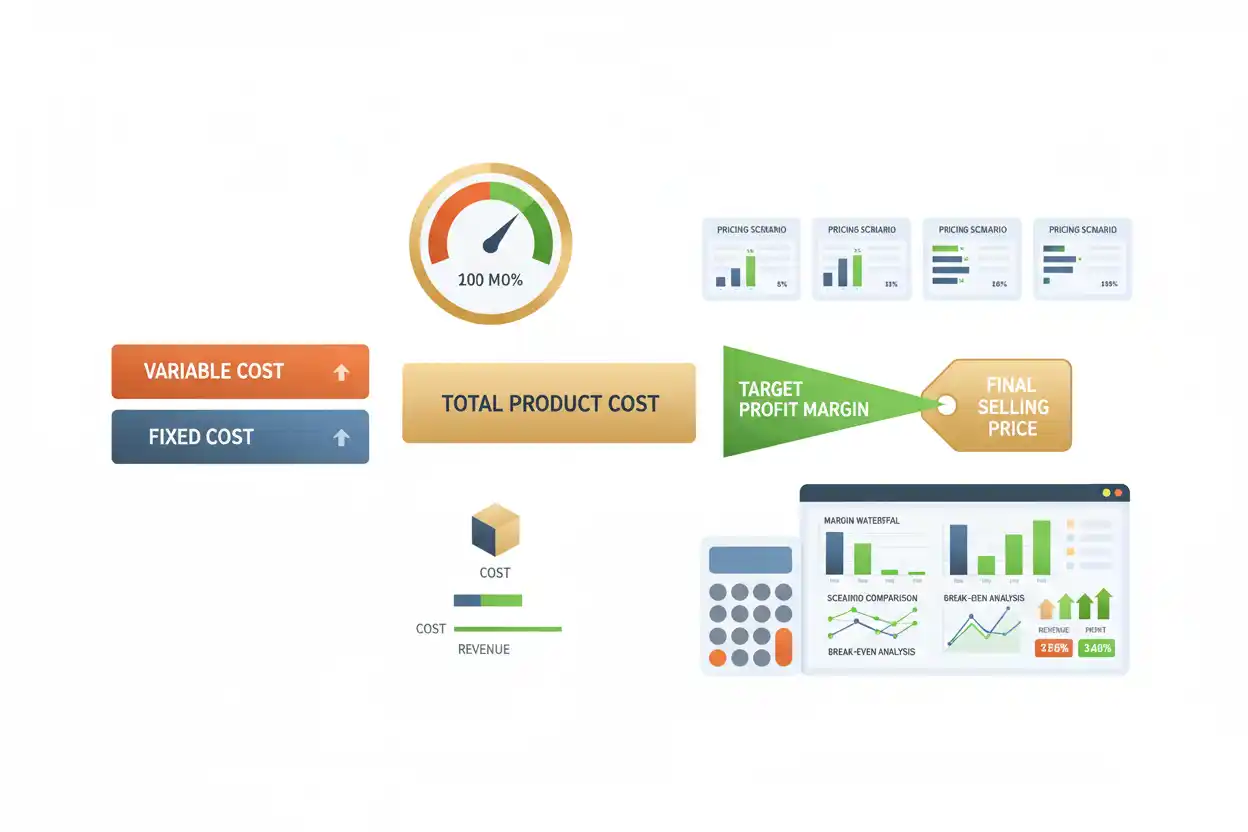

Target pricing calculates the selling price required to achieve a specific profit goal. That goal might be a target profit margin, target dollar profit per unit, total profit objective, or desired return on capital.
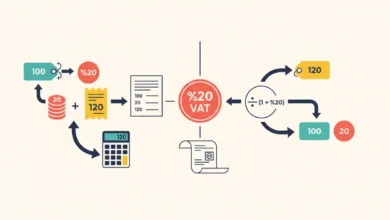
If a product costs $60 per unit and the business wants a 40% margin on the selling price, the required target price is not $84.
The correct margin-based formula is:
Target Price = Unit Cost ÷ (1 − Target Profit Margin)
Therefore:
Target Price = $60 ÷ (1 − 0.40)
Target Price = $60 ÷ 0.60
Target Price = $100
At a $100 selling price:
Profit = $100 − $60 = $40
and:
Profit Margin = $40 ÷ $100 = 40%
This distinction matters because margin and markup use different denominators. Adding 40% to cost would create a 40% markup, not a 40% profit margin.
Within business finance, target pricing connects costs, contribution margin, expected sales volume, break-even, unit economics, and capital-return goals. The calculation provides the price the business needs under its assumptions; the market determines whether customers will actually accept that price.
What Is Target Pricing?
Target pricing is the process of calculating or selecting a selling price designed to achieve a defined financial objective.
The target can be expressed as:
a percentage profit margin;
a dollar profit per unit;
a total profit amount;
a contribution margin;
a return on investment;
or another economic threshold.
For example, a manufacturer may ask:
What price do we need to charge to earn a 30% gross margin?
A service provider may ask:
What hourly rate covers our costs and produces $50 of profit per billable hour?
A retailer may ask:
What list price allows a 20% promotional discount while still preserving a 35% margin?
Target pricing turns those objectives into arithmetic.
However, it does not prove that the resulting price is commercially viable. Competitive prices, customer willingness to pay, product differentiation, demand elasticity, and sales volume still matter.
Target Pricing Formula for a Profit Margin
If unit cost and desired profit margin are known:
Target Price = Unit Cost ÷ (1 − Target Margin)
Where target margin is expressed as a decimal.
For a 25% target margin:
Target Margin = 0.25
For a 40% target margin:
Target Margin = 0.40
For a 60% target margin:
Target Margin = 0.60
Suppose cost is $75 and the desired margin is 25%.
Target Price = $75 ÷ 0.75
Target Price = $100
Profit:
$100 − $75 = $25
Margin:
$25 ÷ $100 × 100 = 25%
The formula works because profit margin is measured relative to the selling price.
Why You Cannot Simply Add the Margin to Cost
Suppose cost is $100 and the target margin is 30%.
A common mistake is:
$100 × 1.30 = $130
At $130, profit is:
$130 − $100 = $30
But margin is:
$30 ÷ $130 × 100
≈ 23.08%
The business achieved a 30% markup on cost, not a 30% margin on revenue.
To reach a true 30% margin:
Target Price = $100 ÷ (1 − 0.30)
Target Price = $100 ÷ 0.70
Target Price ≈ $142.86
Profit:
$42.86
Margin:
$42.86 ÷ $142.86 ≈ 30%
The site’s margin vs markup guide owns the detailed comparison between these two percentages.
Target Price for a Dollar Profit per Unit
If the desired goal is a specific dollar profit rather than a percentage margin:
Target Price = Unit Cost + Target Profit per Unit
Suppose:
Unit cost = $80
Desired profit per unit = $30
Then:
Target Price = $80 + $30
Target Price = $110
The resulting dollar profit is $30.
The resulting margin is:
$30 ÷ $110 × 100
≈ 27.27%
A dollar-profit target and a percentage-margin target therefore produce different pricing logic.
Target Price for a Total Profit Goal
A business can also work backward from a desired total profit.
For a simplified single-product business:
Target Price = Variable Cost per Unit + (Fixed Costs + Target Profit) ÷ Expected Unit Sales
Suppose:
Variable cost per unit = $30
Annual fixed costs = $200,000
Target annual profit = $100,000
Expected sales volume = 20,000 units
The amount each unit must contribute toward fixed costs and profit is:
($200,000 + $100,000) ÷ 20,000
= $15 per unit
Therefore:
Target Price = $30 + $15
Target Price = $45
At 20,000 units:
Revenue:
20,000 × $45 = $900,000
Variable costs:
20,000 × $30 = $600,000
Contribution:
$300,000
After fixed costs:
Profit = $300,000 − $200,000
Profit = $100,000
The business reaches its target exactly under the assumptions.
Target Pricing and Expected Sales Volume
Volume is one of the most important inputs in target pricing when fixed costs are involved.
Suppose:
Variable cost = $30
Fixed costs = $200,000
Target profit = $100,000
At 20,000 expected units:
Target Price = $45
But suppose only 10,000 units are expected.
Required contribution per unit becomes:
($200,000 + $100,000) ÷ 10,000
= $30
Target price:
$30 variable cost + $30 required contribution
Target Price = $60
The required price rises from $45 to $60 because the same fixed costs and profit goal must be supported by half as many units.
Target pricing therefore depends heavily on demand assumptions.
Target Pricing and Variable Costs
The workbook maps variable costs directly to this page because they determine the incremental cost of each additional sale.
Suppose:
Selling price = $100
Variable cost = $60
Contribution per unit:
$40
If variable cost rises to $70 without a price change:
Contribution = $30
The business has lost $10 of contribution on every unit sold.
At 100,000 units:
Profit Impact Before Other Changes = $10 × 100,000
= $1,000,000
A target price should therefore be recalculated when material input, fulfillment, transaction, or service-delivery costs change.
Target Pricing and Fixed Costs
Fixed costs do not usually change directly with each unit sold over the relevant operating range, but they still need to be covered by the business.
Suppose:
Variable cost = $40
Selling price = $70
Contribution per unit:
$30
Fixed costs = $300,000
Break-even volume:
$300,000 ÷ $30
10,000 Units
If the business wants $150,000 of profit:
Required Units = ($300,000 + $150,000) ÷ $30
15,000 Units
Alternatively, if sales volume is fixed at 12,000 units, management can solve for the required target price.
Target Price at a Fixed Sales Volume
Suppose:
Expected sales = 12,000 units
Variable cost = $40 per unit
Fixed costs = $300,000
Desired profit = $150,000
Required contribution per unit:
($300,000 + $150,000) ÷ 12,000
$37.50
Therefore:
Target Price = $40 + $37.50
Target Price = $77.50
At 12,000 units:
Revenue:
$930,000
Variable costs:
$480,000
Contribution:
$450,000
Fixed costs:
$300,000
Profit:
$150,000
Target Pricing and Contribution Margin
Contribution margin is central to pricing decisions involving volume and fixed costs.
Per unit:
Contribution Margin per Unit = Selling Price − Variable Cost per Unit
As a percentage:
Contribution Margin Ratio = Contribution Margin ÷ Selling Price × 100
Suppose:
Price = $80
Variable cost = $48
Contribution:
$32
Contribution margin ratio:
$32 ÷ $80 × 100
40%
Each sale contributes $32 toward fixed costs and profit.
Target pricing can therefore work backward from the contribution required to support the planned cost structure.
Contribution Margin Is Not Net Profit Margin
A 40% contribution margin does not mean the business has a 40% net profit margin.
Fixed operating expenses still need to be paid.
Suppose:
Revenue = $1,000,000
Variable costs = $600,000
Contribution:
$400,000
Contribution margin:
40%
Fixed costs = $300,000
Profit:
$100,000
Net-style profit margin in this simplified model:
$100,000 ÷ $1,000,000
10%
Target pricing must identify which level of margin management actually wants to achieve.
Target Pricing for Gross Margin
A company targeting gross margin can use:
Target Price = Unit COGS ÷ (1 − Target Gross Margin)
Suppose cost of goods sold per unit is $50 and the desired gross margin is 50%.
Target Price = $50 ÷ 0.50
Target Price = $100
Gross profit:
$100 − $50 = $50
Gross margin:
$50 ÷ $100 = 50%
However, this does not guarantee a 50% operating or net profit margin because selling, administrative, marketing, financing, tax, and other expenses remain.
Target Pricing for Operating Margin
If management is targeting an operating margin, the cost model must incorporate the operating expense structure.
Suppose expected annual volume is 100,000 units.
Variable operating cost per unit = $40
Annual fixed operating expenses = $2 million
Target operating profit = $1 million
Required contribution:
$2M + $1M = $3M
Required contribution per unit:
$3M ÷ 100,000 = $30
Target selling price:
$40 + $30 = $70
Expected annual revenue:
$7 million
Operating profit:
$1 million
Operating margin:
$1M ÷ $7M
≈ 14.29%
If the desired operating margin itself is the target, the equation may need to be solved using revenue rather than simply adding a fixed dollar profit.
Target Margin Formula Using Total Unit Cost
If a business has a reliable fully loaded cost per unit and wants a target margin:
Target Price = Total Unit Cost ÷ (1 − Target Margin)
Suppose fully loaded unit cost is $84 and target margin is 30%.
Target Price = $84 ÷ 0.70
Target Price = $120
Profit per unit:
$36
Margin:
$36 ÷ $120 = 30%
The key question is whether the $84 cost truly includes everything management intends the target margin to cover.
Full Cost vs Variable Cost Pricing
Using variable cost alone and using full cost produce different prices.
Suppose:
Variable cost = $40
Allocated fixed cost per unit = $20
Total cost = $60
At 30% target margin using full cost:
Target Price = $60 ÷ 0.70
≈ $85.71
Using variable cost alone:
$40 ÷ 0.70
≈ $57.14
The second price produces contribution, but it may not generate enough total profit to cover fixed costs at the expected sales volume.
A pricing model should therefore match the cost basis to the decision.
Target Pricing vs Cost-Plus Pricing
Cost-plus pricing starts with cost and adds a predetermined markup or profit amount.
For example:
Price = Cost × (1 + Markup Rate)
Target pricing starts from the financial outcome management wants and solves for the selling price that produces it.
The approaches can produce the same result when assumptions align.
However, target pricing is particularly useful when the desired result is expressed as a margin, total profit, or investment return rather than simply a markup on cost.
Target Pricing vs Markup
Markup measures profit above cost relative to cost.
Suppose:
Cost = $60
Selling price = $100
Profit:
$40
Markup:
$40 ÷ $60
66.67%
Margin:
$40 ÷ $100
40%
Therefore, a target 40% margin requires a 66.67% markup on a $60 cost base.
Pricing software, spreadsheets, and commercial teams should label the percentage explicitly to prevent margin/markup confusion.
Converting Target Margin to Markup
The conversion from margin to markup is:
Markup = Target Margin ÷ (1 − Target Margin)
Suppose target margin = 30%.
Markup = 0.30 ÷ 0.70
Markup ≈ 42.86%
Therefore, to achieve a 30% margin, the business needs to mark cost up by approximately 42.86%.
For a $70 cost:
Price = $70 × 1.4286
≈ $100
Converting Markup to Margin
The inverse relationship is:
Margin = Markup ÷ (1 + Markup)
Suppose markup = 50%.
Margin = 0.50 ÷ 1.50
33.33%
Therefore, adding 50% to cost produces a 33.33% margin—not a 50% margin.
This is one of the most common practical pricing errors.
Target Pricing and Break-Even Analysis
Break-even analysis determines the sales level where contribution exactly covers fixed costs.
The unit formula is:
Break-Even Units = Fixed Costs ÷ Contribution Margin per Unit
Suppose:
Target price = $80
Variable cost = $50
Fixed costs = $300,000
Contribution per unit:
$30
Break-even units:
$300,000 ÷ $30
10,000 Units
If management expects only 8,000 units of demand, the $80 target price will not cover the modeled fixed-cost structure.
Target price and expected volume therefore need to be tested together.
Target Price vs Break-Even Price
A break-even price is the price needed to produce zero profit at the expected volume.
A target price typically includes an additional profit requirement.
Suppose:
Variable cost = $40
Fixed cost = $200,000
Expected units = 20,000
Break-even contribution required:
$200,000 ÷ 20,000 = $10
Break-even price:
$40 + $10 = $50
Now suppose desired total profit is $100,000.
Additional profit per unit:
$100,000 ÷ 20,000 = $5
Target price:
$55
The site’s break-even point page owns the zero-profit threshold itself.
Target Pricing and Unit Economics
The workbook maps unit economics directly because target pricing must work at the level of each economically meaningful transaction.
Suppose a subscription product charges $50 per month.
Variable service cost = $15
Payment and support costs = $5
Contribution per customer-month:
$50 − $15 − $5
$30
If the business needs at least $40 of monthly contribution per customer to support acquisition and fixed operating costs, the current $50 price does not reach the target.
Possible responses include:
raising price;
lowering service cost;
reducing support cost;
improving customer retention;
or accepting a lower target.
Target pricing therefore sits inside the broader unit-economics model.
Target Pricing and Customer Acquisition Cost
Customer acquisition cost can be crucial when pricing recurring products.
Suppose:
CAC = $300
Monthly contribution after variable service costs = $30.
Simple contribution payback:
$300 ÷ $30
10 Months
If the target is to recover acquisition cost within six months, monthly contribution needs to rise to:
$300 ÷ 6
$50
If variable service cost is $20:
Target Price = $20 + $50
$70 per month
This simplified example ignores retention, taxes, fixed costs, and other factors, but it shows how customer economics can feed into a target-pricing decision.
Target Pricing and Customer Lifetime Value
Customer lifetime value provides a longer-term perspective.
A lower introductory price may produce a small first-month contribution but still create attractive economics when customers remain for years.
Conversely, a high price with poor retention can reduce total customer value.
The target should therefore match the business model.
Transactional businesses may focus heavily on per-sale margin.
Recurring businesses may optimize lifetime contribution, acquisition recovery, retention, and expansion revenue together.
Target Pricing and ROI
The workbook maps ROI directly because businesses can set prices to support a desired return on an investment.
Suppose a new product requires:
Development investment = $500,000
Management wants:
20% return = $100,000 profit
Expected sales = 10,000 units
Variable cost = $30 per unit
Ignoring other fixed costs for the simplified example, required profit contribution per unit is:
$100,000 ÷ 10,000
$10
If the development investment itself must also be recovered during the pricing horizon, the model needs to include both capital recovery and desired gain rather than only the $100,000 return.
Target pricing therefore needs a clear definition of what “20% return” actually means.
Target Pricing and Return on Invested Capital
The workbook also maps return on invested capital.
A product can generate an attractive margin while requiring enormous capital.
Suppose two products both earn a 30% operating margin.
Product A requires $1 million of working capital and equipment.
Product B requires $10 million.
If operating profit is similar, Product A can produce much stronger capital efficiency.
Target pricing should therefore not optimize margin in isolation when capital intensity is significant.
Target Pricing and Startup Valuation
The workbook maps startup valuation because pricing assumptions can materially affect a startup’s future financial model.
Suppose a startup valuation assumes:
$100 average selling price;
80% gross margin;
and rapid customer growth.
If market testing later shows customers will only pay $60 while service costs remain $20:
Original gross margin:
($100 − $20) ÷ $100 = 80%
At $60:
($60 − $20) ÷ $60
≈ 66.67%
The business can still be attractive, but future gross profit and cash flow can be materially lower than originally forecast.
Pricing assumptions should therefore be tested before they become embedded in ambitious valuation models.
Target Pricing and Working Capital
Working capital can also influence the economics of a target price.
Suppose a product produces a strong accounting margin but requires:
large inventory purchases;
long customer credit terms;
and rapid growth.
The company may need substantial financing before cash from sales is collected.
A price that produces adequate accounting profit can therefore still create weak cash economics if working-capital requirements are ignored.
Target Pricing and Cash Flow Forecasting
Cash flow forecasting helps management test whether a proposed price supports actual cash requirements.
Suppose a business launches at a target price expected to create $500,000 of annual profit.
If customers pay after 90 days while suppliers require payment in 30 days, the company can face a large cash gap.
The target price may be profitable.
The timing of cash receipts and payments can still create financing pressure.
Price, profitability, and liquidity should therefore be modeled together.
Target Pricing and the Market
A calculated target price is not automatically the market price.
Suppose cost analysis says a business needs to charge $120 to earn its desired margin.
Comparable alternatives sell for $80.
The company cannot solve the problem merely by insisting that $120 is the mathematically correct price.
It has several strategic choices:
reduce cost;
create more customer value;
differentiate the product;
accept a lower margin;
change the business model;
or decline to enter the market.
Target pricing reveals the economics required by the company.
Market pricing reveals what customers may accept.
A viable business needs the two to overlap.
Market-Back Target Pricing
Instead of starting with cost, management can start with the price the market is likely to support.
Suppose customers will pay approximately $100.
The company wants a 30% target margin.
Allowable total cost is:
Target Cost = Target Selling Price × (1 − Target Margin)
Target Cost = $100 × 0.70
Target Cost = $70
The company therefore needs to deliver the product for approximately $70 or less under the cost definition used.
This is closely related to target costing.
Target Pricing vs Target Costing
Target pricing asks:
What price is required to produce our target return given our costs?
Target costing reverses the direction:
Given the market price and target profit, what cost can we afford?
For a dollar target:
Target Cost = Market Price − Target Profit
For a margin target:
Target Cost = Market Price × (1 − Target Margin)
Suppose market price is $200 and desired margin is 35%.
Target Cost = $200 × 0.65
Target Cost = $130
If current cost is $150, the company has a $20 cost gap.
Management must reduce cost, accept a lower margin, increase customer-perceived value enough to support a higher price, or reconsider the product.
Target Pricing and Discounts
Discounts can destroy a target margin if the list price is calculated without accounting for them.
Suppose:
List price = $100
Unit cost = $60
Normal margin:
40%
Now offer a 20% discount.
Realized price:
$100 × 0.80 = $80
Profit:
$80 − $60 = $20
Margin:
$20 ÷ $80
25%
A 20% price discount reduced margin from 40% to 25%.
The percentage decline in profit is much larger than the percentage decline in price.
Pricing for an Expected Discount
If a business wants to realize a specific transaction price after a standard discount:
Required List Price = Target Realized Price ÷ (1 − Discount Rate)
Suppose the target realized selling price is $100 and customers normally receive a 20% discount.
Required List Price = $100 ÷ 0.80
Required List Price = $125
A 20% discount from $125 produces:
$100
This technique is useful for businesses where discounts are structurally common rather than exceptional.
Discount Needed to Hit a Customer Price
Suppose:
List price = $150
Desired transaction price = $120
Required discount:
Discount = ($150 − $120) ÷ $150 × 100
Discount = 20%
Before approving the discount, management should recalculate the margin using the $120 realized price, not the original $150 list price.
Target Pricing and Promotions
A temporary promotional price can still be rational if the promotion generates strategically valuable volume or customer acquisition.
However, increased sales volume does not automatically offset a lower unit contribution.
Suppose:
Normal contribution = $40 per unit
Promotional contribution = $20 per unit
To generate the same total contribution:
Required Promotional Volume = Normal Volume × ($40 ÷ $20)
= 2 × Normal Volume
The promotion must double unit volume just to preserve total contribution before considering additional promotion costs.
Price Increase Needed to Offset Cost Inflation
Suppose:
Original cost = $60
Original target margin = 40%
Original target price:
$60 ÷ 0.60 = $100
Cost rises to $66.
To preserve the 40% margin:
New Target Price = $66 ÷ 0.60
$110
A 10% increase in cost requires a 10% increase in price in this particular constant-margin example.
If the company keeps the $100 price:
Profit:
$34
Margin:
34%
The business loses six percentage points of margin.
Price Increase Needed to Restore Margin
Suppose current price is $100.
Current cost has risen to $70.
Current margin:
($100 − $70) ÷ $100
30%
Management wants to restore a 40% margin.
Required price:
$70 ÷ 0.60
$116.67
Required increase:
$16.67
Percentage price increase:
$16.67 ÷ $100
16.67%
A cost increase can require a larger price move than managers expect when restoring a specific margin target.
Target Pricing Across Multiple Products
Businesses rarely sell only one product.
If several products consume different amounts of labor, logistics, service, marketing, and working capital, assigning the same markup to all products can produce misleading profitability.
One product may deserve a higher margin because it:
requires more support;
has higher return rates;
moves slowly;
uses more working capital;
or has greater risk.
Another can operate successfully at a lower percentage margin because it turns rapidly and requires little support.
Target pricing should therefore reflect product-level economics rather than forcing one percentage across an entire catalog.
Product Mix and Target Profit
Suppose a company sells Product A and Product B.
A contribution = $50 per unit.
B contribution = $20 per unit.
If customer demand shifts toward B, total revenue can remain stable while total contribution declines.
A target-pricing model based only on average revenue can therefore miss product-mix effects.
Management should forecast expected mix when different products have materially different margins.
Service Business Target Pricing
Services often require a different cost model because labor capacity is central.
Suppose a consultant has:
Annual compensation and overhead requirement = $180,000
Desired annual business profit = $60,000
Realistically billable hours = 1,200
Required revenue:
$180,000 + $60,000 = $240,000
Target hourly rate:
$240,000 ÷ 1,200
$200 per hour
If the consultant incorrectly assumes 2,000 billable hours:
Target Rate = $120 per hour
The price appears much lower, but the volume assumption may be impossible after nonbillable administration, selling, training, leave, and other time are considered.
Target Pricing for Subscription Businesses
Subscription pricing needs to account for recurring service cost and customer retention.
Suppose:
Monthly variable cost = $15
Target monthly contribution = $35
Target subscription price:
$50 per month
If customers stay an average of only three months, lifetime contribution before acquisition cost is:
$35 × 3
$105
If acquisition cost is $200, the pricing model remains economically weak despite a healthy-looking per-month margin.
Subscription target pricing therefore needs to connect price with retention and lifetime economics.
Target Pricing for Wholesale
A manufacturer selling through distributors or retailers must distinguish its own selling price from the final consumer price.
Suppose:
Manufacturer sells for $60.
Retailer sells for $100.
The manufacturer’s margin depends on the manufacturer’s cost and $60 revenue—not the $100 retail price.
Each layer of the distribution chain has its own economics.
Confusing channel prices can lead to unrealistic profit targets.
Target Pricing and Sales Commissions
Variable selling expenses can change target price.
Suppose:
Production cost = $60
Sales commission = 10% of selling price.
Target profit margin after commission = 20%.
Because commission itself changes with price, simply adding $10 or another fixed amount will not work.
Let price = P.
Profit after production cost and commission:
Profit = P − $60 − 0.10P
For a 20% margin:
P − $60 − 0.10P = 0.20P
Therefore:
0.70P = $60
P ≈ $85.71
The formula needs to account for percentage-based variable expenses that scale with selling price.
Target Pricing With Payment Fees
Suppose payment-processing fees equal 3% of sales.
Product cost = $50.
Target margin after the fee = 30%.
Let price = P.
P − $50 − 0.03P = 0.30P
Combine terms:
0.67P = $50
Therefore:
P ≈ $74.63
Ignoring the transaction fee would produce:
$50 ÷ 0.70 = $71.43
The difference may appear small per sale but become significant at scale.
Target Pricing and Returns or Refunds
Businesses with meaningful returns should consider the economic cost of refunds, reverse logistics, restocking, payment fees, damaged goods, and customer support.
Suppose a retailer calculates a 40% target margin but 15% of transactions generate costly returns.
The realized economics can fall far below the modeled margin.
Historical return rates should therefore be reflected in expected unit economics when material.
Target Pricing and Capacity
A high target price can reduce demand.
A low target price can produce more demand than the business has capacity to serve.
Suppose a service business can deliver only 1,000 projects per year.
If target annual profit requires $500,000 of total contribution:
Required Contribution per Project = $500
If market pricing provides only $300 of contribution, management cannot solve the problem by assuming 2,000 projects when operational capacity is 1,000.
Price, volume, and capacity assumptions must be internally consistent.
Target Pricing and Price Elasticity
A target-pricing model can calculate a required price but cannot automatically predict how demand changes at that price.
Suppose a price increase from $100 to $120 improves unit contribution substantially.
If sales volume falls 50%, total profit may decline.
Therefore, pricing scenarios should test:
price;
unit contribution;
expected volume;
and total profit
together.
The most profitable price is not necessarily the price with the highest margin percentage.
High Margin vs High Profit
Suppose:
Option A
Price = $200
Profit per unit = $100
Sales = 1,000 units
Total profit:
$100,000
Option B
Price = $150
Profit per unit = $60
Sales = 3,000 units
Total profit:
$180,000
Option A has the higher profit per unit and potentially the higher margin.
Option B creates more total profit.
Target pricing should therefore match the actual objective: margin percentage, dollar profit, volume growth, market share, or capital return.
Target Pricing and Competitive Position
A premium brand can sometimes support a higher price because customers perceive differentiated value.
A commodity supplier may face tight price competition.
Therefore, cost does not determine what customers are willing to pay.
Cost determines what the business needs economically.
Value and competition determine how much pricing power the company has.
A sustainable strategy requires alignment between the two.
Target Pricing and Value
A product costing $20 to produce can sometimes sell for $200 if customers perceive enough value.
Another costing $100 may struggle to sell for $110.
Cost is therefore not a measure of customer value.
Target pricing based on cost tells management what price supports the desired economics.
Value-based analysis asks what customers are willing to pay.
The best commercial price often requires both perspectives.
Target Pricing and New Products
New products carry unusually uncertain volume and cost assumptions.
Suppose management expects:
50,000 annual units
but actual demand is only:
20,000 units.
Fixed development and launch costs are then spread across far fewer units.
The original target price may no longer achieve the planned profit.
New-product models should therefore include downside volume scenarios before launch.
Target Pricing Sensitivity Analysis
Suppose the base case is:
Price = $100
Variable cost = $60
Expected sales = 20,000
Fixed costs = $500,000
Contribution:
$40 × 20,000 = $800,000
Profit:
$300,000
Now test a 10% volume decline:
Units = 18,000
Contribution:
$720,000
Profit:
$220,000
Now test variable cost rising to $65:
Contribution per unit:
$35
At 18,000 units:
Total Contribution = $630,000
Profit:
$130,000
A business that looked comfortably profitable in the base case can become much thinner when several assumptions move against it.
Target Pricing Scenario Analysis
A pricing decision can be modeled under several scenarios.
Low-Price Case
Price = $90
High unit sales
Lower contribution per unit
Base Case
Price = $100
Expected volume
Target margin achieved
Premium Case
Price = $120
Higher contribution per sale
Lower expected volume
The objective is to compare total contribution and profit, not simply select the scenario with the highest selling price.
Target Pricing and Return Goals
Management may sometimes begin with a capital-return objective rather than a margin.
Suppose:
Capital invested = $2 million
Desired annual return = 15%
Required annual operating return:
$2M × 15%
$300,000
That $300,000 becomes part of the target-profit requirement.
If:
Annual fixed costs = $700,000
Expected sales = 100,000 units
Variable cost = $20
Required contribution:
$700,000 + $300,000 = $1,000,000
Contribution per unit:
$10
Target price:
$30
This simplified approach connects pricing with capital requirements rather than margin alone.
Target Price Is Not a Guarantee of Profit
A calculated target price can fail to produce the planned profit when:
sales volume misses forecast;
customers receive larger discounts;
costs increase;
product mix changes;
returns rise;
customer acquisition becomes more expensive;
capacity problems occur;
or competitors force price reductions.
Target price is a planning output.
Realized profit depends on actual commercial performance.
Monitoring Realized Price
The list price is often not the economically meaningful price.
Suppose:
List price = $120
Average discount = $15
Average rebate = $3
Average realized price:
$120 − $15 − $3
$102
If the margin model assumes $120, it can materially overstate profit.
Businesses with complex discounting should monitor actual realized selling price rather than relying on the catalog price.
Monitoring Realized Margin
Suppose target margin is 40%.
Actual realized revenue per unit = $100.
Actual cost becomes $65.
Realized margin:
($100 − $65) ÷ $100
35%
The business missed its target by:
5 Percentage Points
Management can then investigate whether the cause was:
lower realized price;
higher cost;
product mix;
or both.
Common Target Pricing Mistakes
One of the most common mistakes is confusing margin with markup.
Another is excluding fixed costs while expecting the product to support a company-wide profit target.
Businesses can also calculate prices from unrealistic unit volumes.
A fourth mistake is ignoring discounts, commissions, payment fees, returns, and other transaction-level costs.
Management may set a mathematically perfect target price without checking whether customers will pay it.
Another mistake is maximizing margin percentage instead of total profit.
Companies can also treat one average margin as suitable for every product despite different capital, support, inventory, and risk requirements.
Finally, a target price can remain unchanged long after costs or market conditions have shifted.
Limitations of Target Pricing
Target pricing depends on assumptions.
Unit costs can change.
Fixed-cost allocations are often imperfect.
Volume forecasts can be wrong.
Customer willingness to pay is uncertain.
Competitor prices can change.
Discounts can reduce realized revenue.
Product mix can shift.
Some costs depend on the selling price itself, such as percentage commissions.
A target-pricing calculation also does not automatically account for cash-flow timing, customer lifetime economics, or capital risk.
Therefore, target pricing should be treated as a decision model rather than a guarantee.
How to Calculate a Target Price Properly
Start by defining the profit objective.
Is the target:
gross margin;
operating margin;
dollar profit per unit;
total annual profit;
or return on capital?
Next, define the relevant costs.
Separate variable costs from fixed costs.
Include percentage-based transaction expenses where material.
Estimate a realistic sales volume.
Then choose the formula that matches the objective.
For a margin target:
Target Price = Unit Cost ÷ (1 − Target Margin)
For a dollar unit-profit target:
Target Price = Unit Cost + Target Profit per Unit
For a total-profit target:
Target Price = Variable Cost per Unit + (Fixed Costs + Target Profit) ÷ Expected Units
Next, calculate contribution margin and break-even.
Test discounts.
Test cost inflation.
Test lower sales volume.
Compare the result with market prices and customer value.
Finally, monitor actual realized price, actual cost, and actual margin after launch.
This process turns target pricing into an operating control system rather than a one-time spreadsheet calculation.
Why Target Pricing Matters
Target pricing works backward from the financial outcome a business wants to achieve.
For a desired margin:
Target Price = Cost ÷ (1 − Target Margin)
For a dollar-profit objective:
Target Price = Cost + Target Profit
For a total business target:
Target Price = Variable Cost + (Fixed Costs + Target Profit) ÷ Expected Volume
The arithmetic establishes the required economics.
But a sustainable price also needs to survive the market.
Customers must perceive enough value.
Volume assumptions must be realistic.
Costs need to be complete.
Discounts need to be modeled.
The price must support not only gross margin but the broader operating structure and capital required by the business.
The most useful target price is therefore not simply the price that produces the desired margin in a spreadsheet.
It is the price at which customer demand, unit economics, operating costs, and the company’s profit objective can realistically coexist.
Frequently Asked Questions
What is target pricing?
Target pricing is the process of calculating or selecting a selling price designed to achieve a specific financial objective such as a profit margin, dollar profit, total profit, or return.
What is the target price formula for a profit margin?
Target Price = Unit Cost ÷ (1 − Target Margin)
For a $60 cost and 40% margin, the required price is $100.
How do I price something for a 30% profit margin?
Divide cost by 0.70.
For a $70 cost:
$70 ÷ 0.70 = $100
The $30 profit represents 30% of the $100 selling price.
Why can’t I add 30% to cost for a 30% margin?
Adding 30% to cost creates a 30% markup. Margin divides profit by selling price, so a 30% margin requires a markup of approximately 42.86%.
How do I calculate a price for a specific dollar profit?
Use:
Target Price = Unit Cost + Desired Profit per Unit
If cost is $50 and desired profit is $20, target price is $70.
How do I include fixed costs in target pricing?
For a simplified single-product model:
Target Price = Variable Cost per Unit + (Fixed Costs + Target Profit) ÷ Expected Units
This spreads the fixed-cost and profit requirement across expected sales volume.
What is the difference between target pricing and cost-plus pricing?
Cost-plus pricing starts with cost and adds a markup or profit amount. Target pricing starts with a defined financial target and solves for the price required to achieve it.
What is the difference between target pricing and target costing?
Target pricing often calculates the selling price needed from cost and profit goals. Target costing starts from a market-supported selling price and subtracts the required profit to determine the maximum allowable cost.
Should discounts be included in target pricing?
Yes. If customers routinely receive discounts, the model should use expected realized price or calculate a list price high enough to preserve the target economics after discounting.
Can a target price be lower than competitors?
Yes. A company with lower costs or lower required margins may profitably price below competitors. Competitive position is only one input into target pricing.
Can the mathematically correct target price still fail?
Yes. Customers may not accept the price, sales volume can miss forecasts, costs can rise, or discounts can reduce realized revenue. Target pricing depends on assumptions.
Is the price with the highest margin always the most profitable?
No. A higher price can reduce sales enough that total profit falls. Target pricing should evaluate price, margin, volume, and total contribution together.