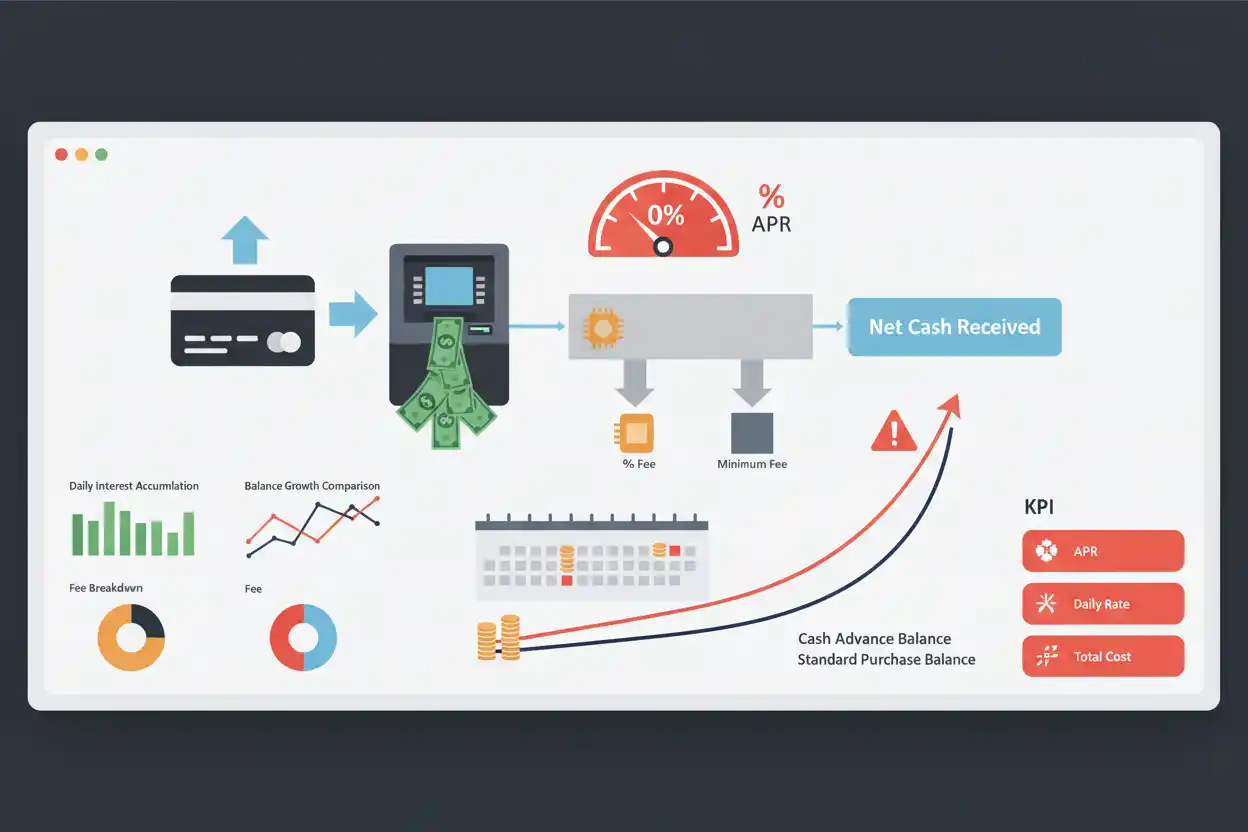

A cash advance fee is a charge that can apply when a credit card is used to obtain cash or complete another transaction treated as a cash advance under the card agreement.
The fee is commonly expressed as a percentage of the transaction, a fixed dollar amount, or the greater of a percentage and a stated minimum.
A typical formula is:
Cash Advance Fee = Greater of (Cash Advance × Fee Rate) or Minimum Fee
For example, suppose a card charges 5% of the advance or $10, whichever is greater.
A $400 cash advance produces:
Percentage Fee = $400 × 5%
Percentage Fee = $20
Because $20 exceeds the $10 minimum:
Cash Advance Fee = $20
The borrower starts with a debt of at least $420 if the fee is added to the card balance, before considering interest or ATM charges.
What Is a Cash Advance Fee?
A cash advance fee is a transaction charge for accessing credit-card funds as cash.
Cash advances can include ATM withdrawals, although other transactions may also be categorized as cash advances depending on the card agreement.
Unlike withdrawing money from a checking account, a credit-card cash advance uses borrowed funds.
As a result, the transaction can involve:
the amount withdrawn, a cash advance fee, a separate cash advance APR, and possibly an ATM operator fee.
Interest on credit-card cash advances also commonly begins immediately rather than receiving the same grace-period treatment that may apply to qualifying purchases.
That combination can make a cash advance significantly more expensive than its headline withdrawal amount suggests.
Cash Advance Fee Formula
If the fee is a simple percentage:
Cash Advance Fee = Advance Amount × Fee Percentage
Suppose:
Advance = $1,000
Fee rate = 5%
Then:
Fee = $1,000 × 5%
Fee = $50
If the card instead charges 5% or $10, whichever is greater:
Cash Advance Fee = MAX(Advance × 5%, $10)
For a $100 advance:
Percentage Fee = $100 × 5% = $5
The minimum fee controls:
Cash Advance Fee = $10
For a $500 advance:
Percentage Fee = $500 × 5% = $25
Now the percentage fee controls:
Cash Advance Fee = $25
Why Minimum Fees Matter
Minimum fees make small cash advances especially expensive as a percentage of the amount borrowed.
Consider a $50 cash advance with a $10 minimum fee.
Immediate Fee Rate = $10 ÷ $50 × 100
Immediate Fee Rate = 20%
The borrower has incurred a fee equal to 20% of the cash received before interest is considered.
Now compare a $1,000 advance with a $50 percentage fee:
Immediate Fee Rate = $50 ÷ $1,000 × 100
Immediate Fee Rate = 5%
The same fee structure can therefore be disproportionately expensive on small advances.
Cash Advance Fee Example
Suppose:
Cash received = $800
Cash advance fee = greater of 5% or $10
Cash advance APR = 29% for illustration
First calculate the fee:
Fee = $800 × 5%
Fee = $40
Assuming the fee is added to the balance:
Starting Cash Advance Balance = $800 + $40
Starting Balance = $840
The borrower receives $800 but immediately owes $840 before additional interest.
Daily Cash Advance Interest
If the card uses a 365-day basis, an approximate daily periodic rate for a 29% APR is:
Daily Rate = 29% ÷ 365
Daily Rate ≈ 0.07945%
On an $840 balance, approximate first-day interest is:
Daily Interest ≈ $840 × 0.0007945
Daily Interest ≈ $0.67
If interest is added to the daily balance, the next day’s interest can be calculated from a slightly larger balance.
Actual card calculations depend on the issuer’s agreement, day-count convention, transaction timing, payment allocation, and balance method.
Cash Advance Fee vs Cash Advance APR
The credit card APR applicable to a cash advance is a rate.
The cash advance fee is a transaction charge.
They are separate costs.
A card might therefore have:
Cash advance fee = 5%
Cash advance APR = 29%
Both can apply to the same transaction.
A fee should not be divided by 12 or treated as the interest rate.
Likewise, the APR should not be mistaken for the one-time transaction fee.
Cash Advance Fee vs Purchase APR
A credit card can apply different APRs to different balance categories.
For example, a card may have one rate for purchases and a higher rate for cash advances.
Therefore, looking only at the purchase APR can understate the cost of accessing cash.
The exact rates appear in the card’s disclosures and agreement.
Cash Advance Fee and Grace Period
A credit card grace period can allow qualifying purchase balances to avoid interest when required conditions are met.
Cash advances usually receive different treatment.
Interest commonly begins from the cash-advance transaction date.
This makes cash advances structurally more expensive than purchases even before considering the transaction fee.
Cash Advance Fee vs Balance Transfer Fee
A balance transfer fee applies when debt is moved from one credit account to another.
A cash advance fee applies when credit is accessed as cash.
Both are commonly expressed as percentages with possible minimum fees, but the underlying transactions differ.
A balance transfer can also carry a promotional APR.
Cash advances commonly use a separate cash advance APR without a purchase-style grace period.
Cash Advance Fee and APR
The general APR framework annualizes borrowing cost.
A cash advance fee is not itself an APR.
Suppose someone borrows $100 and pays a $10 cash advance fee.
The immediate fee equals 10% of the cash received.
That does not mean the credit-card APR is 10%.
Interest is calculated separately according to the account terms.
Cash Advances and Compound Interest
A compound interest loan charges interest on a balance that can include previously added interest.
Some credit cards use a daily periodic rate, adding each day’s interest to the balance used for subsequent calculations.
This is one reason cash-advance debt can become expensive quickly when it remains unpaid.
Cash Advance Fee and Car Payments
Car payments are normally structured installment payments.
A cash advance is revolving credit.
Using a cash advance to cover a car payment may solve an immediate cash shortage but replace one obligation with relatively expensive revolving debt.
The borrower should therefore compare the full cost rather than viewing the cash advance as simply another source of cash.
Cash Advance Fee and Business Loan Payments
Business loan payments are ordinarily based on commercial financing terms.
A cash advance from a credit card uses a different fee and interest structure.
A business facing a temporary cash shortage should not assume credit-card cash advances are economically equivalent to term financing simply because both provide liquidity.
Cash Advance Fee and Business Loan APR
Business loan APR focuses on annualized commercial borrowing cost.
The comparison illustrates why fees matter.
A loan can have an origination fee.
A credit-card cash advance can have a cash advance fee.
In both cases, the amount of financing received and the amount ultimately repaid need to be compared.
Credit Card Minimum Payments
A credit card minimum payment may be much smaller than the amount required to eliminate a cash-advance balance quickly.
Paying only the minimum can leave the higher-cost balance outstanding for an extended period.
The minimum is therefore a contractual payment floor, not necessarily an efficient repayment strategy.
Credit Card Payoff
A deliberate credit card payoff plan can reduce the time a cash-advance balance remains exposed to high interest.
The sooner principal is eliminated, the fewer days remain for additional interest to accrue.
However, payment-allocation rules can matter when a card contains balances at multiple APRs.
Review the account terms rather than assuming every dollar is applied exactly where expected.
Credit Limit and Cash Advance Limit
A card’s general credit limit may be higher than the amount available for cash advances.
Some issuers maintain a separate cash-advance limit.
Therefore, having $5,000 of total available credit does not necessarily mean $5,000 can be withdrawn as cash.
Credit Utilization
A cash advance increases the revolving balance and can therefore affect the credit utilization ratio.
For example, if total revolving balances rise while credit limits remain unchanged, utilization increases.
Credit scoring is broader than one ratio, so the credit score factors page owns the larger scoring intent.
Cash Advance vs Debt Consolidation
Using a high-cost cash advance to pay another debt is generally not the same as structured debt consolidation.
A consolidation strategy attempts to improve the debt structure through lower rates, simpler payments, or a defined payoff schedule.
A cash advance can instead increase borrowing cost unless it solves a specific short-term need and is repaid rapidly.
Debt Payoff Strategy
A debt payoff strategy should generally identify expensive balances explicitly.
A cash advance carrying both an upfront fee and high APR can become one of the most costly balances in a portfolio.
That can affect payoff prioritization.
How to Estimate the Short-Term Cost of a Cash Advance
A simplified estimate is:
Estimated Cash Advance Cost = Fee + Interest Accrued + Other Transaction Charges
Suppose:
Advance = $800
Fee = $40
Approximate interest over the holding period = $17
ATM fee = $4
Then:
Estimated Cost = $40 + $17 + $4
Estimated Cost = $61
The borrower receives $800 but incurs approximately $61 of financing-related cost in this simplified example.
The actual amount depends on card terms and repayment timing.
When Does a Cash Advance Become Especially Expensive?
Cash advances become particularly costly when several factors combine:
a high percentage fee, a minimum fee on a small transaction, a high cash-advance APR, immediate interest accrual, ATM charges, and slow repayment.
The fee alone can make a small advance expensive.
The longer the balance remains unpaid, the more important the interest cost becomes.
Common Cash Advance Fee Mistakes
A common mistake is looking only at the percentage fee and ignoring the minimum charge.
Another is assuming the purchase APR also applies to cash advances.
Borrowers also sometimes expect a normal purchase grace period.
A fourth mistake is withdrawing a small amount without realizing the minimum fee creates a very high immediate percentage cost.
Finally, comparing a cash advance with a personal or business loan solely by speed can overlook a large cost difference.
Frequently Asked Questions
What is a cash advance fee?
It is a charge for obtaining cash or completing another transaction classified as a cash advance under a credit-card agreement.
How is a cash advance fee calculated?
A common structure is:
Cash Advance Fee = Greater of (Advance × Fee Rate) or Minimum Fee
What is a 5% fee on a $500 cash advance?
Fee = $500 × 5% = $25
What if the minimum fee is higher?
The minimum controls when it exceeds the percentage calculation.
Does a cash advance also charge interest?
Usually, yes. The cash advance can have a separate APR in addition to the transaction fee.
When does cash advance interest start?
For many credit cards, it begins from the transaction date rather than after a purchase-style grace period.
Is cash advance APR the same as purchase APR?
Not necessarily. A card can apply a different APR to cash advances.
Can an ATM charge another fee?
Yes. An ATM operator charge can exist in addition to the card issuer’s cash advance fee.
Is a cash advance the same as a balance transfer?
No. A cash advance provides cash from a credit line, while a balance transfer moves debt between accounts.
Does a cash advance affect credit utilization?
It can, because it increases the revolving balance.
Are small cash advances cheap?
Not necessarily. A minimum fee can make a small withdrawal extremely expensive as a percentage of the amount received.
How can cash advance cost be reduced?
If the advance is unavoidable, review the fee and APR before transacting and repay the balance as quickly as practical under the account terms.
Final Takeaway
A cash advance fee is commonly calculated as:
Cash Advance Fee = Greater of (Advance Amount × Fee Rate) or Minimum Fee
For a $400 cash advance with a 5% fee and $10 minimum, the fee is $20.
But the fee is only the beginning.
Cash advances can also carry a separate APR, begin accruing interest immediately, and involve ATM charges. A small withdrawal can be particularly expensive when a minimum fee applies.
The useful comparison is therefore not simply cash received vs fee. It is cash received vs the complete amount required to eliminate the advance.