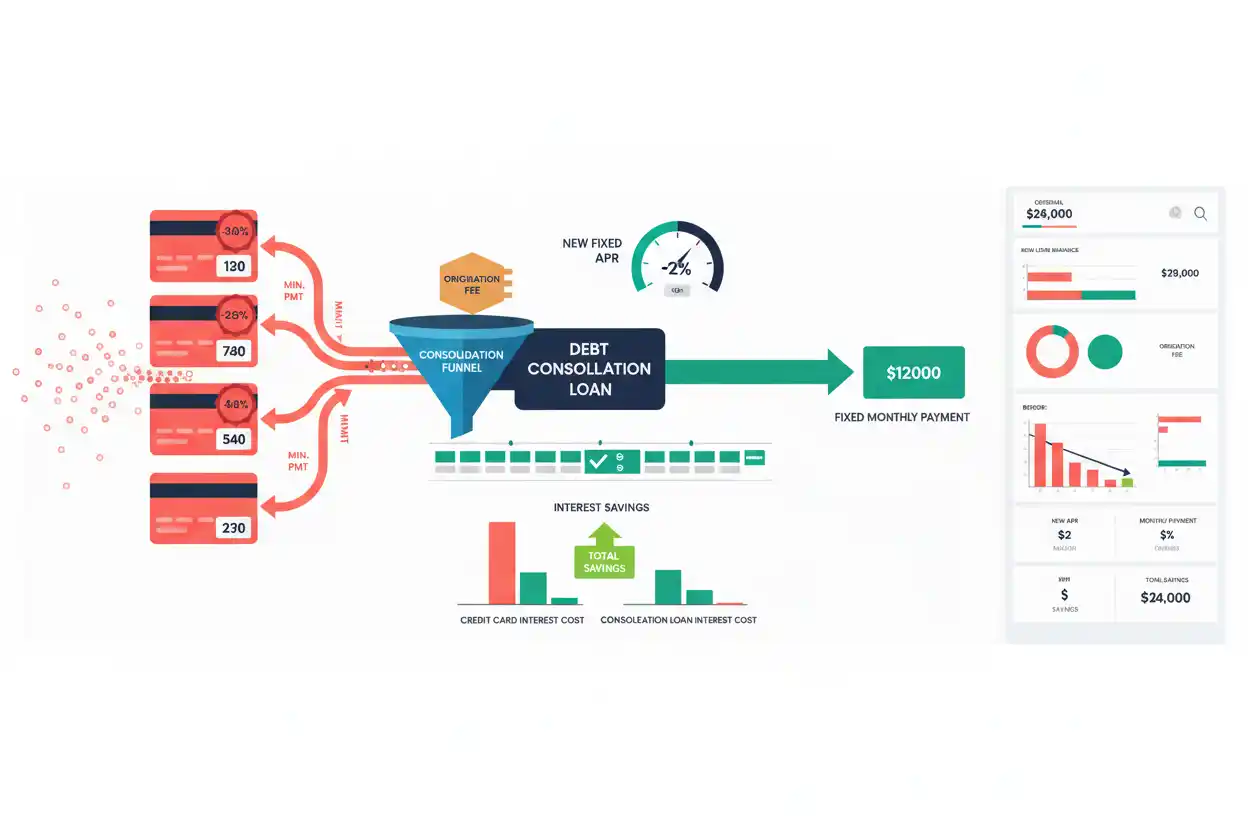

A debt consolidation loan is a new loan used to repay multiple existing debts, replacing several balances and payment schedules with one installment loan.
The appeal is straightforward: if the new loan offers a sufficiently lower borrowing cost and a sensible repayment term, consolidation can simplify monthly payments and reduce total interest.
However, one payment is not automatically cheaper than several payments.
A consolidation loan can become more expensive when it includes a large origination fee, carries only a slightly lower interest rate, or stretches repayment across many additional years.
The correct comparison therefore examines the entire transaction:
Consolidation Benefit = Cost of Existing Repayment Plan − Cost of New Consolidation Loan
The broader debt consolidation topic covers consolidation as a strategy. This page focuses specifically on the debt consolidation loan itself: its payment, cost, fees, term, and savings.
What Is a Debt Consolidation Loan?
A debt consolidation loan is generally an installment loan whose proceeds are used to pay off two or more existing obligations.
For example, a borrower might consolidate:
- three credit-card balances,
- two personal loans,
- or a mixture of eligible unsecured debts.
After consolidation, instead of making several separate payments, the borrower makes the scheduled payment on the new loan.
The debt has not disappeared.
It has changed structure.
If $25,000 of existing debt is replaced with a $25,000 consolidation loan, the borrower still owes approximately $25,000 before considering fees.
Debt Consolidation Loan Payment Formula
For a standard fixed-rate amortizing consolidation loan:
Monthly Payment = P × [r(1 + r)^n] ÷ [(1 + r)^n − 1]
Where:
P = principal financed
r = monthly interest rate
n = number of monthly payments
The monthly rate is:
Monthly Interest Rate = Annual Interest Rate ÷ 12
The number of payments is:
Number of Payments = Loan Term in Years × 12
This is the same core mathematics used by many loan payments calculations.
Debt Consolidation Loan Example
Suppose a borrower has:
Credit Card A: $6,000 at 28%
Credit Card B: $8,000 at 24%
Credit Card C: $6,000 at 20%
Total debt:
Total Existing Debt = $6,000 + $8,000 + $6,000
Total Existing Debt = $20,000
A lender offers:
Consolidation loan = $20,000
Interest rate = 13%
Term = 48 months
Origination fee = 2%, paid separately for the first example
Step 1: Calculate the Monthly Rate
Monthly Rate = 13% ÷ 12
Monthly Rate ≈ 1.08333%
As a decimal:
r = 0.0108333
Step 2: Calculate the Number of Payments
n = 48
Step 3: Calculate the Loan Payment
Payment = $20,000 × [0.0108333(1.0108333)^48] ÷ [(1.0108333)^48 − 1]
The approximate monthly payment is:
Debt Consolidation Loan Payment ≈ $536.55
Step 4: Calculate Total Scheduled Payments
Using full precision:
Total Payments ≈ $536.55 × 48
Total Payments ≈ $25,754
Step 5: Calculate Loan Interest
Total Interest ≈ $25,754 − $20,000
Total Interest ≈ $5,754
The new loan therefore costs roughly $5,754 in interest before considering the origination fee.
Add the Origination Fee
If the loan charges a 2% loan origination fee:
Origination Fee = $20,000 × 2%
Origination Fee = $400
If the fee is paid separately:
Approximate Financing Cost = $5,754 + $400
Approximate Financing Cost = $6,154
If the fee is instead financed into the loan, the principal becomes larger and the payment must be recalculated.
If the Origination Fee Is Financed
Suppose the $400 fee is added to principal.
New Principal = $20,000 + $400
New Principal = $20,400
The payment formula now uses $20,400 instead of $20,000.
Because the borrower is financing the fee, interest is also charged on that additional principal.
This is why “no cash needed upfront” does not necessarily mean the fee has disappeared.
Debt Consolidation Loan Savings Formula
A useful comparison is:
Estimated Savings = Remaining Cost of Existing Debts − Total Cost of Consolidation
Suppose the borrower estimates that continuing the existing repayment strategy would generate $10,000 of additional interest.
The consolidation loan costs approximately:
Interest = $5,754
Fee = $400
Then:
Consolidation Cost = $5,754 + $400
Consolidation Cost = $6,154
Estimated savings:
Savings = $10,000 − $6,154
Savings = $3,846
Under those assumptions, consolidation saves approximately $3,846.
The comparison must use the same realistic repayment horizon on both sides.
Lower Payment vs Lower Cost
One of the biggest consolidation mistakes is focusing on payment alone.
Suppose the existing debts require $700 per month.
A lender offers a consolidation payment of $420.
The $280 monthly reduction looks attractive.
But imagine the $700 plan would eliminate the original debt in three years while the $420 loan lasts six years.
The lower payment may create substantially more total interest.
Always calculate:
Total Scheduled Payments = Payment × Number of Payments
and then compare the resulting financing cost.
Debt Consolidation Loan vs Debt Payoff Strategy
A debt payoff strategy determines how existing debts will be prioritized and eliminated.
A consolidation loan changes the debts themselves.
For example, a borrower could use the debt avalanche and pay the highest-interest credit card first without taking a new loan.
Alternatively, the borrower could consolidate all three cards into one lower-rate installment loan.
The cheaper option depends on rates, fees, repayment term, and payment capacity.
Debt Consolidation Loan vs Debt Snowball
The debt snowball prioritizes the smallest balance.
A consolidation loan removes that multi-balance structure if all targeted debts are paid off.
Instead of choosing which card receives extra cash, the borrower makes one loan payment.
That simplicity can be helpful, but it can also remove the motivational milestones that come from paying individual balances to zero.
Debt Consolidation Loan vs Balance Transfer
A balance transfer fee can accompany a promotional credit-card balance transfer.
Suppose a borrower can choose between:
a 13% consolidation loan for four years, or a 0% balance transfer for 18 months with a 3% fee.
The balance transfer can be significantly cheaper if the borrower can eliminate the debt within the promotional period.
The installment loan may be more manageable if the borrower needs a longer structured repayment period.
The correct option depends on cash flow, not just headline APR.
Debt Consolidation Loan and APR
The loan’s contractual rate may differ from its APR.
For example:
Interest rate = 13%
APR = 14.2%
The difference may reflect applicable financing charges.
APR can therefore provide a more complete cost comparison than the rate alone when comparing similar loan offers.
Debt Consolidation and Daily Simple Interest
Some consolidation loans use daily simple interest.
If so:
Daily Interest = Outstanding Principal × Annual Rate ÷ Day-Count Basis
Paying principal earlier can reduce future interest.
Payment timing can also matter because additional elapsed days create additional interest.
Consolidation Loan Amortization
A standard consolidation loan is usually an amortizing loan.
Each payment generally includes:
interest plus principal repayment.
Early payments tend to contain more interest because the principal balance is larger.
As principal declines, more of each fixed payment generally goes toward principal.
A repayment schedule can show this progression month by month.
Debt Service Coverage for Business Consolidation
Businesses considering refinancing or consolidating commercial obligations may need to evaluate the debt service coverage ratio.
A consolidation loan can reduce payment complexity, but the business must still generate enough cash flow to support the new debt service.
The consumer concept of affordability and the business concept of cash-flow coverage are related but not identical.
Debt-to-Income Ratio After Consolidation
For individuals, the debt-to-income ratio compares monthly debt payments with gross monthly income.
Suppose monthly debt payments fall from $1,800 to $1,500 after consolidation while gross monthly income remains $6,000.
Old DTI:
DTI = $1,800 ÷ $6,000 × 100 = 30%
New DTI:
DTI = $1,500 ÷ $6,000 × 100 = 25%
The consolidation improves the monthly payment ratio in this example.
However, the lower payment may have been achieved by extending the loan term.
Credit Utilization After Consolidation
Paying off credit cards with an installment loan can reduce the credit utilization ratio.
Suppose:
Total card balances = $15,000
Total card limits = $20,000
Utilization = $15,000 ÷ $20,000 × 100 = 75%
If a consolidation loan pays those card balances to zero and the limits remain open:
Revolving Utilization = 0%
But the $15,000 debt still exists as an installment loan.
The debt has changed form rather than disappeared.
Credit Score Factors
A consolidation transaction can affect several credit score factors.
Potential changes include:
- a new credit inquiry,
- a newly opened loan,
- lower revolving balances,
- lower credit utilization,
- subsequent repayment history.
Because multiple variables can move simultaneously, there is no universal number of credit-score points gained or lost from consolidating debt.
Consolidation and Credit Limits
If paid-off cards remain open, their credit limits can continue contributing to total available revolving credit.
However, keeping open cards also means borrowing capacity remains available.
For someone who has difficulty controlling revolving spending, that may increase the risk of rebuilding balances.
The mathematically best utilization outcome is not necessarily the behaviorally safest outcome.
The Double-Debt Risk
Consider a borrower who consolidates $20,000 of cards into one loan.
Immediately afterward:
Consolidation loan = $20,000
Credit-card balances = $0
Six months later, the borrower has added another $7,000 to those cards.
Total debt is now approximately:
Total Debt ≈ Remaining Consolidation Loan + $7,000
The borrower can end up owing more than before consolidation.
This is one of the most important risks of consolidation.
Secured vs Unsecured Consolidation Loans
An unsecured loan does not rely on pledged collateral in the same way as secured financing.
A secured loan uses collateral.
Using secured debt to repay unsecured credit cards can sometimes reduce the interest rate.
However, it changes the consequences of default because an important asset can become exposed to lender remedies under the agreement.
A lower rate should therefore not be evaluated independently of collateral risk.
Fixed vs Variable Consolidation Loan
A fixed vs variable interest rate comparison matters when selecting a consolidation loan.
A fixed rate generally creates more predictable scheduled payments.
A variable rate can rise or fall according to the contract.
If the objective of consolidation is payment stability, variable-rate risk deserves careful consideration.
Consolidation and Prepayment
A borrower planning to repay aggressively should check for a prepayment penalty.
Suppose the consolidation loan is scheduled for 60 months but the borrower expects to repay it in 24.
A large prepayment charge can reduce the value of choosing that financing.
Loan Payoff Quote
The amount required to settle a loan today may differ from the displayed principal.
A loan payoff quote can include accrued interest through the payoff date and other contractual amounts.
This matters if an existing personal loan is being consolidated.
Use the current payoff amount—not an old statement balance—when determining how much new financing is required.
When a Debt Consolidation Loan Can Make Sense
A debt consolidation loan becomes more attractive when:
the new borrowing cost is materially lower, fees are reasonable, the repayment term is sensible, the monthly payment is sustainable, and the borrower stops creating new debt.
A consolidation that improves all five variables can substantially strengthen the repayment plan.
When Consolidation Can Cost More
A consolidation can increase total cost when:
- the new rate is not much lower,
- the origination fee is large,
- the term becomes much longer,
- a prepayment penalty applies,
- or new credit-card debt is accumulated afterward.
The existence of one payment instead of several does not compensate for poor loan economics.
Frequently Asked Questions
What is a debt consolidation loan?
It is a new loan used to repay multiple existing debts so the borrower can make one scheduled loan payment.
Does a consolidation loan eliminate debt?
No. It restructures debt. The new loan must still be repaid.
How is a debt consolidation loan payment calculated?
For a conventional fixed-rate loan:
Payment = P × [r(1 + r)^n] ÷ [(1 + r)^n − 1]
Is debt consolidation always cheaper?
No. Fees, interest rate, term, and repayment behavior determine whether it actually saves money.
Does a longer consolidation term lower the payment?
Usually, but it can increase total interest.
Should I compare the loan rate or APR?
Both are useful. APR can capture applicable borrowing costs beyond the contractual interest rate.
Can consolidation lower credit-card utilization?
Yes, when revolving balances are paid off with an installment loan, although the total debt still exists.
Is consolidation better than the debt avalanche?
It depends on the new financing terms. Avalanche keeps existing debts and targets the highest rate, while consolidation replaces the obligations.
Can I consolidate a personal loan and credit cards?
Potentially, if the new lender permits the debts and the borrower qualifies.
Should I close cards after consolidating them?
There is no universal answer. Consider annual fees, utilization, account history, and the risk of rebuilding debt.
What is the biggest risk of a consolidation loan?
One major risk is accumulating new revolving debt after the old balances are paid off.
How do I know if consolidation saves money?
Compare the realistic remaining interest and fees of the current repayment plan with the total interest, fees, and term of the proposed consolidation loan.
Final Takeaway
A debt consolidation loan can replace several expensive or difficult-to-manage debts with one structured payment.
For a standard loan:
Monthly Payment = P × [r(1 + r)^n] ÷ [(1 + r)^n − 1]
In the worked example, consolidating $20,000 at 13% for 48 months produces a monthly payment of approximately $536.55 and about $5,754 of interest before fees.
A 2% origination fee adds another $400 if paid separately.
The right question is therefore not merely whether consolidation produces one lower monthly payment. It is whether the new loan creates a lower total financing cost, sustainable repayment schedule, and realistic path to zero debt without rebuilding the balances that were just consolidated.