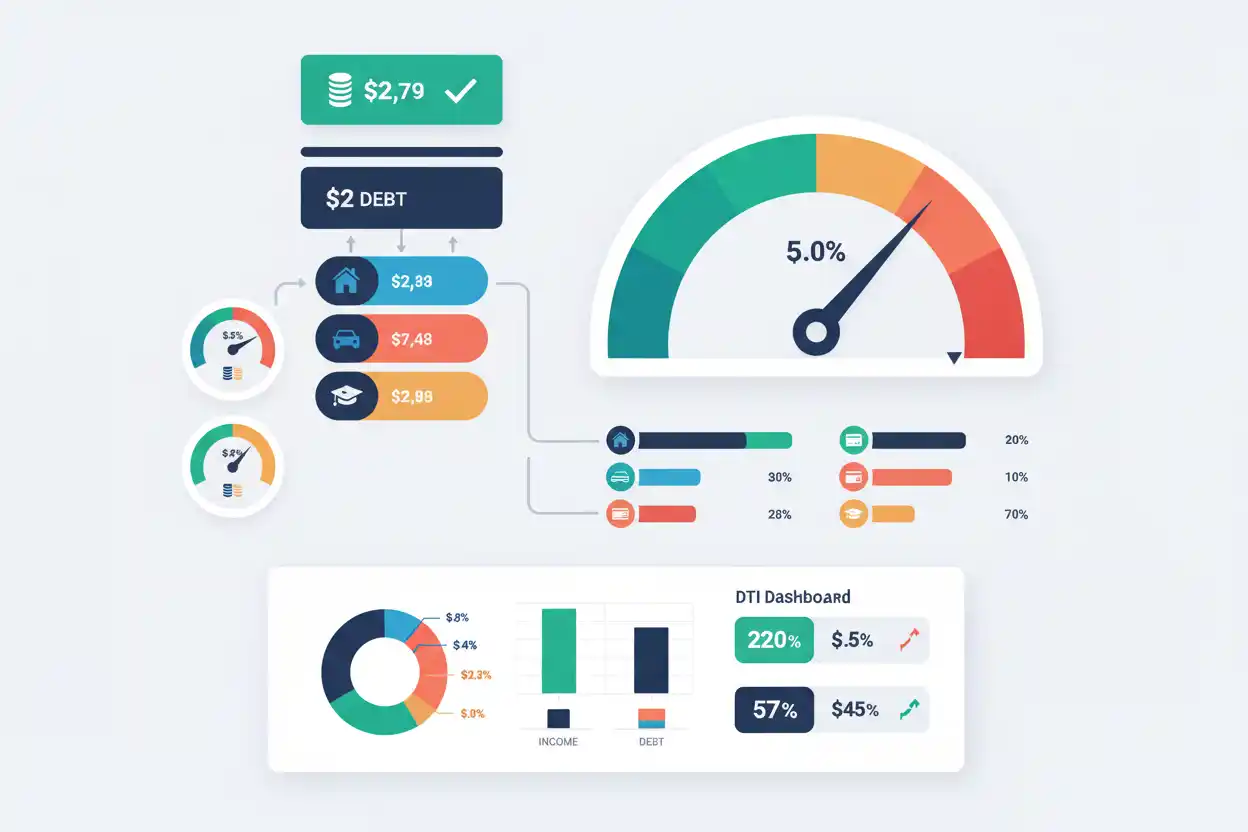
The debt-to-income ratio, or DTI, compares monthly debt payments with gross monthly income.
The standard formula is:
Debt-to-Income Ratio = Total Monthly Debt Payments ÷ Gross Monthly Income × 100
If your monthly debt payments total $2,000 and your gross monthly income is $6,000:
DTI = $2,000 ÷ $6,000 × 100
DTI = 33.3%
That means approximately one-third of gross monthly income is represented by the debt payments included in the calculation.
Lenders can use DTI as one measure of repayment capacity, although exact calculations, acceptable levels, and included obligations vary by lender and loan product.
What Is Debt-to-Income Ratio?
Debt-to-income ratio measures the relationship between recurring debt payments and gross income.
It answers:
How large are the borrower’s monthly debt obligations relative to income before taxes and other payroll deductions?
The formula is:
DTI = Monthly Debt Payments ÷ Gross Monthly Income × 100
A higher DTI indicates that a larger portion of gross income is already committed to debt payments.
A lower DTI indicates that less gross income is committed to those obligations.
Debt-to-Income Ratio Example
Suppose someone has:
Mortgage payment = $1,400
Auto loan payment = $450
Student loan payment = $250
Credit-card required payments = $200
Total monthly debt:
Monthly Debt Payments = $1,400 + $450 + $250 + $200
Monthly Debt Payments = $2,300
Gross monthly income:
Gross Income = $7,000
Then:
DTI = $2,300 ÷ $7,000 × 100
DTI ≈ 32.9%
The borrower’s back-end DTI is approximately 32.9% under these assumptions.
Gross Income vs Net Income
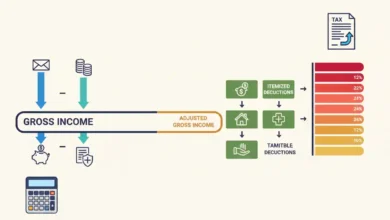
DTI normally uses gross income, not take-home pay.
Gross income is income before applicable taxes and payroll deductions.
Suppose:
Gross monthly income = $6,000
Take-home income = $4,600
Monthly debt payments = $1,800
Using gross income:
DTI = $1,800 ÷ $6,000 × 100
DTI = 30%
Using take-home income would produce:
$1,800 ÷ $4,600 × 100 ≈ 39.1%
That may be useful for personal budgeting, but it is not the same DTI calculation.
What Debt Payments Are Included?
The exact treatment depends on the lender and loan product.
Recurring obligations can include items such as:
housing debt, auto loans, student loans, personal loans, required credit-card payments, and other qualifying obligations.
Every ordinary monthly living expense is not necessarily counted as debt.
For example, groceries and utility bills are real household expenses but are not typically treated as debt payments in the basic DTI formula.
That is one reason a lender-approved DTI does not prove that a payment is comfortable within a household budget.
Front-End DTI
In mortgage analysis, a front-end or housing ratio can compare housing-related obligations with gross monthly income.
A simplified formula is:
Front-End DTI = Monthly Housing Expense ÷ Gross Monthly Income × 100
Suppose:
Housing payment = $1,800
Gross monthly income = $7,500
Then:
Front-End DTI = $1,800 ÷ $7,500 × 100
Front-End DTI = 24%
The exact housing components included depend on the underwriting context.
Back-End DTI
Back-end DTI includes broader monthly debt obligations.
Back-End DTI = Total Qualifying Monthly Debt Payments ÷ Gross Monthly Income × 100
Suppose:
Housing = $1,800
Auto loan = $500
Student loan = $300
Credit cards = $150
Total debt:
$1,800 + $500 + $300 + $150 = $2,750
Gross income = $7,500
Back-End DTI = $2,750 ÷ $7,500 × 100
Back-End DTI ≈ 36.7%
DTI Is Not a Universal Approval Rule
A common mistake is searching for one “maximum DTI” that applies to every loan.
Different:
lenders, mortgage programs, loan products, underwriting systems, borrower profiles, and compensating factors can produce different requirements.
A ratio that qualifies for one product may not qualify for another.
DTI should therefore be interpreted as a measurement—not a universal pass/fail threshold.
Debt Snowball and DTI
A debt snowball can eventually reduce required monthly debt payments as accounts are eliminated.
Suppose DTI includes a $200 card payment.
Once that debt reaches zero and the account no longer requires the $200 payment, qualifying monthly debt obligations can decline by $200.
If gross income remains unchanged, DTI falls.
Debt Payoff Strategy and DTI
A debt payoff strategy can therefore improve DTI over time by eliminating payment obligations.
However, making a large extra principal payment does not always immediately lower contractual monthly payments.
For example, paying an extra $5,000 toward a fixed-payment installment loan may shorten the term without changing the required monthly payment.
In that case, DTI may remain unchanged until the loan is fully repaid or formally recast.
Debt Consolidation Loan and DTI
A debt consolidation loan can change DTI if it changes required monthly payments.
Suppose:
Old combined debt payments = $1,000
New consolidation payment = $700
Gross monthly income = $5,000
Old ratio contribution:
$1,000 ÷ $5,000 × 100 = 20%
New contribution:
$700 ÷ $5,000 × 100 = 14%
Monthly DTI improves by six percentage points.
But the lower payment may be produced by a longer repayment term, so total interest must still be evaluated.
Debt Service Coverage Ratio vs DTI
The debt service coverage ratio serves a similar conceptual purpose in a different context.
DTI asks:
Debt Payments ÷ Gross Income
DSCR asks:
Available Cash Flow ÷ Debt Service
Interpretation runs in opposite directions.
Lower DTI generally means less household debt burden.
Higher DSCR generally means stronger business or property debt coverage.
EMI and DTI
An EMI or other fixed installment payment can contribute directly to monthly debt obligations.
Suppose:
EMI = $600
Other debt payments = $1,200
Gross income = $6,000
Then:
DTI = ($600 + $1,200) ÷ $6,000 × 100
DTI = 30%
Lowering the EMI can reduce DTI if the lender recognizes the lower required payment.
Fixed vs Variable Interest Rates and DTI
A fixed vs variable interest rate structure can affect future DTI.
With a fixed payment, debt obligations are more predictable.
With a variable loan, monthly payments can increase after rate changes.
Suppose:
Old variable payment = $500
New payment after rate adjustment = $650
Gross income = $5,000
DTI increases by:
($650 − $500) ÷ $5,000 × 100
3 Percentage Points
even though the borrower took on no new debt.
Credit Card Minimum Payments and DTI
The required credit card minimum payment can be used as a monthly debt obligation according to the lender’s methodology.
Suppose:
Card minimum = $200
Paying the card balance down substantially might reduce future minimum payments.
That can improve DTI.
However, underwriting rules can specify how card obligations are calculated, so consumers should not assume one formula applies to every lender.
Credit Card Payoff and DTI
A complete credit card payoff removes the revolving balance and its required payment, subject to reporting and lender treatment.
This can reduce DTI more directly than merely making an extra payment while retaining a substantial balance.
Credit Limit vs DTI
A credit limit is not itself a debt payment.
Suppose:
Credit limit = $20,000
Balance = $0
The existence of the unused $20,000 limit does not mean $20,000 enters the DTI numerator.
DTI focuses on qualifying monthly obligations.
This is different from credit utilization, which directly uses revolving credit limits.
Credit Score vs DTI
The credit score factors framework and DTI are separate.
A credit score is generated from credit-report information using a scoring model.
DTI compares monthly debts with income.
A person can have:
a strong credit score but high DTI, or a lower credit score but relatively low DTI.
Lenders can consider both.
Car Payments and DTI
A car payment is a common monthly debt obligation.
Suppose:
Gross monthly income = $6,500
Existing debt payments = $1,500
Proposed car payment = $650
Current DTI:
$1,500 ÷ $6,500 × 100 ≈ 23.1%
After proposed car financing:
New DTI = ($1,500 + $650) ÷ $6,500 × 100
New DTI ≈ 33.1%
The new vehicle payment raises DTI by approximately 10 percentage points.
Auto Loan Payments and DTI
The auto loan payments calculation determines the monthly vehicle obligation.
Longer financing can reduce the payment and therefore reduce its immediate DTI impact.
However, extending the term can increase total interest.
Optimizing only for DTI can therefore produce a more expensive loan.
Business Loan Payments and Personal DTI
Business loan payments require more nuanced treatment.
Whether a business obligation appears in a personal borrower’s DTI can depend on ownership, liability, payment history, underwriting rules, and how the debt is reflected.
Do not automatically include or exclude a business loan without applying the relevant lender methodology.
Loan Term and DTI
A longer loan term commonly lowers monthly payment.
That can lower DTI.
Suppose:
48-month loan payment = $700
72-month loan payment = $500
Gross income = $5,000
DTI contribution:
48-month option:
$700 ÷ $5,000 × 100 = 14%
72-month option:
$500 ÷ $5,000 × 100 = 10%
The longer term improves the monthly ratio but can increase total interest.
DTI vs Loan-to-Income Ratio
The loan-to-income ratio compares a debt amount with income.
DTI instead compares monthly payments with monthly income.
Consider:
Loan amount = $30,000
Annual income = $60,000
Loan-to-income:
$30,000 ÷ $60,000 = 50%
If the monthly loan payment is $600 and gross monthly income is $5,000:
DTI Contribution = $600 ÷ $5,000 × 100 = 12%
The ratios answer different questions.
How to Lower DTI
DTI decreases when:
monthly qualifying debt payments fall, gross qualifying income rises, or both.
The basic relationship is:
Lower DTI = Lower Debt Payments and/or Higher Gross Income
Possible routes include:
paying off obligations, refinancing into lower required payments when economically sensible, avoiding unnecessary new debt, or increasing sustainable income.
The method should improve overall finances rather than merely manipulate one ratio.
Income Increase Example
Suppose:
Monthly debt payments = $2,000
Gross income = $5,000
DTI = 40%
If income increases to $6,000 while debt payments stay unchanged:
New DTI = $2,000 ÷ $6,000 × 100
New DTI ≈ 33.3%
The ratio improves even though no debt was repaid.
Debt Reduction Example
Suppose:
Gross income = $6,000
Debt payments = $2,400
DTI = 40%
A loan with a $600 required payment is fully repaid.
New monthly debt:
$2,400 − $600 = $1,800
New DTI:
$1,800 ÷ $6,000 × 100
DTI = 30%
Eliminating the obligation reduces DTI by 10 percentage points.
DTI Limitations
DTI does not measure every household expense.
Two borrowers can both have 30% DTI but dramatically different financial circumstances.
One may have:
high childcare costs, medical expenses, commuting costs, or unstable income.
Another may have low non-debt expenses and substantial savings.
DTI is therefore a useful underwriting ratio, not a complete household budget.
Common DTI Mistakes
One common mistake is using net income instead of gross income.
Another is including ordinary living expenses in the debt numerator without checking the relevant definition.
A third is assuming one DTI threshold applies to every lender.
Borrowers also sometimes focus on lowering the monthly payment through a longer loan without checking total interest.
Finally, DTI should not be confused with credit utilization, credit score, or debt service coverage ratio.
Frequently Asked Questions
What does DTI stand for?
DTI stands for debt-to-income ratio.
What is the debt-to-income ratio formula?
DTI = Total Monthly Debt Payments ÷ Gross Monthly Income × 100
What is a 30% DTI?
It means qualifying monthly debt payments equal 30% of gross monthly income.
Should I use gross or net income?
Standard DTI calculations generally use gross income, although lender definitions control.
What debts count toward DTI?
Qualifying recurring debts can include housing, auto, student, personal-loan, and revolving-credit obligations, depending on lender methodology.
Are groceries included in DTI?
Ordinary living expenses generally are not included as debt payments in the standard DTI formula.
What is front-end DTI?
It compares qualifying monthly housing expense with gross monthly income.
What is back-end DTI?
It compares broader monthly debt obligations, including housing and other qualifying debts, with gross income.
Is there one maximum DTI for all loans?
No. Requirements vary by lender and loan program.
Does paying off a credit card lower DTI?
It can when the repayment eliminates or reduces the monthly obligation recognized by the lender.
Does increasing income lower DTI?
Yes, when qualifying gross income rises while debt payments remain unchanged.
Is DTI the same as credit utilization?
No. DTI compares debt payments with income. Utilization compares revolving balances with credit limits.
Final Takeaway
The debt-to-income ratio measures monthly debt payments relative to gross monthly income.
The formula is:
Debt-to-Income Ratio = Total Monthly Debt Payments ÷ Gross Monthly Income × 100
If monthly debt obligations total $2,300 and gross monthly income is $7,000:
DTI = $2,300 ÷ $7,000 × 100 ≈ 32.9%
The ratio helps show how much of a borrower’s gross income is already committed to debt payments.
However, DTI is not a complete affordability test and there is no universal acceptable percentage for every loan.
Use it alongside actual household cash flow, loan terms, interest cost, credit profile, and the specific underwriting rules that apply to the financing being considered.