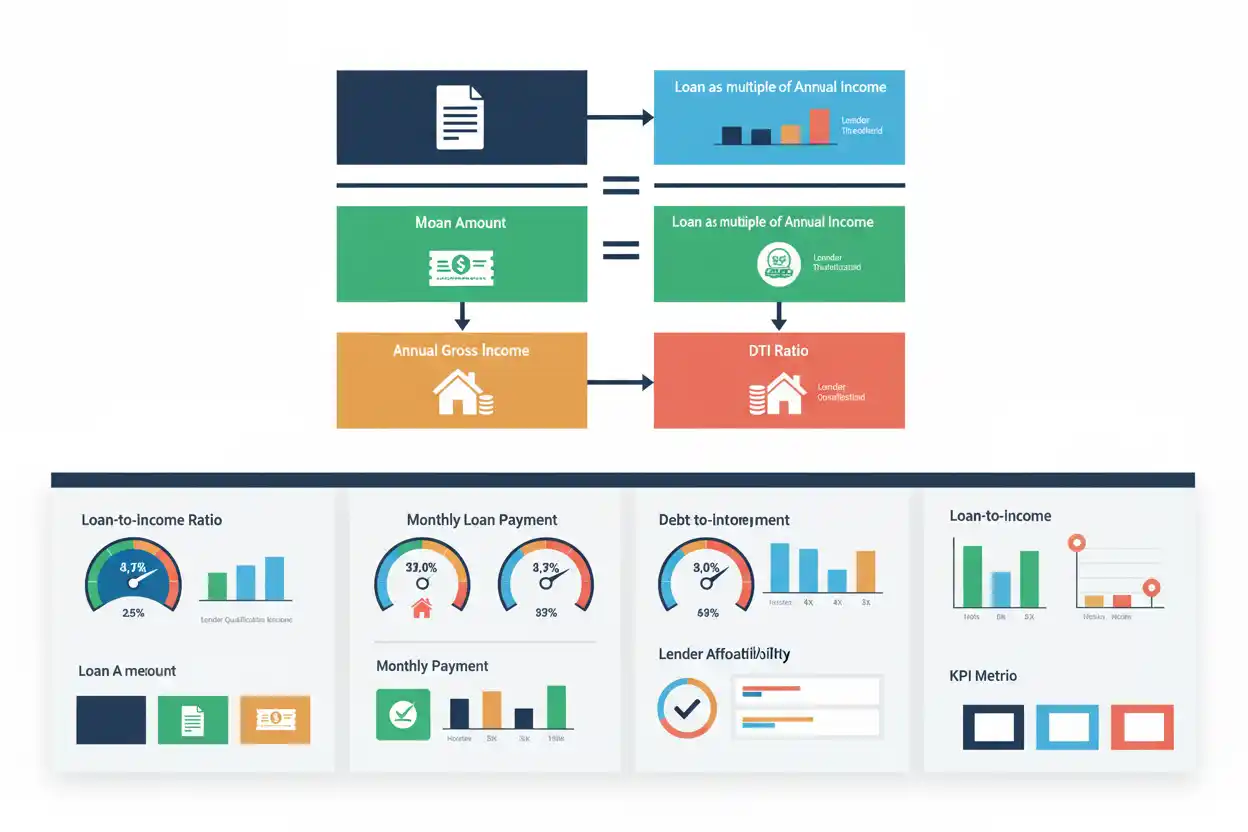

The loan-to-income ratio compares the amount of a loan with a borrower’s income.
A simple formula is:
Loan-To-Income Ratio = Loan Amount ÷ Gross Annual Income × 100
If someone borrows $40,000 and earns $80,000 in gross annual income:
Loan-To-Income Ratio = $40,000 ÷ $80,000 × 100
Loan-To-Income Ratio = 50%
The same relationship can be expressed as an income multiple:
Loan-to-Income Multiple = Loan Amount ÷ Gross Annual Income
$40,000 ÷ $80,000 = 0.50×
The borrower is therefore taking a loan equal to half of one year’s gross income.
The calculation is useful for comparing debt size with earning capacity, but it is not the same as the debt-to-income ratio, which compares monthly debt payments with monthly income.
That distinction is essential.
What Is the Loan-to-Income Ratio?
The loan-to-income ratio, often shortened to LTI, measures the size of borrowing relative to income.
At its simplest:
LTI = Loan Amount ÷ Annual Income
A larger ratio means the loan represents a larger multiple of the borrower’s annual earnings.
A smaller ratio means the principal is smaller relative to income.
Within the broader Loans & Credit framework, loan-to-income provides one way to evaluate loan size before considering the payment, rate, term, or total borrowing cost.
Loan-to-Income Formula
When expressed as a percentage:
Loan-To-Income Ratio = Loan Principal ÷ Gross Annual Income × 100
When expressed as a multiple:
Loan-To-Income Multiple = Loan Principal ÷ Gross Annual Income
Suppose:
Loan amount = $60,000
Gross annual income = $100,000
Percentage:
LTI = $60,000 ÷ $100,000 × 100
LTI = 60%
Multiple:
LTI Multiple = $60,000 ÷ $100,000
LTI Multiple = 0.60×
Both figures describe the same relationship.
Loan-to-Income Ratio Example
Assume a borrower earns:
Gross monthly income = $7,500
Annualized income is:
Gross Annual Income = $7,500 × 12
Gross Annual Income = $90,000
The borrower wants a $45,000 personal loan.
Then:
Loan-To-Income Ratio = $45,000 ÷ $90,000 × 100
Loan-To-Income Ratio = 50%
The income multiple is:
$45,000 ÷ $90,000 = 0.50×
The requested loan equals half of the borrower’s annual gross income.
Converting Monthly Income to Annual Income
Because loan-to-income commonly compares principal with annual income, monthly income should be converted consistently.
Annual Income = Gross Monthly Income × 12
If monthly gross income is $5,500:
Annual Income = $5,500 × 12
Annual Income = $66,000
A $20,000 loan would then produce:
LTI = $20,000 ÷ $66,000 × 100
LTI ≈ 30.3%
Using monthly income directly against the full loan amount would produce a meaningless comparison because the measurement periods would not match.
Loan-to-Income Ratio vs Debt-to-Income Ratio
Loan-to-income and DTI answer different questions.
Loan-to-income asks:
How large is the loan relative to annual income?
DTI asks:
How large are recurring monthly debt payments relative to monthly income?
The debt-to-income ratio formula is:
DTI = Monthly Debt Payments ÷ Gross Monthly Income × 100
Suppose:
Loan = $40,000
Annual income = $80,000
Monthly loan payment = $850
Other monthly debts = $1,000
Gross monthly income = $6,666.67
LTI:
$40,000 ÷ $80,000 × 100 = 50%
DTI after the loan:
DTI = ($1,000 + $850) ÷ $6,666.67 × 100
DTI ≈ 27.8%
One ratio compares principal with income.
The other compares payments with income.
Why Loan Term Changes DTI but Not Initial LTI
The loan term can dramatically affect monthly payments.
Suppose the same $40,000 loan can be repaid over:
three years or seven years.
The seven-year loan usually has a lower monthly payment.
Therefore, it can create a lower DTI contribution.
However, initial loan-to-income remains:
$40,000 ÷ $80,000 = 50%
because neither the principal nor annual income changed.
This demonstrates why LTI and DTI should be analyzed together rather than substituted for one another.
Loan-to-Income and Loan Payments
The loan payments formula converts principal, rate, and term into a periodic obligation.
A high LTI can sometimes produce a manageable monthly payment when the term is long.
That does not mean the loan is inexpensive.
Extending repayment lowers the payment partly because principal remains outstanding longer.
Loan-to-Income and Interest Rates
Suppose two borrowers both have a 50% LTI.
Borrower A receives an 8% loan.
Borrower B receives a 20% loan.
Their LTI ratios are identical, but borrowing cost and monthly payment differ sharply.
That is why the nominal vs effective interest rate comparison and other rate measures remain important even after the loan-to-income ratio has been calculated.
Loan-to-Income and Personal Loan APR
The personal loan APR measures annualized borrowing cost.
LTI measures loan size relative to income.
Suppose:
Loan amount = $20,000
Annual income = $80,000
LTI = 25%
That 25% ratio is unchanged whether the personal loan APR is 8% or 24%.
APR changes the cost.
LTI does not.
Loan-to-Income and Credit Profile
A lender can consider many factors beyond the ratio.
The credit score factors framework can include repayment history, revolving balances, account history, and recent credit activity.
Income, existing obligations, collateral, loan purpose, and lender underwriting standards can also matter separately.
A favorable LTI therefore does not guarantee approval.
LTI Does Not Measure Existing Debt
Suppose two borrowers both earn $100,000 and request a $25,000 loan.
Both have:
LTI = $25,000 ÷ $100,000 × 100 = 25%
Borrower A has no other debt.
Borrower B already makes $3,500 of monthly debt payments.
Their LTI ratios are identical.
Their repayment capacity is not.
That limitation is why payment-based ratios remain essential.
LTI Does Not Measure Interest Cost
Loan-to-income also ignores the financing rate.
For example:
Loan A = $30,000 at 7%
Loan B = $30,000 at 22%
Income = $75,000
Both produce:
LTI = $30,000 ÷ $75,000 × 100
LTI = 40%
Yet Loan B is much more expensive.
The ratio therefore measures scale, not cost.
LTI Does Not Measure Loan Duration
Consider two $50,000 loans against $100,000 annual income.
Both produce:
LTI = 50%
One is repaid in two years.
The other lasts 10 years.
Their initial LTI is identical despite dramatically different repayment schedules and lifetime interest.
Loan-to-Income and Loan Payoff
A loan payoff quote can be used to calculate an updated ratio if the objective is to compare today’s remaining debt with current income.
Suppose:
Original loan = $40,000
Current payoff amount = $18,000
Current annual income = $90,000
Current payoff-to-income comparison:
$18,000 ÷ $90,000 × 100 = 20%
That is different from the original LTI.
When presenting the figure, specify whether it uses:
original loan amount, current principal balance, or current payoff amount.
Loan-to-Income and Principal Balance
A principal balance falls as debt is repaid.
If you calculate LTI from current principal instead of original principal, the ratio should decline over time when income remains unchanged.
For example:
Current principal = $15,000
Annual income = $75,000
Current Principal-to-Income = $15,000 ÷ $75,000 × 100
Current Ratio = 20%
Labeling the numerator clearly prevents confusion.
Loan-to-Income and Origination Fees
A loan origination fee can cause the contractual loan amount and usable cash received to differ.
Suppose:
Gross loan = $20,000
Origination fee deducted = $1,000
Annual income = $60,000
Gross LTI:
$20,000 ÷ $60,000 × 100 = 33.3%
Net cash received:
$19,000
The borrower still has contractual borrowing associated with the $20,000 loan even though usable proceeds are lower.
Therefore, gross financed amount is generally the clearer numerator when measuring the size of the credit obligation itself.
Loan-to-Income and Personal Loan Payments
Personal loan payments reveal whether the proposed loan creates a manageable monthly obligation.
Suppose two loans each have 40% LTI.
The first requires $400 per month.
The second requires $850.
A borrower can experience very different cash-flow pressure despite the same LTI.
Loan-to-Income and Debt Consolidation
A debt consolidation loan can create an interesting LTI issue.
Suppose someone consolidates $30,000 of existing debt into a new $30,000 loan.
The new loan’s LTI may look substantial, but the transaction has not necessarily created $30,000 of additional net debt if the old balances are extinguished.
When evaluating consolidation, focus on total debt before and after, not merely the face amount of the replacement loan.
Loan-to-Income and Prepayment
A prepayment penalty does not normally enter the original LTI formula.
It can, however, increase the cost of reducing the debt early.
That reinforces a broader principle: LTI measures debt size relative to income, but it does not capture every contractual feature affecting repayment.
Joint Borrowers
For a joint loan, the appropriate income denominator depends on the analytical or underwriting definition being used.
If qualifying joint income is $140,000 and the loan is $350,000:
LTI = $350,000 ÷ $140,000
LTI = 2.50×
or:
250%
Do not combine one borrower’s loan exposure with another person’s income unless the specific calculation permits that treatment.
Irregular Income
Variable income makes the denominator less straightforward.
Someone earning commissions, bonuses, freelance income, or seasonal revenue may not have one stable annual figure.
Possible approaches include:
current annualized income, trailing 12-month income, multi-year averages, or lender-defined qualifying income.
The chosen method should be disclosed.
What Is a Good Loan-to-Income Ratio?
There is no universal good LTI percentage for every loan type.
The significance depends on:
loan purpose, payment term, interest rate, existing debt, income stability, collateral, underwriting standards, and jurisdiction.
A 100% LTI might be manageable for one type of long-term secured financing while being unusually large for short-term unsecured borrowing.
Therefore, avoid treating one generic threshold as a universal approval rule.
Common Loan-to-Income Ratio Mistakes
The most common mistake is confusing LTI with DTI.
Another is dividing the loan amount by monthly income instead of comparable annual income.
Borrowers can also interpret a low ratio as proof that monthly payments are affordable.
A fourth mistake is ignoring interest rate and term.
Finally, analysts should specify whether the numerator is original principal, current balance, or payoff amount because each produces a different ratio.
Frequently Asked Questions
What is the loan-to-income ratio?
It compares a loan amount with the borrower’s gross annual income.
What is the loan-to-income ratio formula?
Loan-To-Income Ratio = Loan Amount ÷ Gross Annual Income × 100
What is an LTI multiple?
It is the same ratio without multiplying by 100.
LTI Multiple = Loan Amount ÷ Annual Income
What is a $40,000 loan on $80,000 income?
LTI = 50% = 0.50×
Is loan-to-income the same as debt-to-income?
No. LTI compares principal with annual income. DTI compares monthly debt payments with monthly income.
Does loan term affect LTI?
Not if the numerator is the original loan amount. Term affects payment size rather than the initial principal-to-income relationship.
Does interest rate affect LTI?
No. The standard LTI formula contains no interest-rate input.
Is a lower LTI always better?
A smaller loan relative to income generally indicates less principal exposure, but affordability still depends on payments, other debts, rates, and household cash flow.
Should I use gross or net income?
Gross income is a common basis, but use the definition required by the specific lender or analysis.
Can I calculate LTI using current balance?
Yes, but label it clearly as a current balance-to-income measure rather than the original loan-to-income ratio.
Is there one maximum acceptable LTI?
No universal limit applies across all credit products and jurisdictions.
Why calculate LTI if lenders already use DTI?
LTI provides a useful scale measure: it shows how large the principal is relative to annual earning capacity, while DTI measures recurring payment burden.
Final Takeaway
The loan-to-income ratio compares the size of a loan with annual gross income:
Loan-To-Income Ratio = Loan Amount ÷ Gross Annual Income × 100
A $45,000 loan against $90,000 of annual income produces:
LTI = 50%
or:
0.50× Annual Income
The ratio is useful for understanding the scale of borrowing, but it does not measure monthly affordability, interest cost, existing debt, or repayment term.
For a complete lending analysis, use loan-to-income alongside loan payments, DTI, APR, term, existing obligations, and cash-flow capacity.