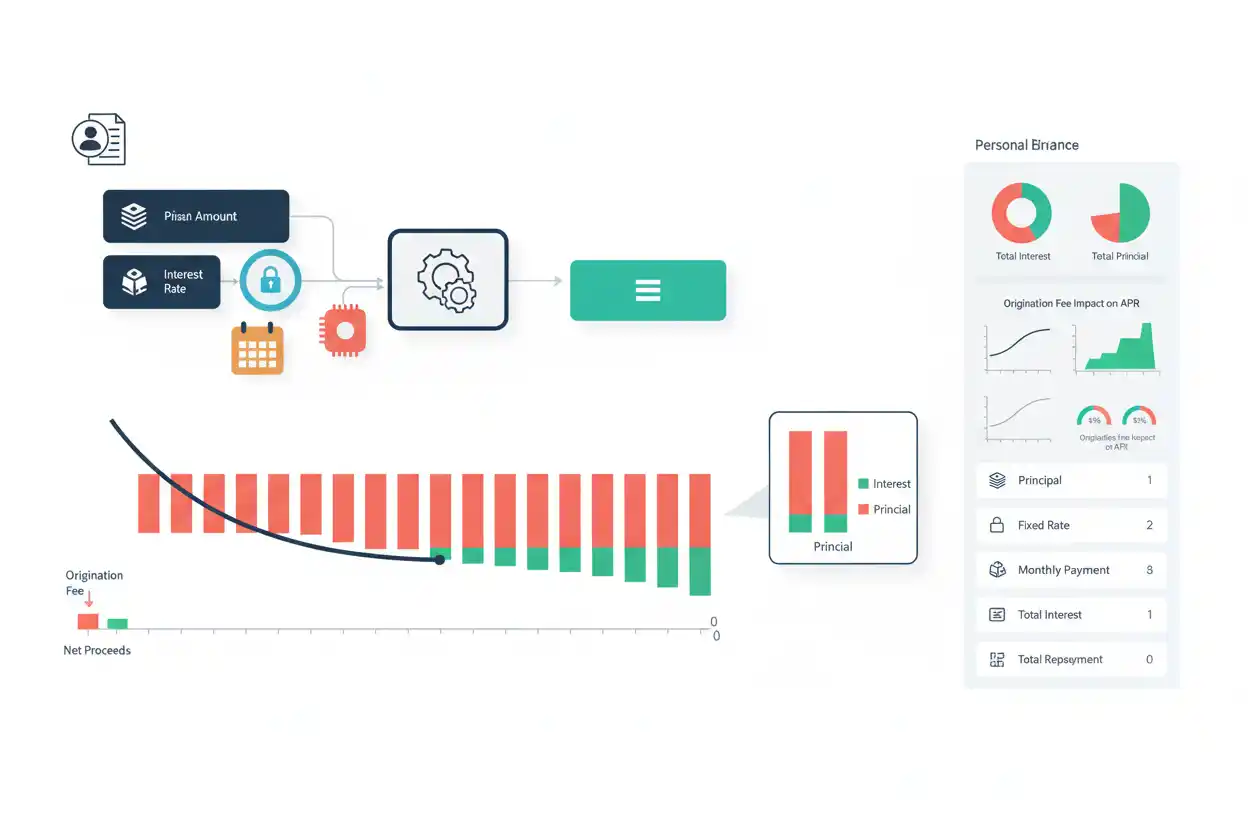

Personal loan payments are the scheduled amounts required to repay a personal loan according to its principal, interest rate, repayment term, and payment structure.
For a standard fixed-rate amortizing personal loan, the formula is:
Personal Loan Payment = P × [r(1 + r)^n] ÷ [(1 + r)^n − 1]
Where:
P = principal financed
r = periodic interest rate
n = total number of payments
Suppose you borrow $15,000 at 11% for four years.
The payment is approximately:
$387.68 per Month
Over 48 months, the borrower repays approximately $18,608.78, including about $3,608.78 of interest.
That monthly figure is useful, but a good personal-loan decision also considers APR, fees, term, early payoff, and whether the payment comfortably fits the household budget.
What Are Personal Loan Payments?
Personal loan payments are recurring amounts paid toward an installment loan.
On a standard amortizing structure:
Payment = Principal Repayment + Interest
The payment can remain level while its internal composition changes.
Early installments generally contain more interest.
Later installments generally contain more principal.
This is the same underlying structure described in the broader loan payments framework, while this page focuses specifically on personal loans.
Personal Loan Payment Formula
For monthly payments:
Payment = P × [r(1 + r)^n] ÷ [(1 + r)^n − 1]
Convert the annual nominal rate to a monthly rate:
Monthly Rate = Annual Interest Rate ÷ 12
Convert years to monthly periods:
Number of Payments = Years × 12
Personal Loan Payment Example
Assume:
Principal = $15,000
Annual interest rate = 11%
Term = 4 years
Payments = monthly
Step 1: Calculate the Monthly Rate
Monthly Rate = 11% ÷ 12
Monthly Rate ≈ 0.91667%
As a decimal:
r ≈ 0.0091667
Step 2: Calculate Number of Payments
n = 4 × 12
n = 48
Step 3: Calculate the Payment
Payment = $15,000 × [0.0091667(1.0091667)^48] ÷ [(1.0091667)^48 − 1]
Monthly Payment ≈ $387.68
Total Personal Loan Interest
Total scheduled payments are:
Total Payments ≈ $387.68 × 48
Using full precision:
Total Payments ≈ $18,608.78
Total interest:
Total Interest = $18,608.78 − $15,000
Total Interest ≈ $3,608.78
The borrower therefore pays roughly $3,609 in interest if the loan follows the assumed schedule.
First Payment Breakdown
First-month interest:
Interest = $15,000 × 11% ÷ 12
Interest = $137.50
Principal reduction:
Principal Paid = $387.68 − $137.50
Principal Paid ≈ $250.18
New principal balance:
New Balance = $15,000 − $250.18
New Balance ≈ $14,749.82
Second Payment
Second-month interest is approximately:
$14,749.82 × 11% ÷ 12
Interest ≈ $135.21
Principal reduction becomes approximately:
$387.68 − $135.21 = $252.47
The payment remains approximately the same, but progressively more of it reduces principal.
A repayment schedule tracks this change across the entire loan.
Personal Loan Payments and APR
The personal loan APR measures annualized borrowing cost.
Payment calculations usually start with the contractual rate and amount financed.
These are not automatically the same thing.
Suppose a loan charges:
11% contractual interest plus a 5% origination fee.
The payment may be calculated from the contractual principal and rate while the fee pushes APR materially higher.
Personal Loan Payments and Origination Fees
A loan origination fee can affect the payment differently depending on how it is charged.
If deducted from proceeds:
the borrower receives less cash, but the payment may remain based on the full contractual principal.
If financed:
the principal becomes larger and the payment increases.
Suppose:
Cash needed = $15,000
Financed fee = $750
New principal:
Financed Principal = $15,750
At the same rate and term, the payment is higher because more money is being financed.
Personal Loan Payments and Nominal vs Effective Rate
The nominal vs effective interest rate distinction explains why an annual nominal rate is not simply the same as its effective annual mathematical rate.
For payment purposes, use the contractual periodic rate.
If the loan states an 11% nominal rate with monthly payments:
Monthly Rate = 11% ÷ 12
Do not replace that monthly rate with the full effective annual rate.
Personal Loan Payments and Loan-to-Income Ratio
The loan-to-income ratio compares principal with annual income.
Suppose:
Loan = $15,000
Annual income = $60,000
LTI = $15,000 ÷ $60,000 × 100
LTI = 25%
That tells you how large the loan is relative to income.
It does not tell you whether the $387.68 payment fits the monthly budget.
Personal Loan Payments and Debt-to-Income Ratio
The debt-to-income ratio provides the monthly view.
Suppose:
Gross monthly income = $5,000
Existing debt payments = $1,000
New personal loan payment = $387.68
Then:
DTI = ($1,000 + $387.68) ÷ $5,000 × 100
DTI ≈ 27.75%
A lender can use its own qualifying-payment and income rules, but the basic relationship illustrates how the personal loan affects monthly debt burden.
How Term Changes Personal Loan Payments
The loan term is one of the strongest payment levers.
Suppose the same $15,000 loan at 11% is repaid over:
three years versus six years.
The six-year loan has a smaller payment because principal is spread over twice as many months.
However, total interest increases substantially.
Therefore:
Longer Term → Lower Monthly Payment, Usually Higher Total Interest
Personal Loan Term Comparison
Using $15,000 at 11%:
36 months produces a higher payment and faster payoff.
48 months produces the approximately $387.68 payment used above.
60 or 72 months would reduce the monthly obligation further but leave principal outstanding longer.
A borrower should compare at least:
payment, total interest, and debt-free date.
Fixed-Rate Personal Loans
A fixed vs variable interest rate structure matters because fixed rates create more predictable principal-and-interest payments.
If the rate stays fixed and the loan is fully amortizing, the scheduled payment normally remains stable.
That makes budgeting easier.
Variable-Rate Personal Loans
If the personal loan uses a variable rate, future payments may change.
A rate increase can raise:
interest cost, payment amount, remaining term, or a combination depending on the contract.
A borrower should therefore test whether the loan remains affordable after a significant rate increase.
Personal Loan Payments and Prepayment
A prepayment penalty can affect the value of paying a personal loan off faster.
If no meaningful penalty applies, extra principal generally reduces future interest on a declining-balance loan.
If an early-repayment charge applies, compare the penalty with the interest that would be avoided.
Extra Payment Example
Suppose the outstanding balance is $10,000 at 11%.
An extra $1,000 applied directly to principal lowers the interest-bearing balance to approximately:
$10,000 − $1,000 = $9,000
Next month’s simplified interest falls by approximately:
Interest Reduction = $1,000 × 11% ÷ 12
Interest Reduction ≈ $9.17
The savings continue into later months because the balance remains lower.
Personal Loan Payoff
A loan payoff quote should be requested when you want to settle the debt entirely.
The payoff amount can differ from the displayed balance because accrued interest and other contractual amounts may need to be included.
It should not be calculated by multiplying the normal payment by the number of remaining months.
Secured vs Unsecured Personal Loans
An unsecured loan generally does not rely on pledged collateral in the same way as a secured loan.
A secured loan uses specified collateral.
Collateral can affect rates and approval, but it also changes the consequences of default.
The monthly payment alone therefore does not capture the complete risk of the financing.
Personal Loan Payments and Debt Consolidation
A personal loan is often considered for debt consolidation.
Suppose several credit cards require $700 of combined monthly minimums.
A new personal loan requires $500.
The monthly payment falls by $200.
However, consolidation is advantageous only if the new rate, fees, term, and total repayment create a better overall outcome.
Personal Loan Payment vs Credit Card Minimum
A personal loan payment is usually designed to repay the debt by a defined maturity.
A credit-card minimum can decline as the revolving balance changes.
That makes personal loans potentially useful for borrowers who want a fixed payoff schedule.
The tradeoff is that the required personal-loan payment must be made each month regardless of whether the borrower would prefer a smaller minimum during a cash-flow shortage.
Payment Affordability
A mathematical loan payment can still be unaffordable.
Someone earning $5,000 gross per month might technically qualify for a payment while still facing:
high housing costs, childcare, medical expenses, or unstable income.
A personal budget should therefore use take-home cash flow and real living expenses rather than relying only on lender ratios.
Personal Loan Payments and Emergency Funds
Using every available dollar for extra loan repayment can create a liquidity problem.
If an unexpected expense immediately forces the borrower back onto high-cost credit, the payoff strategy can reverse.
An appropriate cash reserve should be considered alongside accelerated repayment.
Common Personal Loan Payment Mistakes
One mistake is calculating the payment from net cash received rather than contractual principal.
Another is using APR as though it were always the contractual payment rate.
Borrowers also choose long terms solely for a low monthly payment.
A fourth mistake is forgetting origination fees.
Finally, someone planning early payoff should check whether extra payments actually reduce principal and whether a prepayment penalty applies.
Frequently Asked Questions
How are personal loan payments calculated?
For a conventional fixed-rate amortizing loan:
Payment = P × [r(1 + r)^n] ÷ [(1 + r)^n − 1]
What is the payment on $15,000 at 11% for four years?
Approximately $387.68 per month.
How much total interest does that example produce?
Approximately $3,608.78 over 48 months.
Does the payment include interest and principal?
Yes, under a standard amortizing personal loan.
Why does the interest portion fall?
Because the outstanding principal balance declines.
Does APR determine the payment?
The contractual rate and financed principal generally drive the standard payment, while APR measures broader annualized borrowing cost.
Does a longer term reduce the payment?
Generally yes, but it usually increases lifetime interest.
How does an origination fee affect payment?
If financed, it raises principal and payment. If withheld, it can reduce net proceeds without necessarily lowering the payment.
Can I pay extra principal?
Often, but confirm the lender’s payment-allocation and prepayment rules.
Is a personal loan always unsecured?
No. Personal-purpose financing can be secured or unsecured depending on the product.
How do I know whether the payment is affordable?
Compare it with actual take-home cash flow, recurring expenses, existing debts, and an appropriate financial cushion.
Is the remaining balance the same as payoff amount?
Not always. A payoff quote can include accrued interest and other contractual amounts.
Final Takeaway
Personal loan payments convert principal, rate, and term into a recurring obligation.
For a standard fixed-rate loan:
Personal Loan Payment = P × [r(1 + r)^n] ÷ [(1 + r)^n − 1]
A $15,000 personal loan at 11% for 48 months produces a payment of approximately:
$387.68 per Month
Total repayment is approximately $18,608.78, including about $3,608.78 of interest.
Before accepting the loan, evaluate more than the payment. Compare the APR, origination fee, term, total repayment, prepayment rules, collateral risk, and effect on monthly cash flow.