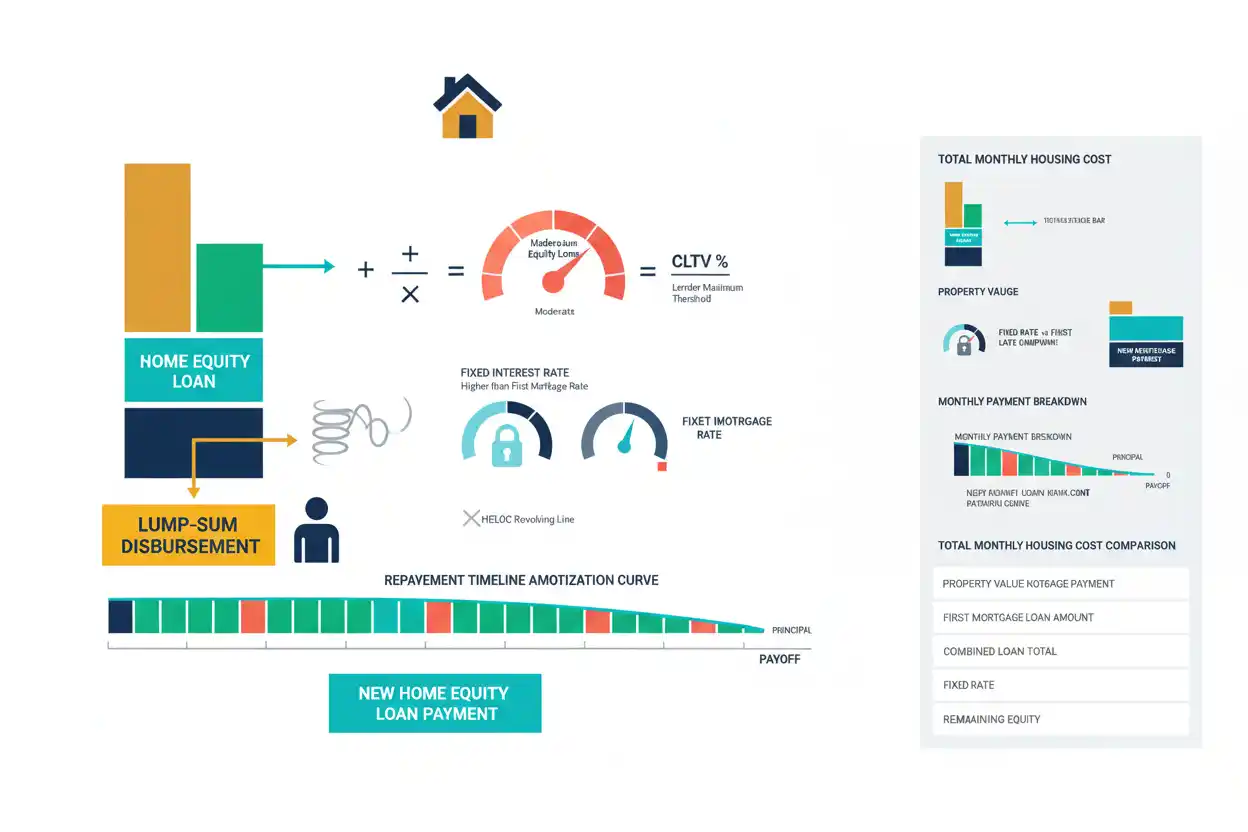

A home equity loan allows a homeowner to borrow a lump sum using home equity as collateral.
CFPB describes a home equity loan as borrowing against equity in the home, with the proceeds received as a lump sum. It also notes that these loans usually have fixed interest rates and that failure to repay can place the home at risk because the debt is secured by the property.
The first useful calculation is:
Gross Home Equity = Home Value − Existing Property-Secured Debt
Suppose:
Home value = $500,000
Existing first mortgage = $250,000
Gross equity is:
$500,000 − $250,000
$250,000
That does not mean the homeowner can necessarily borrow all $250,000.
The lender can restrict borrowing based on combined loan-to-value, credit, income, property, and other underwriting requirements.
What Is a Home Equity Loan?
A home equity loan is commonly structured as a second mortgage.
The borrower receives a defined amount of money at closing.
The loan then has its own:
principal, interest rate, repayment term, payment, and lien against the home.
This differs from a HELOC, which is revolving credit and allows repeated borrowing during its draw period.
Home Equity Loan Example
Suppose:
Home value = $500,000
First mortgage balance = $250,000
Home equity loan = $75,000
Interest rate = 8.5%
Term = 15 years
Combined property debt after borrowing:
$250,000 + $75,000
$325,000
Current gross equity after the new borrowing:
$500,000 − $325,000
$175,000
The homeowner has converted $75,000 of prior home equity into debt-backed cash.
Home Equity Loan CLTV
The combined loan-to-value ratio becomes:
CLTV = Combined Property-Secured Debt ÷ Property Value × 100
CLTV = $325,000 ÷ $500,000 × 100
CLTV = 65%
Before the home equity loan:
First-Mortgage LTV = $250,000 ÷ $500,000 × 100
50%
After borrowing:
combined leverage rises to 65%.
Home Equity Loan Payment Formula
For a fixed-rate amortizing home equity loan:
Payment = P × [r(1 + r)ⁿ] ÷ [(1 + r)ⁿ − 1]
Where:
P = home equity loan principal
r = periodic interest rate
n = number of payments
Using:
P = $75,000
Annual rate = 8.5%
Term = 15 years
Monthly rate:
8.5% ÷ 12 ≈ 0.70833%
Number of payments:
15 × 12 = 180
Monthly payment:
≈ $738.55
Total Interest Example
Total scheduled payments:
$738.55 × 180
Using full precision:
≈ $132,939.84
Total interest:
$132,939.84 − $75,000
≈ $57,939.84
The homeowner obtains $75,000 of cash but repays almost $133,000 over 15 years under the example.
This is why the monthly payment should not be the only comparison metric.
First Payment Breakdown
First-month interest:
Interest = $75,000 × 8.5% ÷ 12
Interest ≈ $531.25
Principal reduction:
Principal = $738.55 − $531.25
Principal ≈ $207.30
New home equity loan balance:
$75,000 − $207.30
≈ $74,792.70
The loan amortizes gradually in the same mathematical way as other fixed-rate installment debt.
Home Equity Loan vs HELOC
CFPB explains that a home equity loan generally delivers one lump sum, while a HELOC permits repeated draws from an available line and usually has an adjustable interest rate.
The practical distinction is:
Home Equity Loan = Lump Sum + Defined Repayment
HELOC = Revolving Access + Variable Balance
If you know you need exactly $75,000 today, a home equity loan can create a straightforward payment schedule.
If your expenses will occur gradually and the final amount is uncertain, a HELOC can offer more flexibility.
Home Equity Loan and Fixed-Rate Mortgage
A homeowner can keep an existing fixed-rate mortgage and add a separate home equity loan.
This can be useful when the first mortgage has a very low rate.
Suppose:
First mortgage = 3.5%
Home equity loan = 8.5%
Only the $75,000 new debt carries 8.5%.
A cash-out refinance might instead require replacing the entire first mortgage at current rates.
Home Equity Loan vs Cash-Out Refinance
A cash-out refinance replaces the existing first mortgage with a larger new mortgage.
A home equity loan normally leaves the existing first mortgage intact.
Suppose:
Existing mortgage = $250,000 at 3.5%
Cash needed = $75,000
Home equity loan:
keeps $250,000 at 3.5% and adds $75,000 at the new second-mortgage rate.
Cash-out refinance:
can reprice the entire $325,000 new mortgage.
Which is cheaper depends on actual rates, fees, terms, and holding period.
Home Equity Loan and Home Affordability
The mapped home affordability relationship matters even after the home has been purchased.
A homeowner might have comfortably afforded the original mortgage.
Adding a $738.55 home equity loan payment changes that budget.
Suppose:
Original housing-related debt payment = $2,500
New home equity loan payment = $738.55
Combined debt payment becomes:
$3,238.55 per Month
The home itself did not become more expensive, but the property-secured debt burden did.
Home Equity Loan and Interest-Only Mortgage
An interest-only mortgage can complicate the picture because the first mortgage may not be reducing principal during its interest-only phase.
Adding a home equity loan while the first mortgage remains largely unchanged can cause total property debt to stay high for longer.
The borrower should examine both balances together.
Home Equity Loan and Jumbo Mortgage
A jumbo mortgage can coexist with a home equity loan.
The first mortgage’s jumbo status does not remove the need to calculate combined property leverage.
With large loan amounts, relatively small percentage changes in CLTV can represent substantial dollar amounts.
Home Equity Loan and Loan-to-Value Ratio
The loan-to-value ratio of the first mortgage alone can make the property look lightly leveraged.
Example:
First mortgage LTV = 50%.
That sounds conservative.
But after adding a $75,000 second loan:
CLTV = 65%
Both ratios are correct.
They simply measure different scopes of debt.
Home Equity Loan and Mortgage Payoff
The mortgage payoff amount for the first mortgage does not automatically include a separate home equity loan.
When the property is sold, both liens generally need to be addressed according to their contracts.
A seller estimating net proceeds should therefore account for all property-secured debts.
Selling the Home Example
Suppose later:
Home sale price = $550,000
First mortgage payoff = $230,000
Home equity loan payoff = $65,000
Selling costs = $35,000
Estimated remaining proceeds:
$550,000 − $230,000 − $65,000 − $35,000
$220,000
Ignoring the second mortgage would overstate expected sale proceeds by $65,000.
Home Equity Loan and Refinancing
Refinancing can require the home equity loan to be paid off, refinanced, or addressed in the new lien structure.
This matters particularly when the homeowner wants a new first mortgage but intends to retain the second loan.
Lien priority is part of the refinancing process.
Home Equity Loan Fees
CFPB notes that home equity loans can carry upfront fees and costs and recommends comparing more than the monthly payment.
A $75,000 loan with:
3% closing and financing costs
would create:
Upfront Costs = $75,000 × 3%
$2,250
If those costs are financed, principal rises.
If paid in cash, the borrower receives the full loan but contributes more money upfront.
Home Equity Loan for Debt Consolidation
Borrowers sometimes use home equity loans to repay credit cards or unsecured debt.
This can reduce the nominal interest rate.
However, CFPB cautions that using home equity to pay other debts places the home behind an obligation that previously may not have been secured by it.
A lower rate should therefore be weighed against the change in collateral risk and repayment term.
Debt Consolidation Example
Suppose:
Credit-card debt = $40,000 at 22%
Home equity loan = $40,000 at 8.5%
The rate reduction is large.
But if the home equity loan stretches repayment over 15 years, the borrower should not focus on interest rate alone.
A disciplined shorter repayment schedule can preserve more of the benefit.
Home Equity Loan for Renovation
A lump-sum home equity loan can fit a renovation project with a known fixed budget.
Suppose:
Contractor price = $70,000
Contingency = $5,000
Required cash:
$75,000
The loan example matches that need closely.
By contrast, an open-ended project with uncertain timing might be better suited to staged HELOC draws, depending on costs and risk.
Home Equity Loan and Mortgage Recast
A mortgage recast reduces the required payment on an eligible first mortgage after a large principal reduction.
Taking a home equity loan to fund a first-mortgage recast would generally replace one form of property debt with another rather than genuinely reduce leverage.
The full combined debt position should be analyzed.
Home Equity Loan and Mortgage Insurance
Borrowing through a second mortgage does not automatically recreate private mortgage insurance on the original first mortgage.
However, future refinancing can involve new LTV and insurance calculations.
High combined leverage can therefore affect later financing flexibility.
Property Value Risk
Suppose:
Combined debt = $325,000
Home value = $500,000
CLTV = 65%.
If the home later falls to $375,000 while balances remain close to $325,000:
CLTV = $325,000 ÷ $375,000 × 100
≈ 86.7%
The homeowner’s equity cushion has shrunk substantially even though no additional borrowing occurred.
Frequently Asked Questions
What is a home equity loan?
It is a lump-sum loan secured by equity in the borrower’s home.
How is home equity calculated?
Home Equity = Home Value − Existing Property Debt
Is all home equity available to borrow?
No. Lenders typically limit borrowing based on underwriting and property leverage.
What is the payment on $75,000 at 8.5% for 15 years?
Approximately:
$738.55 per Month
How much interest does that loan produce?
Approximately:
$57,939.84
over 15 years under the example.
Is a home equity loan usually fixed-rate?
CFPB says home equity loans usually have fixed rates, although actual products can vary.
What is the difference between a HELOC and home equity loan?
A home equity loan provides a lump sum; a HELOC permits repeated borrowing from an available line.
Can a home equity loan put my home at risk?
Yes. The home secures the loan, so nonpayment can expose the property to foreclosure risk.
Does a home equity loan replace my mortgage?
Usually it is separate from the existing first mortgage.
Does it affect CLTV?
Yes. The balance is added to other property-secured debt when calculating combined leverage under the relevant method.
Can I use a home equity loan for debt consolidation?
Yes, but doing so can convert unsecured debt into debt secured by the home.
What should I compare before borrowing?
Compare rate, APR, payment, term, fees, CLTV, total interest, first-mortgage rate, and the consequences of pledging home equity.
Final Takeaway
A home equity loan converts part of a homeowner’s equity into a lump-sum secured debt.
In the example:
Home value = $500,000
First mortgage = $250,000
Home equity loan = $75,000
Combined debt becomes:
$325,000
and CLTV becomes:
65%
At 8.5% for 15 years, the home equity loan payment is approximately:
$738.55 per Month
with about:
$57,939.84 of Total Interest
The core question is not simply whether equity is available. It is whether converting that equity into debt is justified after considering the payment, interest, fees, property risk, existing first-mortgage rate, and alternatives such as a HELOC or cash-out refinance.