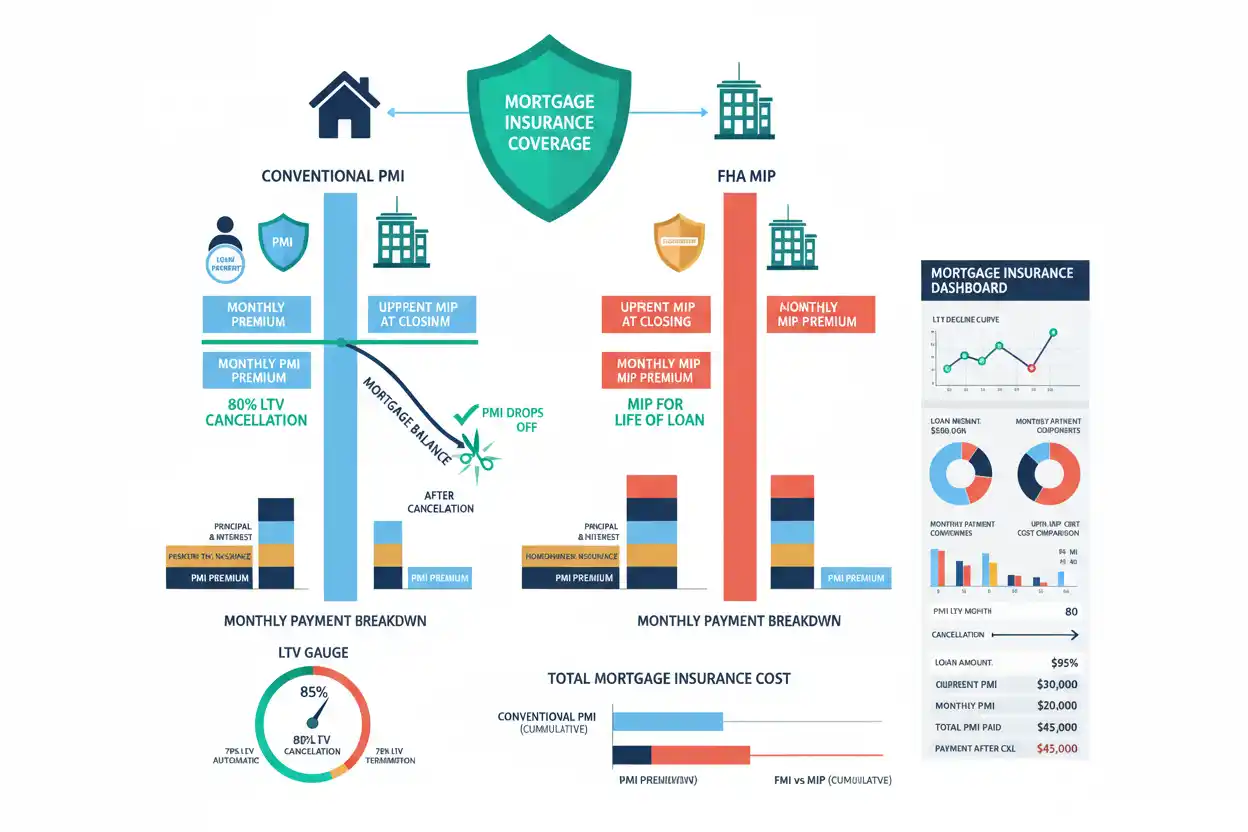

Mortgage insurance is insurance that primarily protects the lender or mortgage guarantor against specified losses if the borrower fails to repay the mortgage.
It does not function like homeowners insurance.
Homeowners insurance protects against covered property-related risks.
Mortgage insurance primarily reduces the lender’s credit risk.
CFPB states that mortgage insurance protects the lender rather than the borrower and can allow borrowers to qualify for mortgages with smaller down payments, although it increases borrowing cost.
There is no one universal mortgage insurance formula because pricing depends on the mortgage program, insurer, loan-to-value ratio, borrower characteristics, mortgage term, and other applicable factors.
For simple planning, a conventional monthly premium can be illustrated as:
Estimated Monthly Mortgage Insurance = Applicable Mortgage Balance × Illustrative Annual Premium Rate ÷ 12
The actual lender or insurer premium should always replace the illustrative rate.
Mortgage Insurance Example
Suppose:
Home price = $500,000
Down payment = 10%
Mortgage = $450,000
Initial loan-to-value ratio:
LTV = $450,000 ÷ $500,000 × 100
LTV = 90%
Now assume an illustrative conventional PMI rate of 0.60% annually.
This is not a universal PMI rate.
Annual premium estimate:
$450,000 × 0.60%
$2,700
Monthly estimate:
$2,700 ÷ 12
$225 per Month
The example shows how mortgage insurance can materially increase the required monthly housing payment.
Mortgage Payment With Insurance
Assume:
Mortgage = $450,000
Rate = 6.5%
Term = 30 years
Principal-and-interest payment:
≈ $2,844.31
Illustrative PMI:
$225
Combined before property taxes and homeowners insurance:
$3,069.31
Mortgage insurance increases this simplified payment by:
$225 per Month
or:
$2,700 per Year
at the assumed initial premium level.
Actual PMI pricing can differ substantially from the illustrative assumption.
What Determines Mortgage Insurance Cost?
For conventional private mortgage insurance, pricing can depend on factors including down payment and borrower credit characteristics.
CFPB notes that PMI rates vary and that conventional PMI is commonly paid as part of the monthly mortgage payment, though other payment structures can exist.
Therefore:
Do Not Assume One PMI Percentage Applies to Every Borrower
Use the actual Loan Estimate or mortgage-insurance quote.
Mortgage Insurance vs Homeowners Insurance
These policies solve different risks.
Mortgage insurance: protects the lender or guarantor against specified default losses.
Homeowners insurance: protects against specified property and liability risks under the homeowners policy.
A borrower may need both at the same time.
Paying mortgage insurance does not insure the homeowner against foreclosure. CFPB specifically warns that PMI does not protect the borrower from losing the home after payment default.
Mortgage Insurance and Escrow
A monthly mortgage escrow payment can include money associated with taxes and insurance-related obligations.
The total mortgage payment can therefore contain:
principal, interest, property taxes, homeowners insurance, and mortgage insurance.
These components should be separated when analyzing the mortgage.
Conventional Private Mortgage Insurance
On a conventional mortgage, mortgage insurance is generally called:
Private Mortgage Insurance, or PMI.
The dedicated private mortgage insurance page owns the conventional PMI-specific calculation and cancellation details.
This page remains broader by comparing mortgage-insurance structures across loan types.
PMI and 20% Down
CFPB says borrowers making less than a 20% down payment typically need mortgage insurance in many conventional mortgage situations.
Suppose:
Home = $500,000
20% down = $100,000
Mortgage:
$400,000
LTV:
80%
Contrast with 10% down:
Mortgage:
$450,000
LTV:
90%
The 10% down borrower finances another $50,000 and can also face PMI, increasing both principal-and-interest and insurance cost.
Borrower-Requested PMI Cancellation at 80%
For many covered mortgages on single-family principal residences, CFPB explains that borrowers can request PMI cancellation when the principal balance is scheduled to reach 80% of the home’s original value, provided applicable conditions are satisfied. Extra principal payments can also allow a request once the balance actually reaches that 80% level.
For a $500,000 original value:
80% Threshold = $500,000 × 80%
$400,000
In the $450,000 mortgage example, principal must decline by:
$450,000 − $400,000
$50,000
to reach that balance threshold.
Estimated Scheduled 80% Point
Using the illustrative:
$450,000 mortgage
6.5% rate
30-year term
the scheduled balance falls below $400,000 at approximately payment:
95
That is roughly:
7 Years and 11 Months
into the schedule.
Actual cancellation rights depend on the legal requirements, mortgage terms, payment history, property-value conditions, and servicer procedures described in the borrower’s PMI disclosures.
Automatic PMI Termination at 78%
CFPB states that, for many covered mortgages, servicers generally must automatically terminate PMI when the scheduled principal balance reaches 78% of the home’s original value, provided the borrower is current.
For a $500,000 original value:
78% Threshold = $500,000 × 78%
$390,000
In the same illustrative mortgage schedule, principal falls below $390,000 around payment:
109
or approximately:
9 Years and 1 Month
The legal distinction matters:
80% generally relates to borrower-requested cancellation rights subject to conditions.
78% generally relates to automatic termination under the applicable Homeowners Protection Act rules for covered mortgages.
Extra Payments Can Reach the PMI Threshold Earlier
Suppose:
Current mortgage balance = $410,000
Original value = $500,000
80% threshold:
$400,000
Additional principal needed:
$410,000 − $400,000
$10,000
If the borrower makes a $10,000 principal payment, the balance reaches 80% of the original value.
That can allow the borrower to request PMI cancellation earlier when the applicable legal and servicer conditions are satisfied.
FHA Mortgage Insurance
An FHA loan uses FHA mortgage insurance rather than conventional PMI.
CFPB explains that FHA mortgage insurance includes both an upfront component and a recurring monthly cost, and the upfront amount can generally be financed into the mortgage.
The FHA page owns the exact FHA MIP calculations.
The important distinction here is:
FHA MIP ≠ Conventional PMI
Their pricing and termination rules differ.
USDA Mortgage Insurance
USDA loans use their own government-program guarantee and recurring fee structure.
CFPB notes that USDA borrowers can pay both an upfront amount and an ongoing charge, with the upfront portion potentially financed into the mortgage.
Again, do not apply conventional PMI cancellation rules to a USDA loan.
VA Loans
VA-backed mortgages use a different structure.
CFPB explains that the VA guarantee replaces ordinary mortgage insurance, so there is no monthly mortgage-insurance premium, although an upfront VA funding fee can apply depending on the borrower and transaction.
That makes a VA mortgage-insurance comparison fundamentally different from conventional PMI or FHA MIP.
Mortgage Insurance and Mortgage DTI
The mortgage debt-to-income ratio can include the required mortgage-insurance payment as part of the qualifying housing expense.
Suppose:
Gross monthly income = $8,000
Mortgage insurance = $225
Ratio contribution:
$225 ÷ $8,000 × 100
2.81 Percentage Points
Removing PMI later can therefore improve monthly cash flow materially.
Mortgage Insurance and Mortgage Affordability
Mortgage affordability should include mortgage insurance when it applies.
Suppose the household has:
$3,000 Total Housing Budget
Taxes and homeowners insurance = $600
Mortgage insurance = $225
Remaining for principal and interest:
$3,000 − $600 − $225
$2,175
Ignoring the insurance would overstate mortgage capacity by $225 per month.
Mortgage Insurance and Closing Costs
Some mortgage-insurance structures create upfront mortgage closing costs.
Others are primarily monthly.
Some can combine both.
The Loan Estimate should therefore be checked for:
upfront insurance charges and projected recurring mortgage-insurance payments.
CFPB’s Loan Estimate explainer identifies upfront FHA, VA, USDA, and applicable conventional mortgage-insurance-related charges in the form’s cost sections.
Mortgage Insurance and Mortgage APR
Applicable mortgage-insurance charges can affect overall borrowing cost.
However, the mortgage APR calculation follows specific regulatory finance-charge rules.
Do not estimate APR merely by:
Mortgage Rate + Mortgage Insurance Rate
The two percentages are not directly additive in that way.
Mortgage Insurance and Mortgage Interest
The mapped mortgage interest is the contractual cost of borrowing principal.
Mortgage insurance is a separate insurance charge.
If:
Interest = $2,400 per month
Mortgage insurance = $225
the total cost contains both items, but they should remain analytically separate.
Mortgage Insurance and Mortgage Interest Deduction
The mortgage interest deduction concerns tax treatment of qualifying mortgage interest.
Mortgage-insurance premiums are a different category.
Do not assume that because a payment appears on the mortgage statement it receives the same tax treatment as mortgage interest.
Tax rules can change, so current tax guidance should control.
Mortgage Insurance and Down Payment
The down payments amount is one of the clearest levers affecting mortgage-insurance exposure.
On a $500,000 home:
5% down:
Mortgage = $475,000
10% down:
Mortgage = $450,000
20% down:
Mortgage = $400,000
Larger down payment means:
lower principal and lower LTV.
Depending on the mortgage type, this can materially change mortgage-insurance requirements or pricing.
Mortgage Insurance and Home Equity
Mortgage insurance does not create borrower equity.
If the borrower pays:
$225 of PMI
that $225 does not reduce principal.
Only the principal component of the mortgage payment increases equity through debt reduction.
This is why eliminating unnecessary mortgage insurance can improve monthly cash flow without changing the scheduled mortgage principal payment.
Mortgage Insurance and Refinancing
Refinancing can change mortgage-insurance requirements because the new mortgage receives a new LTV and program analysis.
A borrower refinancing an FHA loan into conventional financing, for example, should compare:
new rate, new PMI if any, closing costs, mortgage term, and the cost of leaving the existing FHA insurance structure.
Removing mortgage insurance alone does not prove the refinance saves money.
Mortgage Insurance and Mortgage Recast
A mortgage recast can lower the required principal-and-interest payment after a substantial principal reduction on an eligible mortgage.
A large principal reduction might also bring a conventional loan closer to a PMI-cancellation threshold.
However, recast eligibility and PMI cancellation are separate lender/servicer processes.
Mortgage Insurance and Mortgage Escrow Changes
If mortgage insurance is removed, the total payment can fall even when:
mortgage rate, principal-and-interest payment, property taxes, and homeowners insurance remain unchanged.
The escrow or servicing payment structure then needs to reflect the discontinued insurance charge as applicable.
Common Mortgage Insurance Mistakes
One mistake is believing mortgage insurance protects the homeowner.
Another is confusing PMI with homeowners insurance.
Borrowers also assume every mortgage-insurance product can be cancelled at 80% LTV.
A fourth mistake is applying conventional PMI rules to FHA financing.
Finally, mortgage insurance should be included when calculating monthly affordability even though it does not reduce principal.
Frequently Asked Questions
What is mortgage insurance?
It is insurance or a comparable program structure that protects the lender or guarantor against specified mortgage-default losses.
Does mortgage insurance protect me from foreclosure?
No. It primarily protects the lender, not the borrower.
What is PMI?
PMI is private mortgage insurance used with applicable conventional mortgages.
How can I estimate monthly PMI?
For planning only:
Monthly PMI ≈ Mortgage Balance × Illustrative Annual PMI Rate ÷ 12
Use the actual lender/insurer premium for a real mortgage.
What is $450,000 at an illustrative 0.60% annual PMI rate?
$225 per Month
Can I request PMI cancellation at 80%?
For many covered mortgages, yes, subject to the statutory and servicer conditions.
When is PMI automatically terminated?
For many covered mortgages, generally when the scheduled balance reaches 78% of original value and the borrower is current.
Are FHA mortgage-insurance rules the same?
No. FHA uses its own mortgage-insurance premium structure.
Does VA require monthly mortgage insurance?
CFPB states that the VA guarantee replaces mortgage insurance; VA-backed loans can instead involve an upfront funding fee.
Does mortgage insurance reduce principal?
No.
Does mortgage insurance affect DTI?
Yes, when the required premium is included in the qualifying monthly housing payment.
Is mortgage insurance the same as homeowners insurance?
No. They protect against different risks.
Final Takeaway
Mortgage insurance can make a mortgage available with less borrower equity, but it increases financing cost.
For a $500,000 home with 10% down:
Mortgage:
$450,000
LTV:
90%
At an illustrative annual PMI rate of 0.60%:
Estimated PMI = $225 per Month
With a 6.5%, 30-year mortgage, principal and interest are approximately:
$2,844.31
so the simplified payment before taxes and homeowners insurance becomes:
$3,069.31
For many covered conventional mortgages, borrower-requested PMI cancellation can become available around the 80% original-value threshold, while automatic termination generally occurs at the scheduled 78% threshold when applicable conditions are satisfied.
The essential distinction is that mortgage insurance protects the lender, increases the borrower’s cost, and follows different rules depending on whether the mortgage is conventional, FHA, USDA, VA-backed, or another program.