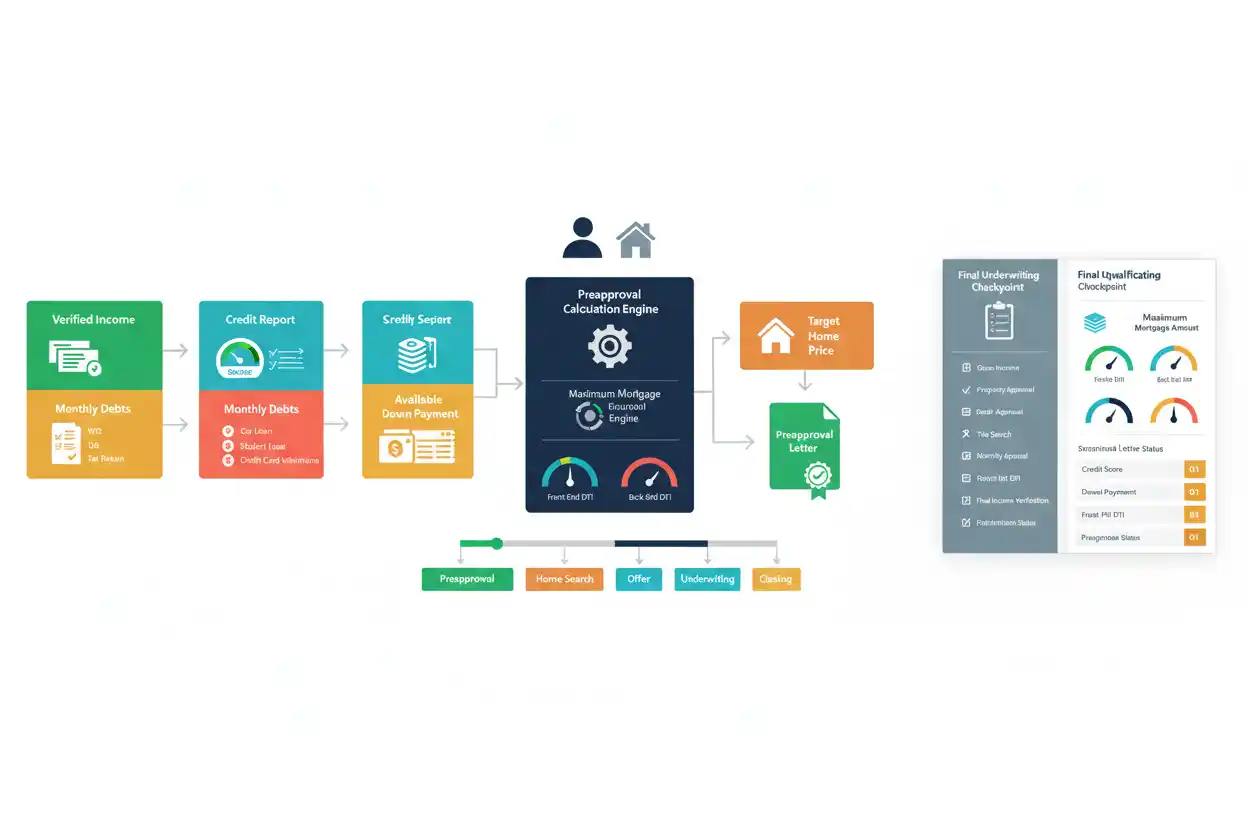

Mortgage preapproval is a lender’s preliminary indication that it is tentatively willing to lend a borrower up to a specified amount based on information and assumptions reviewed at that stage.
It is not the same as final mortgage approval.
CFPB describes a preapproval letter as a statement that a lender is tentatively willing to lend up to a certain amount. The letter is based on assumptions and is not a guaranteed loan offer.
A useful planning relationship is:
Estimated Maximum Purchase Price = Tentative Preapproved Mortgage + Available Down Payment
Suppose:
Preapproved mortgage amount = $450,000
Planned down payment = $50,000
Then:
Estimated Purchase Price Ceiling = $450,000 + $50,000
$500,000
That does not mean every $500,000 property will ultimately qualify.
The specific property, final underwriting, loan program, rate, taxes, insurance, appraisal, and other conditions can change the final result.
What Does Mortgage Preapproval Mean?
Mortgage preapproval provides a preliminary financing range before the home purchase is complete.
CFPB explains that both prequalification and preapproval letters can state how much a lender is generally willing to lend based on assumptions, while lender processes vary substantially and neither letter is a guaranteed final loan.
The practical value is that the buyer enters the property search with a lender-reviewed financing estimate rather than guessing from income alone.
Mortgage Preapproval Is Not Final Approval
A preapproval can still change.
For example:
the borrower takes on new debt, income changes, the property appraises below expectations, mortgage rates move, the chosen loan program changes, or documentation reveals information that changes underwriting.
Therefore:
Preapproval Amount ≠ Guaranteed Final Mortgage
This distinction should remain explicit throughout the buying process.
Mortgage Preapproval Example
Suppose a lender tentatively preapproves a borrower for:
$450,000
The borrower has:
$75,000 Available for Down Payment
A simplistic purchase ceiling would be:
$450,000 + $75,000
$525,000
However, suppose the buyer also needs:
Closing costs = $15,000
Desired post-closing emergency reserve = $20,000
If total available cash is only $75,000, not all of it should be treated as down-payment money.
Cash remaining for the down payment:
$75,000 − $15,000 − $20,000
$40,000
More conservative purchase-price estimate:
$450,000 + $40,000
$490,000
That is often a more useful planning number.
Preapproval and Down Payment
The amount of down payment changes the relationship between loan amount and property price.
Suppose:
Preapproved mortgage = $400,000
With $25,000 down:
Illustrative Purchase Price = $425,000
With $100,000 down:
Illustrative Purchase Price = $500,000
However, the larger purchase can also have:
higher taxes, insurance, HOA charges, or property-specific expenses.
Loan amount is not the entire affordability calculation.
What Information Can a Lender Review?
CFPB’s current mortgage-shopping guidance describes preapproval as involving a lender’s review of a borrower’s finances, including the credit report, to estimate potential borrowing and likely interest terms.
Depending on the lender and process, the borrower may need documentation supporting areas such as:
income, assets, debts, and credit history.
The exact process varies by lender.
Mortgage Preapproval and Credit Checks
CFPB notes that mortgage lenders can obtain a credit report when determining how much they may be willing to lend for a mortgage preapproval.
Borrowers shopping among lenders should therefore understand when each lender intends to pull credit and what documentation it requires.
CFPB also states that multiple mortgage credit checks within a 45-day shopping window are generally treated as a single inquiry for credit-scoring impact in the context it describes.
Preapproval vs Prequalification
The names are less important than the actual lender process.
CFPB explicitly warns that lender processes vary widely and the words “prequalification” and “preapproval” alone do not tell you how much verification has occurred.
Therefore, ask:
What information was verified?
Was credit reviewed?
Which assumptions does the letter use?
When does it expire?
What must still happen before final approval?
Mortgage Preapproval and Principal
The mapped mortgage principal is the actual amount borrowed when the loan closes.
A preapproval amount is only a potential maximum.
Suppose:
Preapproval = $450,000
Final selected mortgage = $385,000
Actual starting principal is:
$385,000
not $450,000.
Borrowing below the preapproval amount can reduce monthly payment and interest materially.
Mortgage Preapproval and Mortgage Points
The mortgage points structure can change final pricing.
Suppose the lender preliminarily assumes:
6.5% with zero points.
Later, the buyer chooses:
6.25% with one point.
The amount of cash required at closing changes.
Depending on lender underwriting and transaction figures, the final financing package can therefore differ from early assumptions.
Preapproval and Mortgage Rate Lock
A mortgage rate lock is separate from preapproval.
A lender can be tentatively willing to lend a certain amount while the interest rate remains unlocked.
CFPB notes that if the rate is not locked, it can change; a lock protects specified mortgage pricing for its stated period when applicable conditions are satisfied.
Therefore:
Preapproved Loan Amount ≠ Automatically Locked Interest Rate
Why Rate Changes Can Affect Preapproval
Suppose a borrower can support:
$2,500 of Monthly Principal and Interest
At 6.25% for 30 years, that supports approximately:
$406,000 of Mortgage Principal
At a materially higher rate, the same $2,500 payment supports less principal.
Therefore, a rate change can affect the mortgage amount consistent with the lender’s payment and underwriting assumptions.
This is one reason preapproval should not be treated as a permanent purchasing guarantee.
Preapproval and Mortgage Payoff Strategies
The mapped mortgage payoff strategies page can matter when an applicant already owns property.
Aggressively paying off debt before preapproval can reduce obligations.
However, spending substantial liquid savings on existing debt can also reduce funds available for:
down payment, closing costs, and reserves.
The strongest balance depends on the applicant’s full financial position.
Existing Mortgage Payoff Amount
If a buyer plans to sell an existing property, the mortgage payoff amount can affect expected sale proceeds.
Suppose:
Sale price = $500,000
Mortgage payoff = $300,000
Selling costs = $35,000
Estimated net proceeds:
$500,000 − $300,000 − $35,000
$165,000
Those expected proceeds can influence the planned down payment on the next property, but they are not final until the sale closes.
Preapproval and Home Affordability
A lender’s tentative approval amount should not replace the buyer’s own home affordability calculation.
CFPB emphasizes that the amount a lender is willing to provide can differ from the amount a household is comfortable spending.
A buyer should preserve room for:
maintenance, emergencies, savings, and non-housing priorities.
Preapproval and DTI
The mortgage debt-to-income ratio can be part of the lender’s evaluation.
However, there is no one universal preapproval formula.
Different lenders and mortgage programs can apply different underwriting rules.
Therefore, online “preapproval calculators” should be treated as estimates rather than lender commitments.
Preapproval and Appraisal
A preapproval evaluates the borrower before the lender has necessarily accepted a particular property’s value and eligibility.
Suppose:
Purchase contract = $500,000
Preapproval supports loan amount = $450,000
If the lender’s accepted property value is materially lower than expected, the required financing structure can change.
The borrower may need:
more cash, a smaller loan, renegotiation, or another solution.
Preapproval Does Not Reserve a House
A mortgage preapproval is financing-related.
It does not create ownership rights in a property.
The buyer still needs a successful purchase agreement and closing.
Should You Get More Than One Preapproval?
CFPB’s 2026 mortgage-shopping guidance encourages borrowers to ask at least three lenders for preapproval so they can compare potential financing.
The objective is not simply to find the lender willing to quote the largest number.
Compare likely pricing, service, fees, loan types, and documentation expectations.
Common Mortgage Preapproval Mistakes
One mistake is treating preapproval as guaranteed final approval.
Another is shopping for a property exactly at the preapproval ceiling without preserving room for closing costs.
Borrowers also assume the interest rate is locked simply because a preapproval letter exists.
A fourth mistake is making major credit or debt changes during the mortgage process.
Finally, the largest preapproval is not necessarily the most affordable mortgage.
Frequently Asked Questions
What is mortgage preapproval?
It is a lender’s preliminary statement that it is tentatively willing to lend up to a specified amount based on stated assumptions.
Is mortgage preapproval guaranteed?
No.
What is a simple purchase-price formula?
Estimated Purchase Price = Preapproved Mortgage + Available Down Payment
subject to closing costs and final underwriting.
If I am preapproved for $450,000 and have $50,000 down, can I buy a $500,000 home?
Potentially, but final qualification, property approval, closing costs, and other requirements still matter.
Is preapproval the same as prequalification?
Lender processes vary, and CFPB says the terminology alone does not reveal how rigorous the review was.
Does preapproval involve a credit check?
It can; CFPB notes mortgage lenders can obtain credit reports for preapproval decisions.
Does preapproval lock my rate?
Not automatically.
Can my preapproval amount change?
Yes, if important assumptions or borrower/property information changes.
Should I borrow the full preapproved amount?
Not necessarily. Personal affordability can be lower than lender qualification.
Can I obtain preapproval from multiple lenders?
Yes, and CFPB encourages comparison shopping.
Does preapproval guarantee the property will qualify?
No.
What should I avoid after preapproval?
Avoid assuming that major new debt, credit, income, or financial changes cannot affect final underwriting.
Final Takeaway
Mortgage preapproval is a tentative financing range, not a guaranteed mortgage.
A simple planning relationship is:
Estimated Purchase Price = Tentative Mortgage Amount + Usable Down Payment
If:
Preapproval = $450,000
Usable down payment = $40,000
then a preliminary purchase target is:
About $490,000
But the final mortgage still depends on updated borrower information, the selected property, loan program, interest rate, documentation, underwriting, appraisal, closing costs, and other conditions.
Use preapproval to establish a credible shopping range—not as permission to spend to the absolute maximum.