Statistics & Probability
-

Mean and Variance: Definition, Formula & Example
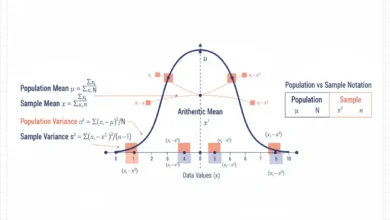
Mean and variance are two fundamental statistical measures used together to describe the center and spread of numerical data or…
Read More » -
Mean Absolute Deviation: Definition, Formula & Example
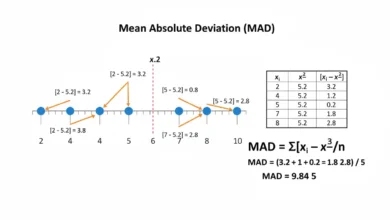
Mean absolute deviation is a measure of statistical dispersion that describes the average absolute distance between observations and a chosen…
Read More » -
Mean: Average
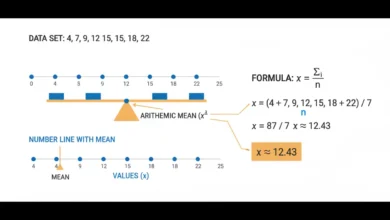
The mean is one of the most widely used measures of central tendency in statistics. It summarizes a collection of…
Read More » -
Logarithmic Regression: Definition, Formula & Example
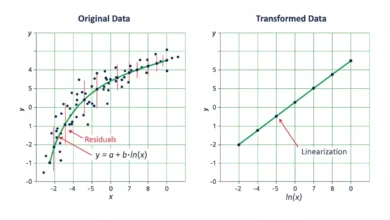
Logarithmic regression is a statistical modeling method used when a quantitative response changes rapidly at smaller predictor values and then…
Read More » -
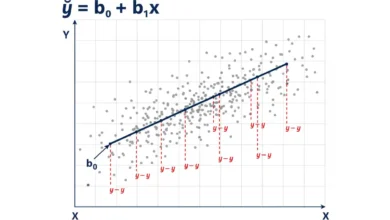
Linear Regression: Definition, Formula & Example
Linear regression is a statistical method used to model how a quantitative response variable changes in relation to one or…
Read More » -
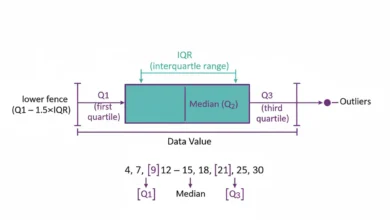
Interquartile Range: IQR
The interquartile range is a measure of statistical spread that describes the width of the middle 50% of an ordered…
Read More » -
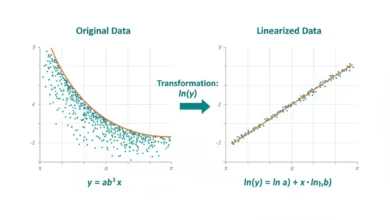
Exponential Regression: Definition, Formula & Example
Exponential regression is a statistical modeling method used when a quantitative response changes approximately by a constant multiplicative factor rather…
Read More » -
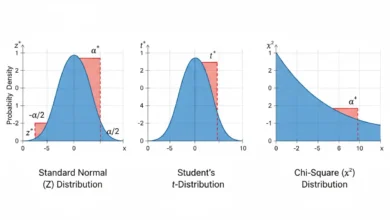
Critical Values: z, t, chi-square
Critical values are cutoff points on a reference probability distribution that separate values considered sufficiently extreme for a statistical procedure…
Read More » -
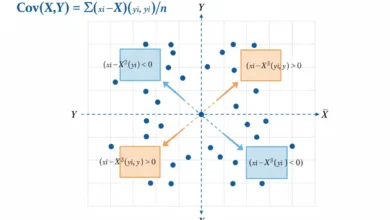
Covariance: Definition, Formula & Example
Covariance measures how two quantitative variables vary together. A positive covariance indicates that observations above the mean of one variable…
Read More » -
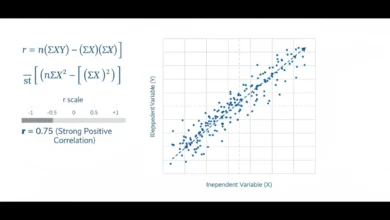
Correlation Coefficient: Definition, Formula & Example
A correlation coefficient is a numerical measure that describes the strength and direction of association between two variables. The most…
Read More »