Accounting & Operations: Complete Guide, Formulas & Examples

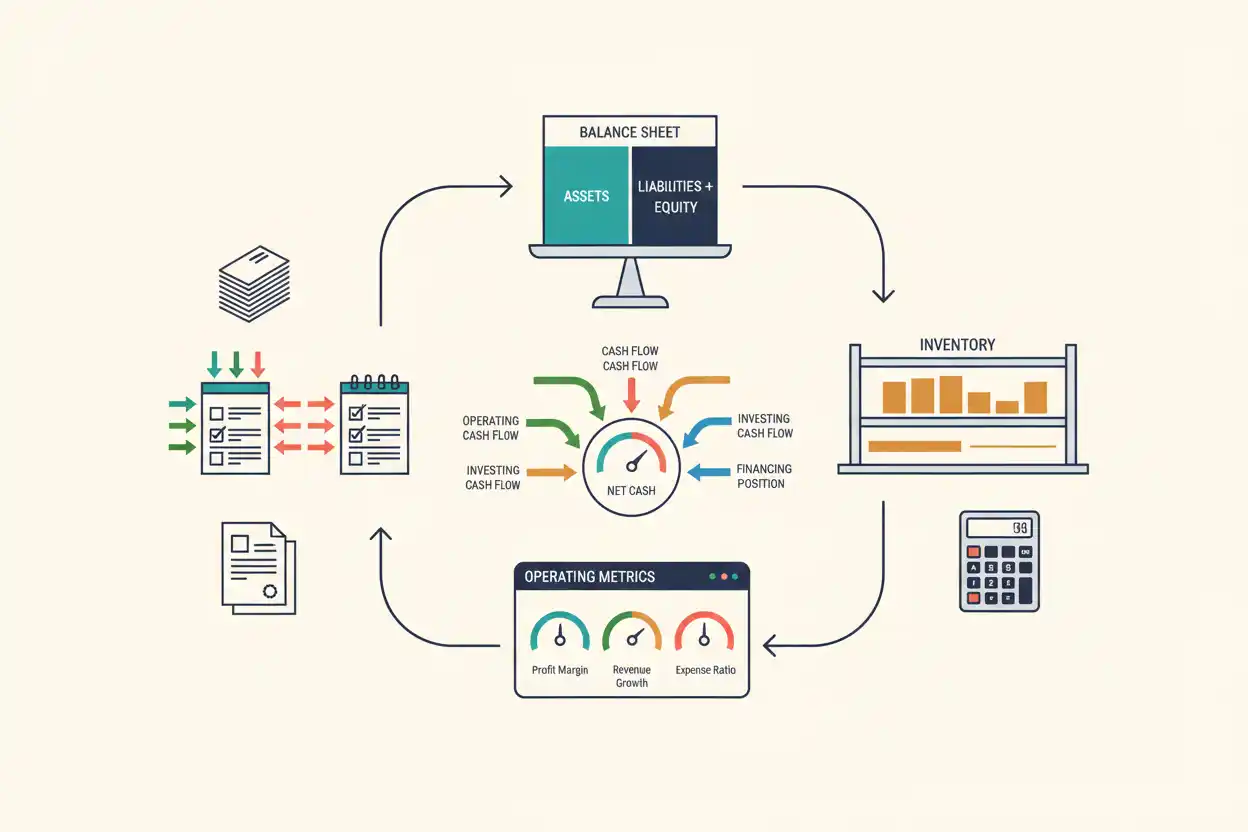
Accounting & operations connect what a business does economically with how those activities are measured, recorded, controlled, and analyzed.
A company may sell $100,000 of products this month without collecting all $100,000 in cash. It may receive supplies today without paying the vendor until next month. It may purchase an intangible asset that provides value for several years rather than treating the entire cost as one month’s expense.
Accounting creates the measurement framework for those events. Operations determines how efficiently the underlying business activities are executed.
The most useful analysis therefore does not stop at profit. It asks how revenue, expenses, receivables, payables, assets, liabilities, working capital, and cash flow fit together.
The Core Accounting Equation
Nearly every accounting system is built around:
Assets = Liabilities + Equity
If a company has:
Assets = $500,000
and:
Liabilities = $320,000
then equity is:
Equity = $500,000 − $320,000
= $180,000
This relationship is reflected in the company’s balance sheet.
A transaction can change several accounts at once, but the accounting equation must remain balanced.
Revenue, Expense, and Profit
A basic operating-income relationship is:
Profit = Revenue − Expenses
Suppose a business earns:
Revenue = $250,000
and records:
Expenses = $190,000
Then:
Profit = $250,000 − $190,000
= $60,000
That $60,000 does not necessarily mean the business generated $60,000 of cash during the period.
Accounting profit and cash movement can differ substantially.
Why Cash and Profit Differ
Suppose a company records $100,000 of sales, but customers pay only $70,000 before month-end.
Revenue recorded:
$100,000
Cash collected:
$70,000
Uncollected amount:
$30,000
That $30,000 can appear in accounts receivable rather than disappearing from revenue merely because cash has not yet arrived.
The company can therefore report a profitable month while simultaneously experiencing pressure on cash flow.
Accounts Receivable
Accounts receivable represents amounts customers owe the business for qualifying credit sales already recognized.
A simplified balance roll-forward is:
Ending Accounts Receivable = Beginning Accounts Receivable + Credit Sales − Customer Collections − Other Reductions
Suppose:
Beginning AR = $40,000
Credit Sales = $120,000
Collections = $105,000
and no other adjustments occur.
Then:
Ending AR = $40,000 + $120,000 − $105,000
= $55,000
Receivables increased by $15,000 even though the business was collecting significant cash.
Accounts Payable
A business often receives goods or services before paying the supplier.
Those unpaid obligations can enter accounts payable.
A simplified roll-forward is:
Ending Accounts Payable = Beginning Accounts Payable + Credit Purchases or Expenses − Payments to Suppliers
Suppose:
Beginning AP = $35,000
New Credit Purchases = $80,000
Supplier Payments = $72,000
Then:
Ending AP = $35,000 + $80,000 − $72,000
= $43,000
Accounts payable rose by $8,000.
The company recognized obligations faster than it paid them.
Receivables and Payables Together
Receivables and payables often move in opposite cash-flow directions.
Higher receivables mean customers have not yet paid cash the business is owed.
Higher payables mean the business has not yet paid cash it owes suppliers.
Suppose during a period:
AR Increases by $20,000
and:
AP Increases by $12,000
The receivable increase generally ties up more cash, while the payable increase generally delays a cash outflow.
The net working-capital effect cannot be understood from either account alone.
Accrual Accounting
Under accrual accounting, revenue and expenses are generally recognized based on the underlying economic activity rather than merely when cash enters or leaves the bank account.
Suppose a company performs $10,000 of services in December and receives payment in January.
Under a simplified accrual approach:
December Revenue = $10,000
even though:
December Cash Collection = $0
The customer obligation can become accounts receivable until payment occurs.
Accrued Expenses
The same principle applies to expenses.
Suppose employees earn:
$8,000
of wages during the final week of December but are paid in January.
The economic cost belongs to December under a simplified accrual framework because employees performed the work during December.
The business can therefore record:
December Wage Expense = $8,000
while cash payment occurs later.
This timing difference is central to accrual-based financial statements.
Amortization Expense
Some long-lived intangible costs provide benefits across multiple accounting periods.
Rather than recognizing the entire cost immediately, a finite-lived intangible may be allocated over its useful life through amortization expense.
A common straight-line formula is:
Annual Amortization Expense = (Cost − Residual Value) ÷ Useful Life
Suppose an eligible finite-lived intangible costs:
$120,000
with no residual value and an estimated useful life of:
6 Years
Then:
Annual Amortization Expense = $120,000 ÷ 6
= $20,000
The accounting expense is spread across the periods benefiting from the asset.
Accounting Is a Timing System
Many apparent accounting complications are fundamentally timing questions.
When was revenue earned?
When was the expense incurred?
When should cash be collected?
When should a liability be paid?
Over how many periods should an asset cost be recognized?
Operations generates those events. Accounting assigns them to the appropriate accounts and reporting periods.
Income Statement
The income statement measures financial performance over a period.
A simplified sequence is:
Revenue − Cost of Sales = Gross Profit
Then:
Gross Profit − Operating Expenses = Operating Profit
Additional income, expenses, interest, and taxes can then affect final net income.
Suppose:
Revenue = $500,000
Cost of Sales = $300,000
Gross profit:
$200,000
Operating expenses:
$130,000
Operating profit:
$70,000
The business generated $70,000 before any additional items outside this simplified operating calculation.
Balance Sheet
The balance sheet measures financial position at a point in time rather than performance across a period.
Accounts receivable can appear as an asset.
Accounts payable can appear as a liability.
Cash, inventory, property, debt, and equity also contribute to the balance-sheet structure.
This creates a direct connection between day-to-day operations and financial position.
Cash Flow
Cash flow answers a different question from profit:
What actually happened to cash?
Suppose the company earns:
Net Income = $60,000
but receivables increase:
$40,000
and payables decrease:
$15,000
Those working-capital movements can reduce operating cash relative to accounting earnings.
A profitable business can therefore experience a cash shortage.
Working Capital
A common operating measure is:
Working Capital = Current Assets − Current Liabilities
Suppose:
Current Assets = $300,000
Current Liabilities = $220,000
Then:
Working Capital = $80,000
Positive working capital can provide short-term operating flexibility, although the quality and liquidity of the underlying current assets still matter.
A large receivable balance is not economically identical to the same amount held in cash.
Current Ratio
Another basic liquidity measure is:
Current Ratio = Current Assets ÷ Current Liabilities
Using the same numbers:
$300,000 ÷ $220,000
≈ 1.36
The company has approximately $1.36 of current assets for each $1 of current liabilities.
This ratio should be interpreted within the company’s industry, operating cycle, asset quality, and cash needs.
Operational Efficiency
Accounting records what happened. Operational analysis asks whether it happened efficiently.
Suppose two companies each report:
Annual Revenue = $1,000,000
Company A requires:
$700,000 of Operating Costs
Company B requires:
$800,000
Simplified operating margins are:
Company A:
($1,000,000 − $700,000) ÷ $1,000,000
= 30%
Company B:
20%
The revenue is identical, but operational efficiency differs substantially.
Break-Even Thinking
Operating decisions often depend on the revenue required to cover fixed costs.
If contribution margin ratio is known:
Break-Even Sales = Fixed Costs ÷ Contribution Margin Ratio
Suppose:
Fixed Costs = $120,000
and:
Contribution Margin Ratio = 40%
Then:
Break-Even Sales = $120,000 ÷ 0.40
= $300,000
The detailed break-even sales calculation can help management evaluate pricing, volume, and cost structures without confusing break-even revenue with accounting profit after every possible item.
Gross Margin and Operating Decisions
Suppose a product sells for:
$100
and its variable cost is:
$60
Contribution per unit:
$40
If fixed operating costs are $200,000:
Break-Even Units = $200,000 ÷ $40
= 5,000 Units
If the company sells 6,000 units:
Contribution:
6,000 × $40 = $240,000
Amount above fixed costs:
$40,000
This kind of operational math complements financial accounting by helping managers plan before transactions occur.
Accounts Payable as an Operating Lever
Suppose a supplier allows 30 days to pay an invoice.
Paying on day 10 uses cash 20 days earlier than necessary unless there is an economic reason to do so.
However, delaying payment beyond agreed terms can damage supplier relationships, create penalties, or interrupt supply.
Effective payables management balances:
Liquidity + Supplier Terms + Discounts + Reliability
The largest accounts payable balance is not automatically the best operating outcome.
Accounts Receivable as an Operating Lever
The same principle applies to customer collections.
Suppose monthly credit sales remain $100,000 but average collection time increases substantially.
Revenue may initially look unchanged.
Cash availability can deteriorate because more money remains tied up in receivables.
Revenue growth without collection discipline can therefore create working-capital stress.
Reconcile Operations With Accounting
A useful operating review asks whether accounting balances make sense relative to business activity.
If sales rise 10% but receivables rise 70%, collections deserve attention.
If purchases remain stable but payables double, supplier-payment timing should be investigated.
If reported profit rises while operating cash deteriorates, working capital or noncash accounting items may explain the gap.
Accounting numbers become most useful when connected back to the underlying operating processes.
Forecasting Accounts
Suppose revenue is projected to rise:
20%
from:
$1,000,000 to $1,200,000
If receivables historically average 10% of annual sales under a simplified planning assumption:
Projected AR ≈ $1,200,000 × 10%
= $120,000
If the current receivable balance is $100,000:
Additional Working Capital Required ≈ $20,000
Growth can therefore consume cash even when the business becomes more profitable.
Accounting Controls
Strong accounting & operations processes need reliable controls.
Invoices should be approved before payment.
Customer balances should be reconciled to supporting records.
Bank accounts should be reconciled regularly.
Unusual journal entries should be reviewed.
Assets should be tracked.
Operational data should be matched against financial records.
These controls are not merely administrative. They reduce the risk that management decisions are based on incomplete or incorrect information.
Accruals and Forecasting
Suppose a company has incurred $15,000 of utility costs that have not yet been invoiced.
If management forecasts expenses only from vendor bills already received, the forecast can understate actual operating costs.
Recognizing the economic obligation through appropriate accrual processes gives management a more realistic view of the period.
Noncash Expenses
Amortization illustrates why profit and cash flow differ.
Suppose annual amortization expense is:
$20,000
The income statement may include the $20,000 expense even though no new $20,000 cash payment occurs that year for the original asset acquisition.
The cash outflow may have occurred when the asset was purchased.
This difference is essential when translating accounting profit into cash-flow analysis.
Operational Decisions Should Use the Right Metric
No single accounting number answers every management question.
Revenue measures sales activity.
Gross profit measures the amount remaining after direct cost.
Operating profit reflects a broader operating cost structure.
Accounts receivable shows customer balances still to be collected.
Accounts payable shows supplier obligations still to be paid.
Cash measures immediate liquidity.
Break-even analysis measures the activity level required to cover a defined cost structure.
Using the wrong metric can make a mathematically correct calculation operationally misleading.
Frequently Asked Questions
What does accounting & operations mean?
It describes the connection between business activities and the accounting systems used to record, measure, control, and analyze those activities.
What is the core accounting equation?
Assets = Liabilities + Equity
Is profit the same as cash flow?
No. Accrual timing, working capital, noncash expenses, financing, and investing activities can cause substantial differences.
Why can sales increase without cash increasing equally?
Credit sales can increase accounts receivable before customers pay.
Why can an expense exist before cash is paid?
Accrual accounting can recognize a cost when it is incurred even when payment occurs later.
What does accounts payable represent?
It generally represents qualifying amounts a business owes suppliers or other creditors for goods or services already received.
What does accounts receivable represent?
It generally represents amounts customers owe the business for qualifying sales already recognized.
Why does amortization reduce profit without necessarily reducing current cash?
It allocates a qualifying asset’s cost across accounting periods after the original acquisition expenditure has occurred.
What is working capital?
Working Capital = Current Assets − Current Liabilities
Why is break-even analysis useful?
It helps management estimate the sales or unit volume required to cover a defined fixed and variable cost structure.
Why reconcile accounting balances with operational activity?
Unexpected movements in receivables, payables, margins, or cash can reveal collection problems, supplier issues, cost changes, errors, or emerging operating risks.
What makes accounting information operationally useful?
The numbers become valuable when they are tied to real business processes, compared over time, checked for accuracy, and used to support specific decisions.