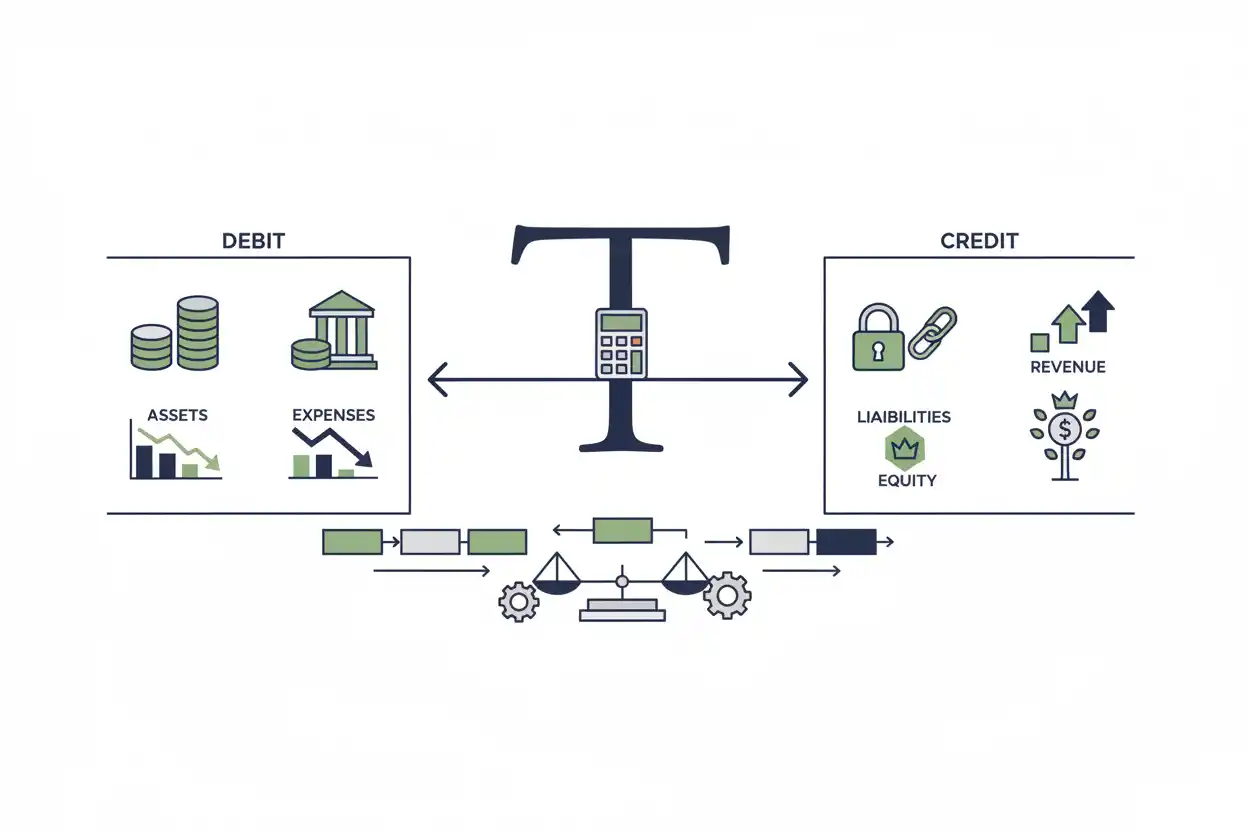

A debit and credit are the two sides used to record accounting transactions. Every properly recorded transaction keeps total debits equal to total credits, preserving the balance of the accounting records.
Debit does not simply mean “increase,” and credit does not simply mean “decrease.” Whether a debit or credit increases an account depends on the type of account being recorded.
For example, receiving cash usually creates a debit to cash, while borrowing that cash creates a credit to a liability. Paying an expense normally creates a debit to the expense account and a credit to cash or another account representing how the expense was funded.
What Are Debits and Credits?
A debit is an entry recorded on the left side of an account.
A credit is an entry recorded on the right side.
In a balanced accounting entry:
Total Debits = Total Credits
Suppose a business buys $5,000 of equipment with cash.
The equipment account increases by $5,000, while cash decreases by $5,000.
The entry can be represented as:
| Account | Debit | Credit |
|---|---|---|
| Equipment | $5,000 | — |
| Cash | — | $5,000 |
| Total | $5,000 | $5,000 |
The transaction changes the composition of assets but does not create an imbalance.
These paired entries form the basic mechanics behind double-entry bookkeeping.
Debit and Credit Formula
There is no universal formula saying “debit equals positive” or “credit equals negative.” The fundamental balancing rule is:
Total Debits = Total Credits
That rule works alongside the accounting equation:
Assets = Liabilities + Equity
Every transaction must be recorded in a way that preserves the accounting equation.
For example, borrowing $20,000 from a bank increases cash by $20,000 and increases a loan liability by $20,000.
The accounting equation changes from both sides:
Assets +$20,000 = Liabilities +$20,000
The corresponding entry is:
Debit Cash $20,000
Credit Loan Payable $20,000
Debits and credits are therefore recording mechanics used to keep the accounting equation balanced.
Which Accounts Increase With a Debit?
Debits normally increase:
- assets;
- expenses; and
- certain contra or distribution accounts depending on the accounting structure.
Credits normally decrease these accounts.
For a typical asset account:
Ending Asset Balance = Beginning Balance + Debits − Credits
Suppose cash begins at $30,000. The business receives $12,000 and pays $8,000.
Ending Cash = $30,000 + $12,000 − $8,000 = $34,000
Because cash is an asset, cash receipts generally appear as debits and cash payments as credits to the cash account.
Which Accounts Increase With a Credit?
Credits normally increase:
- liabilities;
- owners’ or shareholders’ equity;
- revenue; and
- certain contra accounts.
Debits normally decrease these accounts.
For a typical liability:
Ending Liability Balance = Beginning Balance + Credits − Debits
Suppose accounts payable begins at $10,000. The company purchases $7,000 of goods on credit and later pays suppliers $4,000.
Ending Accounts Payable = $10,000 + $7,000 − $4,000 = $13,000
The credit purchase increases the liability with a credit. The supplier payment reduces it with a debit.
Debit and Credit Normal Balances
A normal balance is the side—debit or credit—on which an account normally increases.
| Account Type | Normal Balance | Increase | Decrease |
|---|---|---|---|
| Assets | Debit | Debit | Credit |
| Expenses | Debit | Debit | Credit |
| Liabilities | Credit | Credit | Debit |
| Equity | Credit | Credit | Debit |
| Revenue | Credit | Credit | Debit |
This pattern is more useful than trying to remember debit as “good,” “bad,” “plus,” or “minus.”
The meaning depends entirely on the account involved.
Example: Cash Sale
Assume a business provides a service and receives $2,500 in cash immediately.
Cash increases, so the cash account is debited.
Revenue increases, so revenue is credited.
| Account | Debit | Credit |
|---|---|---|
| Cash | $2,500 | — |
| Revenue | — | $2,500 |
| Total | $2,500 | $2,500 |
The entry balances:
Debits = $2,500
Credits = $2,500
This transaction also increases assets and equity through earned revenue.
Example: Sale on Credit
Now assume the company provides $4,000 of services but allows the customer to pay later.
Instead of cash, accounts receivable increases.
The entry is:
| Account | Debit | Credit |
|---|---|---|
| Accounts Receivable | $4,000 | — |
| Revenue | — | $4,000 |
| Total | $4,000 | $4,000 |
When the customer later pays the $4,000:
| Account | Debit | Credit |
|---|---|---|
| Cash | $4,000 | — |
| Accounts Receivable | — | $4,000 |
| Total | $4,000 | $4,000 |
The collection changes one asset into another. Total assets do not increase from the collection itself because the revenue was already recognized.
This timing distinction is especially important under accrual accounting.
Example: Buying Inventory for Cash
Suppose a retailer purchases $10,000 of inventory and pays immediately.
Inventory increases with a debit.
Cash decreases with a credit.
| Account | Debit | Credit |
|---|---|---|
| Inventory | $10,000 | — |
| Cash | — | $10,000 |
| Total | $10,000 | $10,000 |
The purchase does not automatically mean the full $10,000 becomes cost of goods sold at that moment. Inventory cost generally moves into COGS when the related goods are sold under the applicable accounting treatment.
Example: Recording Cost of Goods Sold
Suppose merchandise that originally cost $600 is sold.
A simplified perpetual inventory entry for the cost side is:
| Account | Debit | Credit |
|---|---|---|
| Cost of Goods Sold | $600 | — |
| Inventory | — | $600 |
| Total | $600 | $600 |
COGS is an expense, so it increases with a debit.
Inventory is an asset, so reducing inventory requires a credit.
If the merchandise was sold for $1,000, the revenue side would usually be recorded separately:
| Account | Debit | Credit |
|---|---|---|
| Cash or Accounts Receivable | $1,000 | — |
| Sales Revenue | — | $1,000 |
The transaction therefore affects both revenue and the cost assigned to the goods sold.
Example: Paying an Expense
Assume a company pays $3,000 of monthly rent.
Rent expense increases, requiring a debit.
Cash decreases, requiring a credit.
Debit Rent Expense = $3,000
Credit Cash = $3,000
The journal entry balances at $3,000 on each side.
Because expenses reduce profit, the transaction will eventually affect the income statement, even though the expense account itself has a normal debit balance.
Example: Borrowing Money
Suppose a company receives a $50,000 bank loan.
Cash increases:
Debit Cash = $50,000
The loan liability increases:
Credit Loan Payable = $50,000
The entry balances:
$50,000 Debits = $50,000 Credits
The transaction increases assets and liabilities by equal amounts.
The company’s profit does not increase merely because it borrowed money.
Example: Owner Investment
Assume an owner contributes $25,000 of cash to the business.
Cash, an asset, increases with a debit:
Debit Cash = $25,000
Owner equity increases with a credit:
Credit Owner Equity = $25,000
The transaction preserves the accounting equation:
Assets +$25,000 = Equity +$25,000
Owner contributions are therefore different from operating revenue.
Debit and Credit for Depreciation Expense
Depreciation expense provides a useful example because the expense can be recognized without a matching current-period cash payment.
Suppose monthly depreciation is $1,500.
A simplified entry is:
| Account | Debit | Credit |
|---|---|---|
| Depreciation Expense | $1,500 | — |
| Accumulated Depreciation | — | $1,500 |
Depreciation expense increases with a debit.
Accumulated depreciation generally carries a credit balance because it reduces the carrying amount of the related asset without directly crediting the asset’s original-cost account each period.
No $1,500 cash payment is required simply because depreciation expense was recorded.
Debits and Credits on the Balance Sheet
The balance sheet groups assets, liabilities, and equity at a point in time.
Debit and credit rules explain how individual transactions change those balances.
Assets generally have debit balances.
Liabilities and equity generally have credit balances.
Suppose a company has:
- Assets: $300,000
- Liabilities: $180,000
- Equity: $120,000
Then:
$300,000 = $180,000 + $120,000
A properly recorded transaction may change one account or several accounts, but it must preserve that relationship.
Debit Does Not Mean Cash In
One of the most common misunderstandings is assuming that debit always means cash received.
It does not.
A debit to cash usually represents an increase in cash, but a debit to an expense represents an increase in expense.
A debit to accounts payable represents a decrease in a liability.
A debit can therefore have different economic meanings depending on the account.
Credit Does Not Mean Cash Out
The opposite misconception is that credit always means money leaving the business.
A credit to cash does reduce cash, but a credit to revenue increases revenue.
A credit to accounts payable increases a liability.
A credit to owner equity increases equity.
The words debit and credit identify sides of the accounting entry, not automatically the direction of cash movement.
Actual cash movements are analyzed more directly through the cash flow statement.
Debit and Credit vs. Double-Entry Bookkeeping
Debit and credit describe the mechanics of individual entries.
Double-entry bookkeeping is the broader accounting system that requires transactions to affect at least two accounts while remaining balanced.
The central relationship is:
Total Debits = Total Credits
A transaction can involve more than one debit or more than one credit.
For example, assume a company pays a $6,000 invoice using $2,000 cash and finances the remaining $4,000.
The entry could contain:
Debit Asset or Expense = $6,000
Credit Cash = $2,000
Credit Liability = $4,000
Total credits are:
$2,000 + $4,000 = $6,000
The entry remains balanced even though it contains three account lines.
Compound Debit and Credit Example
Suppose employees earn $12,000 of wages, but the company pays $9,000 immediately and records $3,000 as wages payable.
The entry is:
| Account | Debit | Credit |
|---|---|---|
| Wage Expense | $12,000 | — |
| Cash | — | $9,000 |
| Wages Payable | — | $3,000 |
| Total | $12,000 | $12,000 |
The number of individual debit and credit lines does not have to match.
Only their monetary totals must be equal.
Debits and Credits When Costs Differ From Expectations
Accounting entries record actual transactions. A cost variance compares those actual costs with a budget, standard, or other benchmark.
Suppose a material purchase was expected to cost $20,000 but actually costs $22,500.
The accounting system records the $22,500 transaction using the appropriate debit and credit accounts.
Variance analysis separately identifies:
Cost Variance = $22,500 − $20,000 = $2,500 Unfavorable
The journal entry and the variance calculation answer different questions. One records what happened; the other evaluates the result against an expectation.
Contribution Margin Does Not Change Debit and Credit Rules
Management measures such as the contribution margin ratio can combine accounting information for decision-making, but they do not change how transactions are posted.
A sale, variable expense, receivable, inventory movement, or cash payment must still be recorded according to the underlying accounts involved.
This distinction matters because management calculations often rearrange accounting data for analysis without becoming separate debit-and-credit rules.
How to Determine Whether to Debit or Credit an Account
A reliable approach is to identify the transaction before thinking about left and right sides.
First determine which accounts changed.
Then classify each account as an asset, liability, equity, revenue, expense, or another appropriate category.
Next determine whether each account increased or decreased.
Finally apply the normal-balance rule.
For example, if cash decreases:
- Cash is an asset.
- Assets normally increase with debits.
- Therefore, an asset decrease is normally recorded with a credit.
This approach is more reliable than memorizing individual transactions.
How to Check Whether an Entry Is Balanced
Assume a journal entry contains:
- Debit Equipment: $18,000
- Debit Prepaid Insurance: $2,000
- Credit Cash: $5,000
- Credit Loan Payable: $15,000
Total debits:
$18,000 + $2,000 = $20,000
Total credits:
$5,000 + $15,000 = $20,000
Therefore:
Total Debits = Total Credits = $20,000
The entry passes the mathematical balancing check.
That does not automatically prove every account was classified correctly, but an unequal entry is definitely incomplete or incorrect.
Common Debit and Credit Mistakes
A frequent mistake is treating every debit as an increase. Debits increase assets and expenses but normally decrease liabilities, equity, and revenue.
Another is thinking every credit represents money received or money owed. Credits have different effects depending on the account.
A balanced entry can also contain an accounting error. Debiting the wrong expense and crediting the correct cash account can still produce equal totals.
Another mistake is recording only the cash side of a transaction. A $10,000 equipment purchase cannot be fully recorded merely by reducing cash; the equipment increase must also be recognized.
The balancing rule is essential, but account selection and timing matter too.
Frequently Asked Questions
What is debit and credit in simple terms?
A debit is the left side of an accounting entry, while a credit is the right side.
Every balanced transaction has equal total debits and credits.
What is the debit and credit formula?
The core balancing rule is:
Total Debits = Total Credits
Debit and credit rules also operate within the accounting equation:
Assets = Liabilities + Equity
Does debit mean increase?
Not always.
Debits normally increase assets and expenses, but they normally decrease liabilities, equity, and revenue.
Does credit mean decrease?
Not always.
Credits normally decrease assets and expenses, but increase liabilities, equity, and revenue.
Is cash a debit or credit?
Cash is an asset with a normal debit balance.
An increase in cash is generally recorded as a debit. A decrease in cash is generally recorded as a credit.
Is revenue a debit or credit?
Revenue normally has a credit balance.
An increase in revenue is generally credited, while a reduction or reversal generally produces a debit.
Are expenses debits or credits?
Expenses generally have normal debit balances.
Recording an expense normally involves debiting the relevant expense account.
Why must debits equal credits?
Equal debits and credits are the mechanism through which double-entry accounting preserves the balance of the accounting equation.
If total debits and credits do not match, the entry is incomplete or mathematically unbalanced.
Can one transaction have several debits and credits?
Yes.
A compound journal entry can contain multiple debit and credit lines. The requirement is that the total monetary value of all debits equals the total value of all credits.
Can an entry balance and still be wrong?
Yes.
An entry can debit or credit the wrong accounts while still having equal totals. Balancing confirms mathematical equality, not necessarily correct classification.
Are debit and credit the same as profit and loss?
No.
Debits and credits are recording mechanics. Profit and loss result from the relationship among revenue, expenses, and other recognized items.
Understanding debit and credit is therefore fundamental to the wider accounting and operations system, but the two terms should not be interpreted as synonyms for gains and losses.