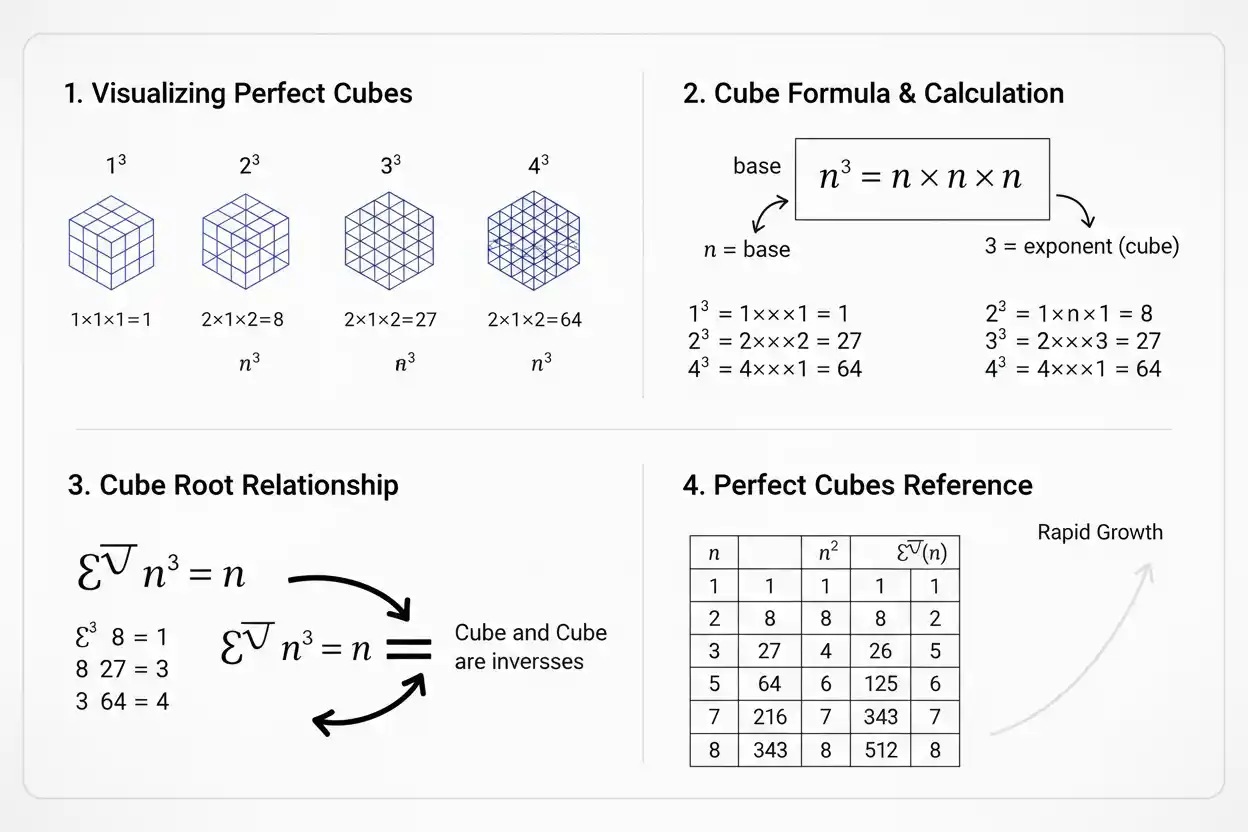
Perfect cubes are numbers obtained by multiplying an integer by itself three times.
The basic formula is:
C = n³ = n × n × n
For example:
4³ = 4 × 4 × 4
= 64
Therefore:
64 is a perfect cube
because its cube root is the integer:
∛64 = 4
Common positive perfect cubes begin:
1, 8, 27, 64, 125, 216, 343, 512, 729, 1,000, …
Zero is also a perfect cube:
0³ = 0
and negative integers produce negative perfect cubes:
(-3)³ = -27
Perfect cubes are closely connected with cube roots, powers, prime factorization, and number patterns.
What Is a Perfect Cube?
An integer C is a perfect cube if there is an integer n such that:
C = n³
Equivalently:
∛C = n
where n is an integer.
For example:
125 = 5³
so:
∛125 = 5
Therefore:
125 is a perfect cube
But:
126
is not a perfect cube because its cube root is not an integer.
Perfect Cube Formula
The defining formula is:
n³ = n × n × n
Examples:
2³ = 8
3³ = 27
5³ = 125
10³ = 1,000
The exponent rules involved are part of the broader exponents framework.
First Perfect Cubes
The first positive perfect cubes are:
| n | n³ |
|---|---|
| 1 | 1 |
| 2 | 8 |
| 3 | 27 |
| 4 | 64 |
| 5 | 125 |
| 6 | 216 |
| 7 | 343 |
| 8 | 512 |
| 9 | 729 |
| 10 | 1,000 |
The values grow quickly because the input appears as three equal factors.
Is 0 a Perfect Cube?
Yes.
Since:
0³ = 0
we have:
0 is a perfect cube
Some elementary lists begin at 1³, but the integer definition includes zero.
Can a Perfect Cube Be Negative?
Yes.
Odd powers preserve the sign of an integer.
For example:
(-2)³ = -8
(-4)³ = -64
(-10)³ = -1,000
Therefore:
-8, -64, and -1,000 are perfect cubes
This differs from perfect squares, which are never negative when defined as squares of real integers.
How to Check Whether a Number Is a Perfect Cube
One direct test is to calculate its cube root.
A number is a perfect cube if its exact cube root is an integer.
For example:
∛216 = 6
Therefore:
216 is a perfect cube
Now consider:
∛200 ≈ 5.848
Since the cube root is not an integer:
200 is not a perfect cube
Perfect Cube Test Using Prime Factorization
A positive integer is a perfect cube exactly when every exponent in its prime factorization is divisible by 3.
For example:
216 = 2³ × 3³
Both prime exponents are:
3
which is divisible by 3.
Therefore:
216 is a perfect cube
Indeed:
216 = (2 × 3)³
= 6³
Example: Is 1,728 a Perfect Cube?
Prime-factorize:
1,728 = 2⁶ × 3³
The exponents are:
6 and 3
Both are divisible by 3.
Group them:
2⁶ × 3³
= (2²)³ × 3³
= (4 × 3)³
= 12³
Therefore:
1,728 is a perfect cube
and:
∛1,728 = 12
Example: Is 432 a Perfect Cube?
Prime-factorize:
432 = 2⁴ × 3³
The exponent of 3 is divisible by 3, but:
4
is not divisible by 3.
Therefore:
432 is not a perfect cube
However, its cube root can be simplified:
∛432 = ∛(2³ × 3³ × 2)
= 6∛2
The remaining factor prevents an integer cube root.
Prime-Exponent Rule
Suppose:
N = p₁^a₁ × p₂^a₂ × … × pₖ^aₖ
Then positive integer N is a perfect cube exactly when:
a₁, a₂, …, aₖ are all multiples of 3
For example:
2⁹ × 3⁶ × 5³
is a perfect cube because:
9, 6, and 3
are all divisible by 3.
Its cube root is:
2³ × 3² × 5
= 8 × 9 × 5
= 360
Cube Root of a Perfect Cube
If:
C = n³
then:
∛C = n
For example:
15³ = 3,375
so:
∛3,375 = 15
Unlike even roots, cube roots preserve negative signs:
∛(-3,375) = -15
The general relationship is also a special case of nth roots.
Perfect Cubes as Fractional Exponents
Using fractional exponents:
∛a = a^(1/3)
Therefore, for:
a = n³
we have:
(n³)^(1/3) = n
For example:
729^(1/3) = 9
because:
9³ = 729
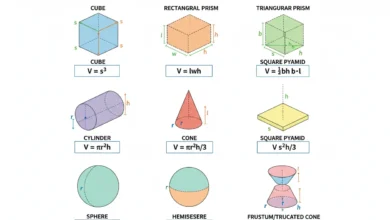
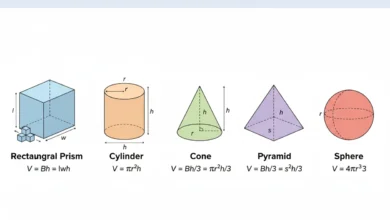
Geometric Meaning of a Perfect Cube
The term cube comes from geometry.
A cube with side length:
n
has volume:
V = n³
A cube measuring:
4 units × 4 units × 4 units
contains:
4³ = 64
cubic units.
Thus 64 can be visualized as 64 unit cubes arranged into a:
4 × 4 × 4
cube.
Difference Between Consecutive Perfect Cubes
Consider:
n³
and:
(n+1)³
Their difference is:
(n+1)³ – n³
Expand:
n³ + 3n² + 3n + 1 – n³
Therefore:
(n+1)³ – n³ = 3n² + 3n + 1
For example, between:
4³ = 64
and:
5³ = 125
the difference is:
3(4²) + 3(4) + 1
= 48 + 12 + 1
= 61
Check:
125 – 64 = 61
Differences Between the First Cubes
Perfect cubes:
1, 8, 27, 64, 125, 216, …
First differences:
7, 19, 37, 61, 91, …
Second differences:
12, 18, 24, 30, …
Third differences:
6, 6, 6, …
A cubic polynomial sequence has constant third differences.
This connects perfect cubes with broader number sequences.
Sum of the First n Odd Numbers Is Not the Cube Formula
A common pattern associated with perfect squares is:
1 + 3 + 5 + … + (2n-1) = n²
Perfect cubes follow different identities.
For example:
n³ – (n-1)³
produces the difference between consecutive cubes rather than simply the next odd number.
Keeping square and cube patterns distinct prevents sequence errors.
Sum of Consecutive Odd Numbers Can Produce Cubes
Each positive cube can be written as a sum of n consecutive odd numbers.
For example:
2³ = 8
and:
3 + 5 = 8
For:
3³ = 27
we have:
7 + 9 + 11 = 27
For:
4³ = 64
we have:
13 + 15 + 17 + 19 = 64
A general identity is:
n³ = (n²-n+1) + (n²-n+3) + … + (n²+n-1)
with n consecutive odd terms.
Sum of the First n Cubes
A remarkable identity is:
1³ + 2³ + 3³ + … + n³ = [n(n+1)/2]²
The sum of the first n cubes equals the square of the nth triangular number.
For example:
1³ + 2³ + 3³ + 4³
= 1 + 8 + 27 + 64
= 100
Now:
4(5)/2 = 10
and:
10² = 100
The identity holds.
Example: Sum of First Five Cubes
Use:
[n(n+1)/2]²
with:
n = 5
Then:
[5 × 6 / 2]²
= 15²
= 225
Check directly:
1 + 8 + 27 + 64 + 125
= 225
Therefore:
1³ + 2³ + 3³ + 4³ + 5³ = 225
Last Digit Patterns of Perfect Cubes
The last digit of an integer cube depends on the last digit of the original integer.
For decimal digits:
| n ends in | n³ ends in |
|---|---|
| 0 | 0 |
| 1 | 1 |
| 2 | 8 |
| 3 | 7 |
| 4 | 4 |
| 5 | 5 |
| 6 | 6 |
| 7 | 3 |
| 8 | 2 |
| 9 | 9 |
Every decimal digit can occur as the final digit of a perfect cube, unlike perfect squares, whose final digits are more restricted.
Cube Ending in 2
If a perfect cube ends in:
2
its cube root ends in:
8
because:
8³ = 512
Likewise, a cube ending in:
8
comes from a cube root ending in:
2
This one-to-one last-digit relationship can help with some mental cube-root problems.
Perfect Cubes Modulo 9
Cubes have restricted residues modulo 9.
Testing residues 0 through 8 shows that integer cubes modulo 9 can only be:
0, 1, or 8
Since:
8 ≡ -1 (mod 9)
this may also be written:
0, ±1 (mod 9)
Therefore a number congruent to:
2, 3, 4, 5, 6, or 7 mod 9
cannot be a perfect cube.
This is a useful necessary test, though passing it does not prove a number is a cube.
Example Using Modulo 9
Consider:
100
Calculate:
100 mod 9 = 1
Since 1 is a possible cube residue, the test does not rule it out.
But:
∛100
is not an integer.
Therefore 100 is not a perfect cube.
Modulo tests can eliminate candidates but do not always confirm them.
Perfect Cubes and Divisibility
Suppose a perfect cube is divisible by a prime p.
Its prime-factor exponent must occur in a multiple of 3.
For example, if a perfect cube is divisible by 2, its factorization contains at least:
2³ = 8
Therefore every even perfect cube is divisible by:
8
Likewise, every perfect cube divisible by 3 is actually divisible by:
3³ = 27
These properties follow directly from the prime-exponent criterion.
Example: Even Perfect Cubes
Take:
6³ = 216
Since 6 is even:
216 ÷ 8 = 27
exactly.
Likewise:
10³ = 1,000
and:
1,000 ÷ 8 = 125
Every even integer can be written:
2k
so:
(2k)³ = 8k³
which proves the result.
Factors of a Perfect Cube
The factors of a perfect cube reflect its prime exponents.
Suppose:
N = p^(3a)q^(3b)
The number of positive factors is:
(3a+1)(3b+1)
Unlike perfect squares, a perfect cube does not necessarily have an odd number of factors.
For example:
8 = 2³
has:
4
positive factors:
1, 2, 4, 8
So factor-count parity is not a universal test for perfect cubes.
Perfect Cubes That Are Also Perfect Squares
A positive number is both a perfect square and a perfect cube exactly when it is a perfect sixth power.
Why?
A perfect square needs every prime exponent divisible by 2.
A perfect cube needs every prime exponent divisible by 3.
Therefore the exponents must be divisible by:
LCM(2,3) = 6
For example:
64 = 2⁶
and:
64 = 8² = 4³
Therefore:
64 is both a perfect square and a perfect cube
Examples of Square-Cubes
Positive numbers that are both squares and cubes begin:
1, 64, 729, 4,096, 15,625, …
They are:
1⁶, 2⁶, 3⁶, 4⁶, 5⁶, …
For example:
729 = 27²
and:
729 = 9³
Therefore 729 belongs to both classes.
Perfect Cubes and Percentage Growth
The relative increase between consecutive perfect cubes can be measured using percentage growth.
For example:
3³ = 27
4³ = 64
Growth:
(64 – 27)/27 × 100%
= 37/27 × 100%
≈ 137.04%
Now compare:
10³ = 1,000
11³ = 1,331
Growth:
331/1,000 × 100%
= 33.1%
Although absolute gaps between cubes grow, their relative percentage growth eventually becomes smaller as n increases.
Percentage Difference Between Two Perfect Cubes
If two cube values are being compared as peers rather than as an earlier-to-later change, percentage difference uses their average as the reference.
For:
8 and 27
difference:
19
average:
17.5
Therefore:
19/17.5 × 100%
≈ 108.57%
This is distinct from percentage growth from 8 to 27, which uses 8 as its baseline.
Percentage Change Between Cube Values
The broader percentage change framework can describe movement between any two positive cube values.
For:
64 → 125
change:
61
Relative to 64:
61/64 × 100%
≈ 95.31%
The result describes change between values; it does not determine whether either number is itself a perfect cube.
Perfect Cubes and Permutation Rank
Permutation rank assigns an ordering position to a permutation, while perfect cubes classify integers by the power rule:
n³
The concepts are distinct, but a rank can itself happen to be a perfect cube.
For example, if an ordering convention assigns a permutation rank:
64
then that rank value is also:
4³
Its cube classification concerns the numerical rank, not how the permutation was ranked.
Perfect Cubes and Arithmetic Sequences
The perfect cubes themselves:
1, 8, 27, 64, …
do not form an arithmetic sequence because their consecutive differences are not constant.
For example:
8 – 1 = 7
27 – 8 = 19
64 – 27 = 37
Since:
7 ≠ 19 ≠ 37
the sequence is not arithmetic.
Perfect Cubes and Geometric Sequences
Perfect cubes also do not form a geometric sequence because consecutive ratios are not constant.
For example:
8/1 = 8
27/8 = 3.375
64/27 ≈ 2.370
The rule is instead:
aₙ = n³
Finding the Next Perfect Cube
Suppose the list is:
64, 125, 216, 343, …
Recognize:
64 = 4³
125 = 5³
216 = 6³
343 = 7³
The next is:
8³ = 512
Therefore:
Next perfect cube = 512
Finding the nth Positive Perfect Cube
The nth positive perfect cube is simply:
Cₙ = n³
For example, the 20th positive perfect cube is:
20³
= 20 × 20 × 20
= 8,000
Therefore:
C₂₀ = 8,000
Finding Which Cube a Number Is
Suppose:
4,913
is known to be a perfect cube.
Find:
∛4,913
Since:
17³ = 4,913
we get:
4,913 is the 17th positive perfect cube
The cube root provides the index.
Cubes Between Two Values
To identify perfect cubes between:
100 and 500
find nearby cube roots.
4³ = 64
5³ = 125
6³ = 216
7³ = 343
8³ = 512
Therefore the perfect cubes strictly between 100 and 500 are:
125, 216, 343
Common Mistake: Confusing Cube With Triple
Cubing a number does not mean multiplying it by 3.
For:
5³
the correct calculation is:
5 × 5 × 5
= 125
not:
5 × 3 = 15
The exponent tells how many equal factors are multiplied.
Common Mistake: Confusing Cubes and Squares
For:
n = 6
square:
6² = 36
cube:
6³ = 216
A square contains two equal factors.
A cube contains three.
The classifications should not be interchanged.
Common Mistake: Assuming Every Multiple of 8 Is a Cube
Every even perfect cube is divisible by 8, but the reverse is false.
For example:
24
is divisible by 8:
24 = 8 × 3
but:
∛24
is not an integer.
Therefore:
24 is not a perfect cube
A necessary property is not always a sufficient one.
Common Mistake: Forgetting Negative Cubes
Because:
(-n)³ = -n³
negative perfect cubes exist.
For example:
-125 = (-5)³
Therefore:
-125 is a perfect cube
How to Check a Perfect Cube
Suppose someone claims:
2,197
is a perfect cube.
Take the cube root or test a likely integer:
13³ = 13 × 13 × 13
= 169 × 13
= 2,197
Therefore:
2,197 is a perfect cube
Frequently Asked Questions
What is a perfect cube?
A perfect cube is an integer that can be written as:
n³
for some integer n.
What is the perfect cube formula?
C = n³ = n × n × n
What are the first ten positive perfect cubes?
1, 8, 27, 64, 125, 216, 343, 512, 729, 1,000
Is 64 a perfect cube?
Yes.
64 = 4³
Is 100 a perfect cube?
No. Its cube root is not an integer.
Is 125 a perfect cube?
Yes.
125 = 5³
Is 216 a perfect cube?
Yes.
216 = 6³
Is 0 a perfect cube?
Yes.
0 = 0³
Can perfect cubes be negative?
Yes.
-27 = (-3)³
How can prime factorization identify a perfect cube?
Every prime exponent must be divisible by 3.
Is every perfect cube a perfect square?
No.
For example:
8
is a cube but not a square.
When is a number both a perfect cube and a perfect square?
When it is a perfect sixth power.
Final Example
Determine whether:
13,824
is a perfect cube.
Prime-factorize:
13,824 = 2⁹ × 3³
The prime exponents are:
9 and 3
Both are divisible by 3.
Take one-third of each exponent:
2^(9/3) × 3^(3/3)
= 2³ × 3
= 8 × 3
= 24
Therefore:
13,824 = 24³
Check:
24² = 576
576 × 24 = 13,824
So:
13,824 is a perfect cube
and:
∛13,824 = 24
The defining test remains:
N is a perfect cube ⇔ N = n³ for some integer n
For positive integers, the equivalent prime-factor test is that every prime exponent is a multiple of 3.