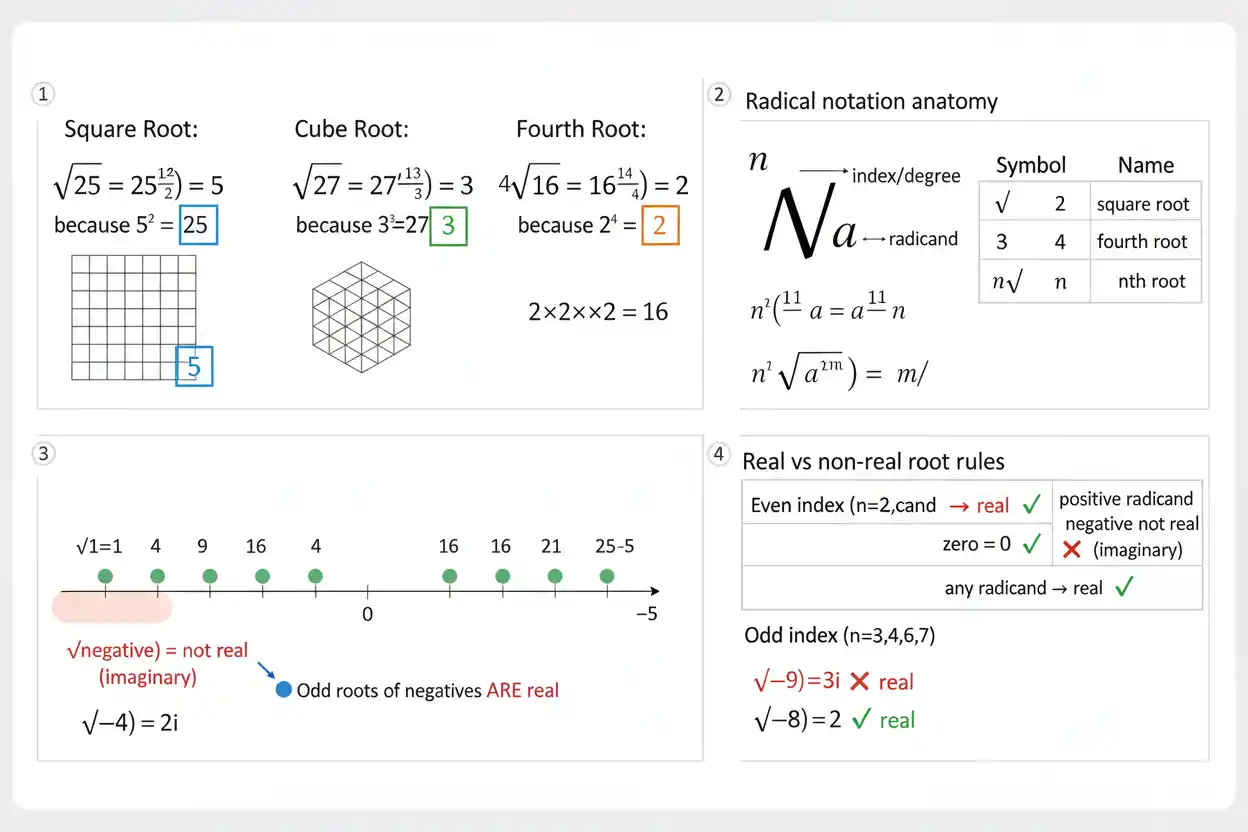

Roots reverse exponentiation. If a power asks what result is produced by repeatedly multiplying a base, a root asks which base produces a known result.
For example:
5² = 25
so:
√25 = 5
Similarly:
3³ = 27
so:
∛27 = 3
The general nth-root relationship is:
ⁿ√a = b ⇔ bⁿ = a
where n is the root index, a is the radicand, and b is a root.
Square roots, cube roots, and higher roots all follow this same inverse relationship, but their real-number behavior differs depending on whether the index is even or odd.
What Is a Root?
A root identifies a number that produces a given value when raised to a specified power.
If:
bⁿ = a
then:
b
is an nth root of:
a
For example:
2⁵ = 32
therefore:
⁵√32 = 2
The root operation reverses the corresponding power operation described by exponents.
Parts of a Radical
In:
ⁿ√a
n is the index.
a is the radicand.
The radical symbol is:
√
For square roots, the index 2 is normally omitted:
²√a = √a
For cube roots:
∛a
For fourth roots:
⁴√a
and so on.
Square Roots
A square root reverses squaring.
If:
b² = a
then b is a square root of a.
For example:
9² = 81
so:
√81 = 9
The dedicated square roots topic handles exact and decimal square-root calculations in greater depth.
Principal Square Root
The radical expression:
√a
denotes the principal, nonnegative square root when a ≥ 0.
Therefore:
√49 = 7
not:
±7
However, the equation:
x² = 49
has two solutions:
x = ±7
because:
7² = 49
and:
(-7)² = 49
This distinction between a radical value and equation solutions is essential.
Square Roots of Perfect Squares
A perfect square has an integer square root.
Examples:
√1 = 1
√4 = 2
√9 = 3
√16 = 4
√25 = 5
√100 = 10
For:
n ≥ 0
we have:
√(n²) = n
More generally for real n:
√(n²) = |n|
because the principal square root cannot be negative.
Non-Perfect Square Roots
If a positive integer is not a perfect square, its square root may be irrational.
For example:
√2 ≈ 1.41421356…
and:
√7 ≈ 2.64575131…
These are irrational numbers because their decimal expansions do not terminate or repeat.
When a decimal approximation is required, apply appropriate rounding rules only after retaining enough intermediate precision.
Cube Roots
A cube root reverses cubing.
If:
b³ = a
then:
∛a = b
For example:
4³ = 64
so:
∛64 = 4
The specialized cube roots page develops cube-root calculations, simplification, and perfect cubes in detail.
Cube Roots of Perfect Cubes
A perfect cube has an integer cube root.
Examples:
∛8 = 2
∛27 = 3
∛64 = 4
∛125 = 5
∛216 = 6
because:
2³ = 8
3³ = 27
4³ = 64
and so forth.
Cube Roots of Negative Numbers
Odd roots of negative real numbers are real.
For example:
(-3)³ = -27
therefore:
∛(-27) = -3
Similarly:
∛(-125) = -5
This behavior is fundamentally different from even roots.
nth Roots
An nth root generalizes square and cube roots.
The defining relationship is:
ⁿ√a = b ⇔ bⁿ = a
For example:
2⁴ = 16
therefore:
⁴√16 = 2
And:
3⁵ = 243
therefore:
⁵√243 = 3
The dedicated nth roots topic develops general index rules and higher-root calculations.
Even Roots
When the index is even:
n = 2,4,6,…
a negative radicand has no real nth root.
For example:
√(-9)
is not a real number.
Likewise:
⁴√(-16)
has no real value.
Why?
Any nonzero real number raised to an even power is positive:
(-2)⁴ = 16
2⁴ = 16
so no real fourth power can equal -16.
Odd Roots
When the index is odd:
n = 3,5,7,…
every real radicand has exactly one real nth root.
For example:
⁵√(-32) = -2
because:
(-2)⁵ = -32
Thus odd roots preserve the sign of the radicand.
Roots in the Real Number System
The real numbers determine which radical expressions have real values.
For an even index:
ⁿ√a is real only when a ≥ 0
For an odd index:
ⁿ√a is real for every real a
For example:
√16 = 4
is real.
∛(-8) = -2
is real.
But:
√(-16)
is not real.
Roots as Fractional Exponents
Roots can be written using fractional exponents:
ⁿ√a = a^(1/n)
For example:
√16 = 16^(1/2)
∛27 = 27^(1/3)
⁴√81 = 81^(1/4)
This gives a direct algebraic connection between roots and powers.
Combined Root and Power Exponents
More generally:
ⁿ√(aᵐ) = a^(m/n)
when the expression is defined in the number system being used.
For example:
³√(8²)
can be written:
8^(2/3)
Since:
∛8 = 2
we get:
2² = 4
Therefore:
8^(2/3) = 4
Example: 27^(2/3)
Interpret:
27^(2/3)
as:
(∛27)²
Since:
∛27 = 3
then:
3² = 9
Therefore:
27^(2/3) = 9
Simplifying Square Roots
Suppose:
√72
Find a perfect-square factor:
72 = 36 × 2
Then:
√72 = √36 × √2
= 6√2
Therefore:
√72 = 6√2
The simplified radical is exact.
Its decimal approximation is:
≈ 8.485
if a decimal is needed.
Simplifying Cube Roots
Consider:
∛54
Factor:
54 = 27 × 2
Then:
∛54 = ∛27 × ∛2
= 3∛2
Therefore:
∛54 = 3∛2
The factor 27 leaves the cube root because:
27 = 3³
Simplifying nth Roots With Prime Factors
Prime factorization can reveal complete groups matching the root index.
Consider:
⁴√(16 × 3)
Since:
16 = 2⁴
we get:
⁴√(2⁴ × 3)
= 2⁴√3
Therefore:
⁴√48 = 2⁴√3
The same idea applies to square, cube, and higher roots.
Product Rule for Roots
For nonnegative real a and b when using even roots:
√(ab) = √a × √b
For example:
√(9 × 5)
= √9 × √5
= 3√5
Likewise, when the relevant real roots are defined:
ⁿ√(ab) = ⁿ√a × ⁿ√b
Care is required with even roots and negative values because the individual real radicals may not exist.
Quotient Rule for Roots
For suitable real values and:
b ≠ 0
we have:
ⁿ√(a/b) = ⁿ√a / ⁿ√b
For example:
√(25/4)
= √25/√4
= 5/2
Therefore:
√(25/4) = 2.5
Roots Do Not Distribute Over Addition
A common error is:
√(a+b) = √a + √b
This is generally false.
For example:
√(9+16)
= √25
= 5
But:
√9 + √16
= 3 + 4
= 7
Therefore:
√(a+b) ≠ √a + √b in general
The same warning applies to subtraction.
Root of a Power
For nonnegative real a:
√(a²) = a
For arbitrary real a:
√(a²) = |a|
For example:
√((-5)²)
= √25
= 5
not:
-5
because the radical symbol denotes the principal square root.
Odd Root of an Odd Power
For every real a:
∛(a³) = a
For example:
∛((-4)³)
= ∛(-64)
= -4
No absolute value is needed because odd roots preserve sign.
Solving x² = a
For:
a > 0
the equation:
x² = a
has:
x = ±√a
For example:
x² = 36
gives:
x = ±6
because:
6² = 36
and:
(-6)² = 36
If:
a = 0
then:
x = 0
If:
a < 0
there is no real solution.
Solving x³ = a
For every real a:
x = ∛a
For example:
x³ = -216
gives:
x = ∛(-216)
= -6
because:
(-6)³ = -216
Only one real solution occurs for a simple odd-power equation of this form.
Solving xⁿ = a
The number of real solutions depends on the index.
For even positive integer n:
If:
a > 0
then:
x = ±ⁿ√a
If:
a = 0
then:
x = 0
If:
a < 0
there are no real solutions.
For odd n:
x = ⁿ√a
gives exactly one real solution for every real a.
Estimating Square Roots
Suppose you need:
√50
Nearby perfect squares are:
7² = 49
and:
8² = 64
Therefore:
7 < √50 < 8
Since 50 is very close to 49, √50 is only slightly above 7.
Numerically:
√50 ≈ 7.071
This bounding method is useful even before using a scientific function.
Estimating Cube Roots
Consider:
∛100
Nearby cubes:
4³ = 64
5³ = 125
Therefore:
4 < ∛100 < 5
Numerically:
∛100 ≈ 4.642
Again, perfect powers establish a useful range.
Calculating Roots With Scientific Functions
Many calculators group roots with scientific functions.
A square-root key evaluates:
√x
while nth roots may be entered using either:
ⁿ√x
or:
x^(1/n)
For example:
7^(1/3)
produces an approximation to:
∛7
When entering fractional exponents, parentheses help preserve the intended order of operations:
7^(1/3)
rather than an ambiguous sequence of keystrokes.
Rounding Root Approximations
Roots of non-perfect powers often require decimal approximations.
For example:
√3 ≈ 1.732050807…
Rounded to three decimal places:
√3 ≈ 1.732
Rounded to three significant figures:
√3 ≈ 1.73
The appropriate precision depends on what the problem asks for.
Exact Form vs. Decimal Form
Suppose:
√20 = 2√5
The expression:
2√5
is exact.
A decimal such as:
4.472
is approximate.
When later calculations depend on the value, preserving the exact radical or several extra decimal digits usually avoids unnecessary rounding error.
Roots and Ratios
Roots can appear inside ratios.
For example:
√8 : √2
has quotient:
√8/√2
Simplify:
√(8/2)
= √4
= 2
Therefore:
√8 : √2 = 2:1
An expression containing irrational components can sometimes simplify to a rational ratio.
Roots and Remainders
remainders belong primarily to integer division, while roots reverse powers.
However, integer roots can help identify power structures that affect divisibility.
For example:
64 = 4³
so:
∛64 = 4
The same integer 64 divided by 4 has:
remainder 0
because 4 is a factor.
The concepts are distinct: a root identifies a power base, while a remainder measures leftover quantity after division.
Common Mistake: Writing √25 = ±5
The radical:
√25
means the principal nonnegative square root:
5
The symbol:
±
appears when solving an equation such as:
x² = 25
which gives:
x = ±5
Common Mistake: Treating Even and Odd Roots the Same
The expression:
∛(-8)
is real:
-2
But:
√(-8)
is not real.
Always check whether the root index is even or odd before evaluating a negative radicand.
Common Mistake: Forgetting Absolute Value
For real x:
√(x²) = |x|
For:
x = -7
we have:
√((-7)²)
= √49
= 7
not -7.
Common Mistake: Distributing a Root Across Addition
In general:
√(a+b) ≠ √a + √b
For:
a = 4
b = 5
left side:
√9 = 3
right side:
2 + √5
which is not 3.
Common Mistake: Rounding Too Early
Suppose a longer calculation uses:
√2
Replacing it immediately with:
1.4
can introduce substantial error.
Using:
√2
exactly, or retaining several decimal places until the final step, produces a more reliable result.
Frequently Asked Questions
What are roots in mathematics?
Roots reverse powers. If bⁿ = a, then b is an nth root of a.
What is the general root formula?
ⁿ√a = b ⇔ bⁿ = a
What is a square root?
A square root reverses squaring.
√a = b
means:
b² = a
for the principal nonnegative root when a ≥ 0.
What is a cube root?
A cube root reverses cubing:
∛a = b ⇔ b³ = a
What is an nth root?
An nth root satisfies:
ⁿ√a = b ⇔ bⁿ = a
Is √25 equal to ±5?
No. √25 = 5. The equation x² = 25 has solutions x = ±5.
Can you take a square root of a negative number?
Not within the real-number system.
Can you take a cube root of a negative number?
Yes.
For example:
∛(-27) = -3
How are roots related to exponents?
ⁿ√a = a^(1/n)
Is √2 rational?
No. It is irrational.
Is √64 rational?
Yes.
√64 = 8
Why is √(x²) equal to |x|?
Because the principal square root is nonnegative.
Final Example
Evaluate and classify:
⁴√81
The root asks:
What nonnegative number raised to the fourth power equals 81?
Since:
3⁴ = 3 × 3 × 3 × 3
= 81
we have:
⁴√81 = 3
Using fractional exponents:
81^(1/4) = 3
Now consider the equation:
x⁴ = 81
Because the exponent is even and 81 is positive:
x = ±3
Both satisfy:
3⁴ = 81
and:
(-3)⁴ = 81
The central relationship for all roots is:
ⁿ√a = b ⇔ bⁿ = a
Square roots use index 2, cube roots use index 3, and nth roots extend the same inverse-power idea to any positive integer index. The key real-number distinction is that even roots require nonnegative radicands, while odd roots can accept any real radicand.