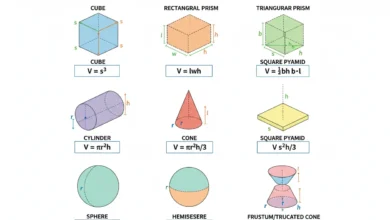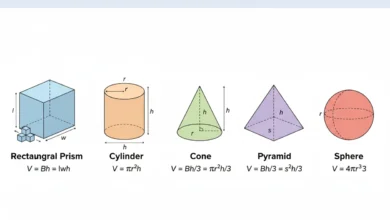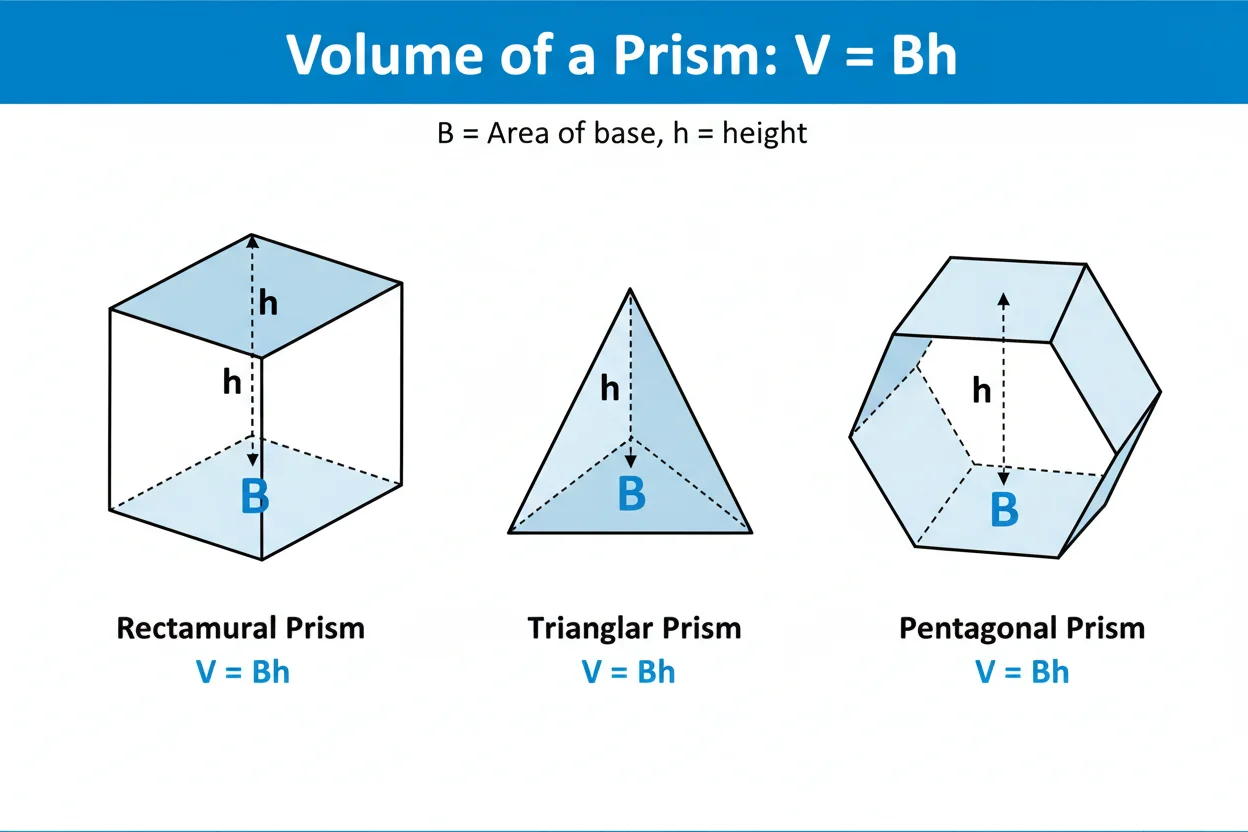
Prism volume measures the three-dimensional space inside a prism. For any prism, the fundamental formula is V = Bh, where B is the area of one base and h is the perpendicular distance between the two parallel congruent bases. A rectangular prism therefore uses V = lwh, while a triangular prism uses V = (bh/2)L when b and h describe the triangular base and L is the prism’s perpendicular length. The same V = Bh relationship applies to right and oblique prisms as long as h is measured perpendicular to the bases. Because the base shape can vary, solving prism volume usually has two stages: calculate the base area with the appropriate two-dimensional formula, then multiply by the prism height. Prism volume is measured in cubic units and can be rearranged to find a missing height, base area, or base dimension.
What Is a Prism?
A prism is a three-dimensional solid with two:
parallel
congruent
bases.
The bases are connected by lateral faces.
The base shape determines the prism’s name.
Examples include:
triangular prism
rectangular prism
pentagonal prism
hexagonal prism
A right prism has lateral edges perpendicular to the bases.
An oblique prism is slanted, but its volume still depends on the perpendicular distance between its bases.
General Prism Volume Formula
For every prism:
V = Bh
where:
V = volume
B = area of one base
h = perpendicular distance between the bases
The symbol B represents an area, not a base side length.
That distinction is essential.
Basic Prism Volume Example
Suppose a prism has:
base area B = 24 cm²
and:
height h = 10 cm
Then:
V = Bh
= 24(10)
Therefore:
V = 240 cm³
Because area is multiplied by another length:
cm² × cm = cm³
the result has cubic units.
Why Prism Volume Is Base Area × Height
A prism has the same cross-sectional area parallel to its bases throughout its perpendicular height.
Imagine slicing it into very thin layers parallel to a base.
Each layer has area:
B
Stacking those constant-area layers through height h gives:
V = Bh
This is the same structural principle behind rectangular and cylindrical volume formulas.
Rectangular Prism Volume
For a rectangular prism, the base can be a rectangle with:
B = lw
If the prism height is h:
V = lwh
where:
l = length
w = width
h = perpendicular height
This familiar formula is simply:
V = Bh
with:
B = lw
Rectangular Prism Example
Suppose:
l = 8
w = 5
h = 12
Then:
V = 8(5)(12)
= 480
cubic units.
Alternatively:
B = 8(5) = 40
Then:
V = 40(12)
= 480
Cube Volume
A cube is a rectangular prism with:
l = w = h = s
Therefore:
V = s³
If:
s = 6
then:
V = 6³
Therefore:
V = 216
cubic units.
Triangular Prism Volume
For a triangular prism:
V = B L
where L is the perpendicular prism length and B is the area of the triangular base.
If the triangle has base b and perpendicular altitude h_t:
B = bh_t/2
Therefore:
V = (bh_t/2)L
The two heights must not be confused:
h_t = height inside the triangular base
L = perpendicular distance between the two triangular bases
Triangular Prism Example
Suppose the triangular base has:
b = 6
h_t = 4
Then:
B = 6(4)/2
= 12
If the prism length is:
L = 10
then:
V = 12(10)
Therefore:
V = 120
cubic units.
Triangle Base From Three Sides
A triangular prism may give the three side lengths of its base rather than a triangular altitude.
Then Heron Formula can find the base area.
For side lengths:
a, b, c
calculate:
s = (a + b + c)/2
Then:
B = √[s(s − a)(s − b)(s − c)]
Finally:
V = Bh
Heron Formula Prism Example
Suppose the triangular base has sides:
5, 5, 6
Semiperimeter:
s = 8
Base area:
B = √[8·3·3·2]
= 12
If prism height is:
9
then:
V = 12(9)
Therefore:
V = 108
cubic units.
Parallelogram Base Prism
If the prism base is a parallelogram:
B = b h_b
where h_b is the perpendicular height within the parallelogram.
Then:
V = b h_b h_p
where h_p is the prism’s perpendicular height.
The Parallelogram Area calculation must be completed before multiplying by prism height.
Parallelogram Base Example
Suppose the base has:
b = 10
h_b = 6
So:
B = 60
If:
h_p = 8
then:
V = 60(8)
Therefore:
V = 480
cubic units.
Parallelogram Base From Sides and Angle
If the base has adjacent sides:
a
and:
b
with included angle:
θ
then:
B = ab sinθ
Therefore prism volume is:
V = ab h_p sinθ
Suppose:
a = 5
b = 8
θ = 30°
h_p = 12
Then:
B = 5(8)(1/2)
= 20
and:
V = 20(12)
Therefore:
V = 240
Trapezoidal Prism
If a prism has trapezoidal bases with parallel sides:
b₁
b₂
and perpendicular trapezoid height:
h_t
then:
B = (b₁ + b₂)h_t/2
Prism volume:
V = [(b₁ + b₂)h_t/2]h_p
where h_p is the perpendicular distance between the trapezoidal bases.
Trapezoidal Prism Example
Suppose:
b₁ = 8
b₂ = 14
h_t = 5
Then:
B = (8 + 14)(5)/2
= 55
If:
h_p = 10
then:
V = 550
cubic units.
Regular Polygonal Prism
A prism can have a regular polygon as its base.
For a regular polygon with apothem a and perimeter P:
B = aP/2
Using Regular Polygon Area:
V = aPh/2
This works for regular pentagonal, hexagonal, octagonal, and other regular polygonal prisms.
Regular Hexagonal Prism Example
Suppose a regular hexagonal base has:
perimeter P = 36
apothem a = 3√3
Then:
B = (3√3)(36)/2
= 54√3
If prism height is:
h = 10
then:
V = 540√3
Approximately:
V ≈ 935.31
cubic units.
Regular Polygon Base From Exterior Angle
If the regular base’s Exterior Angles are known:
E = 360°/n
so:
n = 360°/E
This can identify the base polygon.
If:
E = 45°
then:
n = 8
so the prism has regular octagonal bases.
Length information is still required to calculate the base area B.
Base Identification From Polygon Diagonals
The number of Polygon Diagonals can also reveal the number of base sides.
If a polygonal base has D diagonals:
D = n(n − 3)/2
Suppose:
D = 20
Then:
n = 8
The base is an octagon.
This identifies the base shape, but its actual area still requires dimensions.
Find Prism Height From Volume
Starting with:
V = Bh
divide by B:
h = V/B
Suppose:
V = 450
B = 30
Then:
h = 450/30
Therefore:
h = 15
Find Base Area From Volume
From:
V = Bh
solve:
B = V/h
Suppose:
V = 720
h = 12
Then:
B = 720/12
Therefore:
B = 60
square units.
If the base shape is known, this base area can then be used to recover missing base dimensions.
Find Rectangle Width From Prism Volume
For a rectangular prism:
V = lwh
Suppose:
V = 600
l = 10
h = 6
Then:
w = V/(lh)
= 600/(60)
Therefore:
w = 10
Find Cube Edge From Volume
For a cube:
V = s³
Therefore:
s = ∛V
If:
V = 343
then:
s = ∛343
Therefore:
s = 7
Right Prism Versus Oblique Prism
In a right prism, the lateral edges are perpendicular to the bases.
The lateral edge length equals the perpendicular prism height.
In an oblique prism, lateral edges are slanted.
The volume formula remains:
V = Bh
but h must be the shortest perpendicular distance between the parallel base planes.
Do not substitute a slanted lateral edge for h unless it is perpendicular.
Oblique Prism Example
Suppose an oblique prism has:
B = 50
lateral edge = 13
but perpendicular height:
h = 12
Then:
V = 50(12)
Therefore:
V = 600
Using:
50(13) = 650
would be incorrect because 13 is not the perpendicular height.
Finding Perpendicular Height From a Slanted Edge
An oblique prism problem may give lateral edge L and an angle.
If L makes angle θ with the base plane, the perpendicular component is:
h = L sinθ
If it makes angle θ with the perpendicular direction instead:
h = L cosθ
The diagram determines which ratio is appropriate.
Once h is found:
V = Bh
Oblique Prism Trigonometry Example
Suppose:
B = 40
L = 10
and the lateral edge makes:
30°
with the base plane.
Then:
h = 10sin30°
= 5
Therefore:
V = 40(5)
= 200
cubic units.
Why Slant Does Not Change Volume for Equal B and h
Imagine sliding the top base of a right prism sideways without changing its shape or perpendicular distance from the bottom base.
The solid becomes oblique.
Every horizontal cross section parallel to the bases still has area:
B
and the perpendicular height remains:
h
Therefore the volume remains:
Bh
The sideways shear changes shape but not volume.
Prism Versus Pyramid Volume
A prism and pyramid with the same base area B and perpendicular height h have:
V_prism = Bh
and:
V_pyramid = Bh/3
Therefore:
V_prism = 3V_pyramid
The Pyramid Volume specialist page handles the one-third factor and pyramid-specific geometry.
Prism and Pyramid Example
Suppose both solids have:
B = 48
h = 10
Prism:
V = 48(10)
= 480
Pyramid:
V = 48(10)/3
= 160
Therefore the prism contains:
3
times the volume.
Prism Versus Cylinder
A cylinder also has constant cross-sectional area and uses:
V = Bh
For a circular base:
B = πr²
so:
V = πr²h
The Cylinder Volume formula therefore follows the same base-area-times-height principle.
A cylinder is not a polygonal prism in the strict elementary definition, but the volume structures are analogous.
Prism Versus Frustum
A prism has congruent bases and constant parallel cross-sectional area.
A frustum has two similar but differently sized bases.
Therefore Frustum Volume uses:
V = h(B₁ + B₂ + √(B₁B₂))/3
rather than:
V = Bh
The equal-base condition is what makes prism volume simpler.
Prism Volume and the Pythagorean Theorem
The Pythagorean Theorem often appears when prism dimensions are supplied indirectly through face or space diagonals.
For a rectangular prism with dimensions:
l, w, h
a face diagonal might satisfy:
d_face² = l² + w²
A space diagonal satisfies:
d_space² = l² + w² + h²
Once the missing dimension is recovered:
V = lwh
Rectangular Prism Space Diagonal
For a rectangular prism:
d = √(l² + w² + h²)
Suppose:
d = 13
l = 3
w = 4
Then:
13² = 3² + 4² + h²
169 = 9 + 16 + h²
Therefore:
h² = 144
so:
h = 12
Volume:
V = 3(4)(12)
Therefore:
V = 144
Face Diagonal Example
Suppose a rectangular prism has:
base width = 5
base diagonal = 13
and base length l is unknown.
Using:
l² + 5² = 13²
we get:
l² = 144
Therefore:
l = 12
If prism height is:
8
then:
V = 12(5)(8)
= 480
cubic units.
Prism Volume From Coordinate Base Vertices
If a prism’s base vertices are given as coordinates, first calculate base area B.
For a rectangular or parallelogram base, coordinate vectors can determine the area.
For a triangular base, coordinate area or side lengths can be used.
Then:
V = Bh
provided the perpendicular prism height is known.
Coordinate Triangular Base Example
Suppose a triangular base has vertices:
A = (0,0)
B = (6,0)
C = (0,8)
This is a right triangle with:
base = 6
height = 8
Therefore:
B = 6(8)/2
= 24
If the prism extends perpendicular to the base by:
10
then:
V = 240
cubic units.
Coordinate Base With Distance Formula
If base side lengths are not horizontal or vertical, the Distance Formula can determine them:
d = √[(x₂ − x₁)² + (y₂ − y₁)²]
Those lengths can feed:
Heron’s formula
parallelogram formulas
regular polygon formulas
or another appropriate base-area method.
Volume follows only after B is known.
Polar Coordinates and Prism Bases
A polygonal base may be represented in Polar and Rectangular Form.
For a polar vertex:
(r,θ)
convert with:
x = r cosθ
y = r sinθ
Once all base vertices are in rectangular coordinates, coordinate-area methods can calculate B.
Then:
V = Bh
Polar conversion is an intermediate geometry step rather than a new prism-volume equation.
Regular Base in Polar Form
A regular n-gon centered at the origin can have vertices:
(R, θ₀ + 2πk/n)
where:
k = 0,1,…,n−1
The equal angular spacing can be used to calculate side length:
s = 2R sin(π/n)
Then the regular polygon base area can be found from its side/apothem geometry before multiplying by prism height.
Point-Slope Form and Prism Geometry
Point-Slope Form may appear when edges or cross-sectional boundaries of a prism are defined in coordinates.
For a line through:
(x₁,y₁)
with slope m:
y − y₁ = m(x − x₁)
Line equations can help determine base vertices or intersection points.
After the finite base shape is established, its area B can be calculated.
The line equation itself is not a volume formula.
Building a Base From Line Intersections
Suppose a polygonal base is bounded by several line equations.
Find the Line Intersection of consecutive boundary lines to determine the base vertices.
Then calculate:
side lengths
diagonals
or:
coordinate area
as needed.
Once the base area is established:
prism volume = base area × perpendicular height
Prism Volume and Perimeter
The Perimeter of a prism base may help determine base area when the base is regular.
For a regular polygon:
P = ns
If apothem a is also known:
B = aP/2
Therefore:
V = aPh/2
For an irregular base, perimeter alone is generally insufficient to determine area.
Perimeter Example
Suppose a regular polygonal base has:
P = 48
apothem = 6
Then:
B = 6(48)/2
= 144
If prism height is:
10
then:
V = 1440
cubic units.
Prism Surface Area Versus Volume
Volume measures interior space:
V = Bh
Surface area measures the total area of the solid’s boundary.
For a right prism with base perimeter P, base area B, and height h:
S = 2B + Ph
The term:
Ph
represents the lateral rectangular faces in a right prism.
The two measurements answer different questions and use different units.
Rectangular Prism Surface Area Comparison
For dimensions:
l, w, h
volume is:
V = lwh
Surface area is:
S = 2(lw + lh + wh)
For:
l = 4
w = 5
h = 6
volume:
V = 120
Surface area:
S = 2(20 + 24 + 30)
= 148
The numerical values are not directly comparable because one uses cubic units and the other square units.
Composite Prism Volume
A complicated prism-like solid can often be split into simpler prisms.
If the pieces do not overlap:
total volume = V₁ + V₂ + …
If a section is removed:
remaining volume = outer volume − removed volume
The key is to identify the correct base area and perpendicular height for each component.
L-Shaped Prism Example
Suppose an L-shaped base can be treated as an:
8 × 6
rectangle with a:
3 × 2
rectangle removed.
Base area:
B = 48 − 6
= 42
If the prism height is:
10
then:
V = 42(10)
Therefore:
V = 420
cubic units.
Hollow Rectangular Prism
Suppose an outer rectangular prism has dimensions:
L, W, H
and a rectangular hole extends completely through it with cross-sectional dimensions:
l, w
Then:
V_material = LWH − lwH
if the hole extends through the same height H.
Factor:
V_material = H(LW − lw)
This is equivalent to multiplying the remaining base area by H.
Hollow Prism Example
Outer base:
10 × 8
Inner opening:
6 × 4
Height:
12
Remaining base area:
B = 80 − 24
= 56
Therefore material volume:
V = 56(12)
= 672
cubic units.
Scaling Prism Volume
If every linear dimension is multiplied by factor k:
V_new = k³V_old
The reason is that base area scales by:
k²
while height scales by:
k
Therefore:
k² × k = k³
Scaling Example
Suppose a prism has volume:
90
and every dimension doubles.
Then:
V_new = 2³(90)
= 720
The volume becomes eight times as large.
Doubling Only the Prism Height
If B remains fixed and h doubles:
V_new = B(2h)
Therefore:
V_new = 2V
Prism volume varies linearly with perpendicular height when the base is unchanged.
Doubling All Base Lengths Only
Suppose every linear dimension of the base doubles while prism height remains fixed.
Then base area becomes:
4B
Therefore:
V_new = 4Bh
So volume becomes:
4
times as large.
Similar Prisms
If two geometrically similar prisms have linear scale factor:
k
their volumes satisfy:
V₂/V₁ = k³
Their corresponding surface areas scale by:
k²
and corresponding lengths scale by:
k
These relationships are useful when exact dimensions are not required individually.
Volume Ratio Example
Suppose one prism is geometrically similar to another with:
linear scale factor = 3
If the smaller volume is:
40
then:
V_large = 3³(40)
= 27(40)
Therefore:
V_large = 1080
Prism Capacity
A prism-shaped container’s ideal internal capacity follows:
V = Bh
provided B and h use internal measurements.
For a rectangular tank:
V = lwh
If:
l = 80 cm
w = 40 cm
h = 50 cm
then:
V = 160,000 cm³
Since:
1000 cm³ = 1 L
the ideal capacity is:
160 L
Internal Versus External Dimensions
A container’s external dimensions include wall thickness.
Capacity requires the internal base area and internal height.
Using outside dimensions can overestimate usable storage volume.
The geometric formula remains:
V = Bh
but B and h must correspond to the interior space being measured.
Unit Analysis
If:
B = 24 cm²
and:
h = 10 cm
then:
V = 24 cm² × 10 cm
Therefore:
V = 240 cm³
Prism volume always uses cubic units.
Converting Cubic Units
Since:
1 m = 100 cm
then:
1 m³ = 100³ cm³
Therefore:
1 m³ = 1,000,000 cm³
A linear conversion factor must be cubed when converting volume.
Liters and Cubic Units
Useful metric relationships include:
1 cm³ = 1 mL
1000 cm³ = 1 L
1 m³ = 1000 L
These relationships are useful when prism volume represents container capacity.
Exact Versus Approximate Volume
If base area contains a radical or π-like expression from earlier geometry, retain exact values when possible.
For example:
B = 24√3
h = 5
gives:
V = 120√3
Approximately:
V ≈ 207.85
Keeping the exact form prevents cumulative rounding error.
Common Prism Volume Mistakes
A frequent mistake is treating B as a base length rather than the entire base area.
The formula is:
V = Bh
not simply:
base side × height
unless the base area happens to equal that base-side measurement numerically.
Another error is using slanted lateral edge length instead of perpendicular height in an oblique prism.
For triangular prisms, distinguish the triangle’s altitude from the prism’s height.
Use cubic units, not square units.
If the base is irregular or composite, calculate its complete area before multiplying by prism height.
Do not insert the pyramid factor:
1/3
into a prism formula.
When dimensions come from diagonals, recover the actual side or perpendicular height before calculating volume.
Finally, make sure the two selected bases are congruent and parallel; otherwise the solid may not be a prism.
Frequently Asked Questions
What is the prism volume formula?
V = Bh
What does B represent?
B is the area of one base.
What does h represent?
h is the perpendicular distance between the two parallel bases.
What is rectangular prism volume?
V = lwh
What is cube volume?
V = s³
What is triangular prism volume?
V = B h_p
where B is the triangular base area. If the triangle has base b and altitude h_t:
V = (bh_t/2)h_p
Does V = Bh work for an oblique prism?
Yes, provided h is the perpendicular distance between the bases.
How do you find prism height?
h = V/B
How do you find base area?
B = V/h
How is prism volume related to pyramid volume?
For the same B and h:
V_prism = 3V_pyramid
How is prism volume related to cylinder volume?
Both follow the base-area-times-height principle:
V = Bh
A cylinder uses:
B = πr²
Can polygon diagonals determine prism volume?
Not by themselves. They may identify or help dimension the base, but volume still requires base area and perpendicular height.
How does prism volume scale?
If every length is multiplied by k:
volume is multiplied by k³
What units does prism volume use?
Cubic units such as cm³, m³, ft³, or in³.
How can I check a prism-volume answer?
Calculate the base area independently, verify that the chosen height is perpendicular to the bases, multiply B by h, and confirm that the final units are cubic.