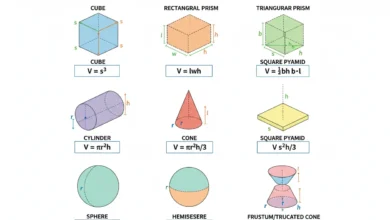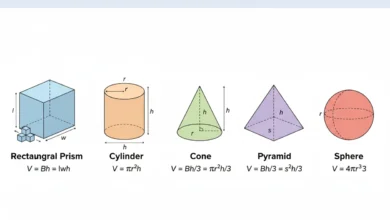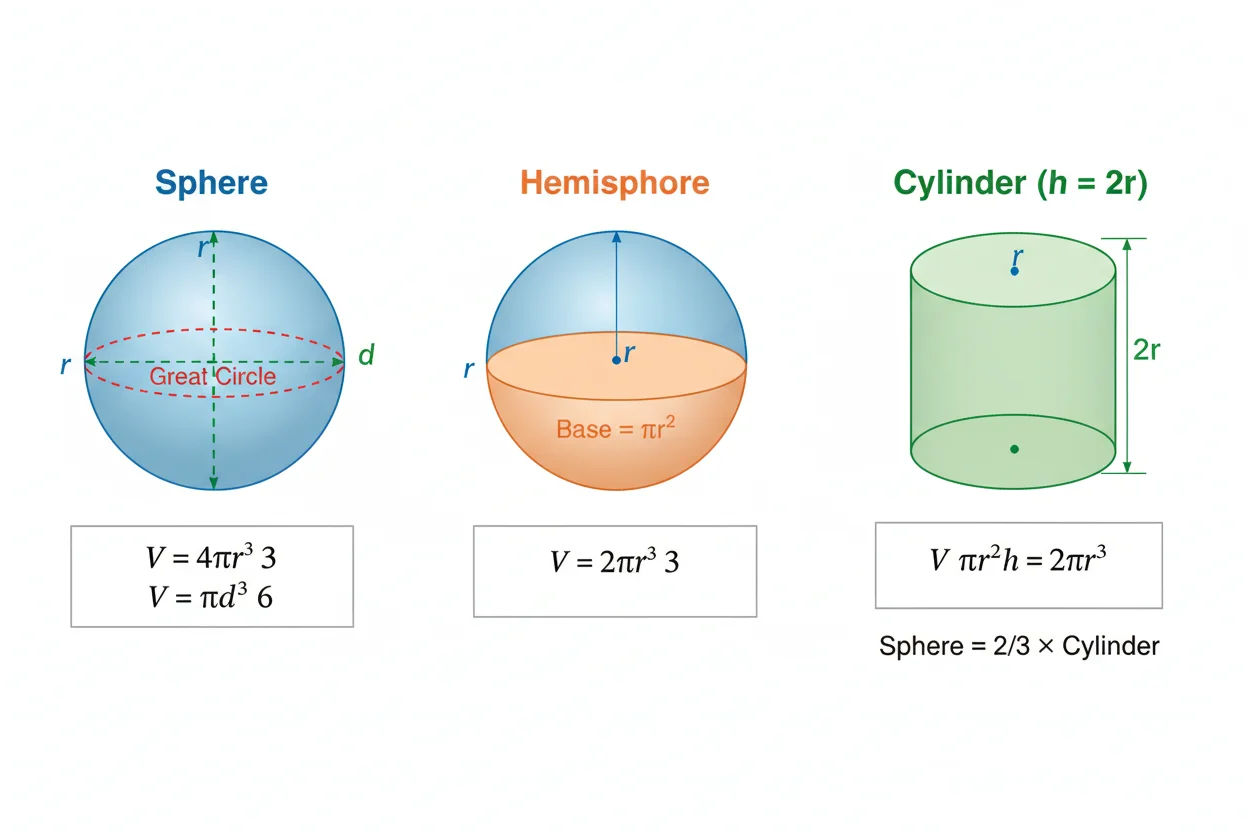

Sphere volume measures the three-dimensional space enclosed inside a sphere. For radius r, the sphere volume formula is V = 4πr³/3. If diameter d is known instead, the equivalent formula is V = πd³/6. Because radius is cubed, volume grows rapidly as a sphere becomes larger: doubling the radius increases volume by a factor of 8, while tripling it increases volume by a factor of 27. A hemisphere contains exactly half the volume of a sphere, giving V = 2πr³/3. The formula can also be rearranged to determine radius or diameter from a known volume. Sphere volume is measured in cubic units and is used in capacity, displacement, scaling, composite-solid, hollow-shell, and comparison problems.
Sphere Volume Formula
For a sphere:
V = 4πr³/3
where:
V = volume
r = radius
π ≈ 3.14159
The radius is the distance from the sphere’s center to its surface.
Sphere Volume Using Diameter
Because:
d = 2r
we have:
r = d/2
Substitute into:
V = 4πr³/3
Then:
V = 4π(d/2)³/3
= 4πd³/(8·3)
Therefore:
V = πd³/6
So either formula can be used:
V = 4πr³/3
or:
V = πd³/6
Basic Sphere Volume Example
Suppose:
r = 3 cm
Then:
V = 4π(3³)/3
= 4π(27)/3
Therefore:
V = 36π cm³
Approximately:
V ≈ 113.10 cm³
Example Using Diameter
Suppose:
d = 10 m
Then:
V = π(10³)/6
= 1000π/6
Therefore:
V = 500π/3 m³
Approximately:
V ≈ 523.60 m³
Using radius:
r = 5
produces the same result.
Why Sphere Volume Uses Cubic Units
Volume measures three-dimensional space.
If radius is measured in centimeters:
r³ → cm³
Therefore:
4πr³/3
uses cubic centimeters.
Common volume units include:
mm³
cm³
m³
in³
ft³
This differs from Sphere Surface Area, which uses square units.
Find Radius From Sphere Volume
Start with:
V = 4πr³/3
Multiply by 3:
3V = 4πr³
Divide by:
4π
Then:
r³ = 3V/(4π)
Take the cube root:
r = ∛[3V/(4π)]
Radius Example
Suppose:
V = 288π
Then:
r = ∛[3(288π)/(4π)]
= ∛216
Therefore:
r = 6
Check:
4π(6³)/3 = 288π
Find Diameter From Volume
Using:
V = πd³/6
solve:
d³ = 6V/π
Therefore:
d = ∛(6V/π)
Suppose:
V = 36π
Then:
d = ∛216
Therefore:
d = 6
The corresponding radius is:
3
Check an Inverse Problem
Suppose:
V = 500π/3
Then:
r³ = [3(500π/3)]/(4π)
= 125
Therefore:
r = 5
Substitute:
V = 4π(125)/3
= 500π/3
The calculation is verified.
Volume of a Hemisphere
A hemisphere is exactly half of a sphere.
Therefore:
V_hemisphere = 1/2(4πr³/3)
So:
V_hemisphere = 2πr³/3
Hemisphere Example
Suppose:
r = 6
Then:
V = 2π(6³)/3
= 2π(216)/3
Therefore:
V = 144π
cubic units.
Two identical hemispheres together contain:
288π
which equals the volume of the full sphere.
Sphere Volume Versus Surface Area
Sphere surface area:
A = 4πr²
Sphere volume:
V = 4πr³/3
Divide volume by surface area:
V/A = r/3
Equivalently:
A/V = 3/r
The extra factor of r explains why volume grows faster than surface area.
Example of A/V
For:
r = 3
we have:
A/V = 3/3
Therefore:
A/V = 1
The numerical area and volume expressions are both:
36π
but their units remain different:
square units versus cubic units
Find Volume From Surface Area
If surface area A is known:
r = √[A/(4π)]
Then:
V = 4πr³/3
Suppose:
A = 144π
Then:
r = √36
= 6
Therefore:
V = 4π(216)/3
= 288π
Find Volume From Great-Circle Area
A great circle has area:
K = πr²
Therefore:
r = √(K/π)
Then sphere volume is:
V = 4π/3 · (K/π)^(3/2)
Usually the cleaner method is to determine r first.
Great-Circle Example
Suppose the sphere’s great-circle area is:
49π
Then:
r = 7
Sphere volume:
V = 4π(343)/3
Therefore:
V = 1372π/3
Volume From Great-Circle Circumference
A great circle has Circle Circumference:
C = 2πr
Therefore:
r = C/(2π)
Substitute into the volume formula:
V = 4π/3 [C/(2π)]³
Simplify:
V = C³/(6π²)
Circumference Example
Suppose:
C = 12π
Then:
r = 6
Therefore:
V = 288π
Using the direct expression:
V = (12π)³/(6π²)
= 1728π³/(6π²)
= 288π
Scaling Sphere Volume
If radius is multiplied by scale factor k:
r_new = kr
Then:
V_new = 4π(kr)³/3
Therefore:
V_new = k³V
Sphere volume follows the standard cubic scaling rule.
Doubling the Radius
If:
k = 2
then:
V_new = 2³V
Therefore:
V_new = 8V
A sphere with twice the radius has eight times the volume.
Tripling the Radius
If:
k = 3
then:
V_new = 27V
For example, if the original volume is:
20π
the new volume is:
540π
Radius Ratio From Volume Ratio
For two spheres:
V₂/V₁ = (r₂/r₁)³
Therefore:
r₂/r₁ = ∛(V₂/V₁)
If one sphere has:
64
times another’s volume:
r₂/r₁ = ∛64
Therefore:
r₂/r₁ = 4
Volume Ratio Example
Sphere 1:
r₁ = 3
Sphere 2:
r₂ = 9
Radius ratio:
3
Therefore:
V₂/V₁ = 3³
So:
V₂/V₁ = 27
Similar Spheres
All spheres are similar.
If linear scale factor is k:
radius ratio = k
diameter ratio = k
circumference ratio = k
surface-area ratio = k²
volume ratio = k³
This is the three-dimensional extension of the scaling relationships found in Similar Triangles.
Percentage Increase in Radius
Suppose radius increases by:
10%
Then:
r_new = 1.1r
Volume becomes:
V_new = 1.1³V
Therefore:
V_new = 1.331V
The volume increases by:
33.1%
Percentage Increase of 20%
If radius increases by:
20%
then:
r_new = 1.2r
Thus:
V_new = 1.2³V
= 1.728V
The volume increases by:
72.8%
This shows why small changes in radius can cause much larger volume changes.
Percentage Decrease in Radius
If radius decreases by:
10%
then:
r_new = 0.9r
Volume becomes:
0.9³V
Therefore:
V_new = 0.729V
The volume decreases by:
27.1%
Hollow Sphere Volume
A hollow spherical shell with:
outer radius R
inner radius r
contains material volume equal to:
outer sphere volume − inner sphere volume
Therefore:
V_shell = 4πR³/3 − 4πr³/3
Factor:
V_shell = 4π(R³ − r³)/3
Hollow Sphere Example
Suppose:
R = 6
r = 5
Then:
V_shell = 4π(216 − 125)/3
= 4π(91)/3
Therefore:
V_shell = 364π/3
cubic units.
Hollow Sphere Surface Versus Volume
For the same shell, if both surfaces are exposed:
A = 4π(R² + r²)
But material volume is:
V = 4π(R³ − r³)/3
Surface calculation uses:
sum of squares
while volume uses:
difference of cubes
The two formulas should not be confused.
Thin Spherical Shell Approximation
If shell thickness t is very small compared with radius r, its volume is approximately:
V_shell ≈ 4πr²t
This is:
surface area × thickness
The approximation becomes more accurate as t becomes small relative to r.
It reflects the fact that a very thin shell behaves locally like a surface extended through a tiny thickness.
Exact Thin-Shell Comparison
For outer radius:
r + t
and inner radius:
r
exact volume is:
4π[(r+t)³ − r³]/3
Expand:
= 4π[r²t + rt² + t³/3]
When t is very small:
rt²
and:
t³
are much smaller than:
r²t
so:
V ≈ 4πr²t
Sphere and Cylinder Volume
A cylinder with:
radius r
height 2r
has Cylinder Volume:
V_cylinder = πr²(2r)
Therefore:
V_cylinder = 2πr³
The sphere has:
V_sphere = 4πr³/3
Thus:
V_sphere/V_cylinder = 2/3
A sphere has two-thirds the volume of the circumscribing cylinder with the same radius and height equal to the sphere’s diameter.
Cylinder Comparison Example
Suppose:
r = 3
Cylinder:
V = π(9)(6)
= 54π
Sphere:
V = 36π
Therefore:
36π/54π = 2/3
Sphere and Cone Volume
A cone with:
radius r
height 2r
has Cone Volume:
V_cone = πr²(2r)/3
Therefore:
V_cone = 2πr³/3
Sphere volume is:
4πr³/3
So:
V_sphere = 2V_cone
for this particular same-radius, height-2r cone.
Sphere, Cone, and Cylinder Relationship
For common radius r and cylinder/cone height 2r:
V_cone = 2πr³/3
V_sphere = 4πr³/3
V_cylinder = 2πr³
Therefore their volume ratio is:
cone : sphere : cylinder
1 : 2 : 3
This classic relationship provides a useful check on all three formulas.
Sphere Versus Prism Volume
A Prism Volume uses:
V = Bh
because its cross-sectional area remains constant through height.
A sphere’s cross-sectional area changes continuously from:
0
at one pole to:
πr²
at the center and back to:
0
Therefore the simple prism formula cannot be applied directly to the whole sphere.
Sphere Versus Pyramid Volume
A Pyramid Volume uses:
V = Bh/3
The one-third factor comes from linearly shrinking cross sections toward an apex.
A sphere has a different curved cross-sectional pattern, producing:
4πr³/3
The shared fraction 1/3 does not mean the solids have the same geometric structure.
Sphere and General Surface Area
The broader Surface Area of the sphere is:
4πr²
Volume measures the enclosed space:
4πr³/3
A problem asking for material covering generally needs surface area.
A problem asking for capacity or space occupied generally needs volume.
Sphere Volume From Cross-Section Integration
At horizontal coordinate x measured from the sphere’s center, the circular cross section has radius:
y = √(r² − x²)
Its area is:
A(x) = π(r² − x²)
Integrating from:
x = −r
to:
x = r
gives:
V = ∫₋ᵣʳ π(r² − x²) dx
Evaluating produces:
V = 4πr³/3
This gives a calculus derivation of the sphere volume formula.
Disk Interpretation
A sphere can therefore be imagined as many extremely thin circular disks stacked along a diameter.
The disks are smallest near the poles and largest at the center.
This differs from a cylinder, whose corresponding disks all have equal radius.
Sphere Volume From Rotation
A sphere is also formed by rotating a semicircular region around its diameter.
Volume by disks gives:
V = π∫₋ᵣʳ (r² − x²) dx
The result is:
4πr³/3
This connects elementary solid geometry with the Volume By Disks method.
Sphere Volume and Shell Method
The same sphere can be generated and analyzed using cylindrical shells under a suitable setup.
The Volume By Shells method integrates:
circumference × height × thickness
over the appropriate radius interval.
Different integration methods produce the same sphere volume.
Sphere Volume and Polar Coordinates
In Polar and Rectangular Form, radial distance is central to circular geometry.
A sphere extends that idea into three dimensions: every point on the surface lies at constant distance r from the center.
This radial symmetry is why the final volume depends only on:
r³
and not on orientation.
Sine in Sphere Cross Sections
If a point on a great-circle cross section lies at angular position θ, a perpendicular component may be written:
r sinθ
while another component is:
r cosθ
The Sine and cosine functions can therefore determine cross-sectional dimensions or coordinates.
The sphere volume formula itself remains:
4πr³/3
Tangent Geometry
A tangent line to a great-circle cross section is perpendicular to the radius at the contact point.
The Tangent function can also relate angular directions in right-triangle constructions involving the sphere.
Such geometry may help determine radius from external measurements before applying the volume formula.
Does Slope Affect Sphere Volume?
No.
The Slope of a tangent, chord, or coordinate line may help describe a particular cross section or construction.
But once radius is established:
V = 4πr³/3
regardless of how the sphere is oriented in space.
Composite Solid: Hemisphere Plus Cylinder
Suppose a solid consists of a cylinder topped by a hemisphere of the same radius.
Total volume is:
V_total = V_cylinder + V_hemisphere
Therefore:
V_total = πr²h + 2πr³/3
Composite Example
Suppose:
r = 3
cylinder height = 10
Cylinder volume:
90π
Hemisphere volume:
18π
Therefore:
V_total = 108π
cubic units.
Sphere Removed From Another Solid
If a spherical cavity is cut from a larger solid:
remaining volume = original solid volume − sphere volume
Suppose an original solid has:
V = 500
and the spherical cavity has:
V = 120
Then:
remaining volume = 380
The units must be consistent.
Two Nonoverlapping Spheres
For two separate spheres:
V_total = 4πr₁³/3 + 4πr₂³/3
Factor:
V_total = 4π(r₁³ + r₂³)/3
Their volumes cannot generally be replaced by the volume of one sphere whose radius is simply:
r₁ + r₂
because volume depends on the cube.
Equivalent Sphere Radius
Suppose several spheres are melted and recast into one sphere without material loss.
Volume is conserved.
For original radii:
r₁, r₂, …, rₙ
new radius R satisfies:
R³ = r₁³ + r₂³ + … + rₙ³
Therefore:
R = ∛(r₁³ + r₂³ + … + rₙ³)
Two-Sphere Recasting Example
Suppose two spheres have radii:
3
and:
4
Then:
R³ = 27 + 64
= 91
Therefore:
R = ∛91
The new radius is not:
7
because radii do not add when conserving volume.
Eight Equal Spheres Combined
Suppose eight identical spheres each have radius r.
Total volume is:
8(4πr³/3)
If recast into one sphere of radius R:
4πR³/3 = 8(4πr³/3)
Therefore:
R³ = 8r³
so:
R = 2r
Eight equal spheres combine into one sphere with twice the radius.
Capacity of a Spherical Container
A spherical container with internal radius r has ideal internal capacity:
V = 4πr³/3
Use the internal radius rather than external radius if wall thickness is significant.
Capacity may then be converted into liters or other volume units.
Liters and Cubic Centimeters
Useful metric relationships include:
1 cm³ = 1 mL
1000 cm³ = 1 L
Suppose a sphere’s internal volume is:
4500 cm³
Its capacity is:
4.5 L
Capacity Example
Suppose internal radius is:
10 cm
Then:
V = 4π(1000)/3
= 4000π/3 cm³
Approximately:
V ≈ 4188.79 cm³
Therefore capacity is approximately:
4.189 L
Displacement
A completely submerged solid sphere displaces a volume of fluid equal to the sphere’s volume:
4πr³/3
if the fluid is otherwise incompressible and the sphere is fully submerged.
For partial immersion, only the submerged portion contributes to displacement.
The full sphere formula should not be used unless the entire sphere is below the fluid surface.
Surface Area Versus Capacity
Two sphere problems can use the same radius but ask fundamentally different questions.
For:
r = 5
surface area:
A = 100π
Volume:
V = 500π/3
The first measures covering.
The second measures enclosed space.
Always identify which quantity the wording requires.
Volume-to-Surface-Area Ratio
We found:
V/A = r/3
Therefore a larger sphere stores more volume for each unit of surface area.
For:
r = 12
we have:
V/A = 4
For:
r = 3
we have:
V/A = 1
This ratio grows linearly with radius.
Find Radius From V/A
If:
V/A = q
then:
r/3 = q
Therefore:
r = 3q
Suppose:
V/A = 5
Then:
r = 15
Volume of a Spherical Sector or Cap
Portions of a sphere can require specialized formulas distinct from the complete sphere.
For example, a spherical cap with sphere radius R and cap height h has volume:
V_cap = πh²(3R − h)/3
This should not be confused with Sector Area, which is a two-dimensional circular region.
Spherical Cap Example
Suppose:
R = 5
h = 2
Then:
V_cap = π(4)(15 − 2)/3
Therefore:
V_cap = 52π/3
cubic units.
Hemisphere From the Cap Formula
For a hemisphere:
h = R
Then:
V_cap = πR²(3R − R)/3
= 2πR³/3
This is exactly the hemisphere volume formula.
Sphere Volume and Diameter Scaling
Since:
V = πd³/6
volume also scales with the cube of diameter.
If diameter doubles:
V_new = 2³V
Therefore:
V_new = 8V
If diameter halves:
V_new = V/8
Unit Conversions
Because volume uses cubic units, linear conversion factors must be cubed.
Since:
1 m = 100 cm
then:
1 m³ = 100³ cm³
Therefore:
1 m³ = 1,000,000 cm³
This is very different from area conversion.
Mixed Units
Suppose diameter is:
40 cm
but volume is requested in cubic meters.
Convert first:
40 cm = 0.4 m
Then:
V = π(0.4³)/6
= 0.064π/6
Approximately:
V ≈ 0.03351 m³
Consistent units are essential before cubing a measurement.
Exact Versus Approximate Volume
For:
r = 7
sphere volume is:
V = 4π(343)/3
Therefore:
V = 1372π/3
This is exact.
Approximately:
V ≈ 1436.76
Retaining π through intermediate calculations preserves accuracy.
Common Sphere Volume Mistakes
A common mistake is forgetting the factor:
4/3
The correct formula is:
V = 4πr³/3
Another error is squaring the radius instead of cubing it.
If diameter is provided, either divide by 2 first or use:
V = πd³/6
Do not report square units.
For a hemisphere, divide the complete sphere volume by 2.
For a hollow sphere, subtract inner volume from outer volume using cubes:
R³ − r³
When scaling, volume changes by the cube of the scale factor.
Do not use the complete sphere formula for only a spherical cap or partially filled sphere.
Finally, keep radius and units consistent throughout the calculation.
Frequently Asked Questions
What is the sphere volume formula?
V = 4πr³/3
What is the formula using diameter?
V = πd³/6
How do you find radius from volume?
r = ∛[3V/(4π)]
How do you find diameter from volume?
d = ∛(6V/π)
What is hemisphere volume?
V = 2πr³/3
How does sphere volume scale?
If radius is multiplied by k:
volume is multiplied by k³
What happens if radius doubles?
Volume becomes:
8 times
as large.
What happens if radius triples?
Volume becomes:
27 times
as large.
What is hollow sphere material volume?
V = 4π(R³ − r³)/3
What is the relationship between sphere surface area and volume?
A/V = 3/r
or:
V/A = r/3
How does a sphere compare with a cylinder of radius r and height 2r?
The sphere has:
2/3
of the cylinder’s volume.
How does it compare with a cone of radius r and height 2r?
The sphere has:
twice
the cone’s volume.
What is the cone:sphere:cylinder volume ratio for common radius r and height 2r for the cone and cylinder?
1 : 2 : 3
What is spherical cap volume?
V = πh²(3R − h)/3
What units does sphere volume use?
Cubic units such as cm³, m³, ft³, or in³.
Can sphere volume be calculated from surface area?
Yes. First find:
r = √[A/(4π)]
then use:
V = 4πr³/3
How can I check a sphere volume calculation?
Verify whether the measurement is radius or diameter, confirm that the radius is cubed, check cubic units, compare scaling with the cube of the radius ratio, and use V = πd³/6 as a second calculation when the diameter is known.