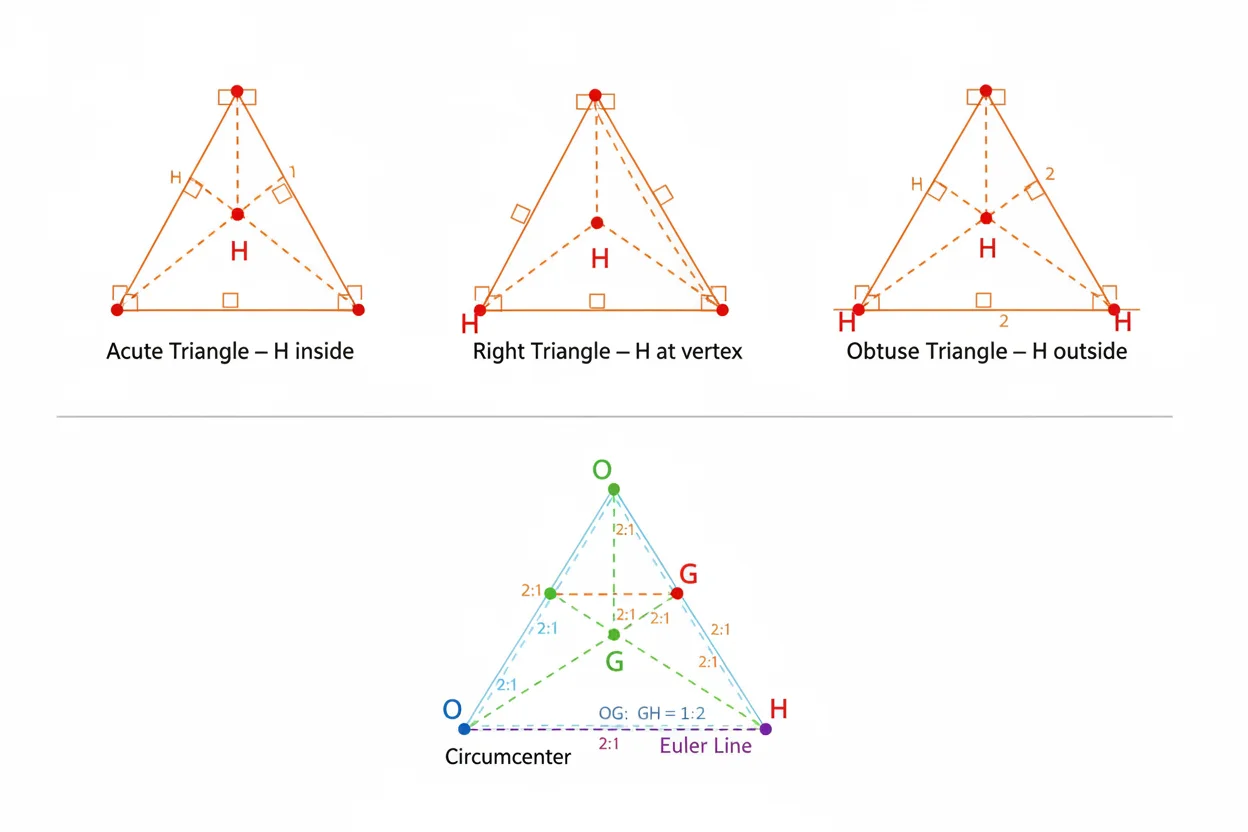
The triangle orthocenter is the point where the three altitude lines of a triangle intersect. An altitude passes through a vertex and is perpendicular to the line containing the opposite side. Every nondegenerate triangle has exactly one orthocenter, but its location changes with the triangle’s angles. In an acute triangle the orthocenter lies inside, in a right triangle it is the right-angle vertex, and in an obtuse triangle it lies outside. In coordinate geometry, an orthocenter can be found by writing equations for two altitudes and calculating their intersection. It is also connected to the centroid and circumcenter by the Euler line: if O is the circumcenter, G the centroid, and H the orthocenter, then O, G, and H are collinear with OG:GH = 1:2. These properties make the orthocenter a central part of triangle-center and perpendicularity problems.
What Is the Triangle Orthocenter?
For triangle ABC, draw an altitude through each vertex.
The altitude from A is perpendicular to:
line BC
The altitude from B is perpendicular to:
line AC
The altitude from C is perpendicular to:
line AB
The three altitude lines intersect at:
H
The point H is the:
orthocenter
Altitudes Determine the Orthocenter
The Triangle Altitudes are the defining lines of the orthocenter.
If D is the perpendicular foot from A to BC:
AD ⟂ BC
If E is the perpendicular foot from B to AC:
BE ⟂ AC
Then:
AD ∩ BE = H
The third altitude through C also passes through H.
Why Only Two Altitudes Are Needed
The concurrency theorem guarantees that all three altitudes meet at one point.
Therefore, to locate the orthocenter:
construct any two altitudes
and find their intersection.
The third altitude is useful as a verification.
Orthocenter of an Acute Triangle
If all three triangle angles are less than:
90°
each altitude meets the opposite side segment inside the triangle.
Therefore the three altitudes intersect:
inside the triangle
So an acute triangle’s orthocenter is an interior point.
Acute Coordinate Example
Take:
A = (0,0)
B = (6,0)
C = (2,4)
Side AB is horizontal.
Therefore the altitude from C is vertical:
x = 2
Slope BC is:
(4−0)/(2−6)
= −1
Therefore the altitude from A has slope:
1
Its equation is:
y = x
Intersect with:
x = 2
Therefore:
H = (2,2)
The point lies inside the triangle.
Orthocenter of a Right Triangle
In a Right Triangle, the two legs are already perpendicular.
Suppose:
AC ⟂ BC
Then:
AC
is an altitude from A to BC.
Likewise:
BC
is an altitude from B to AC.
These two altitudes meet at:
C
Therefore the orthocenter is the:
right-angle vertex
Right Triangle Example
Let:
A = (0,0)
B = (6,0)
C = (0,8)
The right angle is at:
A
Side AB is perpendicular to AC.
Therefore the altitude from B is AB’s? More precisely, the altitude through B to AC lies along AB, while the altitude through C to AB lies along AC.
They intersect at:
A
Thus:
H = (0,0)
Orthocenter of an Obtuse Triangle
If one triangle angle exceeds:
90°
two altitude lines meet extensions of the opposite sides outside the triangle.
Therefore the orthocenter lies:
outside
the triangle.
The altitude lines remain concurrent even though portions must be extended beyond the triangle’s boundary.
Obtuse Coordinate Example
Take:
A = (0,0)
B = (6,0)
C = (1,2)
AB is horizontal, so the altitude from C is:
x = 1
Slope BC:
(2−0)/(1−6)
= −2/5
Therefore the altitude from A has perpendicular slope:
5/2
Its equation is:
y = 5x/2
At:
x = 1
we obtain:
y = 5/2
Therefore:
H = (1,5/2)
Since C is:
(1,2)
the orthocenter lies outside the triangle beyond C.
Orthocenter Location Summary
For a nondegenerate triangle:
acute → H inside
right → H at the right-angle vertex
obtuse → H outside
This is one of the fastest ways to judge whether a calculated orthocenter is reasonable.
Orthocenter of an Equilateral Triangle
In an equilateral triangle, every median is also:
an altitude
an angle bisector
a perpendicular bisector
Therefore the:
orthocenter
centroid
circumcenter
incenter
all coincide.
Complete symmetry makes the four major triangle centers one point.
Coordinate Method Using Slopes
Suppose triangle vertices are:
A = (x₁,y₁)
B = (x₂,y₂)
C = (x₃,y₃)
To construct the altitude from A:
- calculate slope BC;
- find a perpendicular slope;
- write the line through A.
Repeat from another vertex.
Their Line Intersection is H.
Perpendicular Slope Rule
If a side has finite nonzero slope:
m
a perpendicular altitude has slope:
−1/m
For example, if:
m_BC = 2/3
then altitude from A has slope:
−3/2
This follows from the Slope rule for perpendicular lines.
Coordinate Example With Two Slanted Sides
Let:
A = (1,1)
B = (7,1)
C = (4,7)
AB is horizontal, so the altitude from C is:
x = 4
Slope BC:
(7−1)/(4−7)
= −2
Therefore altitude from A has slope:
1/2
Using Point-Slope Form:
y − 1 = 1/2(x − 1)
At:
x = 4
we get:
y − 1 = 3/2
Therefore:
y = 5/2
So:
H = (4,5/2)
Horizontal and Vertical Sides
Special slope cases simplify orthocenter calculations.
If a side is horizontal:
its altitude is vertical
If a side is vertical:
its altitude is horizontal
No negative-reciprocal calculation is necessary.
Recognizing these cases reduces algebra and avoids division-by-zero errors.
Vector Equation of an Altitude
Coordinate slopes are not necessary if vectors are available.
The altitude through A consists of points X satisfying:
(X − A) · (C − B) = 0
because:
X − A
points along the altitude, while:
C − B
points along side BC.
Their Dot Product must be zero for perpendicular vectors.
Vector Example
Suppose:
A = (0,0)
B = (6,0)
C = (2,4)
Direction BC:
C − B = (−4,4)
Let:
X = (x,y)
The altitude through A satisfies:
(x,y)·(−4,4) = 0
So:
−4x + 4y = 0
Therefore:
y = x
This matches the slope method.
Altitude Through Another Vertex
For the same triangle, side AB has direction:
B − A = (6,0)
The altitude from C satisfies:
(X − C)·(6,0) = 0
Therefore its x-coordinate must remain:
2
so:
x = 2
Intersecting:
y = x
and:
x = 2
gives:
H = (2,2)
Orthocenter From Line Equations
If triangle sides have equations, construct a perpendicular line through each opposite vertex.
For example, if side BC is:
Ax + By + C = 0
a normal vector to BC is:
(A,B)
An altitude perpendicular to BC therefore runs in the direction of this normal vector.
This provides another route to its equation.
Orthocenter and the Circumcenter
The mapped Triangle Circumcenter comes from perpendicular bisectors.
The orthocenter comes from altitudes.
They are different constructions:
circumcenter → perpendicular bisectors of sides
orthocenter → perpendicular lines through opposite vertices
Their locations can both lie outside a triangle, but for different geometric reasons.
Orthocenter and the Centroid
The Triangle Centroid is the intersection of the medians.
The centroid always lies inside the triangle.
The orthocenter can lie:
inside
on a vertex
outside
depending on triangle type.
In a non-equilateral triangle, these points are generally distinct.
Orthocenter and Medians
The mapped Triangle Medians connect vertices to opposite-side midpoints.
Altitudes instead connect vertices to opposite-side lines at right angles.
A line can be both a median and altitude when symmetry exists, such as the apex line of an isosceles triangle.
In a general scalene triangle, they are different.
Orthocenter and Incenter
The Triangle Incenter is the intersection of internal angle bisectors.
It is always inside the triangle.
Therefore:
angle bisectors → incenter
altitudes → orthocenter
An obtuse triangle makes their different behavior especially clear because the orthocenter moves outside while the incenter remains inside.
Euler Line
In every non-equilateral triangle, the:
circumcenter O
centroid G
orthocenter H
are collinear.
This line is called the:
Euler line
The centroid lies between O and H.
Their distances satisfy:
OG : GH = 1 : 2
Therefore:
GH = 2OG
and:
OH = 3OG
Euler-Line Example
Suppose:
OG = 5
Then:
GH = 10
and:
OH = 15
The centroid lies one-third of the way from circumcenter O to orthocenter H.
Orthocenter From Circumcenter and Centroid
Using position vectors:
H = 3G − 2O
This provides a powerful coordinate shortcut.
If O and G are known, H can be calculated without explicitly constructing altitudes.
Coordinate Euler-Line Example
For triangle:
A = (0,0)
B = (6,0)
C = (2,4)
the centroid is:
G = ((0+6+2)/3,(0+0+4)/3)
Therefore:
G = (8/3,4/3)
Its circumcenter is:
O = (3,1)
Then:
H = 3G − 2O
= (8,4) − (6,2)
Therefore:
H = (2,2)
This matches the altitude-intersection calculation.
Circumcenter-Origin Vector Formula
If the circumcenter O is chosen as the vector origin and vertex position vectors are:
a, b, c
then the orthocenter vector is:
h = a + b + c
Since centroid vector is:
g = (a + b + c)/3
we immediately obtain:
h = 3g
relative to circumcenter O.
This is another form of the Euler-line relationship.
Distance Between Circumcenter and Orthocenter
A useful identity is:
OH² = 9R² − (a² + b² + c²)
where:
R = circumradius
and:
a, b, c
are the triangle sides.
This connects triangle-center separation directly with side lengths.
OH Example for a Right Triangle
For a:
3-4-5
triangle:
R = 5/2
Then:
OH² = 9(25/4) − (9+16+25)
= 225/4 − 50
= 25/4
Therefore:
OH = 5/2
In a right triangle, H is the right-angle vertex and O is the midpoint of the hypotenuse, so this result is exactly expected.
Equilateral Check
For an equilateral triangle with side s:
R² = s²/3
Then:
OH² = 9(s²/3) − 3s²
= 3s² − 3s²
Therefore:
OH = 0
The orthocenter and circumcenter coincide.
Vertex-to-Orthocenter Distance
In an acute triangle:
AH = 2R cos A
BH = 2R cos B
CH = 2R cos C
These relationships connect the orthocenter with the circumradius and triangle angles.
For obtuse triangles, directed-distance conventions are required because one cosine becomes negative, so ordinary unsigned lengths should be handled carefully.
Acute Example
Suppose:
R = 10
A = 60°
Then:
AH = 2(10)cos60°
Therefore:
AH = 10
Orthocenter and Trigonometry
Altitude lengths can be expressed through sine:
hₐ = c sinB
or:
hₐ = b sinC
The angle relationships underlying perpendicular directions also follow standard Trigonometric Identities.
For example:
sin(90°−θ) = cosθ
explains why complementary angles naturally appear when an altitude creates right triangles inside the original triangle.
Orthocenter in an Isosceles Triangle
For an isosceles triangle, the altitude from the apex is also:
a median
an angle bisector
a perpendicular bisector of the base
Therefore the orthocenter lies on the triangle’s symmetry axis.
Its exact location along that axis depends on whether the triangle is acute, right, or obtuse.
Isosceles Acute Example
Take:
A = (0,6)
B = (−4,0)
C = (4,0)
The altitude from A is:
x = 0
By symmetry, the orthocenter lies somewhere on:
x = 0
Using another altitude locates its y-coordinate.
This often simplifies an otherwise two-variable coordinate calculation.
Orthocenter in an Equilateral Triangle
For an equilateral side s, altitude is:
h = s√3/2
The common center lies:
2/3
of the way down each median from a vertex.
Therefore vertex-to-orthocenter distance is:
2h/3
So:
AH = s√3/3
This equals the circumradius because all major centers coincide.
Reflection Property of the Orthocenter
Reflect the orthocenter H across any side of triangle ABC.
The reflected point lies on the triangle’s circumcircle.
Thus there are three reflected images of H, one across each side, and each lies on the circumcircle.
This provides a powerful bridge between altitude geometry and circumcircle geometry.
Why the Reflection Property Is Plausible
Suppose H is reflected across BC to H′.
Because AH is perpendicular to BC and altitude-angle relationships produce supplementary inscribed angles, the reflected point satisfies the angular condition for lying on the circumcircle through A, B, and C.
This property is especially useful in geometric proofs.
Orthocentric Systems
For a triangle ABC with orthocenter H, any one of:
A
B
C
H
acts as the orthocenter of the triangle formed by the other three points.
The four points form an:
orthocentric system
This follows from the network of perpendicular side-altitude relationships.
Orthocenter and Triangle Area
The orthocenter itself does not directly determine total Triangle Area.
However, locating H usually reveals altitude lines.
If the length of an altitude hₐ and side a are known:
A = ahₐ/2
Thus orthocenter constructions often provide the perpendicular information required for area calculations.
Coordinate Area Check
For:
A = (0,0)
B = (6,0)
C = (2,4)
the altitude from C to AB is:
4
Therefore:
area = 6(4)/2
So:
A = 12
The orthocenter:
H = (2,2)
lies along that altitude, but CH is not the entire altitude length in this example.
The altitude foot lies at:
(2,0)
Orthocenter Is Not Usually an Altitude Foot
The orthocenter is the intersection of altitude lines.
It is generally not the foot where an altitude meets the opposite side.
In an acute triangle, H lies somewhere along each altitude between its vertex and foot only in certain portions of the geometry.
The foot itself is a separate point on the opposite side.
Finding Altitude Feet
Once an altitude line is known, its foot can be found by intersecting it with the corresponding opposite-side line.
The Line From Two Points method can establish that side equation.
Then the intersection supplies the foot coordinates.
Orthocenter From Triangle Solving Data
A Triangle Solving problem may first determine:
sides
angles
altitudes
or coordinates.
Once enough geometry is known, the orthocenter can be constructed.
The orthocenter is therefore usually a consequence of the triangle’s fully determined shape rather than an independent size measurement.
Orthocenter and Right-Triangle Solving
If triangle solving determines:
C = 90°
then no further altitude intersection is needed.
Immediately:
H = C
The circumcenter simultaneously becomes the midpoint of the hypotenuse.
This makes right triangles one of the simplest orthocenter cases.
Orthocenter and Pythagorean Geometry
Each altitude creates right triangles.
The Pythagorean Theorem can therefore calculate altitude segments, distances from vertices to H, or side subdivisions when enough lengths are known.
However, a general altitude should not be assumed to bisect the opposite side.
That occurs only in special symmetric cases.
Orthocenter and Similar Triangles
Altitudes often create pairs of Similar Triangles.
For example, in an acute triangle the small right triangles around altitude feet share complementary angle relationships with the original geometry.
Similarity can then establish ratios involving:
altitude segments
side projections
distances to H
before locating or analyzing the orthocenter.
Scaling the Orthocenter Configuration
If a triangle is scaled by factor k:
sides scale by k
altitudes scale by k
medians scale by k
circumradius scales by k
Distances involving the orthocenter also scale by:
k
The orthocenter retains the same relative position under a similarity transformation.
Translation and Rotation
Translating or rotating a triangle moves the orthocenter by the same rigid transformation.
Perpendicularity is preserved, so altitude concurrency remains unchanged relative to the triangle.
Therefore the orthocenter depends on the triangle’s shape and position but not on how the diagram is oriented on a page.
Orthocenter Under Reflection
Reflecting an entire triangle reflects its orthocenter as well.
The altitude structure is preserved because reflections preserve:
angles
perpendicularity
incidence
This is distinct from reflecting only H across one side, which produces a point on the circumcircle.
Can the Orthocenter Lie on a Side?
For an ordinary nondegenerate triangle, the orthocenter lies on the triangle boundary only in the right-triangle case, where it is a vertex.
For acute triangles it is strictly inside.
For obtuse triangles it lies outside.
Can the Orthocenter Equal the Centroid?
Yes, but only in the equilateral case for a nondegenerate triangle.
If orthocenter and centroid coincide, the triangle’s symmetry forces all three sides and angles to be equal.
The circumcenter and incenter then coincide there as well.
Can the Orthocenter Equal the Circumcenter?
Again, this occurs for an equilateral triangle.
For a right triangle they are particularly far apart geometrically:
H = right-angle vertex
O = hypotenuse midpoint
Their separation equals the circumradius.
Orthocenter and Nine-Point Geometry
The midpoint of segment:
OH
is the center of the triangle’s nine-point circle.
That circle passes through important points including:
the three side midpoints
the three altitude feet
the midpoints of AH, BH, and CH
This is a deeper consequence of the orthocenter-circumcenter relationship.
Units
The orthocenter is a point, so its coordinates use ordinary coordinate units.
Distances such as:
AH
OH
use linear units.
Area calculations involving altitude lengths use square units.
No special “orthocenter unit” exists.
Common Triangle Orthocenter Mistakes
A common mistake is drawing medians instead of altitudes.
The orthocenter comes from lines through vertices perpendicular to opposite sides.
Another error is assuming H must be inside the triangle.
It lies outside an obtuse triangle and at the right-angle vertex of a right triangle.
For coordinate problems, use the perpendicular slope, not the same slope as the opposite side.
Horizontal and vertical sides require special handling because vertical slopes are undefined.
Do not confuse an altitude foot with the orthocenter.
The centroid’s 2:1 median rule does not define H.
When using the Euler line, remember:
OG : GH = 1 : 2
with G between O and H.
Finally, verify a calculated orthocenter by checking that it lies on a third altitude.
Frequently Asked Questions
What is the triangle orthocenter?
The orthocenter is the intersection of a triangle’s three altitude lines.
What is an altitude?
A line through a vertex perpendicular to the line containing the opposite side.
How many orthocenters does a triangle have?
Exactly one for every nondegenerate triangle.
Where is the orthocenter of an acute triangle?
Inside the triangle.
Where is the orthocenter of a right triangle?
At the right-angle vertex.
Where is the orthocenter of an obtuse triangle?
Outside the triangle.
How do you find the orthocenter from coordinates?
Write equations for two altitudes and find their intersection.
What slope does an altitude have?
If the opposite side has finite nonzero slope m:
altitude slope = −1/m
How can vectors define an altitude?
The altitude from A satisfies:
(X−A)·(C−B) = 0
Is the orthocenter the same as the centroid?
Not generally.
Is it the same as the circumcenter?
Not generally.
Is it the same as the incenter?
Not generally.
When do the major triangle centers coincide?
In an equilateral triangle.
What is the Euler line?
The line containing the circumcenter O, centroid G, and orthocenter H.
What ratio holds on the Euler line?
OG : GH = 1 : 2
How do you find H from O and G?
H = 3G − 2O
What is the circumcenter-orthocenter distance formula?
OH² = 9R² − (a²+b²+c²)
What happens when the orthocenter is reflected across a triangle side?
Its reflection lies on the circumcircle.
How can I check an orthocenter calculation?
Verify that the point lies on two independently constructed altitudes, confirm its location matches the triangle type, and test it against the third altitude when possible.