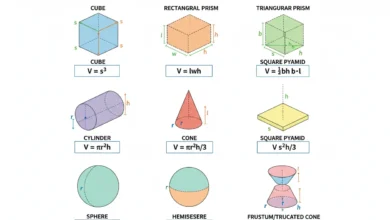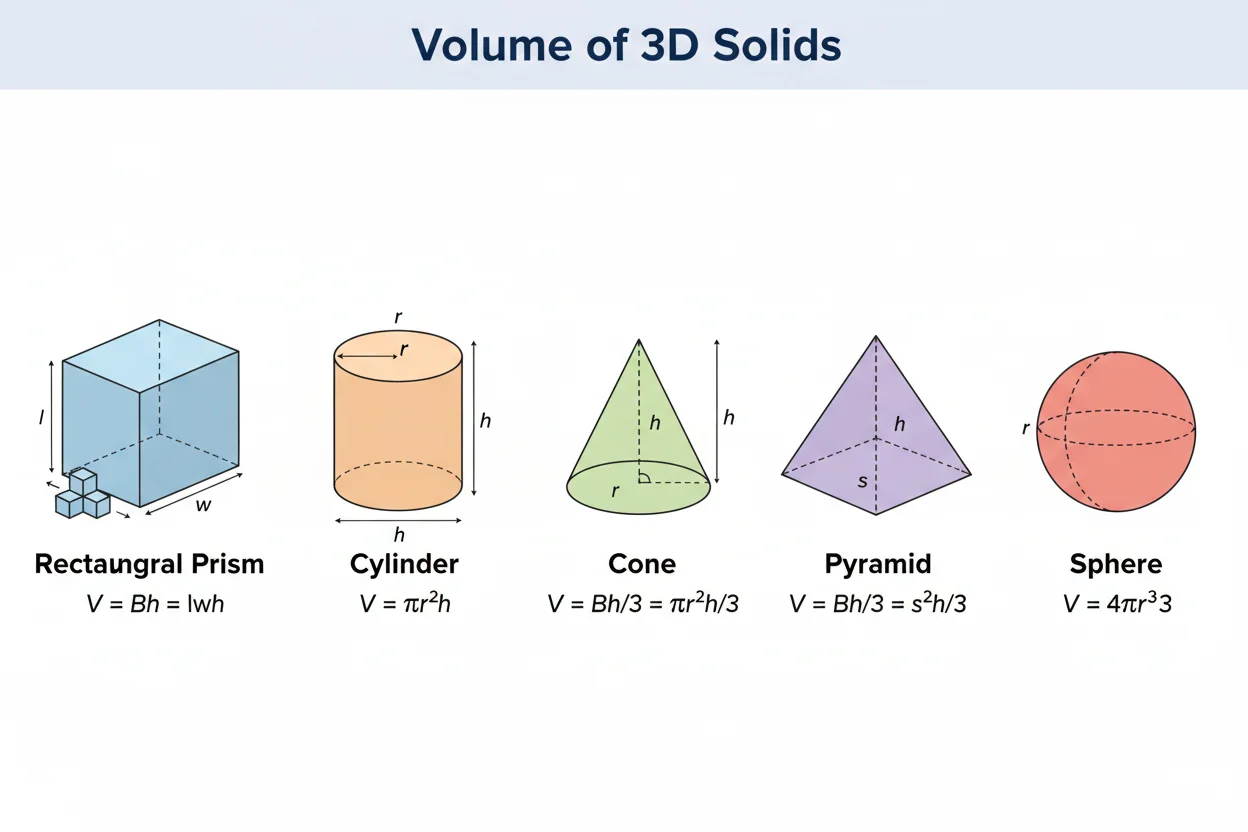
Volume measures the amount of three-dimensional space enclosed by a solid. It is expressed in cubic units such as cm³, m³, in³, or ft³ because three independent length dimensions contribute to the measurement. For many prisms and cylinders, volume follows the principle V = Bh, where B is the area of a constant cross section or base and h is the perpendicular height. Pyramids and cones with the same base and height contain one-third as much volume, giving V = Bh/3. A sphere uses V = 4πr³/3. Composite solids can be handled by adding or subtracting component volumes, while irregular objects can sometimes be measured through displacement. If every linear dimension of a similar solid is multiplied by k, its volume is multiplied by k³.
What Is Volume?
Volume is the measure of the space occupied or enclosed by a three-dimensional object.
Examples include the interior space of:
a box
a tank
a cylinder
a cone
a sphere
a prism
Volume differs from Surface Area, which measures the outside covering of a solid.
Why Volume Uses Cubic Units
Consider a rectangular block with dimensions:
length
width
height
Its volume is:
length × width × height
If each measurement is in centimeters:
cm × cm × cm = cm³
Therefore volume uses cubic units.
Common units include:
mm³
cm³
m³
in³
ft³
Cubic Unit Interpretation
A volume of:
1 cm³
is the space occupied by a cube measuring:
1 cm × 1 cm × 1 cm
A solid with volume:
60 cm³
occupies the same amount of space as:
60 unit cubes
each with volume:
1 cm³
even if the solid is not shaped like a rectangular box.
General Prism Principle
For any right prism:
V = Bh
where:
B = area of the base
h = perpendicular distance between the two congruent parallel bases
This formula works because the cross-sectional area remains constant through the prism’s height.
The specialist Prism Volume relationship develops this structure for different prism bases.
Rectangular Prism Volume
For a rectangular prism:
B = lw
Therefore:
V = lwh
where:
l = length
w = width
h = height
Rectangular Prism Example
Suppose:
l = 8 cm
w = 5 cm
h = 3 cm
Then:
V = 8(5)(3)
Therefore:
V = 120 cm³
Cube Volume
A cube has:
l = w = h = s
Therefore:
V = s³
For:
s = 6
we obtain:
V = 216
cubic units.
Find Cube Side From Volume
From:
V = s³
solve:
s = ∛V
Suppose:
V = 343
Then:
s = ∛343
Therefore:
s = 7
Triangular Prism Volume
A triangular prism still uses:
V = Bh
but its base area is a triangle.
If triangular base has:
base b
altitude h_t
then:
B = bh_t/2
Therefore prism volume is:
V = (bh_t/2)L
where L is the prism’s perpendicular length.
Triangular Prism Example
Suppose the base triangle has:
b = 6
h_t = 4
Base area:
B = 12
If prism length is:
10
then:
V = 12(10)
Therefore:
V = 120
cubic units.
Why Base Area Comes First
Many volume problems are easier when separated into two steps:
- find the two-dimensional base area B;
- multiply by the perpendicular solid height h.
This makes Area formulas a fundamental part of volume calculations.
For example, a trapezoidal prism uses trapezoid area for B, while a triangular prism uses triangle area.
Cylinder Volume
A cylinder has circular base area:
B = πr²
Therefore its Cylinder Volume is:
V = πr²h
where h is the perpendicular distance between the circular bases.
Cylinder Example
Suppose:
r = 4
h = 10
Then:
V = π(4²)(10)
Therefore:
V = 160π
Approximately:
V ≈ 502.65
cubic units.
Find Cylinder Height
From:
V = πr²h
solve:
h = V/(πr²)
Suppose:
V = 200π
r = 5
Then:
h = 200π/(25π)
Therefore:
h = 8
Find Cylinder Radius
From:
V = πr²h
solve:
r² = V/(πh)
Therefore:
r = √[V/(πh)]
Use the positive square root for a physical radius.
Cylinder Radius Example
Suppose:
V = 144π
h = 9
Then:
r = √(144π/9π)
= √16
Therefore:
r = 4
Pyramid Volume
A pyramid with base area B and perpendicular height h has Pyramid Volume:
V = Bh/3
A pyramid therefore contains one-third the volume of a prism with the same base and perpendicular height.
Square Pyramid Example
Suppose square base side is:
s = 6
Then:
B = 36
If pyramid height is:
h = 10
then:
V = 36(10)/3
Therefore:
V = 120
cubic units.
Cone Volume
A cone is the circular-base analogue of a pyramid.
Its Cone Volume is:
V = πr²h/3
This is one-third of the volume of a cylinder with the same radius and height.
Cone Example
Suppose:
r = 6
h = 9
Then:
V = π(36)(9)/3
Therefore:
V = 108π
cubic units.
Cone Versus Cylinder
For equal r and h:
V_cylinder = πr²h
V_cone = πr²h/3
Therefore:
V_cone = V_cylinder/3
or:
V_cylinder = 3V_cone
This comparison is an effective formula check.
Sphere Volume
The Sphere Volume formula is:
V = 4πr³/3
A sphere has no flat base or constant cross section, so the basic Bh prism structure does not directly apply.
Sphere Example
Suppose:
r = 3
Then:
V = 4π(27)/3
Therefore:
V = 36π
Approximately:
V ≈ 113.10
cubic units.
Find Sphere Radius From Volume
From:
V = 4πr³/3
solve:
r³ = 3V/(4π)
Therefore:
r = ∛[3V/(4π)]
Suppose:
V = 288π
Then:
r = ∛216
Therefore:
r = 6
Hemisphere Volume
A hemisphere is half of a sphere.
Therefore:
V = 2πr³/3
For:
r = 6
we get:
V = 144π
cubic units.
Frustum Volume
A frustum is formed by cutting the top from a cone or pyramid with a plane parallel to the base.
A circular Frustum Volume with height h and radii R and r is:
V = πh(R² + Rr + r²)/3
This is not simply the average of the two circular base areas multiplied by height.
Frustum Example
Suppose:
R = 5
r = 3
h = 6
Then:
V = π(6)(25 + 15 + 9)/3
= 2π(49)
Therefore:
V = 98π
cubic units.
General Volume Logic
Many formulas can be understood through cross-sectional behavior.
For a prism or cylinder:
cross-sectional area remains constant
so:
V = Bh
For a pyramid or cone:
cross sections shrink toward an apex
producing:
V = Bh/3
For a sphere:
circular cross sections vary continuously
leading to:
V = 4πr³/3
The next Volume Formulas reference organizes individual solid formulas, while the central idea here is how volume behaves and how to reason through a problem.
Volume and Perpendicular Height
The height in a volume formula is usually a perpendicular dimension.
For a prism:
h = perpendicular distance between bases
For a cylinder:
h = perpendicular distance between circular base planes
For a pyramid or cone:
h = perpendicular distance from apex to base plane
A slant height is generally not interchangeable with the perpendicular volume height.
Cone Slant Height Versus Height
For a right cone:
ℓ² = r² + h²
If slant height ℓ and radius r are known:
h = √(ℓ² − r²)
Then:
V = πr²h/3
The Pythagorean calculation must occur before the volume formula is applied.
Cone Example From Slant Height
Suppose:
ℓ = 13
r = 5
Then:
h = √(13² − 5²)
= 12
Therefore:
V = π(25)(12)/3
So:
V = 100π
Pyramid Slant Geometry
A pyramid may also require a right-triangle calculation to recover its perpendicular height.
For a regular square pyramid, the face slant height, perpendicular height, and half-base side can form a right triangle.
Once h is known:
V = Bh/3
This separates slanted surface geometry from enclosed volume.
Volume of Composite Solids
A composite solid can be broken into simpler components.
If the parts do not overlap:
V_total = V₁ + V₂ + …
If one region is removed:
V_remaining = V_outer − V_removed
The key is to identify the three-dimensional regions correctly.
Cylinder Plus Hemisphere Example
Suppose a cylinder of radius 3 and height 10 is topped by a hemisphere of the same radius.
Cylinder volume:
V₁ = π(3²)(10)
= 90π
Hemisphere volume:
V₂ = 2π(3³)/3
= 18π
Therefore:
V_total = 108π
cubic units.
Spherical Cavity Example
Suppose a solid originally has volume:
500 cm³
A spherical cavity of volume:
120 cm³
is removed.
Then:
V_remaining = 500 − 120
Therefore:
V_remaining = 380 cm³
No shared boundary adjustment is needed for volume; subtract only the removed space.
Volume and Surface Area Behave Differently
If every linear dimension is multiplied by k:
surface area scales by k²
but:
volume scales by k³
Therefore enlarging a solid changes its volume more rapidly than its exterior area.
This distinction is fundamental for similar solids.
Scaling Volume
Suppose:
original volume = V
and every dimension is multiplied by k.
Then:
V_new = k³V
If:
k = 2
volume becomes:
8V
If:
k = 3
volume becomes:
27V
Scaling Example
A model has volume:
40 cm³
A similar version is built with every length:
2.5
times as large.
Then:
V_new = 2.5³(40)
= 15.625(40)
Therefore:
V_new = 625 cm³
Find Linear Scale Factor From Volume Ratio
For similar solids:
V₂/V₁ = k³
Therefore:
k = ∛(V₂/V₁)
Suppose:
V₂/V₁ = 64
Then:
k = 4
The corresponding lengths are four times as large.
Surface Area From a Volume Scale Factor
If:
volume ratio = 27
then:
k = 3
Therefore the corresponding surface-area ratio is:
3² = 9
This lets volume and surface area comparisons reinforce each other.
Volume Ratios of Similar Solids
If similar solids have side, radius, or other corresponding linear measurements in ratio:
a:b
their volumes are in ratio:
a³:b³
For radius ratio:
2:5
the volume ratio is:
8:125
provided the solids are geometrically similar.
Unit Conversion for Volume
Linear conversion factors must be cubed.
Since:
1 m = 100 cm
then:
1 m³ = 100³ cm³
Therefore:
1 m³ = 1,000,000 cm³
Using only a factor of 100 would be incorrect.
Cubic Centimeters and Milliliters
A useful metric relationship is:
1 cm³ = 1 mL
Therefore:
750 cm³ = 750 mL
and:
1000 cm³ = 1 L
These conversions are useful for capacity problems.
Cubic Meters and Liters
Since:
1 m³ = 1,000,000 cm³
and:
1000 cm³ = 1 L
we obtain:
1 m³ = 1000 L
Therefore:
2.4 m³ = 2400 L
Capacity Versus Geometric Volume
Geometric volume and capacity describe closely related quantities.
Volume describes the space occupied or enclosed.
Capacity often refers specifically to how much a container can hold.
For a container with wall thickness, use its:
internal dimensions
when calculating capacity.
Using exterior dimensions would overestimate the usable interior space.
Tank Example
Suppose a rectangular tank has internal dimensions:
2 m × 1.5 m × 1 m
Then:
V = 3 m³
Convert:
3 m³ = 3000 L
Therefore the idealized internal capacity is:
3000 L
Displacement Method
An irregular object can sometimes have its volume measured by fluid displacement.
If initial liquid volume is:
V₁
and final volume after full submersion is:
V₂
then:
V_object = V₂ − V₁
This assumes the object is fully submerged and does not absorb, dissolve, or significantly alter the fluid.
Displacement Example
Initial reading:
350 mL
Final reading:
425 mL
Therefore:
V_object = 75 mL
Since:
1 mL = 1 cm³
the object volume is:
75 cm³
Partial Submersion
If only part of an object is submerged, the displaced fluid measures only:
submerged volume
not the object’s complete volume.
This distinction matters for floating objects and partially immersed solids.
Find an Unknown Dimension
Volume formulas can be rearranged.
For a rectangular prism:
V = lwh
Solve for height:
h = V/(lw)
Suppose:
V = 240
l = 8
w = 5
Then:
h = 240/40
Therefore:
h = 6
Find a Prism Base Area
From:
V = Bh
solve:
B = V/h
Suppose:
V = 450
h = 15
Then:
B = 30
square units.
The next step may involve solving the particular base shape from its area.
Triangular Base Volume Problems
If a prism or pyramid has a triangular base, first determine the base Triangle Area.
For example:
B = bh_t/2
The required triangular altitude may itself come from Triangle Altitudes, trigonometry, or coordinate geometry.
Triangle Solving in Volume Problems
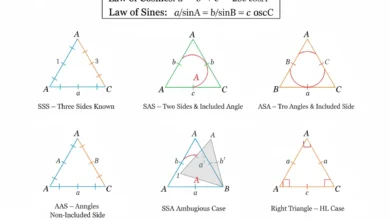
A triangular base is sometimes specified through sides and angles rather than base and altitude.
The mapped Triangle Solving methods can determine the missing side or angle.
Then base area might be found with:
B = ab sinC/2
before using:
V = Bh
or:
V = Bh/3
for the corresponding solid.
Orthocenter Geometry in Triangular Bases
In more advanced triangular-base problems, the mapped Triangle Orthocenter or altitude construction can identify the perpendicular height of a triangular face or base.
Once the required 2D base area is known, the volume calculation remains separate.
The orthocenter itself is not a volume quantity; it helps establish the perpendicular geometry used in the base.
Area and Volume
A two-dimensional base area has square units.
Multiplying by a perpendicular length gives cubic units:
square units × linear units = cubic units
This dimensional check explains why:
V = Bh
has the correct units.
For pyramid-like solids, the factor 1/3 changes magnitude but not units.
Volume of a Solid of Revolution
Calculus can find volumes created by rotating plane regions around an axis.
Three major methods are:
disks
washers
cylindrical shells
These methods generalize familiar geometry formulas to curved or irregular boundaries.
Disk Method
The Volume By Disks method uses:
V = π∫[R(x)]² dx
when solid cross sections perpendicular to the axis are disks.
Each thin disk has approximate volume:
πR² dx
and integration sums them continuously.
Washer Method
The Volume By Washers method handles hollow cross sections:
V = π∫[R(x)² − r(x)²] dx
where:
R = outer radius
r = inner radius
It is essentially the disk method with an inner disk removed.
Shell Method
The Volume By Shells method uses thin cylindrical shells.
A typical x-based form around the y-axis is:
V = 2π∫ x·f(x) dx
under the appropriate region setup.
The best method depends on the axis of rotation and the shape of the region.
Unit Circle and Volumes of Revolution
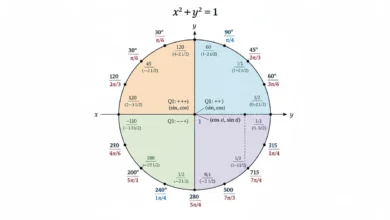
The mapped Unit Circle has:
x² + y² = 1
The upper semicircle is:
y = √(1−x²)
Rotating this semicircular region around the x-axis generates a sphere of radius:
1
Using disks:
V = π∫₋₁¹ (1−x²) dx
The result is:
4π/3
which matches the unit-sphere formula.
Trigonometric Identities in Volume Calculations
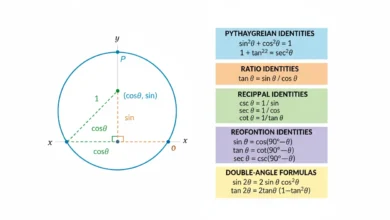
The mapped Trigonometric Identities can simplify volume integrals or geometric radius expressions.
For example, if circular coordinates are represented as:
x = r cosθ
y = r sinθ
then:
x² + y² = r²(cos²θ + sin²θ)
Using:
cos²θ + sin²θ = 1
gives:
x² + y² = r²
This preserves the circular radius used in cylindrical and spherical geometry.
Cavalieri’s Principle
If two solids have equal heights and equal cross-sectional areas at every corresponding height, they have equal volumes.
This idea, known as Cavalieri’s principle, helps explain why seemingly different solids can share volume relationships.
It also provides conceptual support for integral-based volume methods.
Why a Pyramid Has One-Third of a Matching Prism
A pyramid’s cross sections shrink as they approach the apex.
The resulting accumulation of cross-sectional areas produces:
V = Bh/3
rather than:
Bh
For the same base and height:
pyramid volume : prism volume = 1 : 3
A cone and cylinder have the same relationship.
Cone, Sphere, and Cylinder Relationship
Consider a cone and cylinder with:
radius = r
height = 2r
The cone volume is:
2πr³/3
A sphere of radius r has:
4πr³/3
The cylinder volume is:
2πr³
Therefore:
cone : sphere : cylinder = 1 : 2 : 3
This classic ratio is a useful consistency check.
Hollow Solids
A hollow solid’s material volume is usually:
outer volume − inner cavity volume
For a hollow sphere:
V = 4π(R³ − r³)/3
For a cylindrical tube:
V = π(R² − r²)h
where R and r are outer and inner radii.
Hollow Cylinder Example
Suppose:
R = 5
r = 3
h = 10
Then:
V = π(25 − 9)(10)
Therefore:
V = 160π
cubic units.
This measures material, not the hollow interior capacity.
Density and Volume
If density ρ and volume V are known:
mass = ρV
If mass m and density are known:
V = m/ρ
The units must be compatible.
For example, if density is in:
g/cm³
and mass is in grams, the resulting volume is in:
cm³
Density Example
Suppose:
mass = 540 g
density = 2.7 g/cm³
Then:
V = 540/2.7
Therefore:
V = 200 cm³
Volume and Packing
When smaller solids are placed inside a larger container, total object volume alone does not necessarily equal the container volume because gaps may remain.
Thus:
number × individual volume
describes material volume
but not necessarily the external space occupied by the collection.
Packing efficiency must be considered separately.
Volume Conservation
If a material is melted or reshaped without loss, its volume remains constant.
For example, if several spheres are recast into one larger sphere:
sum of original volumes = new volume
The radius must be calculated through cubes, not by adding radii.
Recasting Example
Eight identical spheres each have radius:
r
Total volume:
8(4πr³/3)
If recast into one sphere of radius R:
4πR³/3 = 8(4πr³/3)
Therefore:
R³ = 8r³
So:
R = 2r
Eight equal spheres produce one sphere with twice the radius.
Percentage Change in Dimensions
Suppose every dimension increases by:
10%
Then:
k = 1.10
Volume becomes:
1.10³V
Therefore:
V_new = 1.331V
The volume increases by:
33.1%
A 10% linear increase does not mean a 10% volume increase.
Percentage Decrease Example
If every dimension decreases by:
20%
then:
k = 0.8
Therefore:
V_new = 0.8³V
= 0.512V
The volume decreases by:
48.8%
Comparing Two Volumes
For similar spheres with radii:
4 and 10
volume ratio:
10³/4³
= 1000/64
Therefore:
V₂/V₁ = 125/8
The larger sphere has:
15.625
times the volume.
Exact Versus Approximate Volume
Expressions containing π are often best retained exactly.
For example:
V = 160π cm³
is exact.
Approximately:
V ≈ 502.65 cm³
If the result will be used in later calculations, the exact form reduces rounding error.
Measurement Precision
Volume can be sensitive to measurement errors because dimensions may be squared or cubed.
For a sphere:
V ∝ r³
A small error in r can therefore cause a larger relative error in volume.
This is another reason to avoid premature rounding.
Common Volume Mistakes
A common mistake is reporting square units instead of cubic units.
Another is confusing surface area with volume.
For cylinders and prisms, use perpendicular height.
For cones and pyramids, remember the factor:
1/3
Do not use slant height where perpendicular height is required.
When diameter is given, convert to radius before applying a radius-based formula.
For composite solids, add only nonoverlapping regions and subtract actual cavities.
When converting units, cube the linear conversion factor.
In similar solids, volume scales with:
k³
not k or k².
Finally, make sure a capacity problem uses internal rather than external dimensions when wall thickness matters.
Frequently Asked Questions
What is volume?
Volume is the amount of three-dimensional space occupied or enclosed by a solid.
What units does volume use?
Cubic units such as:
cm³, m³, in³, ft³
What is the general prism volume formula?
V = Bh
What is rectangular prism volume?
V = lwh
What is cube volume?
V = s³
What is cylinder volume?
V = πr²h
What is pyramid volume?
V = Bh/3
What is cone volume?
V = πr²h/3
What is sphere volume?
V = 4πr³/3
Why do cones and pyramids use one-third?
They contain one-third the volume of matching cylinders or prisms with the same base area and perpendicular height.
How do you find a missing dimension?
Rearrange the relevant volume equation and solve for the unknown measurement.
How does volume scale?
If every length is multiplied by k:
volume is multiplied by k³
What happens when all dimensions double?
Volume becomes:
8 times
as large.
What is displacement?
A method of finding submerged volume from:
final fluid reading − initial fluid reading
What is 1 cm³ in milliliters?
1 cm³ = 1 mL
How many liters are in 1 m³?
1000 L
What is composite-solid volume?
The sum or difference of simpler component volumes according to the physical regions present.
How can I check a volume calculation?
Confirm the correct solid and dimensions, use perpendicular height where required, verify cubic units, compare scaling with k³, and estimate whether the magnitude is reasonable relative to the object’s dimensions.