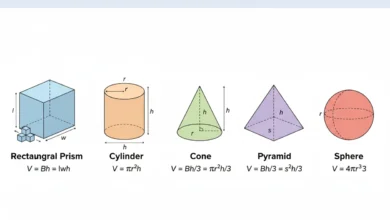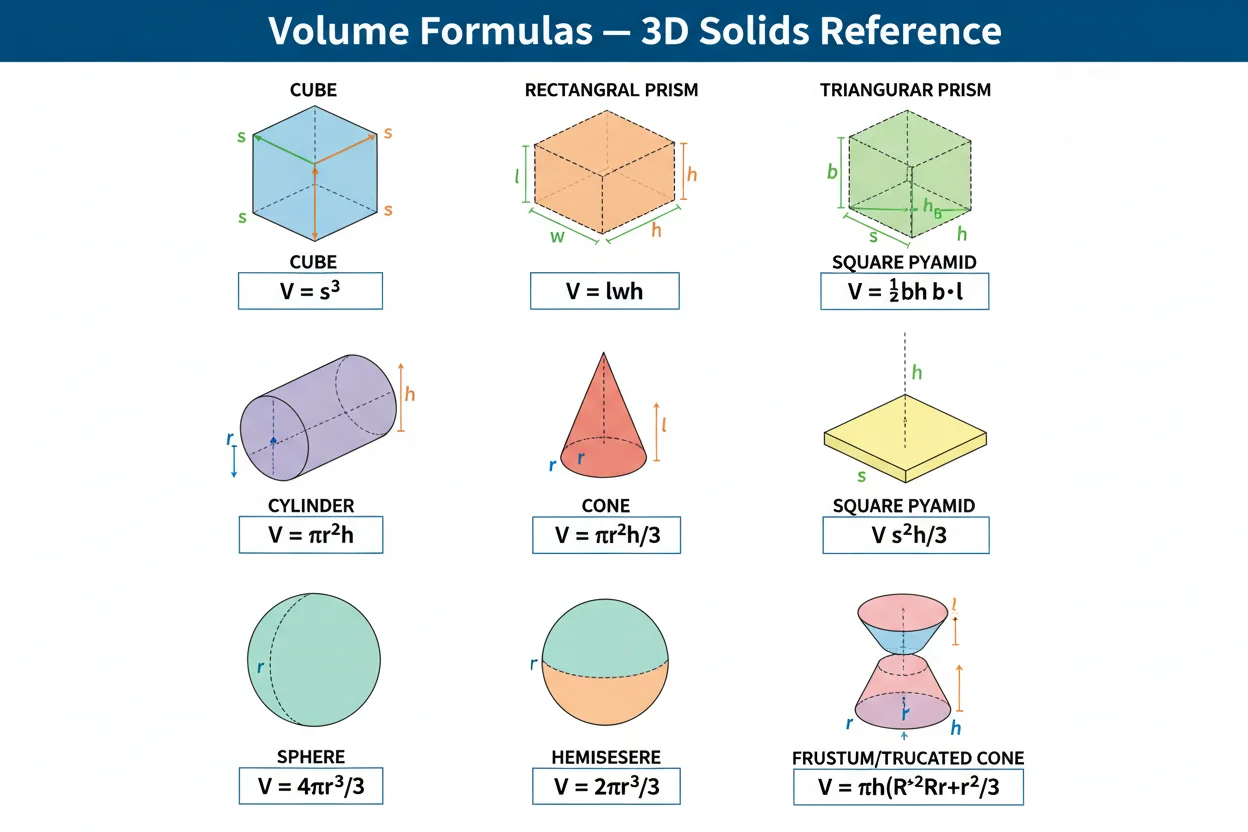

Volume formulas calculate the three-dimensional space enclosed by solid shapes. The correct formula depends on the solid’s geometry and the measurements provided. A rectangular prism uses V = lwh, any prism can use V = Bh, a cylinder uses V = πr²h, a pyramid uses V = Bh/3, a cone uses V = πr²h/3, and a sphere uses V = 4πr³/3. In these formulas, B represents base area, h is normally perpendicular height, r is radius, and l and w are length and width. Volume is always expressed in cubic units such as cm³, m³, or ft³. Composite solids are calculated by adding or subtracting component volumes, while similar solids obey the scaling rule V₂/V₁ = k³. The key to choosing among volume formulas is identifying the solid, its base, and which dimensions are perpendicular rather than slanted.
What Is a Volume Formula?
A volume formula converts the dimensions of a three-dimensional solid into the amount of space it encloses.
The broader concept of Volume explains why volume uses cubic units and how volume behaves under scaling, displacement, and decomposition.
For formula selection, the first questions are:
What solid is being measured?
What is its base?
Is the given height perpendicular?
Is the object solid, hollow, open, truncated, or composite?
Once those details are clear, the appropriate formula is usually direct.
Common Volume Formulas
For a cube:
V = s³
For a rectangular prism:
V = lwh
For a general prism:
V = Bh
For a cylinder:
V = πr²h
For a pyramid:
V = Bh/3
For a cone:
V = πr²h/3
For a sphere:
V = 4πr³/3
For a hemisphere:
V = 2πr³/3
For a circular frustum:
V = πh(R² + Rr + r²)/3
Each formula assumes that the dimensions refer to the geometry indicated by the symbols.
Volume Formula Symbols
Throughout these formulas:
V = volume
B = base area
h = perpendicular height
l = length
w = width
s = side or edge length
r = radius
R = larger radius when two radii are present
The same letter can have different meanings in different contexts, so identify the diagram before substituting values.
Cube Volume Formula
A cube has equal length, width, and height.
If each edge has length s:
V = s³
Example
Suppose:
s = 5 cm
Then:
V = 5³
Therefore:
V = 125 cm³
Find Cube Side From Volume
Rearrange:
V = s³
to get:
s = ∛V
If:
V = 512
then:
s = 8
Rectangular Prism Volume Formula
For a rectangular prism:
V = lwh
where l, w, and h are mutually perpendicular dimensions.
Example
Suppose:
l = 12
w = 5
h = 4
Then:
V = 12(5)(4)
Therefore:
V = 240
cubic units.
General Prism Volume Formula
The Prism Volume formula is:
V = Bh
where B is the area of either congruent parallel base and h is the perpendicular distance between the bases.
This formula includes rectangular, triangular, trapezoidal, and many polygonal prisms.
Triangular Prism Formula
If the triangular base has base b and altitude hₜ:
B = bhₜ/2
If prism length is L:
V = (bhₜ/2)L
The distinction between the triangular altitude and the prism’s length is important.
Example
Suppose:
b = 8
hₜ = 6
L = 10
Then:
B = 24
and:
V = 24(10)
Therefore:
V = 240
Trapezoidal Prism Formula
If the prism’s base is a trapezoid with parallel sides b₁ and b₂ and trapezoid height hₜ:
B = (b₁ + b₂)hₜ/2
Therefore:
V = [(b₁ + b₂)hₜ/2]L
The Trapezoid Area calculation supplies B before the prism formula is applied.
Polygonal Prism Formula
A prism with any polygonal base still uses:
V = Bh
For a regular polygon base, B may come from the Regular Polygon Area.
Thus the three-dimensional formula remains unchanged even though the two-dimensional base-area formula varies.
Cylinder Volume Formula
The Cylinder Volume formula is:
V = πr²h
because the circular base has area:
B = πr²
and a cylinder follows:
V = Bh
Example
Suppose:
r = 4
h = 9
Then:
V = π(4²)(9)
Therefore:
V = 144π
Approximately:
V ≈ 452.39
Cylinder Formula Using Diameter
If diameter d is known:
r = d/2
Substitute:
V = π(d/2)²h
Therefore:
V = πd²h/4
For:
d = 10
h = 8
we get:
V = 200π
Find Cylinder Height
From:
V = πr²h
solve:
h = V/(πr²)
If:
V = 300π
r = 5
then:
h = 12
Find Cylinder Radius
From:
V = πr²h
we obtain:
r = √[V/(πh)]
For:
V = 196π
h = 4
then:
r = √49
Therefore:
r = 7
Pyramid Volume Formula
The Pyramid Volume formula is:
V = Bh/3
where:
B = base area
h = perpendicular distance from the apex to the base plane
A pyramid contains one-third the volume of a prism with the same base and height.
Square Pyramid Formula
For square base side s:
B = s²
Therefore:
V = s²h/3
Example
Suppose:
s = 9
h = 12
Then:
V = 81(12)/3
Therefore:
V = 324
cubic units.
Rectangular Pyramid Formula
For base dimensions l and w:
B = lw
Therefore:
V = lwh/3
If:
l = 10
w = 6
h = 9
then:
V = 180
cubic units.
Cone Volume Formula
The Cone Volume formula is:
V = πr²h/3
A cone therefore contains one-third the volume of a cylinder with the same radius and perpendicular height.
Example
Suppose:
r = 6
h = 10
Then:
V = π(36)(10)/3
Therefore:
V = 120π
Find Cone Height
Rearrange:
V = πr²h/3
to get:
h = 3V/(πr²)
Suppose:
V = 100π
r = 5
Then:
h = 300π/(25π)
Therefore:
h = 12
Find Cone Radius
Solve:
r² = 3V/(πh)
Therefore:
r = √[3V/(πh)]
For:
V = 48π
h = 9
we obtain:
r = √16
Therefore:
r = 4
Cone Slant Height Is Not Volume Height
The perpendicular height h and slant height ℓ are different.
For a right cone:
ℓ² = r² + h²
If only ℓ and r are known:
h = √(ℓ² − r²)
Then use:
V = πr²h/3
Do not substitute ℓ directly for h.
Sphere Volume Formula
The Sphere Volume formula is:
V = 4πr³/3
Example
Suppose:
r = 6
Then:
V = 4π(216)/3
Therefore:
V = 288π
Approximately:
V ≈ 904.78
Sphere Formula Using Diameter
Since:
r = d/2
we have:
V = 4π(d/2)³/3
Therefore:
V = πd³/6
For:
d = 12
we get:
V = 288π
which matches the radius-6 calculation.
Find Sphere Radius
Rearrange:
V = 4πr³/3
Then:
r³ = 3V/(4π)
Therefore:
r = ∛[3V/(4π)]
Hemisphere Volume Formula
A hemisphere contains exactly half a sphere:
V = 2πr³/3
If:
r = 3
then:
V = 18π
cubic units.
Unlike hemisphere surface-area problems, there is no additional flat-base term for volume. The interior space is simply half of the full sphere.
Circular Frustum Volume Formula
For a conical frustum with:
larger radius = R
smaller radius = r
perpendicular height = h
the Frustum Volume formula is:
V = πh(R² + Rr + r²)/3
Example
Suppose:
R = 7
r = 3
h = 6
Then:
V = π(6)(49 + 21 + 9)/3
= 2π(79)
Therefore:
V = 158π
Why the Frustum Formula Is Not Bh
A frustum’s circular cross sections change continuously from radius r to radius R.
It is therefore not a cylinder with constant base area.
Nor can its volume be obtained by simply averaging the two circular base areas and multiplying by h.
Its exact tapered geometry creates the:
R² + Rr + r²
term.
Hollow Cylinder Formula
For a cylindrical tube with:
outer radius = R
inner radius = r
height = h
material volume is:
V = πR²h − πr²h
Therefore:
V = πh(R² − r²)
Example
Suppose:
R = 6
r = 4
h = 10
Then:
V = 10π(36 − 16)
Therefore:
V = 200π
Hollow Sphere Formula
A spherical shell with outer radius R and inner radius r contains:
V = 4πR³/3 − 4πr³/3
Therefore:
V = 4π(R³ − r³)/3
This calculates the volume of material between the two spherical surfaces.
Hollow Sphere Example
Suppose:
R = 5
r = 3
Then:
V = 4π(125 − 27)/3
Therefore:
V = 392π/3
Composite Volume Formula
For nonoverlapping component solids:
V_total = V₁ + V₂ + V₃ + …
For a cavity or removed section:
V_remaining = V_outer − V_removed
The correct operation follows the physical geometry rather than the shape names alone.
Cylinder Plus Hemisphere
Suppose a solid contains:
a cylinder of radius r and height h
plus:
a hemisphere of radius r
Then:
V = πr²h + 2πr³/3
For:
r = 3
h = 8
we obtain:
V = 72π + 18π
Therefore:
V = 90π
Prism With a Removed Cylinder
Suppose a rectangular prism has volume:
V_prism = lwh
and a cylindrical hole passes completely through it:
V_hole = πr²h
Then:
V_material = lwh − πr²h
provided h correctly represents the cylinder’s length through the prism.
Base-Area Principle
Several volume formulas can be grouped around B, the area of a base or cross section.
For prisms and cylinders:
V = Bh
For pyramids and cones:
V = Bh/3
The difference is not the base formula but how the solid changes as it extends through height.
Finding B for a Triangle
For a triangular base:
B = bh/2
The specialist Triangle Area page covers ways to find B from:
base and altitude
two sides and an included angle
three sides
coordinates
Once B is known, the solid-volume formula is usually simple.
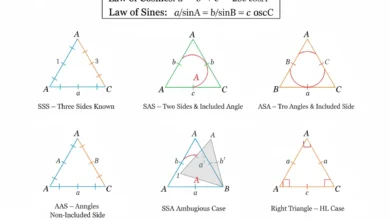
Finding B From Triangle Solving
If a triangular base lacks a direct altitude, Triangle Solving may first determine missing sides or angles.
For example, if sides a and b and included angle C are known:
B = ab sinC/2
A triangular prism then has:
V = ab sinC · h/2
while a triangular pyramid has:
V = ab sinC · h/6
where h is the solid’s perpendicular height.
Triangle Orthocenter and Base Area
The mapped Triangle Orthocenter is the intersection of a triangle’s altitudes.
In a triangular base or face, altitude geometry can provide the perpendicular height needed to find:
B = bh/2
The orthocenter itself is not part of the volume formula; it can help determine the base measurements used by the formula.
Regular Polygon Bases
For a regular n-gon with perimeter P and apothem a:
B = aP/2
Therefore a prism with such a base uses:
V = aPh/2
A pyramid uses:
V = aPh/6
This demonstrates how a base-area formula can be inserted into the general three-dimensional structure.
Circular Base Area
The Circle Area formula is:
B = πr²
Substituting into:
V = Bh
produces the cylinder formula.
Substituting into:
V = Bh/3
produces the cone formula.
The cylinder and cone formulas are therefore applications of the same base-area principle.
Volume Formula Scaling
For similar solids with linear scale factor k:
V_new = k³V_old
If every length doubles:
V_new = 8V_old
If every length triples:
V_new = 27V_old
If every length is halved:
V_new = V_old/8
Volume Ratio Formula
For similar solids:
V₂/V₁ = k³
where:
k = corresponding length₂/corresponding length₁
Therefore:
k = ∛(V₂/V₁)
Volume Ratio Example
Suppose two similar solids have corresponding radii:
3 and 9
Then:
k = 3
Therefore:
V₂/V₁ = 27
The larger solid has 27 times the volume.
Radius Scaling for Spheres
Because:
V ∝ r³
for spheres:
V₂/V₁ = (r₂/r₁)³
Suppose:
r₂/r₁ = 5/2
Then:
V₂/V₁ = 125/8
Volume and Surface Area Scaling
The mapped Surface Area scales differently:
surface-area ratio = k²
while:
volume ratio = k³
Thus if dimensions double:
surface area × 4
volume × 8
This distinction is essential when comparing similar solids.
Volume Formula Units
Volume formulas always produce cubic units.
If dimensions are in:
centimeters
volume is:
cm³
If dimensions are in:
meters
volume is:
m³
If a base area is already in:
m²
and height is in:
m
then:
m² × m = m³
Convert Cubic Units
Since:
1 m = 100 cm
cubing gives:
1 m³ = 1,000,000 cm³
Likewise:
1 cm = 10 mm
so:
1 cm³ = 1000 mm³
Volume conversion factors must be cubed.
Liters and Cubic Centimeters
Useful capacity relationships include:
1 cm³ = 1 mL
1000 cm³ = 1 L
1 m³ = 1000 L
Thus:
2500 cm³ = 2.5 L
Rearranging Volume Formulas
Most formulas can be inverted algebraically.
For:
V = Bh
we have:
B = V/h
and:
h = V/B
For:
V = Bh/3
we have:
B = 3V/h
and:
h = 3V/B
The same principle applies to radius-based formulas.
Inverse Pyramid Example
Suppose:
V = 180
B = 45
Then:
h = 3V/B
= 540/45
Therefore:
h = 12
Inverse Prism Example
Suppose:
V = 420
B = 35
Then:
h = V/B
Therefore:
h = 12
The factor of 3 distinguishes prism-like and pyramid-like solids.
Volume by Disks
For solids of revolution, the Volume By Disks method uses:
V = π∫ₐᵇ [R(x)]² dx
This can be viewed as continuously adding thin circular volumes.
It extends ordinary cylinder-like reasoning to varying radii.
Volume by Washers
If a rotated region creates a hollow center, Volume By Washers uses:
V = π∫ₐᵇ [R(x)² − r(x)²] dx
where:
R(x) = outer radius
r(x) = inner radius
The cross-sectional area is an annulus rather than a solid disk.
Volume by Shells
The Volume By Shells method uses cylindrical shells.
A common form is:
V = 2π∫ radius × height dx
The exact expression depends on the chosen axis and variable.
This method can be more convenient when disk or washer radii would require solving equations for the other variable.
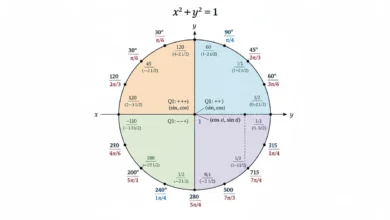
Unit Circle and Solid Geometry
The mapped Unit Circle describes:
x² + y² = 1
Rotating a semicircular region based on that equation can generate a unit sphere.
This creates a direct bridge between planar circular geometry and the sphere volume:
V = 4π/3
for:
r = 1
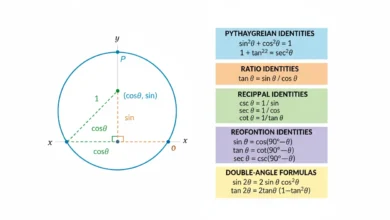
Trigonometric Identities in Volume Problems
The mapped Trigonometric Identities can simplify dimensions defined through angles.
For example:
x = r cosθ
y = r sinθ
gives:
x² + y² = r²
because:
cos²θ + sin²θ = 1
Such relationships can determine circular radii or cross sections before a volume formula is applied.
Exact and Approximate Volume
If:
V = 144π
that is exact.
Using:
π ≈ 3.14159
gives:
V ≈ 452.39
Retaining π until the end generally preserves more accuracy.
Choosing the Correct Volume Formula
Identify the shape first.
If it has congruent constant cross sections:
think V = Bh
If it tapers to one apex:
think V = Bh/3
If it is spherical:
use 4πr³/3
If it has two differently sized parallel circular ends:
consider the frustum formula
If it is hollow or composite:
add or subtract simpler volumes
The geometry determines the formula.
Common Volume Formula Mistakes
A common mistake is using square units instead of cubic units.
Another is confusing radius and diameter.
Do not substitute slant height for perpendicular height in a cone or pyramid.
Remember the factor:
1/3
for cones and pyramids.
For hollow solids, subtract the complete inner cavity volume from the outer volume.
When calculating a composite solid, avoid counting overlapping regions twice.
When converting units, cube the conversion factor.
For similar solids, use:
k³
rather than k².
Finally, calculate a complicated base area before applying the three-dimensional formula rather than mixing unrelated measurements in one step.
Frequently Asked Questions
What is the cube volume formula?
V = s³
What is rectangular prism volume?
V = lwh
What is the general prism volume formula?
V = Bh
What is cylinder volume?
V = πr²h
What is pyramid volume?
V = Bh/3
What is cone volume?
V = πr²h/3
What is sphere volume?
V = 4πr³/3
What is hemisphere volume?
V = 2πr³/3
What is conical frustum volume?
V = πh(R² + Rr + r²)/3
How do you find the volume of a hollow cylinder?
V = πh(R² − r²)
How do you find the volume of a hollow sphere?
V = 4π(R³ − r³)/3
How do volume formulas scale?
If every corresponding length is multiplied by k:
volume is multiplied by k³
What units should volume use?
Cubic units.
Is slant height used directly in cone volume?
No. Cone volume requires perpendicular height.
How do you find composite-solid volume?
Add nonoverlapping component volumes and subtract cavities or removed regions.
How can I check a volume formula calculation?
Confirm the solid type, distinguish radius from diameter, verify perpendicular height, inspect the cubic units, and compare the answer with a related prism, cylinder, cone, or scaling relationship when possible.