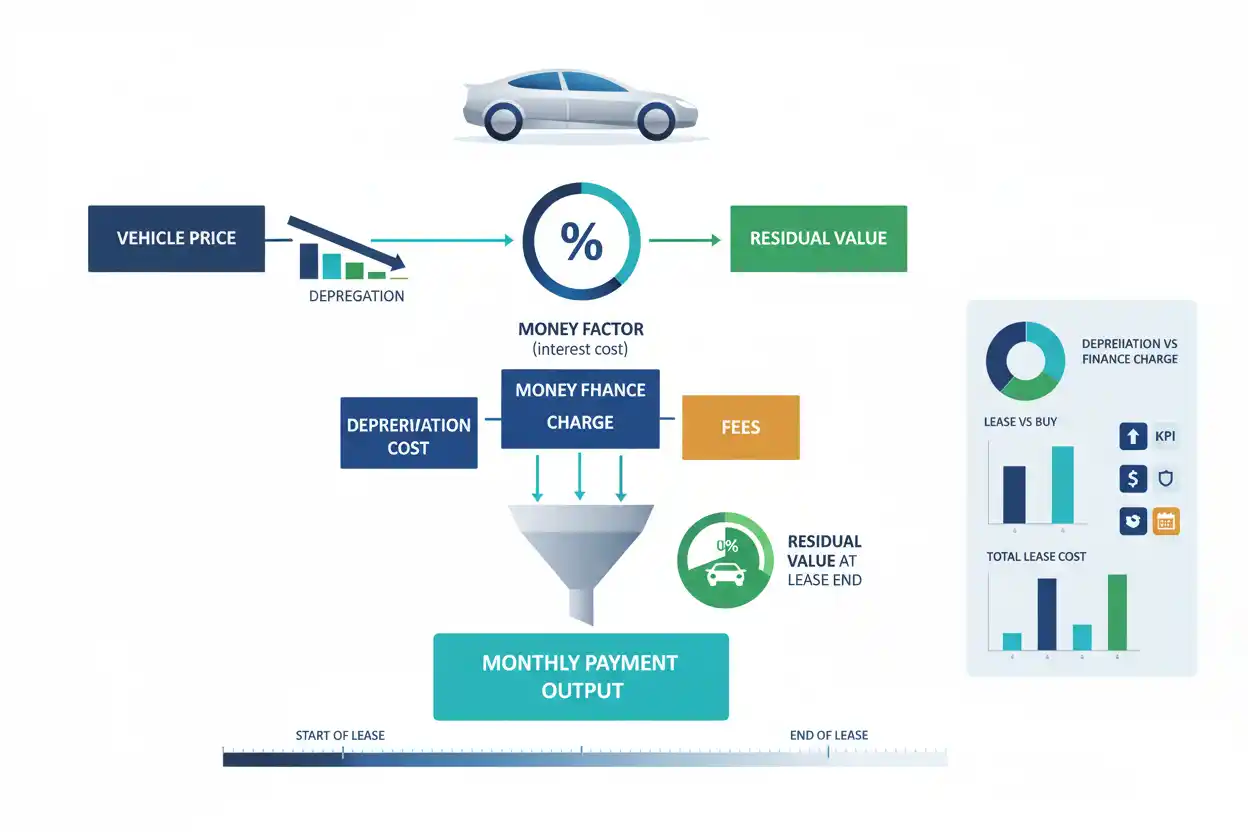

Auto lease payments are primarily determined by how much value the vehicle is expected to lose during the lease, the financing or rent charge applied by the lessor, the lease term, and any taxes or recurring fees.
Unlike an auto loan, a typical closed-end lease does not require you to repay the entire purchase price of the vehicle. Instead, the base payment generally covers the vehicle’s expected depreciation during the lease plus a rent charge.
That distinction makes lease calculations fundamentally different from auto loan payments, even though both produce a monthly vehicle expense.
The basic structure can be summarized as:
Base Lease Payment = Monthly Depreciation + Monthly Rent Charge
Taxes and other recurring charges may then increase the actual amount due each month.
Understanding auto lease payments requires several terms: gross capitalized cost, adjusted capitalized cost, residual value, lease term, depreciation, rent charge, and money factor.
What Are Auto Lease Payments?
An auto lease payment is the periodic amount required under a vehicle lease agreement.
For many consumer vehicle leases, the payment reflects three broad elements:
- the portion of the vehicle’s value expected to be used during the lease;
- the lessor’s financing or rent charge;
- applicable taxes and recurring charges.
The payment therefore should not be interpreted as a conventional principal-and-interest payment.
A loan gradually builds ownership by reducing a principal balance. A lease generally provides contractual use of the vehicle for a specified period while the lessor retains ownership unless a purchase option is exercised.
The broader Loans & Credit framework helps separate these structures from installment borrowing.
Auto Lease Payment Formula
A common lease-payment framework begins by finding the adjusted capitalized cost.
Adjusted Capitalized Cost = Gross Capitalized Cost − Capitalized Cost Reduction
Next, calculate total depreciation allocated to the lease:
Lease Depreciation = Adjusted Capitalized Cost − Residual Value
Then divide that amount across the lease term:
Monthly Depreciation = (Adjusted Capitalized Cost − Residual Value) ÷ Number of Months
Many lessors use a money factor to determine the rent portion of the payment.
A commonly used industry calculation is:
Monthly Rent Charge = (Adjusted Capitalized Cost + Residual Value) × Money Factor
Then:
Base Monthly Lease Payment = Monthly Depreciation + Monthly Rent Charge
Finally:
Estimated Monthly Lease Payment = Base Payment + Applicable Monthly Taxes + Recurring Charges
Actual contracts may calculate or disclose particular charges differently, so the signed lease agreement controls.
What Is Capitalized Cost?
Capitalized cost is the amount used as the starting value for calculating the lease.
The gross capitalized cost can include the negotiated value of the vehicle plus certain items financed through the lease.
For example:
Negotiated vehicle value = $36,000
Acquisition fee capitalized = $895
Then:
Gross Capitalized Cost = $36,000 + $895 = $36,895
If the lessee applies a $2,000 capitalized cost reduction:
Adjusted Capitalized Cost = $36,895 − $2,000
Adjusted Capitalized Cost = $34,895
That $34,895 becomes the starting amount in the simplified lease-payment example.
A capitalized cost reduction lowers the payment, but it should not automatically be treated as savings. It shifts more cash to the beginning of the transaction.
What Is Residual Value?
Residual value is the estimated value assigned to the vehicle at the end of the lease term.
Suppose the adjusted capitalized cost is $34,895 and the residual value is $22,000.
The amount of value allocated to depreciation during the lease is:
Lease Depreciation = $34,895 − $22,000
Lease Depreciation = $12,895
For a 36-month lease:
Monthly Depreciation = $12,895 ÷ 36
Monthly Depreciation ≈ $358.19
A higher residual value generally reduces the depreciation portion of the payment, all else equal.
However, residual value is not simply a number the customer should inflate to obtain a cheaper payment. It is an assumption used by the lessor and can also affect purchase-option economics and end-of-lease exposure.
What Is a Money Factor?
A money factor is a decimal number commonly used by automobile lessors to calculate the rent charge.
For example:
Money factor = 0.00225
Using:
Adjusted capitalized cost = $34,895
Residual value = $22,000
The simplified monthly rent charge is:
Monthly Rent Charge = ($34,895 + $22,000) × 0.00225
Monthly Rent Charge ≈ $128.01
The money factor is not the same disclosure concept as APR on a loan.
A commonly used industry shortcut multiplies the money factor by 2,400 to obtain a rate-like annual percentage estimate:
Approximate Rate Equivalent = Money Factor × 2,400
Using 0.00225:
Approximate Rate Equivalent = 0.00225 × 2,400 = 5.40%
This is a comparison shortcut, not a federally standardized lease APR. Vehicle leases disclose rent charges differently from consumer loans, so the result should not be presented as a legally required APR.
That distinction is also why APR vs APY should not be used as a substitute for understanding lease-specific financing terms.
Auto Lease Payment Example
Assume the following lease:
Negotiated vehicle value = $36,000
Capitalized acquisition fee = $895
Capitalized cost reduction = $2,000
Residual value = $22,000
Lease term = 36 months
Money factor = 0.00225
Step 1: Calculate Gross Capitalized Cost
Gross Capitalized Cost = $36,000 + $895
Gross Capitalized Cost = $36,895
Step 2: Calculate Adjusted Capitalized Cost
Adjusted Capitalized Cost = $36,895 − $2,000
Adjusted Capitalized Cost = $34,895
Step 3: Calculate Total Depreciation
Lease Depreciation = $34,895 − $22,000
Lease Depreciation = $12,895
Step 4: Calculate Monthly Depreciation
Monthly Depreciation = $12,895 ÷ 36
Monthly Depreciation ≈ $358.19
Step 5: Calculate Rent Charge
Monthly Rent Charge = ($34,895 + $22,000) × 0.00225
Monthly Rent Charge ≈ $128.01
Step 6: Calculate Base Payment
Base Lease Payment = $358.19 + $128.01
Base Lease Payment ≈ $486.20
The approximate base lease payment is therefore $486.20 per month before applicable taxes and additional recurring charges.
Tax treatment varies by jurisdiction, so adding one universal sales-tax formula would be misleading.
Total Base Payments
Over 36 months:
Total Base Payments ≈ $486.2082 × 36
Total Base Payments ≈ $17,503.50
Of this amount:
Total Depreciation = $12,895
and approximately:
Total Rent Charge = $128.01375 × 36
Total Rent Charge ≈ $4,608.50
Those figures exclude amounts that may be due separately at signing or at lease termination.
What Fees Can Affect an Auto Lease?
Lease quotations may include several charges beyond depreciation and rent.
An acquisition fee can be charged when the lease begins.
Registration, licensing, title, documentation, taxes, and other government or transaction charges may also apply.
A disposition fee may apply when the vehicle is returned at the end of the lease.
Excess mileage and excessive wear charges can create additional end-of-term costs.
Some costs can be paid upfront, while others can be included in the capitalized cost.
This distinction matters because capitalizing a fee can increase both the payment base and the rent charge.
A similar concept exists in lending when a loan origination fee affects financing economics, although lease acquisition fees and loan origination fees are not the same product.
Amount Due at Signing vs Monthly Payment
A low advertised monthly lease payment can require substantial cash at signing.
Possible upfront amounts include:
first monthly payment, capitalized cost reduction, acquisition fee, registration charges, taxes, security deposit, and other applicable amounts.
Therefore, compare the full transaction rather than evaluating only the monthly number.
A useful conceptual calculation is:
Effective Monthly Cash Cost ≈ (Upfront Nonrefundable Costs + Scheduled Monthly Payments + Expected End Costs) ÷ Months of Use
This is not a regulatory disclosure formula. It is simply a budgeting tool for comparing lease structures with different upfront payments.
Should You Make a Large Lease Down Payment?
A large capitalized cost reduction can make the monthly payment look significantly lower.
Suppose you reduce adjusted capitalized cost by another $3,600 on a 36-month lease.
Ignoring the rent-charge effect for a moment, the depreciation component falls by approximately:
Monthly Depreciation Reduction = $3,600 ÷ 36
Monthly Depreciation Reduction = $100
However, you have effectively prepaid $3,600 to obtain that reduction.
That is different from lowering a loan balance through a traditional down payment because the lessee does not automatically build equivalent ownership equity in the vehicle.
Lease Term and Monthly Payment
The loan term page focuses on borrowing, but the same basic timing principle matters in leasing: the number of months changes how depreciation is allocated.
A longer lease can spread depreciation over more monthly payments.
However, residual value also changes with the expected age and mileage of the vehicle, so simply increasing the term does not produce a proportional reduction in payment.
Lease terms should therefore be compared using complete quotations rather than one-variable assumptions.
Mileage and Residual Value
Mileage allowances affect lease economics because greater use generally reduces expected end-of-term value.
If the permitted mileage is increased at origination, the residual value may be lower.
A lower residual increases the depreciation component:
Monthly Depreciation = (Adjusted Capitalized Cost − Lower Residual) ÷ Term
If actual mileage later exceeds the contractual allowance, excess-mileage charges can apply according to the agreement.
Leasing Costs Beyond the Payment
The payment is only one component of leasing costs.
Other economic factors can include:
cash due at signing, registration, insurance requirements, maintenance, excess mileage, excessive wear, disposition charges, purchase-option terms, and early termination exposure.
That makes a lease comparison more complex than simply finding the lowest payment.
Lease vs Auto Loan Payment
A lease payment primarily covers use, depreciation, rent charge, and applicable fees.
An auto loan APR relates to the annualized cost of borrowing money to purchase the vehicle.
An amortizing loan gradually reduces principal through scheduled payments.
These structures can therefore produce very different monthly numbers even for the same vehicle.
A lower lease payment does not prove that leasing is cheaper over a longer ownership horizon.
Lease vs Car Payment
The broader car payments concept may include purchase financing considerations such as principal and interest.
A lease instead uses residual value and rent charge.
When comparing the two, evaluate:
cash due upfront, monthly payments, expected ownership period, mileage, insurance, maintenance, purchase-option value, and what asset—if any—you own at the end.
Credit and Lease Pricing
A lessor may consider creditworthiness when determining whether to approve a lease and what financing terms are available.
The broader credit score factors framework explains credit scoring inputs, while the debt-to-income ratio explains one way obligations can be compared with income.
Neither metric alone determines every leasing decision.
Fixed vs Variable Financing Costs
Most conventional vehicle lease quotations establish the rent-charge economics at origination rather than resetting like a typical variable-rate loan.
That makes the lease different from the borrowing structures discussed in fixed vs variable interest rate.
Still, understanding the distinction is useful when comparing leasing with variable-rate financing alternatives.
Common Auto Lease Payment Mistakes
One common mistake is comparing only monthly payments.
A $399 lease with $5,000 due upfront can have a very different economic cost from a $475 lease requiring much less cash at signing.
Another mistake is treating the residual value as money being repaid by the lessee. It is primarily the expected remaining vehicle value used in calculating depreciation.
A third mistake is treating a money factor as if it were an ordinary loan APR.
Finally, many shoppers overlook end-of-lease costs such as excess mileage, wear, disposition charges, and early termination obligations.
Frequently Asked Questions
What determines auto lease payments?
The main components are adjusted capitalized cost, residual value, lease term, rent charge or money factor, taxes, and applicable fees.
What is the basic auto lease payment formula?
A simplified structure is:
Base Lease Payment = Monthly Depreciation + Monthly Rent Charge
Taxes and recurring charges can then be added.
What is residual value?
Residual value is the estimated vehicle value at the end of the lease used in calculating the payment.
What is a money factor?
A money factor is a decimal financing factor commonly used by lessors to determine the lease rent charge.
Is money factor the same as APR?
No. A money factor is a lease calculation input. APR is a standardized borrowing-cost measure used for credit.
How do I convert money factor to an approximate rate?
A common industry shortcut is:
Approximate Rate Equivalent = Money Factor × 2,400
It should not be treated as an official lease APR.
Does a larger down payment reduce a lease payment?
A larger capitalized cost reduction generally lowers the monthly payment, but it shifts more cash to the beginning of the lease.
Why does mileage affect lease payments?
Higher expected mileage can reduce residual value, increasing the depreciation that must be covered during the lease.
Are taxes included in the quoted lease payment?
It depends on the quotation and jurisdiction. Review whether the advertised figure includes applicable taxes and recurring charges.
Is leasing always cheaper than financing?
No. A lower monthly lease payment does not automatically mean lower total economic cost. Ownership period, upfront cash, mileage, fees, residual value, and purchase financing all matter.
Final Takeaway
Auto lease payments are built differently from loan payments.
The core relationship is:
Base Lease Payment = Depreciation Portion + Rent Charge
Using an adjusted capitalized cost of $34,895, a residual value of $22,000, a 36-month term, and a 0.00225 money factor, the example produces a base payment of approximately $486.20 per month before taxes and additional recurring charges.
The best lease comparison therefore looks beyond the advertised monthly number. Evaluate the negotiated vehicle value, capitalized cost, residual, money factor, upfront cash, lease term, mileage allowance, recurring charges, and expected end-of-lease costs together.