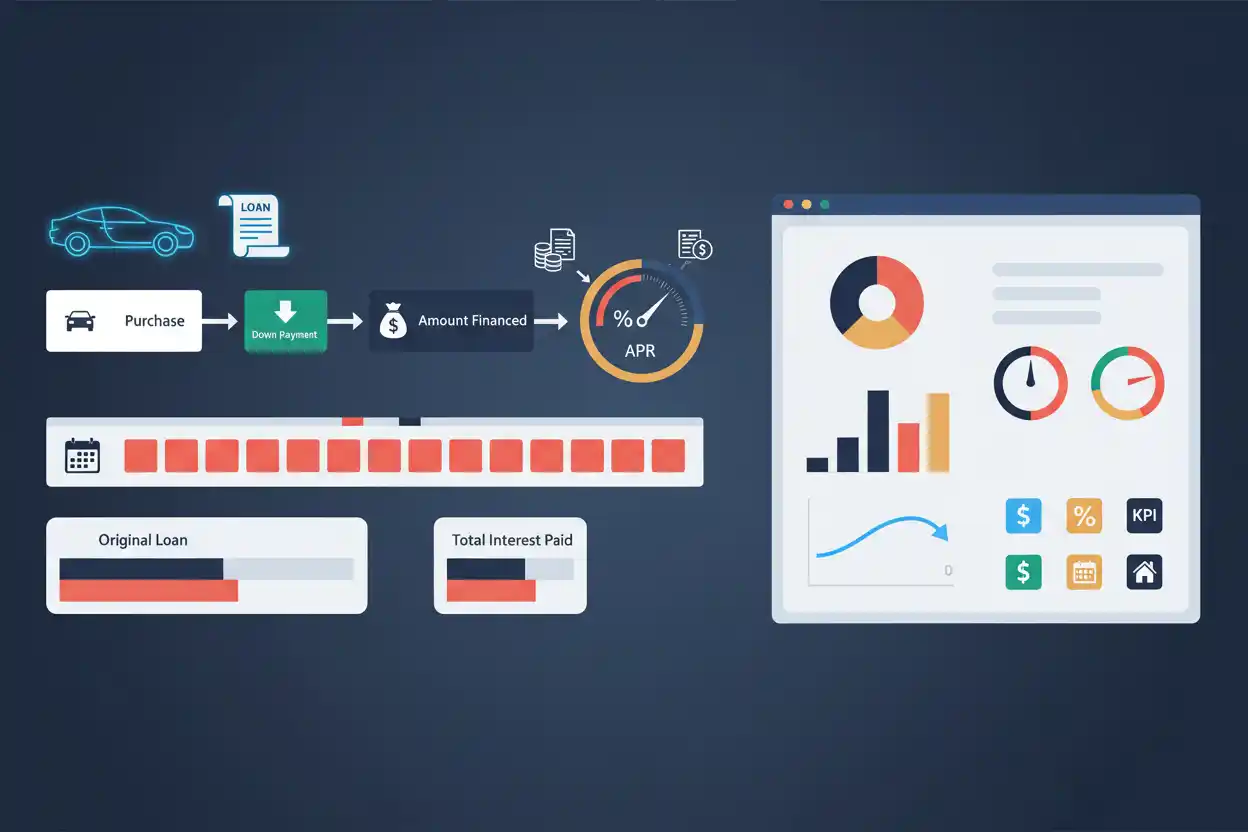

Auto loan APR measures the annualized cost of credit associated with financing a vehicle.
It is related to the loan’s interest rate, but the two figures are not always identical. The contractual interest rate primarily determines how interest accrues, while APR can reflect qualifying finance charges and the timing of the loan’s cash flows.
That makes auto loan APR one of the most useful figures for comparing competing vehicle financing offers.
A borrower should still examine the monthly payment, loan term, amount financed, total interest, fees, and optional add-ons because no single percentage tells the entire story.
What Is Auto Loan APR?
APR stands for annual percentage rate.
For an auto loan, it expresses borrowing cost as a yearly rate.
The general APR concept applies across several credit products, while this page owns the specific search intent for auto loan APR.
Suppose an auto loan shows:
Interest rate = 7.00%
APR = 7.85%
The figures are related, but they answer slightly different questions.
The 7% rate is tied to contractual interest.
The 7.85% APR reflects the annualized cost under the applicable credit calculation, including relevant financing charges in the example.
Auto Loan APR vs Interest Rate
The easiest distinction is:
Interest Rate = Rate Used to Calculate Contractual Interest
APR = Annualized Cost of Credit
If a loan has no additional finance charges and follows a straightforward structure, the rate and APR may be close.
If qualifying fees reduce the amount of value the borrower receives or otherwise increase the finance charge, APR can be higher.
This is why comparing vehicle loans only by advertised rate can produce the wrong conclusion.
Auto Loan APR Is Not a Simple Fee Percentage
There is no reliable universal formula that says:
APR = Interest Rate + Fee Percentage
APR depends on the timing and amount of cash flows.
A conceptual closed-end credit relationship is:
Amount Financed = Present Value of Required Payments Discounted at the Periodic APR Rate
For a regular monthly-payment illustration:
Amount Financed ≈ Σ Payment ÷ (1 + i)^t
where i represents the periodic cost rate.
The annualized APR is then based on the periodic rate according to the applicable calculation convention.
For ordinary consumers, the important lesson is not to reproduce regulatory actuarial calculations manually. It is to understand why fees and timing can make APR differ from the stated interest rate.
Auto Loan APR Example
Assume:
Loan balance used to calculate payments = $30,000
Contractual annual interest rate = 7.00%
Loan term = 60 months
Prepaid finance charge in this illustration = $600
Amount financed after that charge = $29,400
First calculate the monthly contractual interest rate:
Monthly Rate = 7% ÷ 12
Monthly Rate ≈ 0.58333%
For a standard fixed-payment amortizing loan:
Payment = P × [r(1 + r)^n] ÷ [(1 + r)^n − 1]
Using:
P = $30,000
r = 0.07 ÷ 12
n = 60
the monthly payment is approximately:
Monthly Payment ≈ $594.04
Total scheduled payments are approximately:
Total Payments = $594.04 × 60
Total Payments ≈ $35,642.40
Using full-precision calculations, the total is approximately $35,642.16.
The contractual interest generated by the $30,000 loan is approximately:
Interest ≈ $35,642.16 − $30,000
Interest ≈ $5,642.16
When the $600 prepaid finance charge is also considered, the economic financing cost is higher.
Solving for the monthly discount rate that equates the $29,400 amount financed with the 60 scheduled payments gives an illustrative periodic cost of approximately 0.6543%.
Annualizing that monthly figure:
Illustrative APR ≈ 0.6543% × 12
Illustrative APR ≈ 7.85%
So an auto loan with a 7% contractual rate can have an APR of roughly 7.85% when an applicable upfront finance charge changes the transaction economics.
Actual lender disclosures should be used rather than recreating APR from simplified assumptions.
Auto Loan APR vs Monthly Payment
APR measures annualized borrowing cost.
The auto loan payments calculation determines the periodic amount required under the financing terms.
A borrower can therefore receive a lower monthly payment without receiving a lower APR.
For example, extending a loan from 48 months to 72 months may reduce the monthly burden while leaving the rate unchanged and increasing total interest.
The loan term is therefore central to understanding affordability versus cost.
Auto Loan APR vs Total Interest
APR and total interest are also different.
APR is a rate.
Total interest is a dollar amount.
For a standard loan:
Total Interest = Total Scheduled Principal-and-Interest Payments − Original Principal
A longer loan can produce more total interest even when the APR is identical because the principal remains outstanding longer.
What Affects Auto Loan APR?
Several factors can affect an auto loan offer.
Credit Risk
The borrower’s credit profile can influence the rate offered.
The credit score factors page explains the broader variables associated with credit scoring.
A lender may also evaluate income, debt obligations, collateral value, and other underwriting information.
Loan Term
Longer terms alter lender risk and the timing of repayments.
Term also changes how long interest can accrue.
New vs Used Vehicle
Collateral age, value, loan amount, and lender policy can affect pricing.
Amount Financed
The amount borrowed can affect loan structure and affordability.
Down Payment and Trade Equity
A larger down payment can reduce the amount financed.
Lower principal generally reduces the monthly payment and total interest when the other loan terms remain unchanged.
Finance Charges
Certain financing fees can affect APR.
The loan origination fee page explains this concept in greater detail.
Amount Financed and APR
The amount financed is not always identical to the vehicle’s sticker price or even the face amount associated with the debt.
A financing transaction may involve:
vehicle price, sales taxes, registration charges, documentation fees, optional products, trade-in credit, down payment, negative equity, and other amounts.
Some charges affect the financed principal.
Others can affect the cost-of-credit calculation differently.
Therefore, a consumer should compare the disclosed amount financed with the actual cash price and itemized transaction.
Auto Loan APR vs Auto Lease Payment
An auto lease payment uses a different economic structure involving capitalized cost, residual value, depreciation, and rent charge.
A lease money factor should not be treated as if it were a standard auto loan APR.
When deciding between leasing and buying, compare the complete cash flows rather than placing the lease money factor beside the loan APR without adjustment.
APR vs APY for Auto Loans
APR vs APY explains two frequently confused annual percentage concepts.
For a vehicle loan, APR is the relevant borrowing-cost measure.
APY is generally associated with annual yield and compounding, particularly for deposits.
Converting an auto loan APR into an APY-style figure does not replace the loan’s disclosed APR.
Nominal vs Effective Rate
The nominal vs effective interest rate distinction can help explain how intra-year compounding affects mathematical annual rates.
For example, a nominal 12% rate with monthly compounding can produce an effective annual rate above 12%.
However, that effective-rate calculation should not automatically be substituted for auto loan APR because APR follows its own credit-cost framework.
Simple Interest Auto Loans
Many vehicle loans use a simple interest loan structure.
Interest is generally calculated from the outstanding principal rather than from the original principal throughout the entire term.
When interest is calculated daily, the daily simple interest framework becomes important because payment timing can affect the amount of interest accrued between payments.
Auto Loan Amortization
A conventional vehicle loan is often an amortizing loan.
Each scheduled payment typically covers interest and reduces principal.
Early in the term, a larger portion of the payment can go toward interest because the balance is higher.
Later, more of the payment usually reduces principal.
A full repayment schedule shows this change period by period.
Principal Balance and Early Payments
The principal balance is the remaining amount of borrowed principal.
If extra money is applied correctly to principal on a declining-balance loan, future interest can fall because later calculations use a smaller balance.
However, the borrower should confirm how additional payments are applied.
Prepayment Penalties
Some financing agreements can include a prepayment penalty or other contractual provisions affecting early payoff.
Therefore, a lower outstanding balance does not always tell you the exact amount required to close the loan.
When refinancing or selling the vehicle, obtain a current payoff figure.
Auto Loan APR vs Car Payment
The broader car payments concept includes principal, interest, and affordability.
APR is narrower.
For example:
Loan A: $550 monthly, 7.5% APR
Loan B: $490 monthly, 7.8% APR
Loan B’s payment is lower, but that could result from a longer term.
Without comparing term and total payments, the lower monthly amount tells you little about total cost.
Fixed vs Variable Auto Loan Rates
Many auto loans use fixed rates, but borrowers should still understand fixed vs variable interest rate structures.
If a rate can change, future payments and financing cost may also change.
A quoted starting APR should therefore be interpreted together with the contract’s rate-adjustment rules.
APR and Debt Affordability
A competitive APR does not prove the loan is affordable.
The debt-to-income ratio compares debt payments with income and can help frame payment capacity.
The loan-to-income ratio provides another way to compare borrowing with borrower income.
Affordability requires looking at actual cash flow rather than simply obtaining the lowest available rate.
APR and Balance Transfer Fees
A balance transfer fee applies to revolving credit rather than ordinary vehicle financing.
It is nevertheless a useful comparison because it demonstrates the broader principle that a headline interest rate does not reveal every financing cost.
A 0% promotional rate can still involve a transaction fee, just as a low auto loan rate can coexist with financing charges.
Interest Rate Basics
The interest rate basics framework helps separate nominal rates, APR, APY, effective rates, and periodic rates.
For auto loans, the most important practical distinction is between:
the rate used to generate interest, the APR used to express borrowing cost, and the monthly payment required by the amortization schedule.
Common Auto Loan APR Mistakes
A common mistake is assuming APR and interest rate are identical.
Another is choosing the lowest payment without checking the loan term.
Borrowers can also overlook financed add-ons that increase principal even when they do not reduce the advertised rate.
A fourth mistake is comparing APRs from loans with different vehicle prices and down payments without considering the underlying amount financed.
Finally, a borrower should never assume a dealer’s monthly quote alone reveals the complete financing cost.
Frequently Asked Questions
What is auto loan APR?
Auto loan APR is the annualized cost of credit associated with financing a vehicle.
Is auto loan APR the same as the interest rate?
Not always. The contractual interest rate determines interest, while APR can reflect qualifying financing costs and payment timing.
Why is my APR higher than my interest rate?
Applicable finance charges can increase the annualized cost above the contractual rate.
Does APR determine my monthly car payment?
Not directly. The payment is generally based on the financed principal, contractual rate, and number of payments.
Is a lower APR always better?
For genuinely comparable loans, a lower APR generally indicates lower annualized credit cost. Term, fees, amount financed, and contractual features still matter.
Can two auto loans have the same rate but different APRs?
Yes. Different finance charges can produce different APRs.
Does a longer term reduce APR?
Not necessarily. A longer term can reduce the monthly payment while increasing total interest.
Does a down payment lower APR?
A down payment reduces the amount financed but does not automatically change the lender’s rate or APR. It can still materially reduce total borrowing cost.
Is APR or monthly payment more important?
Both matter. APR helps compare cost, while the monthly payment determines cash-flow affordability.
Should I compare auto financing by APR alone?
No. Also compare amount financed, interest rate, term, total payments, fees, optional products, down payment, and prepayment terms.
Final Takeaway
Auto loan APR is an annualized measure of vehicle borrowing cost.
The essential distinction is:
Interest Rate = Contractual Interest Pricing
APR = Annualized Cost of Credit
In the worked example, a $30,000 loan at a 7% contractual rate for 60 months produces a payment of approximately $594.04. When a hypothetical $600 prepaid finance charge reduces the amount financed to $29,400, the illustrative actuarial APR rises to approximately 7.85%.
That is why the lowest advertised interest rate does not automatically mean the cheapest auto loan. Compare APR, amount financed, term, fees, payment, and total repayment together.