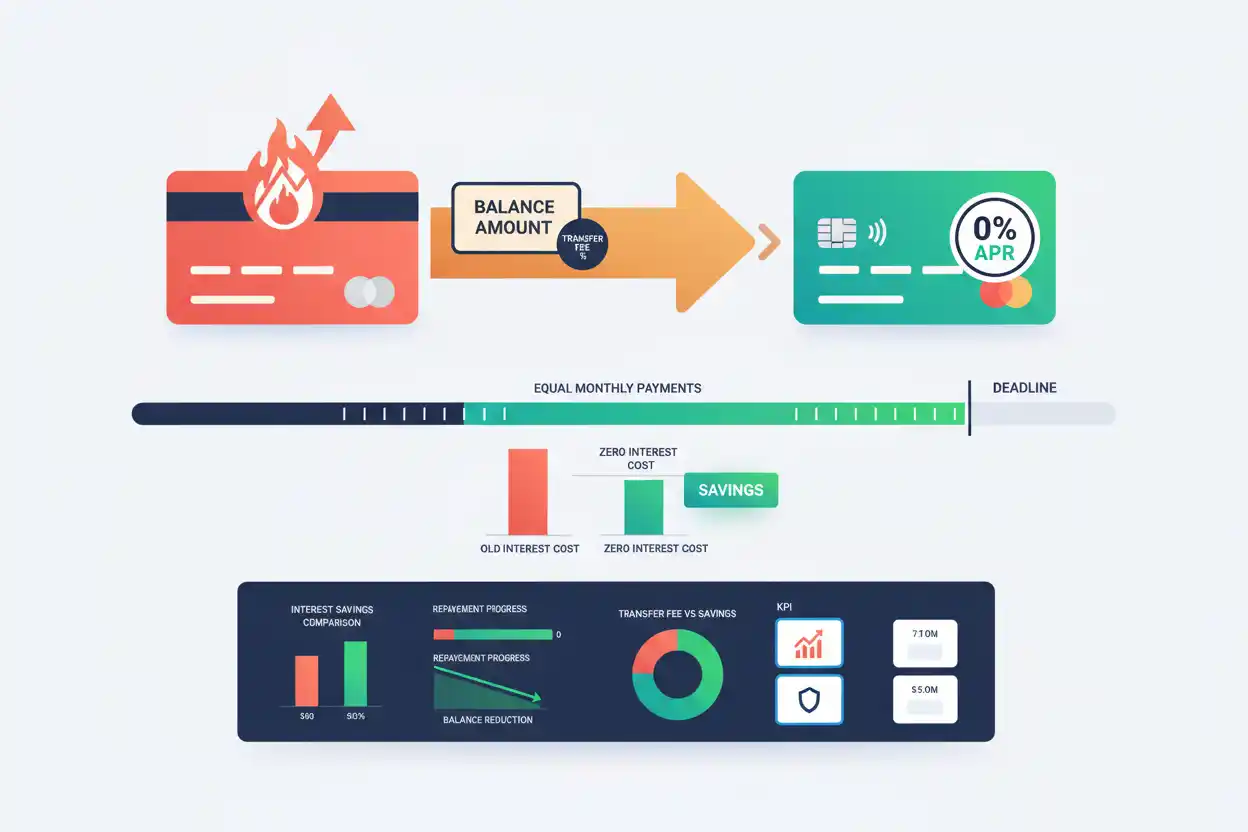

A balance transfer fee is a charge imposed when debt is moved from one credit account to another, most commonly from one credit card to another.
The fee is often calculated as a percentage of the amount transferred, although some card agreements specify a minimum dollar charge.
A simple percentage calculation is:
Balance Transfer Fee = Amount Transferred × Transfer Fee Rate
If the card charges the greater of a percentage or a minimum amount:
Balance Transfer Fee = Greater of (Transfer Amount × Fee Rate) or Minimum Fee
A 0% promotional balance-transfer APR therefore does not necessarily mean transferring the debt is free.
The transfer can still produce an immediate fee that must be included when deciding whether the transaction actually saves money.
What Is a Balance Transfer Fee?
A balance transfer fee is a transaction charge associated with moving an outstanding balance to another credit account.
For example, suppose a card offers:
0% promotional transfer APR for a limited period
3% balance transfer fee
If $8,000 is transferred:
Balance Transfer Fee = $8,000 × 3%
Balance Transfer Fee = $240
If the fee is added to the new card balance:
New Balance = $8,000 + $240
New Balance = $8,240
The borrower now needs to eliminate $8,240, not merely the original $8,000.
Balance Transfer Fee Formula
For a straightforward percentage fee:
Fee = Transfer Amount × Fee Percentage
For a card charging 5%:
Fee = $8,000 × 5%
Fee = $400
If the card instead says “3% of each transfer or $5, whichever is greater,” use:
Fee = MAX(Transfer Amount × 3%, $5)
For a $100 transfer:
Percentage Fee = $100 × 3% = $3
Because $5 is greater:
Actual Fee = $5
The card agreement controls the specific calculation.
0% Balance Transfer Example
Suppose:
Existing balance = $8,000
New transfer APR = 0% during promotion
Balance transfer fee = 3%
Promotion = 15 months
The fee is:
Transfer Fee = $8,000 × 3% = $240
Assuming the fee is added to the card:
New Balance = $8,000 + $240 = $8,240
To repay the transferred amount evenly over 15 months with no additional interest or charges:
Required Monthly Payoff = $8,240 ÷ 15
Required Monthly Payoff ≈ $549.33
Paying only the required minimum could leave a substantial balance when the promotional period expires.
That is why the credit card minimum payment should not be confused with a deliberate payoff target.
Is a Balance Transfer Worth It?
The economic decision depends on the fee compared with the interest that could be avoided.
A simplified savings framework is:
Estimated Net Savings = Interest Avoided − Transfer Fee − New Interest − Other Incremental Costs
Suppose the existing $8,000 balance carries a 24% annual rate.
If it were repaid over 15 months with equal monthly payments at that rate, the required payment would be approximately $622.60 and total interest would be roughly:
Old-Card Interest ≈ $1,339.06
The 3% transfer fee is:
Transfer Fee = $240
Assuming a true 0% transfer period, no additional fees, no new purchases, and full payoff within 15 months:
Approximate Savings = $1,339.06 − $240
Approximate Savings ≈ $1,099.06
That makes the transfer economically attractive under the simplified assumptions.
But the result changes if the balance is not repaid before the promotional rate ends.
Balance Transfer Fee vs APR
The fee and APR are separate costs.
APR expresses the annualized rate applicable to the balance.
The transfer fee is a transaction charge.
A promotional offer can therefore have:
Transfer APR = 0%
Transfer fee = 3%
The transfer is not cost-free because the fee remains.
Similarly, a higher promotional APR with no fee could sometimes be cheaper than a 0% offer with a large fee, depending on repayment speed.
Balance Transfer APR vs Credit Card APR
A card can have more than one APR.
The credit card APR applicable to purchases may differ from the promotional rate on transferred balances.
Cash advances can also carry a separate rate.
Therefore, seeing “0% APR” in an advertisement does not establish that every balance or transaction on the card receives 0%.
Promotional Period
The promotional rate lasts for a specified period according to the offer.
Suppose the transfer balance after the fee is $8,240 and the promotion lasts 12 months.
To pay it off during the promotion:
Monthly Target = $8,240 ÷ 12
Monthly Target ≈ $686.67
For 18 months:
Monthly Target = $8,240 ÷ 18
Monthly Target ≈ $457.78
A longer promotional period can make repayment easier, assuming other terms remain comparable.
Grace Period Risk
A credit card grace period can become important after a balance transfer.
Carrying a transferred balance can affect whether new purchases receive an interest-free grace period under the card’s terms.
For many consumers, one practical strategy is to avoid putting new purchases on a card being used exclusively for a promotional transfer unless they fully understand how the purchase balance will be treated.
Minimum Payments and Promotional Transfers
A 0% transfer offer does not eliminate the minimum-payment requirement.
If the borrower misses required payments, account consequences can follow according to the agreement and applicable rules.
More importantly, minimum payments may not be large enough to clear the balance during the promotional period.
A credit card payoff plan should therefore work backward from the promotion’s expiration date.
Payoff Formula
If there is no transfer interest during the promotion:
Monthly Payoff Target = Balance After Fee ÷ Months Remaining
For the $8,240 example with 15 months:
Monthly Payoff Target = $8,240 ÷ 15
Monthly Payoff Target ≈ $549.33
If you wait three months before beginning the planned payoff and only 12 months remain:
Required Monthly Payoff = $8,240 ÷ 12
Required Monthly Payoff ≈ $686.67
Delay can therefore materially increase the required monthly payment.
Balance Transfer Fee vs Cash Advance Fee
A cash advance fee applies when cash is obtained through a credit-card cash-advance transaction.
A balance transfer fee applies to moving debt.
The percentages can look similar, but the transactions can carry different APRs and interest rules.
They should not be treated as interchangeable.
Balance Transfer vs Debt Consolidation
A balance transfer is one method of combining or relocating debt.
Debt consolidation is broader and can involve cards, personal loans, home-equity products, or other financing.
A debt consolidation loan replaces revolving debt with an installment structure in many cases.
The better choice depends on fee, rate, term, repayment discipline, and available credit.
Balance Transfers and Credit Utilization
A balance transfer does not make the underlying debt disappear.
It relocates it.
The credit utilization ratio can change because balances move between revolving accounts and available limits may differ.
Closing an old card can also change available revolving credit.
The exact credit-score effect is broader than one ratio, so the credit score factors page should be used for that separate intent.
Balance Transfer and Debt Payoff Strategy
A transfer is most useful when paired with a clear debt payoff strategy.
Without a repayment plan, a borrower can transfer $8,000, continue spending on old cards, and eventually end up with more total debt.
The financial benefit comes from replacing expensive interest and then reducing principal—not from moving balances repeatedly.
Balance Transfers vs Other Financing Fees
The workbook maps this topic to several other financing-cost pages because the same comparison principle applies across products.
An auto loan APR can be higher than the vehicle loan’s note rate when relevant financing charges are included.
Auto loan payments can rise when fees are financed into principal.
An auto lease payment can include lease-specific acquisition and rent costs.
Likewise, business loan APR must account for the structure of commercial financing costs rather than assuming the advertised rate tells the whole story.
Even boat loan payments should be evaluated using principal, rate, term, and fees together.
The products differ, but the analytical principle is consistent: separate transaction fees from the headline interest rate before comparing financing.
Balance Transfer Fee and APR vs APY
APR vs APY is a separate annual-rate comparison.
APY does not help determine whether a credit-card transfer fee is worth paying.
For a balance-transfer decision, focus on:
transfer fee, promotional APR, promotional duration, post-promotional APR, existing card rate, and realistic monthly repayment capacity.
When a Balance Transfer May Make Sense
A transfer can be financially useful when:
the new rate is materially lower, the fee is small relative to expected interest savings, the borrower can repay the debt within the favorable period, and new spending does not recreate the old balance.
The strongest case is often one where the borrower already has enough monthly cash flow to eliminate the debt but wants more of each payment to reduce principal instead of paying interest.
When a Balance Transfer May Not Help
A transfer can be less attractive when:
the existing balance will be paid off very quickly, the transfer fee is high, the promotional period is short, the post-promotional rate is expensive, or the borrower is likely to continue accumulating debt.
A transfer is a financing tool, not debt forgiveness.
Common Balance Transfer Fee Mistakes
One common mistake is focusing on “0% APR” and ignoring the transfer fee.
Another is dividing the transferred balance by the promotional months while forgetting to include the fee.
A third is making only minimum payments instead of calculating the amount needed to finish before the promotion expires.
Borrowers can also create new interest costs by using the transfer card for purchases without understanding the grace-period rules.
Finally, repeatedly transferring debt without reducing principal can turn a temporary strategy into a long-term cycle.
Frequently Asked Questions
What is a balance transfer fee?
It is a charge for moving debt from one credit account to another, usually calculated as a percentage of the transferred amount.
How do I calculate a balance transfer fee?
Balance Transfer Fee = Transfer Amount × Fee Rate
subject to any minimum fee specified by the card agreement.
How much is a 3% fee on $5,000?
Fee = $5,000 × 3% = $150
How much is a 5% fee on $10,000?
Fee = $10,000 × 5% = $500
Is a 0% balance transfer free?
Not necessarily. The promotional APR can be 0% while a balance transfer fee still applies.
Is the balance transfer fee added to my balance?
It commonly can be, depending on the card terms. Check the account agreement and transaction details.
How do I know if a transfer saves money?
Estimate the interest you would otherwise pay, then subtract the transfer fee and any interest or other incremental charges on the new card.
Should I pay the balance off before the promotion expires?
Doing so can prevent the remaining balance from becoming subject to the post-promotional rate, according to the account terms.
Can a balance transfer affect new purchases?
Yes. Carrying a transferred balance can affect purchase-interest and grace-period treatment depending on the card agreement.
Is a balance transfer the same as debt consolidation?
It is one form of debt consolidation, but consolidation can also use installment loans and other financing products.
Final Takeaway
A balance transfer fee is usually calculated as:
Balance Transfer Fee = Amount Transferred × Fee Percentage
An $8,000 transfer with a 3% fee costs $240, producing a new balance of $8,240 if the fee is added to the card.
With a 15-month 0% promotional period, the borrower would need to pay approximately:
$8,240 ÷ 15 = $549.33 per month
to eliminate the balance before the promotional period ends, assuming no additional transactions or charges.
The correct decision is therefore not “Is the APR 0%?” It is whether the interest avoided exceeds the fee and whether the debt can realistically be paid off under the new terms.