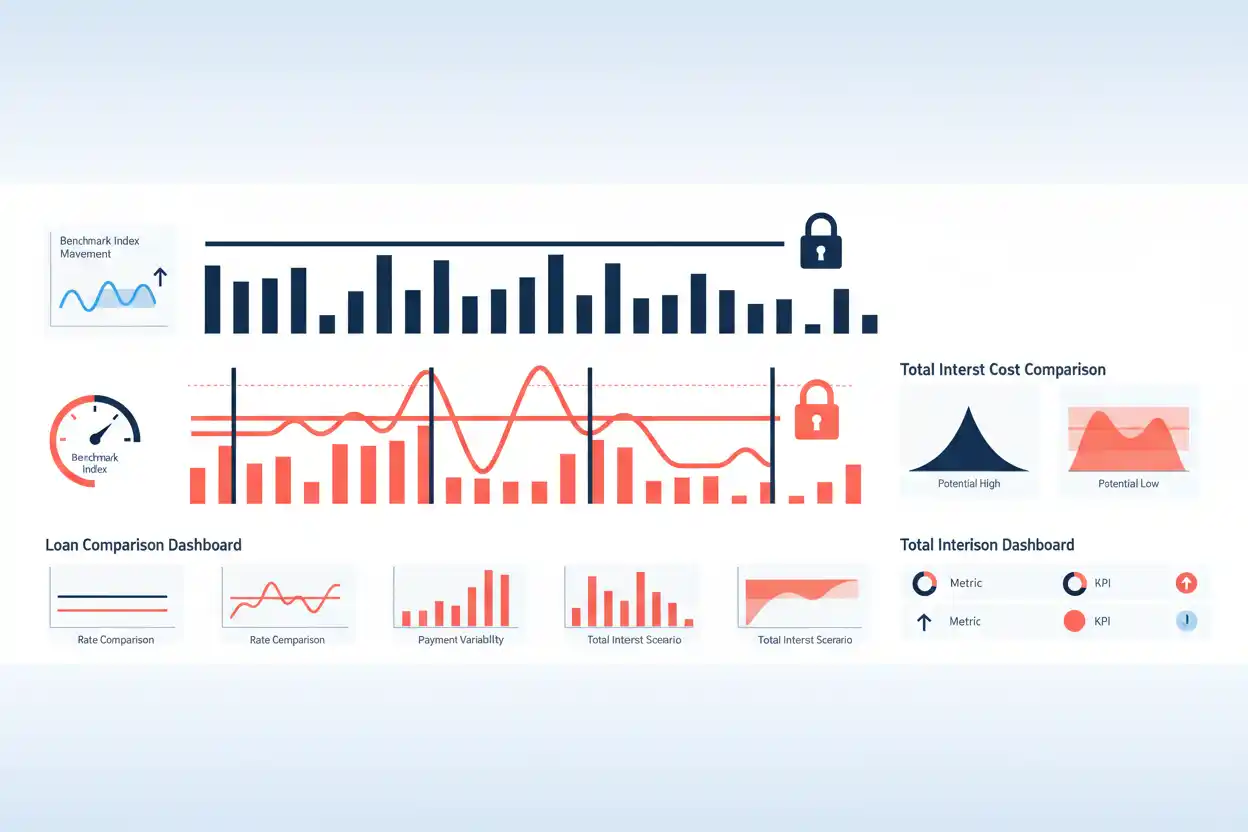

The fixed vs variable interest rate decision determines whether a loan’s borrowing rate remains stable or can change over time.
A fixed interest rate stays at the contractual rate for the period specified by the loan agreement.
A variable interest rate can move according to a benchmark, index, lender reference rate, or another contractual mechanism.
A common variable-rate structure is:
Variable Interest Rate = Benchmark Rate + Contractual Margin
For example, if a loan uses a 4% benchmark plus a 3% margin:
Variable Rate = 4% + 3% = 7%
If the benchmark later rises to 6%:
New Variable Rate = 6% + 3% = 9%
The borrower’s credit spread or margin has not changed, but the total interest rate has increased because the benchmark moved.
The distinction is fundamental within Loans & Credit and the broader Finance framework.
What Is a Fixed Interest Rate?
A fixed interest rate remains unchanged according to the loan’s fixed-rate terms.
Suppose a loan is issued at 6%.
Under a pure fixed structure:
Loan Rate = 6%
throughout the agreed fixed-rate period.
That makes scheduled principal-and-interest payments more predictable when the loan is also structured as a fixed-payment amortizing loan.
The borrower generally knows in advance what rate will be applied even if market interest rates change.
What Is a Variable Interest Rate?
A variable or floating interest rate can adjust over time.
A typical relationship is:
Variable Rate = Index + Margin
Suppose:
Index = 5%
Margin = 2.5%
Then:
Loan Rate = 5% + 2.5%
Loan Rate = 7.5%
If the index falls to 3.5%:
New Rate = 3.5% + 2.5%
New Rate = 6%
If the index rises to 7%:
New Rate = 7% + 2.5%
New Rate = 9.5%
The contract determines when and how the adjustment occurs.
Fixed vs Variable Interest Rate at a Glance
| Feature | Fixed Rate | Variable Rate |
|---|---|---|
| Rate changes | Generally no during fixed period | Can change |
| Payment predictability | Higher | Lower |
| Benefits from market rate declines | Usually not automatically | Potentially |
| Exposure to market rate increases | Lower | Higher |
| Budget certainty | Stronger | Weaker |
| Starting rate | Can be higher or lower | May begin lower |
| Long-term cost | Known more easily | Uncertain |
Neither structure is universally cheaper.
The result depends on future rate movements and the loan’s specific terms.
Fixed-Rate Loan Example
Suppose:
Principal = $250,000
Fixed rate = 6%
Term = 30 years
Payments = monthly
Using the standard loan payments formula:
Payment = P × [r(1 + r)ⁿ] ÷ [(1 + r)ⁿ − 1]
The monthly principal-and-interest payment is approximately:
Fixed Payment ≈ $1,498.88
That scheduled payment remains relatively predictable when the contractual rate remains fixed.
Taxes, insurance, fees, or other nonloan expenses can still change separately.
Variable-Rate Example
Now suppose the same $250,000 loan begins at 5%.
At 5% over 30 years, the initial payment would be approximately:
Initial Payment ≈ $1,342.05
The variable-rate loan begins about:
$1,498.88 − $1,342.05 = $156.83
lower per month than the 6% fixed loan.
That initial saving is real—but it is not guaranteed to continue.
Example of a Rate Reset
Assume the 5% variable rate remains in place for three years.
After 36 payments, the remaining balance is approximately:
Remaining Balance ≈ $238,359
Suppose the rate then resets to 7% with 27 years remaining.
Recalculating the payment produces approximately:
New Payment ≈ $1,639.47
The payment rises by approximately:
$1,639.47 − $1,342.05 = $297.42 per Month
The loan that originally had the lower payment now costs more per month than the 6% fixed-rate alternative.
This example demonstrates the central variable-rate tradeoff.
What If the Rate Falls?
Variable rates can also move in the borrower’s favor.
Using the same remaining balance, suppose the rate falls to 4%.
The recalculated payment would be approximately:
Payment ≈ $1,204.21
The borrower benefits from the lower rate without necessarily refinancing.
That potential upside is one of the attractions of variable-rate borrowing.
Payment vs Term Adjustments
A rate increase does not always translate solely into a larger payment.
Depending on the contract, a lender may adjust:
- the monthly installment,
- the remaining term,
- or both.
For an EMI loan, a lender could keep the EMI closer to its previous amount but extend the repayment term.
This creates another tradeoff: a stable monthly payment can conceal additional years of interest.
Fixed Rate Does Not Always Mean Fixed Forever
Borrowers should read the exact definition in the agreement.
Some loans may be fixed for:
a specific introductory period, several years, or the entire term.
A product described as “fixed for five years” can reset after that period.
The reset clause therefore matters as much as the word fixed.
Variable Rates and Benchmarks
The benchmark is the external or internal reference used to determine part of the variable rate.
The margin is usually the additional percentage specified by the lender.
Conceptually:
Borrower Rate = Benchmark + Margin
If the benchmark changes, the borrowing rate can change even though the margin remains constant.
The interest rate basics page explains the broader relationships among annual rates, periodic rates, APR, APY, and effective rates.
Interest Rate Caps
Some variable-rate loans limit how much the rate can change.
A loan can have:
an adjustment cap, periodic cap, lifetime cap, or floor depending on the product.
Suppose:
Current rate = 6%
Periodic adjustment cap = 2 percentage points
Even if the underlying formula would otherwise produce 9%, a 2-point adjustment limit might restrict the next reset to 8%.
The contract controls the actual mechanics.
Fixed vs Variable and APR
APR measures annualized borrowing cost.
A fixed rate and variable rate are descriptions of how the contractual interest rate behaves.
These concepts overlap without being identical.
A fixed loan can have:
Interest rate = 6%
APR = 6.4%
because applicable financing charges affect annualized credit cost.
Likewise, a variable-rate loan can have an APR disclosure even though its future rate may change.
Fixed vs Variable and Effective Rates
The nominal vs effective interest rate comparison addresses compounding.
Fixed vs variable instead addresses whether the rate can change through time.
A rate can therefore be:
fixed and compounded monthly, or variable and compounded monthly.
These are separate dimensions.
Fixed vs Variable vs Flat or Reducing Balance
The flat vs reducing balance interest distinction answers a different question.
Fixed vs variable asks:
Can the percentage rate change?
Flat vs reducing asks:
What principal base is used to calculate interest?
A loan can theoretically have:
a fixed flat rate, fixed reducing-balance rate, or variable reducing-balance rate.
Do not treat those terms as synonyms.
Fixed vs Variable and Debt-to-Income Ratio
The debt-to-income ratio compares monthly debt payments with gross income.
A variable-rate payment increase can therefore raise DTI.
Suppose:
Gross monthly income = $6,000
Other monthly debts = $1,500
Loan payment rises from $1,000 to $1,300
Old DTI:
DTI = $2,500 ÷ $6,000 × 100 ≈ 41.7%
New DTI:
DTI = $2,800 ÷ $6,000 × 100 ≈ 46.7%
A rate reset increases DTI by about five percentage points in this example.
Fixed vs Variable and Interest Coverage
Businesses also need to consider interest coverage ratio risk.
Suppose a company has:
EBIT = $500,000
Interest expense = $100,000
Coverage:
Interest Coverage = $500,000 ÷ $100,000 = 5.0×
If variable-rate interest rises to $150,000:
New Coverage = $500,000 ÷ $150,000
New Coverage ≈ 3.33×
Operating earnings have not changed, but debt coverage has weakened.
Fixed vs Variable and DSCR
The debt service coverage ratio can also deteriorate after a variable-rate reset.
If annual payments rise while cash flow stays constant, DSCR falls.
This risk is especially important for highly leveraged businesses, rental properties, and borrowers operating with narrow cash-flow margins.
Fixed vs Variable and Debt Snowball
A debt snowball prioritizes debt by smallest outstanding balance rather than rate type.
However, variable-rate risk can justify reviewing the plan.
A relatively low-rate balance today could become more expensive after a benchmark increase.
A strict snowball would not automatically move it earlier, while a hybrid repayment plan might.
Fixed vs Variable Auto Loans
Many auto loan payments use fixed rates.
This allows borrowers to calculate a predictable principal-and-interest payment at origination.
A variable-rate auto loan requires more careful budgeting because future payment amounts or repayment periods can change.
Fixed vs Variable Personal Loans
Personal loan payments can also be fixed or variable depending on the product.
For debt consolidation, payment certainty can be especially important because one purpose of refinancing is often to replace unpredictable revolving debt with a structured payoff.
Fixed vs Variable Business Loans
Business loan payments can be particularly sensitive to variable-rate changes when principal is large.
A business should test multiple scenarios rather than assuming today’s rate will remain unchanged.
For example:
current rate, +2 percentage points, and +4 percentage points.
This reveals how much payment or interest coverage could deteriorate.
Variable Rates and Loan Term
A longer loan term creates more time for variable-rate changes to occur.
A one-year floating loan has far less long-term rate exposure than a 20-year floating loan.
The appropriate structure therefore depends partly on how long the borrower expects the debt to remain outstanding.
Refinancing a Fixed Loan
A fixed-rate borrower does not automatically benefit when market rates fall.
To obtain a lower contractual rate, refinancing may be necessary.
That creates a new comparison involving:
fees, remaining term, new rate, and expected time before payoff.
A lower rate does not guarantee refinancing savings if transaction costs are too large.
Switching From Variable to Fixed
Some loans permit switching from variable to fixed terms.
The lender may charge fees or impose a different margin.
The borrower should compare:
new fixed rate, remaining term, switching cost, expected benchmark movements, and payment stability.
Prepayment and Rate Type
A prepayment penalty can influence the decision to refinance or exit a rate structure.
A variable loan that becomes expensive may be difficult to replace economically when leaving the loan creates a substantial penalty.
Always review exit terms before focusing only on the initial rate.
Loan Payoff and Variable Rates
A loan payoff quote provides the amount required to settle debt on a specified date.
For variable-rate loans, future payoff projections can be less certain because later interest rates may differ from today’s rate.
Common Fixed vs Variable Rate Mistakes
A common mistake is comparing the initial variable rate with the fixed rate as though both will remain unchanged.
Another is assuming “fixed” necessarily means fixed for the entire loan term.
Borrowers also overlook rate caps, floors, margins, and adjustment frequency.
A fourth mistake is comparing monthly payments without considering the possibility of future resets.
Finally, a lower initial rate should not be confused with a lower lifetime cost.
Frequently Asked Questions
What is the difference between fixed and variable interest rates?
A fixed rate remains unchanged according to the loan’s fixed-rate terms, while a variable rate can adjust using a benchmark or contractual mechanism.
What is the variable interest rate formula?
A common structure is:
Variable Rate = Benchmark + Margin
Does a fixed-rate payment always stay the same?
Principal-and-interest payments can remain stable on a standard fixed-rate amortizing loan, although taxes, insurance, fees, or other charges can change separately.
Can a variable rate go down?
Yes, if the underlying benchmark falls and the loan terms allow the decrease to flow through.
Can a variable rate go up?
Yes. That is the principal risk of variable-rate borrowing.
What is a rate cap?
A rate cap limits how much the rate can change under specified circumstances.
Is a variable rate always cheaper initially?
No. It can start below, equal to, or above a fixed alternative depending on the market and product.
Is a fixed rate always cheaper over the loan term?
No. If market rates fall substantially, a variable-rate borrower can pay less.
Can variable rates change EMI?
Yes. A rate reset can increase EMI, extend the repayment term, or affect both depending on the contract.
Is fixed vs variable the same as flat vs reducing balance?
No. Fixed vs variable concerns changes in the percentage rate; flat vs reducing concerns the principal base used to calculate interest.
Does APR change on variable-rate debt?
Future borrowing costs can change with the underlying rate. Applicable APR disclosures should be interpreted according to the product’s terms.
Which is better?
The answer depends on payment certainty, expected holding period, rate-reset terms, risk tolerance, and the relative pricing of available loans.
Final Takeaway
The fixed vs variable interest rate decision is fundamentally a tradeoff between certainty and exposure to future rate movements.
A fixed rate provides greater predictability.
A variable rate commonly follows:
Variable Rate = Benchmark + Margin
and can rise or fall.
In the worked example, a $250,000 loan beginning at 5% produced a payment of approximately $1,342.05. After three years, a reset to 7% would increase the payment on the remaining balance to approximately $1,639.47 if the original maturity date were preserved.
A variable rate can save money when rates fall, but it can create payment stress when rates rise. Compare the initial rate, benchmark, margin, adjustment frequency, caps, loan term, APR, and worst-case payment, not merely today’s monthly installment.