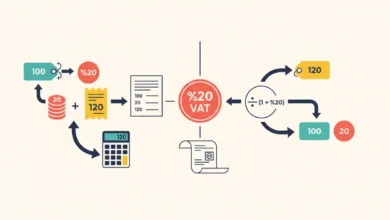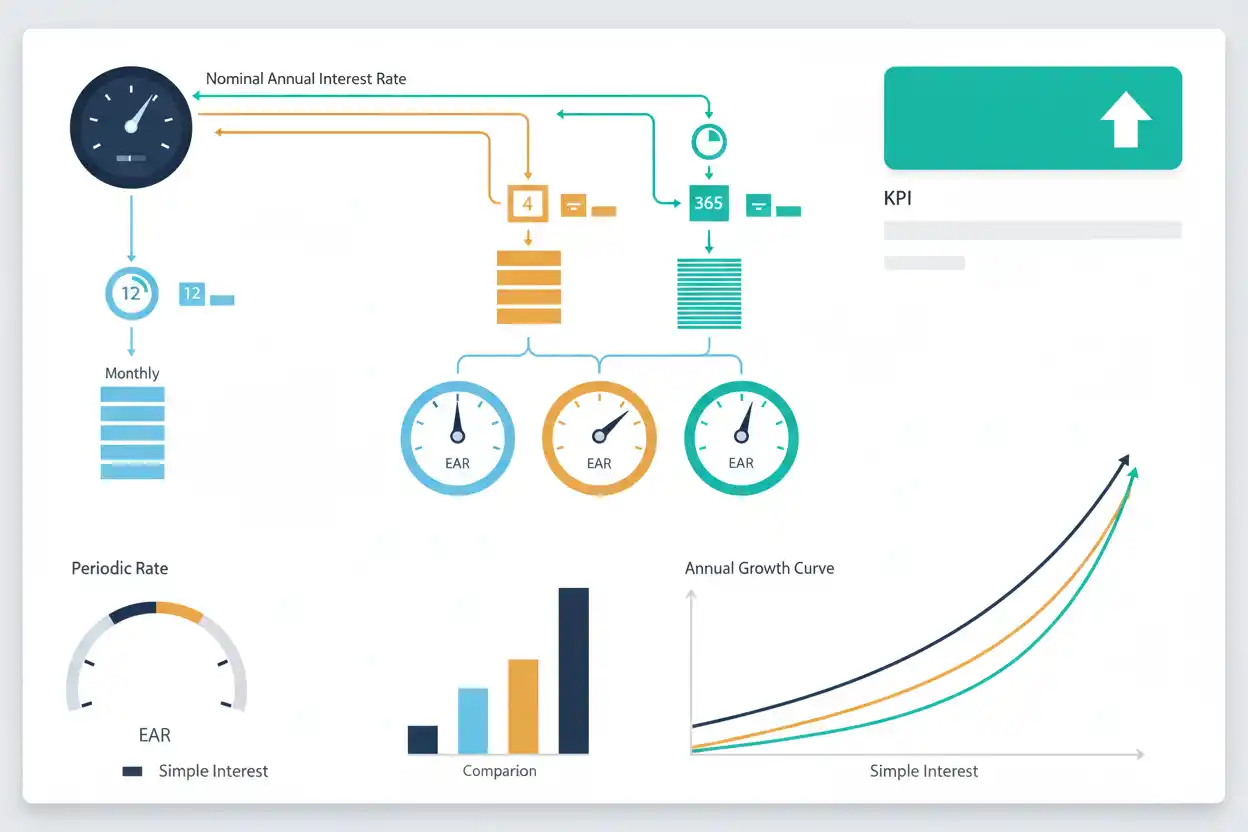

The nominal vs effective interest rate distinction explains why two financial products can quote the same annual percentage yet produce different annual costs or returns.
A nominal interest rate states an annual rate before fully reflecting within-year compounding.
An effective interest rate shows the annual mathematical result after compounding is included.
The standard effective annual rate formula is:
Effective Annual Rate = (1 + Nominal Rate ÷ Compounding Periods)^Compounding Periods − 1
If the nominal rate is 12% and interest compounds monthly:
Effective Rate = (1 + 0.12 ÷ 12)^12 − 1
Effective Rate ≈ 12.68%
The nominal rate is 12%.
The effective annual rate is approximately 12.68%.
The difference comes entirely from compounding within the year.
What Is a Nominal Interest Rate?
A nominal interest rate is a stated annual rate that can be divided into periodic rates.
For example:
Nominal annual rate = 12%
Monthly periods = 12
Then:
Monthly Periodic Rate = 12% ÷ 12
Monthly Periodic Rate = 1%
The 12% nominal rate is therefore equivalent to twelve stated monthly periods of 1% before considering the effect of compounding those periods together.
The wider interest rate basics framework explains annual, periodic, simple, compound, APR, and APY terminology.
What Is an Effective Interest Rate?
The effective annual rate measures the actual mathematical annual growth or cost produced when periodic interest compounds.
If a balance grows 1% every month:
Month 1 multiplies the balance by 1.01.
Month 2 multiplies the already larger balance by 1.01 again.
After 12 months:
Annual Growth Factor = 1.01^12
Annual Growth Factor ≈ 1.126825
Therefore:
Effective Annual Rate ≈ 12.6825%
The extra 0.6825 percentage points come from interest-on-interest.
Nominal vs Effective Interest Rate Formula
Let:
r = nominal annual rate
m = compounding periods per year
Then:
Effective Annual Rate = (1 + r ÷ m)^m − 1
For quarterly compounding:
m = 4
For monthly compounding:
m = 12
For daily compounding using a 365-day convention:
m = 365
Monthly Compounding Example
Suppose:
Nominal rate = 12%
Compounding = monthly
Periodic rate:
Periodic Rate = 12% ÷ 12
Periodic Rate = 1%
Effective annual rate:
EAR = (1.01)^12 − 1
EAR ≈ 12.6825%
A $10,000 balance left untouched for one year would become approximately:
Ending Balance = $10,000 × 1.126825
Ending Balance ≈ $11,268.25
Interest generated:
$11,268.25 − $10,000 = $1,268.25
Annual Compounding Example
Now use the same nominal 12% with annual compounding.
EAR = (1 + 0.12 ÷ 1)^1 − 1
EAR = 12%
Ending $10,000 balance:
$10,000 × 1.12 = $11,200
The annual-compounding product produces $68.25 less interest than the monthly-compounding example.
Quarterly Compounding
For 12% nominal interest compounded quarterly:
Periodic Rate = 12% ÷ 4
Periodic Rate = 3%
Effective annual rate:
EAR = (1.03)^4 − 1
EAR ≈ 12.55%
Thus:
Annual compounding = 12.00% effective
Quarterly compounding ≈ 12.55% effective
Monthly compounding ≈ 12.68% effective
More frequent compounding increases the effective rate when the nominal rate is positive.
Daily Compounding Example
Using 365 compounding periods:
EAR = (1 + 0.12 ÷ 365)^365 − 1
EAR ≈ 12.75%
The increase from monthly to daily compounding is much smaller than the increase from annual to monthly compounding.
As compounding becomes more frequent, the incremental effect gets progressively smaller.
Nominal vs Effective Rate Comparison
At a 12% nominal annual rate:
| Compounding | Effective Annual Rate |
|---|---|
| Annual | 12.00% |
| Quarterly | 12.55% |
| Monthly | 12.68% |
| Daily, 365 | 12.75% |
The nominal rate is identical in every row.
Only compounding frequency changes.
Reverse Formula: Effective to Nominal
If you know the effective annual rate and compounding frequency, the equivalent nominal rate is:
Nominal Rate = m × [(1 + Effective Rate)^(1/m) − 1]
Suppose:
Effective annual rate = 12.68%
Compounding periods = 12
Then:
Nominal Rate ≈ 12 × [(1.1268)^(1/12) − 1]
Nominal Rate ≈ 12%
This allows rates stated on different bases to be converted into comparable terms.
Why Compounding Frequency Matters
Suppose two lenders both quote 10% nominal annual interest.
Loan A compounds annually.
Loan B compounds monthly.
Loan A effective rate:
10.00%
Loan B:
EAR = (1 + 0.10 ÷ 12)^12 − 1
EAR ≈ 10.47%
The nominal percentages are identical.
The effective annual cost is not.
This difference becomes more important as rates increase and compounding becomes more frequent.
Nominal vs Effective Rate and Compound Interest
A compound interest loan demonstrates the mechanism creating the difference.
The nominal rate tells you the periodic rate structure.
The effective rate tells you what happens after those periodic rates interact through compounding over a full year.
Without compounding within the year, the two rates can be identical.
Nominal vs Effective and Simple Interest
A simple interest loan does not inherently charge interest on previously generated interest.
Therefore, a simple-interest annual calculation does not create the same nominal-effective compounding gap.
For one year:
Simple Interest = Principal × Rate × Time
At 12% on $10,000:
Interest = $1,200
The effective annual result under that simplified one-year structure is simply 12%.
Nominal vs Effective and APR
APR should not automatically be treated as synonymous with either a generic nominal rate or an effective annual rate.
APR is an annualized credit-cost disclosure concept.
Depending on the product and applicable rules, it can reflect financing charges and follow specific calculation conventions.
The effective annual rate instead answers a mathematical compounding question.
Therefore:
APR ≠ Automatically Effective Annual Rate
Nominal vs Effective and APY
APY is more directly associated with the effect of compounding on deposit yield.
The APR vs APY comparison explains why deposit accounts often show an annual percentage yield that exceeds the underlying stated annual interest rate when compounding occurs more than annually.
For example:
Nominal deposit rate = 5%
Monthly compounding
Effective Yield = (1 + 0.05 ÷ 12)^12 − 1
Effective Yield ≈ 5.12%
Nominal vs Effective and Personal Loan APR
A personal loan APR can exceed the loan’s contractual interest rate because origination charges or other finance costs are incorporated into the annualized credit-cost calculation.
That difference is conceptually separate from the nominal-effective difference caused purely by compounding.
A loan can therefore involve three distinct percentages:
contractual rate, APR, and effective annual economic rate.
Nominal vs Effective and Personal Loan Payments
Personal loan payments usually use the contractual periodic interest rate.
If the loan states a 12% nominal annual rate with monthly payments:
Monthly Rate = 12% ÷ 12 = 1%
That 1% periodic rate enters the payment formula.
The effective 12.68% annual rate describes the annual mathematical effect of compounding, not the periodic rate that should simply be substituted into the monthly payment equation.
Nominal vs Effective and Loan Term
The loan term determines how long periodic borrowing costs continue.
A modest nominal-effective difference can accumulate into a meaningful dollar difference when balances remain outstanding for many years.
Therefore, rate comparison and term comparison should be performed together.
Nominal vs Effective and Loan-to-Income Ratio
The loan-to-income ratio contains no interest-rate input.
Two loans can have identical LTI but different effective costs because their rates and compounding differ.
LTI measures debt size.
Effective interest measures rate economics.
Nominal vs Effective and Loan Payoff
A loan payoff quote is a dollar amount required to settle debt.
It should not be derived merely by multiplying principal by an effective annual rate.
Payoff calculations depend on contractual accrual rules, elapsed time, balance, and fees.
Nominal vs Effective and Fixed vs Variable Rates
The fixed vs variable interest rate distinction answers whether the rate can change.
Nominal vs effective answers how a stated rate translates after compounding.
A loan can therefore have:
a fixed nominal rate with a fixed effective annual rate, or a variable nominal rate whose effective annual rate changes after each reset.
Nominal vs Effective and Flat Interest
The flat vs reducing balance interest comparison involves a different issue: which balance is used to calculate interest.
A flat 10% rate can have a much higher effective borrowing cost than a 10% reducing-balance rate even before ordinary compounding differences are considered.
Loan Origination Fees
A loan origination fee can increase the effective economic borrowing cost without changing the contractual nominal rate.
Suppose:
Loan amount = $10,000
Nominal rate = 10%
Fee withheld = $500
The borrower receives only $9,500 but may make payments based on $10,000.
That increases the rate implied by the actual cash flows.
Effective Rate and Comparison Shopping
Suppose Product A offers:
12% nominal compounded annually.
Product B offers:
11.8% nominal compounded monthly.
Product B’s effective rate is:
EAR = (1 + 0.118 ÷ 12)^12 − 1
EAR ≈ 12.46%
Despite the lower nominal rate, Product B has a higher effective annual mathematical rate than Product A’s 12%.
This is why rate bases must be normalized before comparison.
Effective Rate Does Not Equal Total Interest
A higher effective rate generally creates greater interest cost when all other variables remain equal.
However, total dollar interest also depends on:
principal, repayment timing, term, and additional borrowing.
A 15% rate on $1,000 can cost fewer dollars than a 5% rate on $100,000.
Rate and dollar cost should therefore remain separate.
Common Nominal vs Effective Rate Mistakes
A frequent mistake is comparing rates without checking compounding frequency.
Another is multiplying a monthly rate by 12 and assuming the result is the effective annual rate.
Borrowers also confuse APR with EAR.
A fourth mistake is applying the effective annual rate directly as a monthly rate.
Finally, fees can change the economic borrowing cost even when nominal and effective compounding calculations are performed correctly.
Frequently Asked Questions
What is a nominal interest rate?
It is a stated annual rate before fully incorporating within-year compounding into the annual percentage.
What is an effective interest rate?
It is the annual mathematical rate after periodic compounding is included.
What is the effective annual rate formula?
EAR = (1 + r ÷ m)^m − 1
What is 12% nominal compounded monthly effectively?
Approximately 12.68% per year.
What is 12% nominal compounded quarterly effectively?
Approximately 12.55%.
What is 12% nominal compounded daily?
Using 365 periods, approximately 12.75% effective annually.
Why is the effective rate higher?
Because interest credited or charged during earlier periods contributes to later compounding.
Is APR an effective annual rate?
Not necessarily. APR follows credit-cost disclosure conventions and can incorporate fees.
Is APY an effective rate?
APY is designed to reflect annual yield including compounding in deposit contexts.
Can the nominal and effective rate be equal?
Yes. With annual compounding, the standard nominal and effective rate are equal.
Which rate should I use to compare investments?
Rates should be converted to a common effective basis when compounding frequencies differ.
Which rate determines my loan payment?
The contractual periodic rate specified by the financing structure normally drives the payment calculation.
Final Takeaway
The nominal vs effective interest rate distinction comes down to compounding.
The core formula is:
Effective Annual Rate = (1 + Nominal Rate ÷ Compounding Periods)^Compounding Periods − 1
A 12% nominal rate compounded monthly produces:
12.68% Effective Annual Rate
Quarterly compounding produces approximately 12.55%, while daily compounding produces approximately 12.75% using 365 periods.
The important lesson is that a quoted annual percentage cannot be compared intelligently until you know whether it is nominal or effective and how often interest compounds.