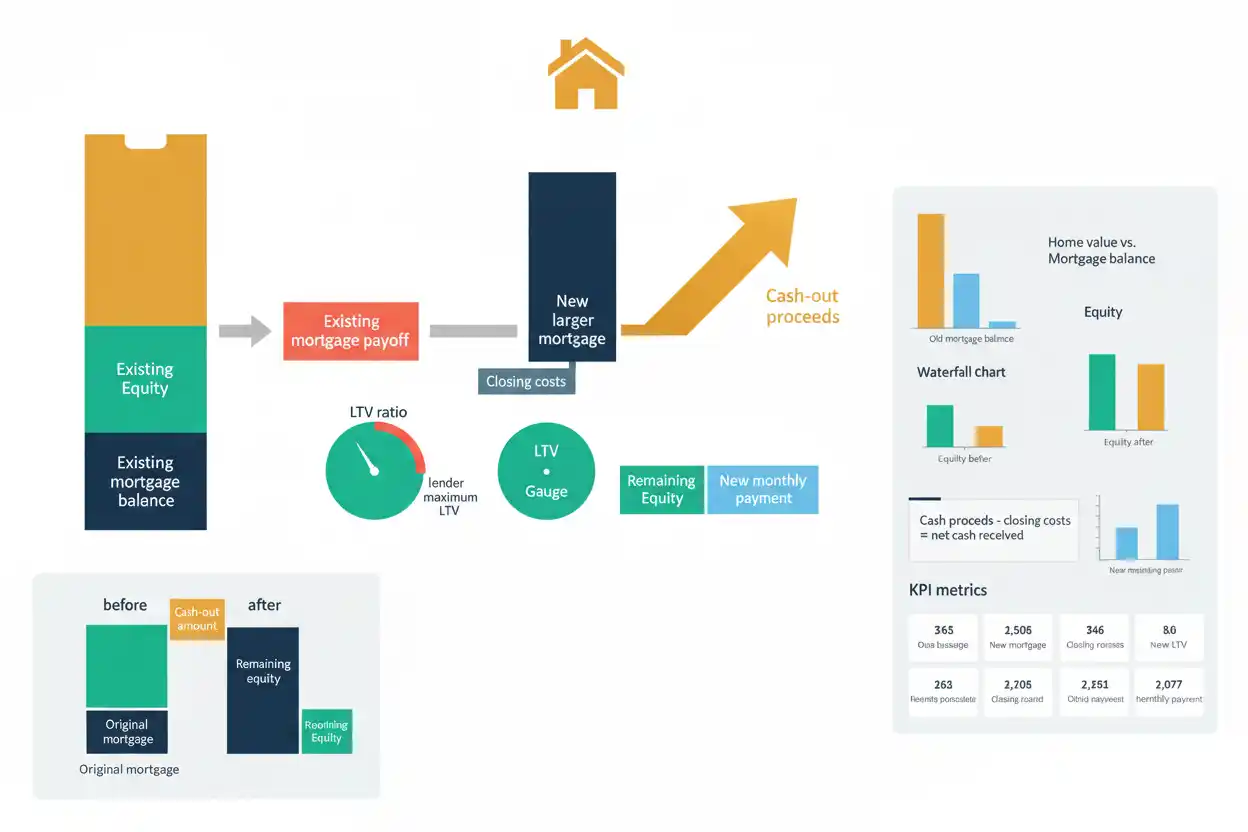

A cash-out refinance replaces an existing mortgage with a larger new mortgage and gives the borrower part of the difference as cash after the old loan and transaction costs are settled.
The basic relationship is:
Gross Cash-Out = New Mortgage Amount − Existing Mortgage Payoff
A more useful net formula is:
Net Cash to Borrower = New Mortgage Amount − Existing Mortgage Payoff − Closing Costs and Other Amounts Paid From Proceeds
Suppose:
New mortgage = $320,000
Existing payoff = $220,000
Closing costs paid from proceeds = $8,000
Then:
Gross Cash-Out = $320,000 − $220,000
Gross Cash-Out = $100,000
Net cash:
Net Cash = $320,000 − $220,000 − $8,000
Net Cash = $92,000
The borrower receives $92,000, but the entire old mortgage has also been replaced by a new $320,000 loan.
That distinction is crucial.
CFPB research updated in June 2026 describes a cash-out refinance as replacing the original mortgage, unlike home equity loans or HELOCs, which generally leave the existing first mortgage in place.
What Is a Cash-Out Refinance?
A cash-out refinance converts some home equity into cash by increasing mortgage debt.
Before:
homeowner has an existing first mortgage.
After:
that first mortgage is paid off and replaced with a larger mortgage.
The extra proceeds can be used for purposes such as:
home improvements, debt repayment, education expenses, major purchases, or other financial needs.
The broader Mortgages & Home Loans framework connects cash-out refinancing with home equity, mortgage rates, loan-to-value ratios, closing costs, and long-term repayment.
Cash-Out Refinance Formula
A simple calculation is:
Gross Cash-Out = New Loan Amount − Old Mortgage Payoff
Then:
Net Cash = Gross Cash-Out − Costs Paid From Proceeds
Suppose:
New loan = $350,000
Old payoff = $250,000
Costs = $9,000
Gross:
$350,000 − $250,000 = $100,000
Net:
$100,000 − $9,000 = $91,000
The borrower takes on $100,000 of additional mortgage principal but receives only $91,000 of cash after costs in this simplified example.
Cash-Out Refinance LTV Formula
The new mortgage creates a new loan-to-value ratio.
New LTV = New Mortgage Amount ÷ Property Value × 100
Suppose:
Home value = $500,000
New mortgage = $320,000
Then:
LTV = $320,000 ÷ $500,000 × 100
LTV = 64%
Before refinancing, the $220,000 old mortgage represented:
Old LTV = $220,000 ÷ $500,000 × 100
Old LTV = 44%
The transaction increases first-mortgage leverage from 44% to 64%.
Home Equity Before and After Cash-Out
Before refinancing:
Home Equity = Home Value − Mortgage Balance
Home Equity = $500,000 − $220,000
Home Equity = $280,000
After the $320,000 new mortgage:
Remaining Equity = $500,000 − $320,000
Remaining Equity = $180,000
The borrower converted approximately $100,000 of gross equity into additional mortgage debt, while $8,000 of the transaction value went toward costs rather than cash in hand.
Cash-Out Refinance Payment Example
Suppose the new mortgage is:
Principal = $320,000
Interest rate = 7%
Term = 30 years
The standard payment formula is:
Payment = P × [r(1 + r)^n] ÷ [(1 + r)^n − 1]
The new principal-and-interest payment is approximately:
New Monthly Payment ≈ $2,128.97
Now suppose the existing $220,000 mortgage had:
Rate = 4%
Remaining term = 20 years
Its hypothetical principal-and-interest payment is approximately:
Old Payment ≈ $1,333.16
Increase:
Payment Increase ≈ $2,128.97 − $1,333.16
Payment Increase ≈ $795.81 per Month
This example highlights why cash-out refinancing should never be evaluated from the cash received alone.
The Entire Old Balance Is Repriced
The borrower receives $92,000 of net cash.
But the refinance does not create a separate $92,000 loan at 7%.
Instead, the entire $320,000 new first mortgage is subject to the new financing structure.
This can be particularly expensive when the existing mortgage has a much lower rate.
For example:
Old rate = 4%
New rate = 7%
The borrower is giving up the 4% financing on the remaining $220,000 to obtain access to additional cash.
That opportunity cost can be substantial.
Cash-Out Refinance vs Home Equity Loan
A home equity loan generally leaves the existing first mortgage unchanged and adds a separate closed-end loan secured by the property.
That can be attractive when the first mortgage has a very favorable rate.
However, the second loan can carry a higher rate than first-mortgage refinancing.
The comparison should evaluate total payments across both debts.
Cash-Out Refinance vs HELOC
A HELOC also leaves the existing first mortgage in place and provides revolving access to home equity.
A HELOC can be useful when the amount needed is uncertain or will be drawn gradually.
The tradeoff is that HELOC rates are often variable and repayment structures differ from a fixed first mortgage.
Cash-Out Refinance and CLTV
The combined loan-to-value ratio matters when subordinate financing remains after the refinance.
Suppose:
New first mortgage = $320,000
HELOC balance = $30,000
Home value = $500,000
CLTV:
CLTV = ($320,000 + $30,000) ÷ $500,000 × 100
CLTV = 70%
A borrower can therefore have 64% first-mortgage LTV but 70% combined leverage.
Cash-Out Refinance and Conforming Loan Rules
A conforming loan is governed by specific eligibility and underwriting requirements.
Cash-out refinance limits can differ from purchase and rate-and-term refinance limits.
Because these requirements can change by property type, occupancy, underwriting method, and program, borrowers should use current lender and program standards rather than a generic LTV threshold.
Freddie Mac, for example, publishes separate LTV/TLTV requirements for cash-out refinance mortgages.
Cash-Out Refinance and Bridge Loans
A bridge loan solves a temporary financing gap.
A cash-out refinance is generally a long-term replacement of the first mortgage.
Using a 30-year refinance to solve a six-month liquidity need can produce unnecessary long-term interest.
Likewise, using expensive bridge financing for money needed over many years may be inefficient.
Match the financing structure to the actual time horizon.
Cash-Out Refinance and Balloon Mortgages
A balloon mortgage may need refinancing before a large maturity payment becomes due.
A borrower can potentially choose a cash-out refinance at that point.
However, extracting additional equity while resolving the balloon increases the new mortgage amount.
The transaction should therefore separate:
required refinancing amount
from:
optional additional cash.
Cash-Out Refinance and Biweekly Payments
Biweekly mortgage payments can accelerate repayment of the new mortgage.
However, making one extra payment per year does not undo poor refinance economics.
Before planning aggressive repayment, determine whether replacing the old mortgage with a larger new mortgage made sense in the first place.
Cash-Out Refinance and Closing Costs
Mortgage closing costs reduce the economic benefit of refinancing.
Suppose:
Gross cash-out = $100,000
Closing costs = $8,000
The borrower receives:
$92,000
but owes the full new mortgage.
If costs are financed instead of deducted from proceeds, the mortgage principal can become even larger.
Financed Closing Costs Example
Suppose the borrower wants a full $100,000 cash payout.
Old payoff = $220,000
Cash desired = $100,000
Financed closing costs = $8,000
Required new mortgage:
New Loan = $220,000 + $100,000 + $8,000
New Loan = $328,000
At a $500,000 property value:
LTV = $328,000 ÷ $500,000 × 100
LTV = 65.6%
The financing costs themselves have increased property leverage.
Cash-Out Refinance and Mortgage APR
The mortgage APR incorporates specified financing costs into an annualized measure.
A borrower comparing cash-out offers should therefore evaluate:
interest rate, APR, points, lender credits, and total closing costs.
A lower interest rate with high points can be less attractive if the borrower will not retain the loan long enough to recover the upfront cost.
Cash-Out Refinance and Discount Points
Discount points can reduce mortgage pricing in exchange for upfront cost.
Suppose:
One point on $320,000:
Point Cost = $320,000 × 1%
Point Cost = $3,200
If paying $3,200 saves $60 per month:
Break-Even = $3,200 ÷ $60
Break-Even ≈ 53.3 Months
The borrower should compare that period with the expected time before selling or refinancing again.
Cash-Out Refinance and Mortgage Break-Even
The mortgage break-even point becomes useful when refinancing is expected to create recurring savings.
However, a cash-out refinance can increase the monthly payment instead of lowering it.
In that case, the analysis is not simply “when do savings recover costs?”
It becomes:
Is the cost of obtaining this cash better than available alternatives?
Cash-Out Refinance and Debt Consolidation
CFPB research has found that cash-out borrowers often use proceeds to pay other debts, including credit card and auto balances.
This can reduce high-rate unsecured debt.
But it also converts some of that debt into borrowing secured by the home and can stretch repayment across a much longer period.
A lower rate does not automatically produce savings when the term expands dramatically.
Debt Consolidation Example
Suppose:
Credit-card debt = $40,000 at 24%
Cash-out mortgage rate = 7%
The mortgage rate is far lower.
However, if the $40,000 is effectively repaid over 30 years instead of a disciplined shorter payoff schedule, total interest can remain substantial.
The borrower should create a separate payoff plan for the extracted amount instead of allowing it to disappear inside a long mortgage balance.
Cash-Out Refinance and Mortgage Term
The mortgage term can create one of the largest hidden costs.
Suppose the old mortgage has 15 years remaining.
The refinance creates a new 30-year mortgage.
Even with a competitive rate, the borrower has reset the debt clock.
A lower payment can result simply because repayment has been extended for another 15 years.
Cash-Out Refinance and Mortgage Amortization
The mortgage amortization schedule also restarts.
The new mortgage begins with a larger balance, and early payments again contain substantial interest.
Borrowers who have spent years building principal momentum should account for this reset.
Cash-Out Refinance and Mortgage Principal
Mortgage principal increases when equity is extracted.
This is the defining debt effect of the transaction.
If:
Old principal = $220,000
New principal = $320,000
Then:
Principal Increase = $100,000
even if net cash received after costs is only $92,000.
Cash-Out Refinance and Mortgage Payoff Amount
Use the actual mortgage payoff amount rather than an old statement balance when calculating cash-out proceeds.
Suppose:
Displayed principal = $220,000
Current payoff = $220,650
Using $220,000 overstates available cash by $650.
Cash-Out Refinance and Mortgage Insurance
A higher new LTV can affect mortgage insurance requirements depending on the loan type.
Borrowers who have built enough equity to eliminate an existing insurance cost should verify whether extracting substantial equity could create new insurance consequences under the replacement mortgage.
Cash-Out Refinance and Home Affordability
Home affordability does not improve merely because a homeowner has equity.
The household still needs enough income and liquidity to support the larger mortgage payment.
Home equity is wealth tied to the property.
Cash-out refinancing turns part of that equity back into debt.
Common Cash-Out Refinance Mistakes
One mistake is treating net cash received as though it were the only new debt.
Another is ignoring the fact that the entire existing mortgage is repriced.
Borrowers also focus on a lower payment while overlooking a longer term.
A fourth mistake is financing closing costs without recognizing that they increase principal.
Finally, using mortgage-secured debt to pay unsecured obligations can increase the consequences of repayment failure.
Frequently Asked Questions
What is a cash-out refinance?
It replaces an existing mortgage with a larger new mortgage and provides part of the difference to the borrower as cash.
What is the cash-out formula?
Gross Cash-Out = New Mortgage − Existing Mortgage Payoff
How do I calculate net cash?
Net Cash = New Mortgage − Existing Payoff − Costs Paid From Proceeds
What is the net cash on a $320,000 refinance with a $220,000 payoff and $8,000 of costs?
$92,000
Does cash-out refinance increase mortgage debt?
Yes. The new mortgage is generally larger than the mortgage it replaces.
Is cash-out refinance the same as a HELOC?
No. A cash-out refinance replaces the first mortgage; a HELOC generally leaves it in place.
Is cash-out refinance the same as a home equity loan?
No. A home equity loan is generally an additional property-secured loan rather than a replacement first mortgage.
Does cash-out refinance affect LTV?
Yes. A larger new mortgage generally increases LTV relative to the same property value.
Can I use cash-out refinance for debt consolidation?
Yes, but converting unsecured debt into home-secured debt changes both the term and risk.
Does a lower mortgage rate guarantee savings?
No. Closing costs, term reset, additional principal, and total repayment matter.
Should I refinance a low-rate existing mortgage to access cash?
Compare the cost of repricing the entire old mortgage with alternatives such as a home equity loan or HELOC.
What should I calculate before refinancing?
Calculate new principal, net cash, LTV/CLTV, payment, APR, closing costs, remaining term on the old loan, new term, and total expected interest.
Final Takeaway
A cash-out refinance does more than release home equity.
It replaces the existing mortgage with a larger new debt.
In the example:
Home value = $500,000
Existing payoff = $220,000
New mortgage = $320,000
Closing costs from proceeds = $8,000
Gross cash-out:
$100,000
Net cash:
$92,000
New LTV:
64%
At 7% for 30 years, the new principal-and-interest payment is approximately:
$2,128.97 per Month
The key decision is therefore not simply whether you want $92,000 of cash. It is whether replacing the entire existing mortgage, increasing property-secured debt, paying closing costs, and potentially restarting a long amortization period is the most efficient way to obtain that money.