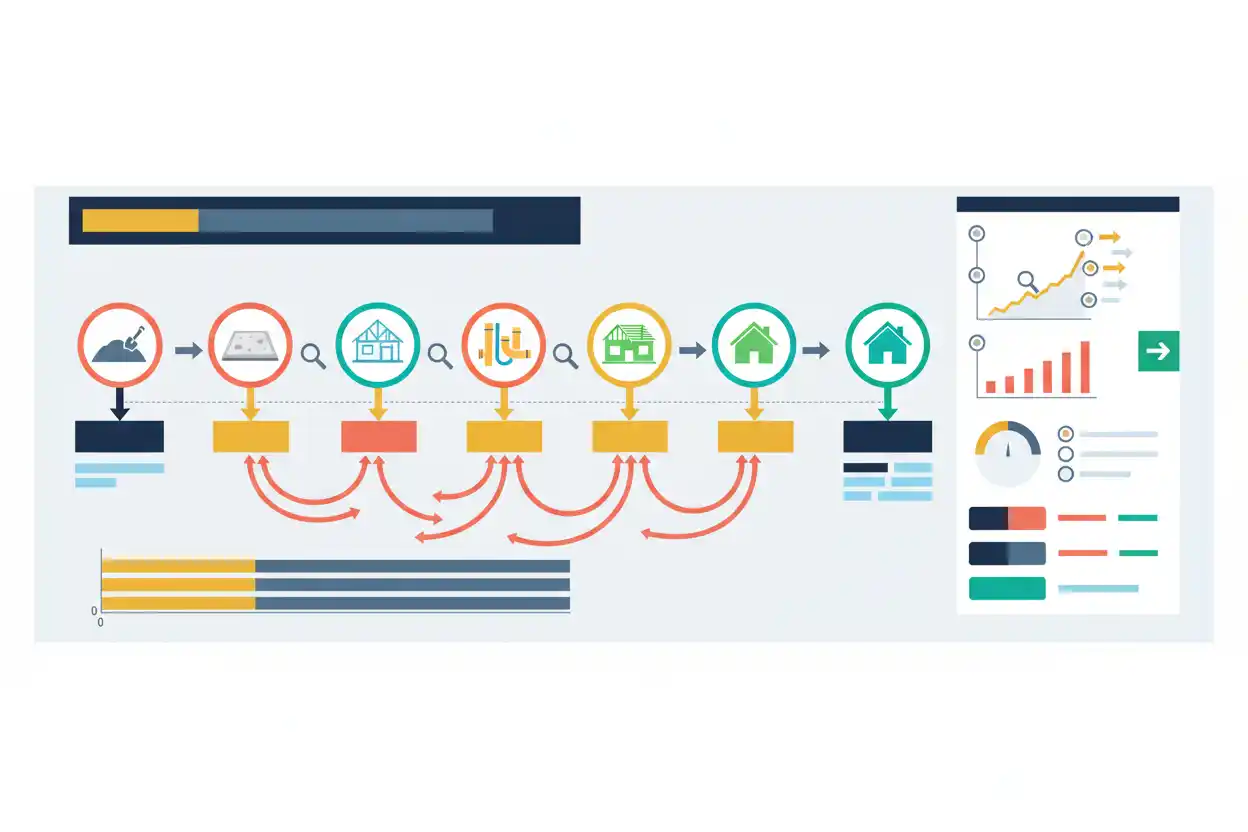
A construction loan finances the building, rehabilitation, or major improvement of a property while construction is underway.
Unlike a conventional purchase mortgage that usually funds a large amount at closing, construction financing can involve multiple advances or draws as the project progresses.
That changes the interest calculation.
If the lender has approved a $600,000 construction facility but only $100,000 has actually been advanced, interest can be calculated from the amount outstanding rather than automatically from the entire commitment under a draw-based structure.
A basic calculation is:
Construction Interest = Outstanding Drawn Balance × Annual Interest Rate × Time
CFPB mortgage rules specifically address multiple-advance construction loans and construction-to-permanent structures. They also recognize construction phases in which interest is payable on the amounts actually advanced while they remain outstanding.
What Is a Construction Loan?
A construction loan is financing designed around a building project rather than an already completed home.
Funds can be released as construction reaches agreed milestones.
A simplified sequence might be:
land or site work, foundation, framing, mechanical systems, interior completion, and final completion.
The lender can use inspections or documentation before authorizing later draws.
The exact process depends on the construction contract and lender.
Construction Loan Draw Formula
At any point:
Outstanding Construction Balance = Sum of All Funded Draws − Principal Repaid
If:
Draw 1 = $100,000
Draw 2 = $150,000
then after the second draw:
Outstanding Balance = $100,000 + $150,000
Outstanding Balance = $250,000
Interest is then calculated according to the loan’s applicable rate and timing rules.
Monthly Interest-Only Formula
For a simplified monthly interest-only structure:
Monthly Construction Interest = Outstanding Balance × Annual Rate ÷ 12
Suppose:
Outstanding balance = $250,000
Rate = 8.5%
Then:
Monthly Interest = $250,000 × 8.5% ÷ 12
Monthly Interest ≈ $1,770.83
If another $200,000 draw raises the balance to $450,000:
Monthly Interest = $450,000 × 8.5% ÷ 12
Monthly Interest = $3,187.50
The payment rises because more money has actually been advanced.
Construction Loan Example
Suppose a borrower has a:
Construction facility = $600,000
Rate = 8.5%
Construction period = 12 months
The draw schedule is:
Months 1–3: $100,000 outstanding
Months 4–6: $250,000 outstanding
Months 7–9: $450,000 outstanding
Months 10–12: $600,000 outstanding
Months 1–3
Interest = $100,000 × 8.5% × 3 ÷ 12
Interest = $2,125
Months 4–6
Interest = $250,000 × 8.5% × 3 ÷ 12
Interest = $5,312.50
Months 7–9
Interest = $450,000 × 8.5% × 3 ÷ 12
Interest = $9,562.50
Months 10–12
Interest = $600,000 × 8.5% × 3 ÷ 12
Interest = $12,750
Total simplified construction-period interest:
Total Construction Interest = $2,125 + $5,312.50 + $9,562.50 + $12,750
Total Construction Interest = $29,750
If the entire $600,000 had been outstanding for the full year, interest would instead be:
$600,000 × 8.5% = $51,000
The staged draw structure saves interest because the borrower does not owe interest on money before it is advanced under the simplified example.
Construction-to-Permanent Loan
A construction-to-permanent loan combines the building phase with permanent mortgage financing.
CFPB rules permit qualifying multiple-advance construction loans that may be permanently financed by the same creditor to be treated as a single transaction or, in specified circumstances, as separate construction and permanent phases for disclosure purposes.
Conceptually:
Construction Phase → Completed Property → Permanent Mortgage Phase
The permanent phase then uses ordinary mortgage amortization.
Construction-Only Loan
A construction-only structure finances the project but requires separate permanent financing.
At completion, the borrower might obtain a fixed-rate mortgage or another home loan to repay the construction balance.
That creates two financing events.
It can also create two sets of underwriting and closing costs.
Interest-Only Construction Payments
Some construction phases require interest-only payments because principal is expected to be repaid or converted when construction ends. CFPB construction disclosure rules specifically address interest-only construction periods in applicable transactions.
A $400,000 outstanding balance at 8.5% creates:
Interest-Only Payment = $400,000 × 8.5% ÷ 12
Interest-Only Payment ≈ $2,833.33
The principal remains $400,000 if no principal repayment occurs.
The dedicated interest-only mortgage article covers the broader interest-only concept.
Construction Loan and Down Payment
Down payments for construction financing can be expressed through the borrower’s required equity contribution.
Suppose:
Total project value or eligible cost basis = $750,000
Maximum construction financing = $600,000
Borrower equity:
Required Equity = $750,000 − $600,000
Required Equity = $150,000
Percentage:
Equity Percentage = $150,000 ÷ $750,000 × 100
Equity = 20%
Actual lender calculations can use land equity, project cost, completed value, or other underwriting measures.
Construction Loan and LTV
The combined loan-to-value ratio can become relevant when other property-secured financing exists.
Construction lending can also use loan-to-cost and loan-to-value measurements.
A simplified completed-value LTV is:
LTV = Loan Amount ÷ Completed Property Value × 100
If:
Loan = $600,000
Completed value = $800,000
LTV = 75%
The lender can also analyze project cost separately.
Loan-to-Cost
A useful construction-specific ratio is:
Loan-to-Cost = Construction Loan ÷ Total Eligible Project Cost × 100
If:
Loan = $600,000
Project cost = $750,000
LTC = $600,000 ÷ $750,000 × 100
LTC = 80%
LTV and LTC should not be used interchangeably.
One compares the loan with property value.
The other compares the loan with cost.
Construction Loan and Conforming Financing
A conforming loan can potentially serve as the permanent financing after construction when the completed transaction meets applicable requirements.
The construction phase itself should not automatically be described as conforming merely because the intended permanent mortgage will be.
Construction Loan and Discount Points
Discount points can appear in permanent mortgage pricing or sometimes within specialized construction financing.
If one point is charged on $600,000:
Point Cost = $600,000 × 1%
Point Cost = $6,000
The borrower should determine which phase the rate reduction applies to before assuming the points reduce construction-period interest.
Construction Loan and Closing Costs
Mortgage closing costs can be particularly important when comparing one-close and two-close construction structures.
If construction and permanent financing close separately, the borrower can incur costs at both transactions.
The apparent interest-rate advantage of one structure can disappear if additional fees are large.
Construction Loan and Cash-Out Refinance
A cash-out refinance is generally a later equity transaction involving an existing completed property.
It should not be confused with construction financing used to build the property.
After construction is complete and equity develops, cash-out financing can become a separate future option subject to its own requirements.
Construction Loan and Bridge Loan
A bridge loan can sometimes solve a temporary liquidity gap while a new home is being built.
For example, a homeowner can have equity trapped in an existing residence while construction expenses require cash.
However, adding bridge debt creates more financing cost and potentially more property leverage.
Construction Loan and Mortgage Principal
Mortgage principal behaves differently during a draw phase.
Instead of beginning at the final loan amount, the outstanding construction principal can increase as draws occur:
Balance After New Draw = Previous Balance + New Advance − Principal Repaid
This is the opposite direction from ordinary amortization, where principal generally falls.
Construction Loan and Rate Locks
A mortgage rate lock can be particularly important when the permanent mortgage will not begin until construction is finished.
If permanent pricing is not fixed at construction closing, the borrower can be exposed to future mortgage-rate changes.
If pricing is locked for a long construction period, extension fees or other conditions can matter.
Construction Loan and Mortgage Term
The mortgage term of permanent financing should be separated from the construction period.
CFPB gives an example in which a one-year construction period plus a 30-year permanent period can be disclosed as a combined 31-year term when the transaction is treated as one combined transaction.
That does not mean the borrower makes the same payment for 31 years.
The construction and permanent phases can have very different payment structures.
Cost Overruns
Suppose:
Construction budget = $750,000
Actual final cost = $800,000
Approved loan remains $600,000
Original borrower contribution:
$150,000
New contribution:
$800,000 − $600,000 = $200,000
Cost overrun:
Additional Cash Required = $50,000
Construction borrowers therefore need contingency planning rather than assuming the approved loan automatically expands when costs increase.
Delayed Construction
A delayed project can increase interest.
Suppose the $600,000 full balance remains outstanding for three additional months at 8.5%.
Extra interest:
Extra Interest = $600,000 × 8.5% × 3 ÷ 12
Extra Interest = $12,750
A three-month construction delay can therefore materially change the financing budget.
Common Construction Loan Mistakes
One mistake is calculating interest from the entire approved facility from day one when the loan actually uses staged draws.
Another is assuming every construction loan automatically converts to permanent financing.
Borrowers also underestimate cost overruns and delays.
A fourth mistake is ignoring the permanent mortgage rate while focusing only on construction-period interest.
Finally, construction cost, completed property value, LTV, and loan-to-cost are distinct measurements.
Frequently Asked Questions
What is a construction loan?
It is financing used to build, rehabilitate, or substantially improve property, often through multiple advances as work progresses.
How is construction interest calculated?
A simplified formula is:
Interest = Outstanding Drawn Balance × Rate × Time
Do I pay interest on the full approved loan immediately?
Not necessarily. Multiple-advance structures can calculate interest from amounts actually advanced while they are outstanding.
What is a draw?
A draw is an advance of part of the approved construction financing.
What is construction-to-permanent financing?
It combines or links the construction phase with permanent mortgage financing.
Can construction payments be interest-only?
Yes, some structures require interest-only payments during construction.
What is loan-to-cost?
LTC = Loan Amount ÷ Project Cost × 100
What is construction LTV?
It generally compares financing with an applicable property-value measure.
What happens if construction costs exceed the budget?
The borrower can need additional cash or approved financing, depending on the lender and contract.
Do construction delays increase interest?
They can because the outstanding balance remains borrowed for longer.
Can a construction loan become conforming financing?
Permanent financing can potentially qualify if it meets applicable conforming requirements.
Should I compare one-close and two-close construction loans?
Yes. Compare rates, fees, rate-lock risk, closing costs, draw mechanics, and permanent financing terms.
Final Takeaway
Construction loans differ from ordinary mortgages because principal can increase in stages as money is drawn.
The central formula is:
Construction Interest = Outstanding Drawn Balance × Rate × Time
In the worked example, a $600,000 facility at 8.5% is drawn gradually over one year.
Because the balance rises from $100,000 to $600,000 in stages, total simplified construction interest is approximately:
$29,750
rather than $51,000, which would result if the entire $600,000 were outstanding for the whole year.
The strongest construction-loan analysis therefore tracks draw timing, outstanding principal, interest rate, cost overruns, project delays, borrower equity, and the permanent financing that takes over when construction is finished.