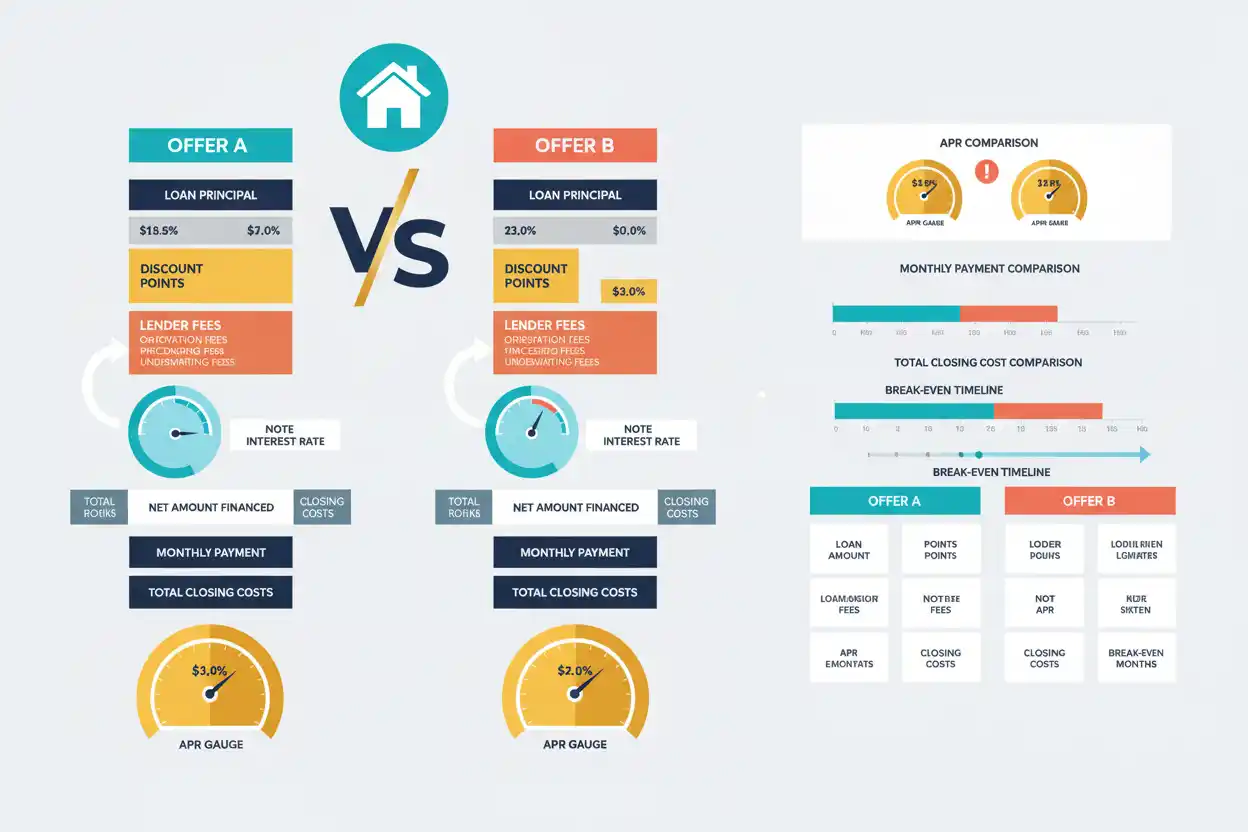

Mortgage APR, or annual percentage rate, is a broader annualized measure of mortgage borrowing cost than the note interest rate alone.
The interest rate primarily determines the contractual interest charged on principal.
APR also reflects applicable finance charges associated with obtaining the mortgage.
CFPB explains that mortgage APR includes the interest rate plus points, fees, and other specified charges, which is why APR is commonly higher than the note rate.
The conceptual relationship is:
Mortgage APR = Annualized Cost of Mortgage Cash Flows Including Applicable Finance Charges
Unlike a simple nominal interest-rate calculation, an exact mortgage APR is determined from the amount and timing of credit received and payments made under Regulation Z’s APR methodology.
Therefore, APR should not be approximated by simply adding fee percentages to the interest rate.
Mortgage APR vs Interest Rate
Suppose a mortgage offer shows:
Interest rate = 6.25%
APR = 6.44%
These percentages answer different questions.
Interest rate: What contractual rate is being charged on mortgage principal?
APR: What is the broader annualized credit cost after applicable finance charges are incorporated?
CFPB describes APR as a broader measure of borrowing cost than the mortgage interest rate.
Mortgage Payment Uses the Note Rate
Assume:
Mortgage principal = $400,000
Interest rate = 6.25%
Term = 30 years
Monthly principal-and-interest payment:
≈ $2,462.87
That payment is based on the contractual 6.25% mortgage rate.
You do not normally take the disclosed APR and insert it into the standard payment formula to reproduce the contractual payment.
APR exists primarily as a borrowing-cost disclosure and comparison measure.
Mortgage APR Example With Fees
Suppose:
Mortgage face amount = $400,000
Note rate = 6.25%
Term = 30 years
Applicable prepaid finance charges used in this simplified illustration = $8,000
Scheduled payment remains based on:
$400,000 at 6.25%
Monthly P&I:
≈ $2,462.87
But if the borrower effectively receives $392,000 of financing value after the simplified $8,000 charge:
Amount Financed for Illustration = $400,000 − $8,000
$392,000
We can then solve for the periodic rate that makes:
Present Value of 360 Payments = $392,000
The resulting approximate annualized nominal rate is:
≈ 6.44%
This resembles the logic behind APR: the borrower is making payments associated with a $400,000 mortgage while the applicable financing charges reduce the net credit value received.
The actual legally disclosed APR must be calculated under the applicable Regulation Z rules and lender disclosures, so this example is educational rather than a substitute for the Loan Estimate or Closing Disclosure.
Why Fees Increase APR
Suppose two mortgages have the same:
principal, note rate, and term.
Loan A has:
$2,000 of Applicable Finance Charges
Loan B has:
$10,000 of Applicable Finance Charges
Loan B generally has the higher APR because the borrower incurs more cost to obtain the same nominal mortgage.
That is why APR can expose differences that are hidden when comparing rate alone.
Mortgage APR and Discount Points
Discount points are an important example.
CFPB states that mortgage APR can reflect points and other applicable charges.
Suppose:
Mortgage = $400,000
Points = 1.5
Cost:
$400,000 × 1.5%
$6,000
The lender might provide a lower note rate in exchange.
The lower rate reduces monthly interest.
The upfront points increase financing cost.
APR helps combine those effects into a standardized annualized comparison.
Mortgage APR and Closing Costs
Not every dollar listed under mortgage closing costs necessarily affects APR in the same way.
APR uses specific finance-charge rules rather than simply adding every closing expense to the loan.
This is why:
APR ≠ Interest Rate + Closing Cost Percentage
The official disclosure calculation determines which charges are included and how timing affects the annualized result.
Mortgage APR and Origination Fees
A mortgage origination fee can increase APR when it is treated as an applicable finance charge.
Suppose:
Mortgage amount = $400,000
Origination charge = 1%
Fee = $4,000
Two lenders offering the same note rate can therefore display different APRs because their financing charges differ.
Mortgage APR and Mortgage Points
The broader mortgage points structure can include pricing choices in which borrowers pay more upfront for a lower rate or accept a higher rate for lender credits.
APR helps compare those alternatives, but expected holding period remains important.
A mortgage with a lower APR can still require much more cash upfront.
Mortgage APR Example: Two Offers
Suppose you are comparing:
Offer A
Rate = 6.25%
APR = 6.44%
Upfront lender finance charges = $8,000
Offer B
Rate = 6.50%
APR = 6.53%
Upfront lender finance charges = $2,000
Offer A has:
lower rate and lower APR, but higher upfront costs.
If the borrower expects to keep the mortgage for decades, Offer A could be attractive.
If the borrower expects to refinance after two years, the extra $6,000 of upfront cost might not be recovered.
APR is useful, but holding-period analysis still matters.
Mortgage APR and Break-Even Point
The mortgage break-even point complements APR.
Suppose:
Extra upfront cost for lower-rate loan = $6,000
Monthly payment savings = $100
Break-Even = $6,000 ÷ $100
60 Months
The borrower needs approximately five years of payment savings to recover the extra upfront cost under the simple model.
APR does not replace this holding-period analysis.
Mortgage APR and Mortgage Amortization
The mortgage amortization schedule uses the contractual rate to determine principal and interest allocation.
Suppose:
Mortgage rate = 6.25%
APR = 6.44%
The first month’s contractual interest on $400,000 is:
$400,000 × 6.25% ÷ 12
$2,083.33
It is not normally calculated as:
$400,000 × 6.44% ÷ 12
APR is not the rate directly applied to outstanding principal for the normal mortgage statement.
Mortgage APR and Mortgage Affordability
The mapped mortgage affordability page should use the note-rate payment when estimating scheduled principal and interest.
APR becomes useful when comparing the broader cost of alternative offers.
Therefore:
Affordability → Monthly Contractual Payment
APR → Broader Financing Cost Comparison
Mortgage APR and Loan-to-Value Ratio
The loan-to-value ratio can influence mortgage pricing.
A borrower with lower LTV can potentially receive different rate or fee pricing than a borrower with higher LTV.
That can indirectly affect APR.
However:
LTV measures leverage.
APR measures borrowing cost.
They remain separate metrics.
Mortgage APR and Jumbo Mortgage
A jumbo mortgage can have large dollar finance charges.
Suppose:
Mortgage = $1,000,000
Point charge = 1%
Points = $10,000
Even when the percentage seems small, APR comparison is important because large loan balances convert small fee percentages into substantial cash amounts.
Mortgage APR and Interest-Only Mortgages
An interest-only mortgage creates more complicated cash flows because the payment pattern can change after the interest-only period.
APR remains an annualized disclosure measure, but borrowers should also examine the actual payment schedule.
A single APR percentage cannot communicate future payment shock by itself.
Mortgage APR and Adjustable-Rate Mortgages
The same limitation applies to an adjustable-rate mortgage.
Future mortgage rates depend on contractual adjustment rules and future index values.
A disclosed APR should therefore not be interpreted as a promise that the borrower will actually pay one constant interest rate for the life of the ARM.
Mortgage APR and Fixed-Rate Mortgage
With a fixed-rate mortgage, APR comparison is easier because the contractual rate does not reset.
Even so, APR assumes the contractual cash flows over the disclosure horizon.
If the borrower sells or refinances early, actual realized cost can differ from what a long-term APR comparison seems to imply.
APR and Short Holding Period
Suppose:
Loan A costs $8,000 upfront and saves $100 per month.
Borrower sells after 24 months.
Payment savings:
$100 × 24 = $2,400
Unrecovered extra cost:
$8,000 − $2,400
$5,600
A favorable APR does not automatically mean the mortgage is optimal for a short holding period.
APR and Refinancing
Refinancing ends the original mortgage early.
Therefore, borrowers expecting future refinancing should evaluate:
APR plus break-even period plus expected holding time.
Paying large upfront finance charges repeatedly can destroy the savings from modest rate reductions.
APR and Lender Credits
A lender can offer credits toward closing expenses in exchange for a higher rate.
That can create:
higher monthly payment but lower upfront cash.
The best option depends on:
how long the mortgage will be kept, how much cash is available, and how the lender’s rate-and-fee combinations compare.
APR helps organize that comparison but should not be the only metric.
APR Is Not Total Interest
Suppose:
Mortgage APR = 6.44%.
That does not mean:
Total Interest = Principal × 6.44%
APR is an annualized rate measure.
Total mortgage interest depends on:
principal, contractual rate, payment timing, term, prepayments, and how long the mortgage actually remains outstanding.
APR Is Not the Monthly Payment
A lower APR generally suggests a lower annualized financing cost among comparable loans, but it does not always produce the lowest monthly payment.
For example:
a short-term mortgage can have a lower APR yet a much higher monthly payment than a 30-year alternative.
The borrower should therefore compare:
payment and APR separately.
How to Compare Mortgage APR Correctly
For each competing offer, compare loans with:
the same mortgage amount, similar term, same rate type, similar lock period, and comparable transaction assumptions.
Then examine:
interest rate, APR, monthly payment, points, lender credits, closing costs, and cash to close.
CFPB encourages consumers to compare Loan Estimates rather than focusing on a single headline rate.
Common Mortgage APR Mistakes
One mistake is assuming APR equals the note rate.
Another is simply adding fee percentages to the interest rate.
Borrowers also insert APR into the ordinary mortgage-payment formula.
A fourth mistake is choosing the lowest APR without considering expected holding period or upfront cash.
Finally, APR should not be confused with APY, total interest, or mortgage LTV.
Frequently Asked Questions
What is mortgage APR?
It is an annualized measure of mortgage credit cost that incorporates the interest rate plus applicable finance charges.
Why is APR usually higher than the mortgage interest rate?
Because APR can include points, fees, and other applicable charges beyond the note interest rate.
Does APR determine my monthly mortgage payment?
The contractual interest rate generally determines scheduled principal and interest.
Can two loans have the same rate but different APRs?
Yes, if their applicable finance charges differ.
Are discount points included in APR?
Applicable mortgage points can affect APR.
Are all closing costs included in APR?
No. APR follows specific finance-charge rules rather than simply including every transaction expense.
Can I calculate exact mortgage APR myself?
You can estimate it through cash-flow mathematics, but the legally disclosed APR follows regulatory calculation rules.
Is a lower APR always better?
For otherwise comparable mortgages held for the assumed period, lower APR generally indicates lower annualized financing cost, but holding period, cash to close, and payment still matter.
Is APR the same as APY?
No. APR and APY use different concepts and should not be substituted.
Does mortgage APR include property taxes?
Ordinary property ownership expenses are not simply added into mortgage APR as though they were lender finance charges.
Should I use APR to calculate affordability?
Use the contractual mortgage payment for monthly affordability and APR for broader cost comparison.
Where can I find the mortgage APR?
It appears in mortgage disclosures such as the Loan Estimate and Closing Disclosure under applicable federal rules.
Final Takeaway
Mortgage APR answers a broader question than the interest rate:
What Is the Annualized Cost of This Mortgage After Applicable Finance Charges Are Considered?
In the simplified example:
Mortgage face amount = $400,000
Note rate = 6.25%
Term = 30 years
Illustrative applicable charges = $8,000
Monthly payment remains approximately:
$2,462.87
based on the 6.25% note rate.
But treating the borrower as effectively receiving $392,000 while making payments associated with the $400,000 mortgage produces an approximate annualized rate near:
6.44%
The exact disclosed APR must follow the applicable regulatory methodology.
The practical lesson is simple: use the interest rate to understand the contractual payment, use APR to compare broader financing cost, and use break-even analysis to determine whether paying extra upfront actually makes sense for the length of time you expect to keep the mortgage.