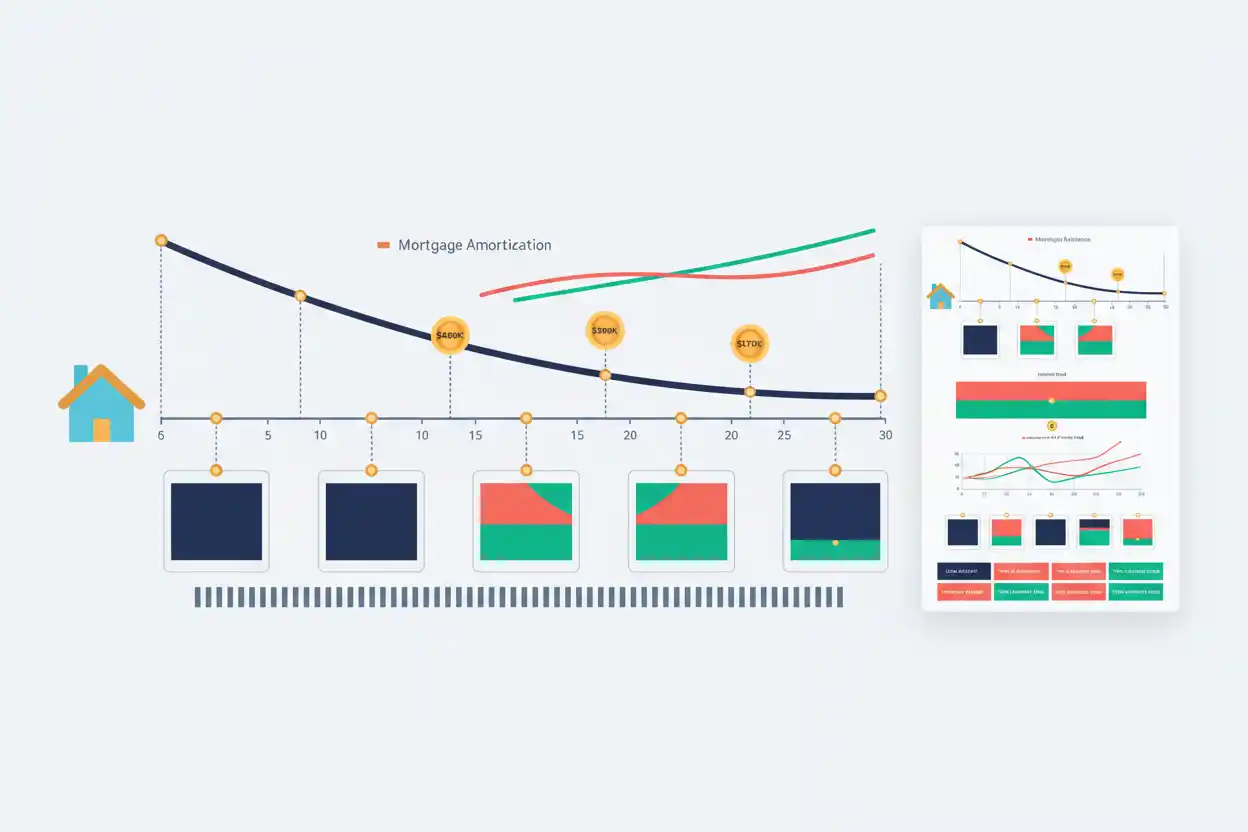

Mortgage amortization is the process of paying down mortgage principal through scheduled payments over time.
On a standard fully amortizing fixed-rate mortgage, the principal-and-interest payment can remain unchanged while its internal allocation changes every month.
Early in the mortgage:
more of the payment goes toward interest.
Later:
more goes toward principal.
CFPB explains that most mortgage principal-and-interest payments are calculated using a standard mathematical formula based on the loan amount, interest rate, and loan term. The total amount sent to the servicer can be higher because taxes, insurance, and other items can also be collected.
The standard payment formula is:
Monthly Payment = P × [r(1 + r)ⁿ] ÷ [(1 + r)ⁿ − 1]
Then each month’s allocation is:
Interest = Beginning Principal × Monthly Rate
Principal Repaid = Payment − Interest
Ending Principal = Beginning Principal − Principal Repaid
That repeating sequence is mortgage amortization.
Mortgage Amortization Example
Assume:
Mortgage principal = $400,000
Annual fixed interest rate = 6.5%
Term = 30 years
Payments = monthly
Monthly rate:
6.5% ÷ 12
0.541667%
Number of payments:
30 × 12 = 360
Monthly principal-and-interest payment:
≈ $2,528.27
The payment stays approximately level under the fixed-rate assumptions.
The balance does not decline by $2,528.27 each month because part of every payment covers interest.
Month 1
Beginning balance:
$400,000
Interest:
$400,000 × 6.5% ÷ 12
$2,166.67
Principal:
$2,528.27 − $2,166.67
$361.61
Ending balance:
$400,000 − $361.61
$399,638.39
Only about 14.3% of the first payment reduces principal.
Month 2
Beginning balance:
$399,638.39
Interest:
$399,638.39 × 6.5% ÷ 12
≈ $2,164.71
Principal:
$2,528.27 − $2,164.71
≈ $363.56
Ending balance:
≈ $399,274.83
The principal portion has already increased slightly because interest is now calculated from a smaller balance.
Month 3
Interest:
$399,274.83 × 6.5% ÷ 12
≈ $2,162.74
Principal:
$2,528.27 − $2,162.74
≈ $365.53
Ending balance:
≈ $398,909.30
The change is gradual, but it compounds over hundreds of payments.
Mortgage Balance After One Year
After 12 scheduled payments:
Remaining Balance ≈ $395,529.10
Principal repaid:
$400,000 − $395,529.10
≈ $4,470.90
Total payments made:
$2,528.27 × 12
≈ $30,339.27
The difference primarily represents interest.
Balance After Five Years
After 60 payments:
Remaining Balance ≈ $374,443.91
Principal repaid:
≈ $25,556.09
Total payments made:
≈ $151,696.33
Again, the mortgage balance falls much more slowly than the cumulative payment total during the early years.
Balance After Ten Years
After 120 payments:
Remaining Balance ≈ $339,104.51
Principal repaid:
≈ $60,895.49
The mortgage is one-third of the way through its scheduled payment count, yet more than 84% of the original principal is still outstanding.
That illustrates the front-loaded interest pattern of a long amortization schedule.
Balance After Fifteen Years
After 180 payments:
Remaining Balance ≈ $290,236.56
Principal repaid:
≈ $109,763.44
Half the scheduled payments have been made, but more than 72% of the original principal remains.
The second half of the mortgage therefore reduces principal much more aggressively than the first half.
Balance After Twenty Years
After 240 payments:
Remaining Balance ≈ $222,661.13
Principal repaid:
≈ $177,338.87
At this point, the principal component of each payment has become much larger than it was in year one.
Balance After Twenty-Five Years
After 300 payments:
Remaining Balance ≈ $129,216.65
Only five years remain.
The final 60 payments eliminate more than $129,000 of principal because far less of each payment is now consumed by interest.
Remaining-Balance Formula
The balance after k payments can be calculated directly:
Balance After k Payments = P(1 + r)ᵏ − A × [((1 + r)ᵏ − 1) ÷ r]
Where:
P = original principal
r = monthly rate
A = monthly payment
k = payments already made
This is useful when estimating:
refinance balances, future equity, payoff timelines, and the effect of extra payments.
Mortgage Amortization and Principal
The mortgage principal is the debt being amortized.
The payment does not amortize interest.
Interest is the financing cost generated by the outstanding principal.
Therefore:
Principal Reduction = Payment − Interest
is the central amortization relationship.
Mortgage Amortization and Interest
The interest portion declines because:
Interest = Outstanding Balance × Periodic Rate
The mortgage interest page owns the detailed interest calculation.
Amortization explains how paying principal lowers the base used for future interest.
Mortgage Amortization and Fixed-Rate Mortgage
A fixed-rate mortgage produces a particularly easy-to-understand amortization schedule because the rate is stable.
When:
rate, payment schedule, and contract remain unchanged,
the full principal-and-interest schedule can be calculated from origination.
Mortgage Amortization and Adjustable Rates
An adjustable-rate mortgage can require the amortization schedule to be recalculated after a rate adjustment.
The new payment can depend on:
remaining principal, new interest rate, and remaining term.
The original schedule therefore should not be assumed to remain valid after the rate changes.
Mortgage Amortization and Interest-Only Mortgage
An interest-only mortgage delays normal amortization.
If scheduled payments cover only interest:
Principal Reduction = $0
The balance therefore does not follow a normal declining amortization path until principal repayment begins.
Mortgage Amortization and Loan-to-Value Ratio
The mapped loan-to-value ratio generally improves as principal amortizes, assuming property value does not fall enough to offset the reduction.
Suppose:
Home value = $500,000
Original mortgage = $400,000
Initial LTV:
80%
After ten years:
Mortgage ≈ $339,104.51
If value remains $500,000:
LTV ≈ $339,104.51 ÷ $500,000 × 100
≈ 67.82%
Amortization has increased the owner’s equity even with no property appreciation.
Mortgage Amortization and Mortgage Affordability
Mortgage affordability determines whether the scheduled payment fits income and debt capacity.
Amortization answers a different question:
Where does that payment go?
A low payment achieved through a long term can improve current affordability while slowing principal reduction.
Mortgage Amortization and Jumbo Mortgages
A jumbo mortgage uses the same basic amortization principles when structured as a conventional fully amortizing loan.
Because the balance is larger, the dollar amount of early interest can be enormous.
The mathematical percentages remain the same, but the financial stakes increase.
Mortgage Amortization and Mortgage APR
The mortgage APR does not replace the note rate in the amortization schedule.
The contractual rate is used to determine ordinary interest and scheduled payments.
APR is a broader annualized measure of credit cost that includes applicable charges.
Mortgage Amortization and Break-Even Analysis
The mortgage break-even point often uses amortization data when comparing refinancing or discount points.
A simple monthly-payment break-even can miss differences in remaining principal.
For a more precise analysis, compare:
cash paid plus mortgage balance under each scenario.
Extra Principal Payment Example
Suppose after five years the balance is approximately:
$374,443.91
The borrower makes an extra principal payment of:
$25,000
New principal:
$349,443.91
Future interest is then calculated from a balance $25,000 lower.
If the normal monthly payment continues, the mortgage can be paid off earlier.
Biweekly Mortgage Payments
Biweekly mortgage payments can accelerate amortization when the schedule produces the equivalent of an additional annual principal payment.
The benefit comes from:
Reducing Principal Earlier
not from the word “biweekly.”
Mortgage Recast
A mortgage recast can formally recalculate future payments after a substantial principal reduction on an eligible mortgage.
Suppose the balance falls from:
$350,000 to $250,000
after a lump-sum payment.
A recast spreads the lower balance over the remaining term at the existing contractual rate, subject to lender rules.
Refinancing Resets Amortization
Refinancing creates a new loan and therefore a new amortization schedule.
Suppose:
15 years remain on the existing mortgage.
The borrower refinances into a new 30-year loan.
Even if the monthly payment falls, repayment has been extended substantially.
This can increase lifetime interest.
Amortization and Home Equity
Home equity can grow through:
principal repayment or rising property value.
Amortization is the predictable debt-reduction component.
Property appreciation is uncertain.
A homeowner should therefore distinguish equity earned through principal repayment from equity created by market movements.
Common Mortgage Amortization Mistakes
One mistake is assuming the mortgage balance declines by the full payment each month.
Another is assuming half the term means half the principal has been repaid.
Borrowers also use APR rather than the contractual interest rate in the amortization formula.
A fourth mistake is forgetting that adjustable-rate changes alter the schedule.
Finally, refinancing into a new long term can restart the slow early-amortization phase.
Frequently Asked Questions
What is mortgage amortization?
It is the gradual repayment of mortgage principal through scheduled payments.
What is the standard payment formula?
Payment = P × [r(1 + r)ⁿ] ÷ [(1 + r)ⁿ − 1]
How is monthly interest calculated?
Interest = Beginning Principal × Monthly Rate
How is principal repayment calculated?
Principal = Payment − Interest
Why is early principal repayment small?
Because the outstanding balance is largest early in the mortgage, so the interest charge is also largest.
What is the payment on $400,000 at 6.5% for 30 years?
Approximately:
$2,528.27
for principal and interest.
How much principal is repaid in the first payment?
Approximately:
$361.61
What is the balance after five years?
Approximately:
$374,443.91
under the example.
Can extra payments accelerate amortization?
Yes, when the extra money is applied to principal.
Does refinancing change amortization?
Yes. Refinancing creates a new mortgage schedule.
Is APR used to amortize the mortgage?
The contractual interest rate normally determines scheduled principal and interest; APR is a broader cost measure.
Does an interest-only mortgage amortize normally?
Not during a period in which required payments cover only interest.
Final Takeaway
Mortgage amortization explains why a fixed mortgage payment can stay constant while debt reduction accelerates.
For a $400,000 mortgage at 6.5% over 30 years:
Monthly P&I = $2,528.27
First-month interest:
$2,166.67
First-month principal:
$361.61
After five years, the balance is still approximately:
$374,443.91
After fifteen years:
$290,236.56
After twenty-five years:
$129,216.65
The key mechanism is simple:
As Principal Falls, Interest Falls, So More of the Same Payment Goes Toward Principal
Understanding that progression makes it much easier to evaluate extra payments, refinancing, recasting, mortgage term, equity growth, and the true cost of keeping a mortgage for decades.