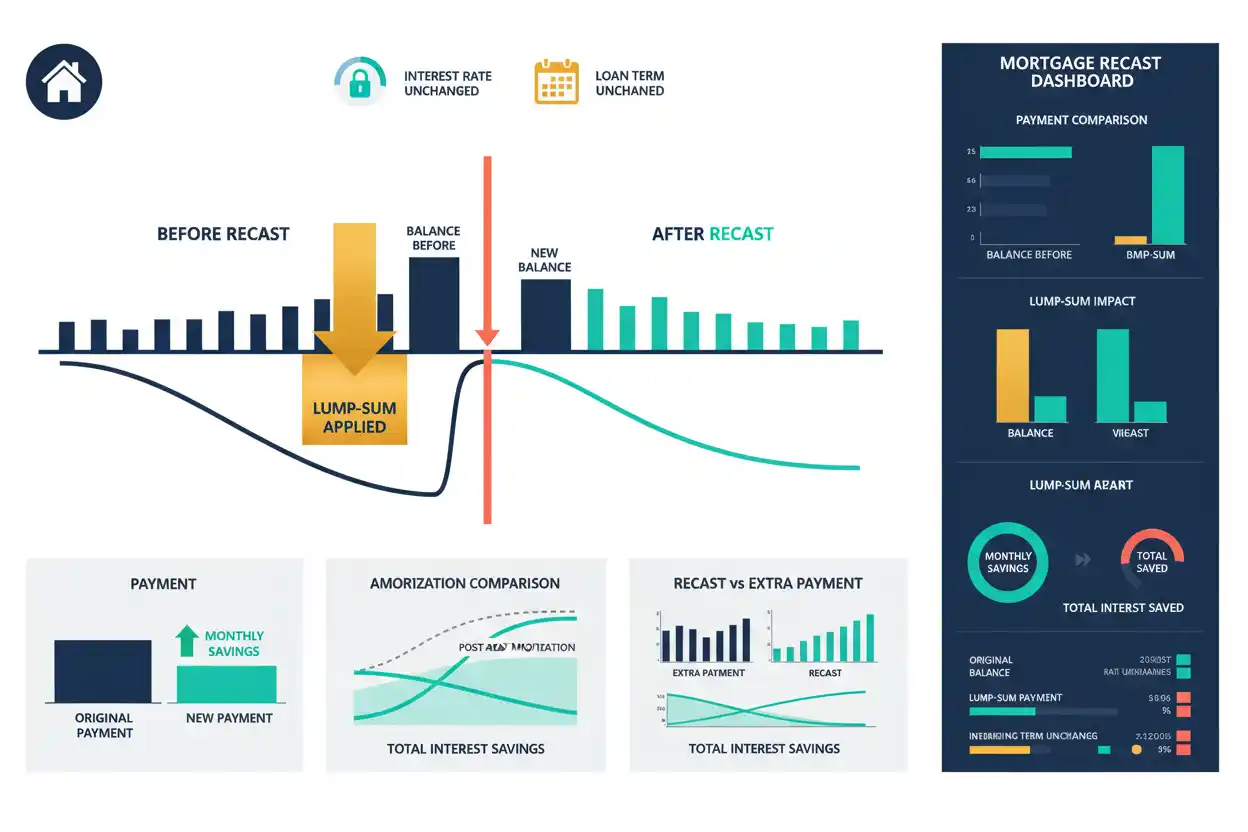
A mortgage recast recalculates the required principal-and-interest payment after a substantial reduction in mortgage principal.
Instead of replacing the mortgage with a new loan, the existing balance is re-amortized over the remaining repayment period using the applicable existing mortgage rate.
A typical conceptual formula is:
Recast Payment = B × [r(1 + r)ⁿ] ÷ [(1 + r)ⁿ − 1]
Where:
B = mortgage balance after the lump-sum principal payment
r = periodic interest rate
n = remaining number of payments
Recasting is not universally available. Investor, servicer, mortgage type, and contract rules matter. For example, Fannie Mae’s current servicing guidance provides a re-amortization process following a substantial principal curtailment on eligible loans.
How a Mortgage Recast Works
Suppose you originally borrowed:
$400,000
at:
6.5% for 30 Years
The original principal-and-interest payment is approximately:
$2,528.27 per Month
After five years of scheduled payments, the remaining mortgage principal is approximately:
$374,443.91
Now suppose you make a:
$75,000 Lump-Sum Principal Payment
New balance:
$374,443.91 − $75,000
$299,443.91
There are 25 years, or 300 monthly payments, remaining.
If the mortgage is recast at the existing 6.5% rate:
New Recast Payment ≈ $2,021.87 per Month
Monthly reduction:
$2,528.27 − $2,021.87
≈ $506.41 per Month
The borrower has reduced the required payment without replacing the existing mortgage.
What Usually Changes in a Recast?
The central changes are:
the outstanding principal balance and the scheduled monthly payment.
The remaining amortization schedule is recalculated from the lower balance.
In a straightforward recast, the existing interest rate and remaining maturity are generally preserved rather than replaced with a new market-rate loan. Availability and exact servicing mechanics depend on the mortgage. Fannie Mae, for example, describes re-amortization specifically as reducing the contractual monthly payment after a substantial principal curtailment.
Mortgage Recast vs Extra Principal Without Recasting
Suppose the borrower makes the same $75,000 lump-sum payment but does not recast.
Balance still falls to:
$299,443.91
If the borrower continues paying:
$2,528.27 per Month
rather than lowering the payment to $2,021.87, the remaining mortgage can be paid off in approximately:
190 Months
or about:
15 Years and 10 Months
instead of the remaining 25 years.
Therefore, the borrower has two distinct objectives.
Recast
Lower Required Payment
Keep Original Payment
Faster Payoff and Greater Interest Savings
The mortgage payoff strategies page focuses on the second objective.
Interest After Recasting
Using the recast balance:
$299,443.91
and new payment:
$2,021.87
for 300 months, approximate remaining interest is:
$307,116.11
By comparison, if the borrower makes the $75,000 principal reduction but continues the old $2,528.27 payment, estimated remaining interest falls to approximately:
$180,717
The exact amounts depend on payment timing and loan terms.
The lesson is important:
A recast lowers the payment, but keeping the old payment after a principal reduction generally eliminates debt faster.
Mortgage Recast vs Refinancing
Refinancing replaces the existing mortgage with a new mortgage.
A recast generally retains the existing mortgage and recalculates its payment.
That creates several differences.
A refinance can change:
interest rate, mortgage term, loan program, and sometimes the amount borrowed.
A recast primarily works from a lower principal balance.
If your existing mortgage has a favorable rate, preserving it can be especially valuable.
Mortgage Recast vs Rate-and-Term Refinance
A rate-and-term refinance replaces the old mortgage primarily to obtain a different rate, term, or both.
A recast normally does not require a new market interest rate.
Suppose:
Existing mortgage rate = 3.5%
Current refinance rate = materially higher
A borrower with a large lump sum may prefer to investigate recasting rather than surrendering the attractive existing rate.
Conversely, if market rates have fallen materially, refinancing can offer benefits a recast cannot provide.
Mortgage Recast and Mortgage Term
The mortgage term is central to the recast formula.
If 25 years remain:
n = 25 × 12 = 300
The reduced principal is amortized across those remaining payments.
A recast should not normally be assumed to restart the mortgage at another 30 years.
That is one major distinction from refinancing into a new 30-year mortgage.
Mortgage Recast and Mortgage Rate Lock
A mortgage rate lock generally matters when originating or refinancing a mortgage.
A recast usually does not involve locking a new market rate because it works with an existing mortgage rather than creating a replacement loan.
This can eliminate one source of market-rate uncertainty.
Mortgage Recast and Private Mortgage Insurance
A large principal payment can also reduce LTV enough to affect private mortgage insurance eligibility.
Suppose:
Original property value = $500,000
Balance before lump sum = $425,000
LTV:
$425,000 ÷ $500,000 × 100
85%
After a $50,000 principal payment:
New Balance = $375,000
New LTV based on original value:
75%
That does not mean PMI necessarily disappears automatically at the moment of recast. PMI termination has separate statutory, investor, valuation, payment-history, and servicing requirements.
Mortgage Recast and Mortgage Preapproval
The mapped mortgage preapproval relationship matters when a homeowner plans to purchase another property.
Lowering the required mortgage payment through a recast can change the household’s monthly obligations.
However, using a substantial amount of cash for the recast can simultaneously reduce:
down-payment funds and liquid reserves.
Both effects should be considered.
Mortgage Recast and Mortgage Amortization
The mortgage amortization schedule is recalculated from the lower principal.
Suppose:
Old balance = $374,443.91
New balance = $299,443.91
The mortgage now begins its remaining amortization from a balance that is exactly:
$75,000 Lower
That permanently reduces the principal on which future interest is calculated.
Mortgage Recast and Loan-to-Value Ratio
A large principal reduction also improves the loan-to-value ratio if property value remains unchanged.
Suppose:
Home value = $500,000
Old balance = $374,443.91
Old LTV:
≈ 74.89%
After the $75,000 reduction:
LTV = $299,443.91 ÷ $500,000 × 100
≈ 59.89%
That strengthens the borrower’s equity position.
Does a Mortgage Recast Save Interest?
Yes, the principal reduction itself generally saves future interest.
However, it is important to identify what creates the savings.
Lump-Sum Principal Payment → Interest Savings
The recast itself mainly:
Recalculates the Required Payment
If the borrower reduces principal but keeps paying the former monthly amount, interest savings are typically greater because repayment accelerates.
Recast vs Paying Off the Mortgage
The mortgage payoff amount completely satisfies the loan.
A recast leaves a mortgage balance and continues repayment.
Suppose:
Mortgage payoff = $300,000
Available cash = $75,000
A recast can use the $75,000 to reduce the debt while preserving liquidity relative to a full payoff.
Does a Recast Require Closing Costs?
A recast generally does not resemble a full mortgage closing because it does not originate a completely new loan.
However, the servicer can have eligibility procedures or permitted charges depending on the mortgage.
Do not assume every servicer offers recasting or that every program has identical costs.
By comparison, mortgage closing costs are a major consideration in refinancing.
When a Mortgage Recast Can Make Sense
A recast can be particularly useful when:
you receive a large lump sum, want to keep the existing mortgage rate, and prefer a lower required monthly payment.
Common cash sources can include:
sale proceeds from another property, inheritance, bonuses, or accumulated savings.
The source of the money matters less to the mathematics than the amount actually applied to principal.
When Recasting May Be Less Attractive
A recast can be less compelling when:
market refinancing rates are materially below your existing rate, you want to change the mortgage term substantially, you need cash rather than want to contribute cash, or your loan is not eligible.
It can also be unnecessary if your primary goal is fastest payoff and you are comfortable continuing the original payment after the lump-sum reduction.
Frequently Asked Questions
What is a mortgage recast?
It is a re-amortization of an existing mortgage after a substantial principal reduction, producing a new required payment on eligible loans.
What is the mortgage recast formula?
Payment = B × [r(1 + r)ⁿ] ÷ [(1 + r)ⁿ − 1]
using the reduced balance and remaining payment count.
Does a recast change the interest rate?
A straightforward recast generally works from the existing mortgage terms rather than replacing the loan with a new market-rate mortgage.
Does recasting restart a 30-year term?
Not in the standard calculation. The reduced balance is re-amortized over the remaining term.
What happens to the payment in the example?
It falls from approximately:
$2,528.27 to $2,021.87
Is every mortgage eligible for recasting?
No. Investor, servicer, mortgage type, and contract rules matter.
Is a mortgage recast the same as refinancing?
No. Refinancing creates a new loan; a recast generally recalculates the existing mortgage.
Can a recast remove PMI?
The principal reduction can help meet an LTV threshold, but PMI termination follows separate requirements.
Is recasting better than making extra payments?
It depends on the objective. Recasting lowers the required payment; keeping the old payment after a lump sum generally accelerates payoff more.
Can I recast after selling another home?
Potentially, if the mortgage is eligible and sale proceeds are applied as a qualifying principal curtailment.
Does a recast reduce interest?
The principal reduction reduces future interest. The recast itself primarily changes the required payment.
Should I refinance or recast?
Compare the existing rate, available refinance rate, fees, desired term, monthly-payment objective, and expected holding period.
Final Takeaway
A mortgage recast is fundamentally:
Large Principal Reduction + Re-Amortization of the Remaining Balance
In the example:
Original mortgage = $400,000
Rate = 6.5%
Original payment ≈ $2,528.27
Balance after five years ≈ $374,443.91
Lump-sum principal payment = $75,000
New balance:
$299,443.91
Recast across the remaining 25 years:
New Payment ≈ $2,021.87
Monthly reduction:
≈ $506.41
The principal reduction creates the interest savings; the recast converts that lower balance into a lower required payment while preserving the existing mortgage structure on eligible loans.