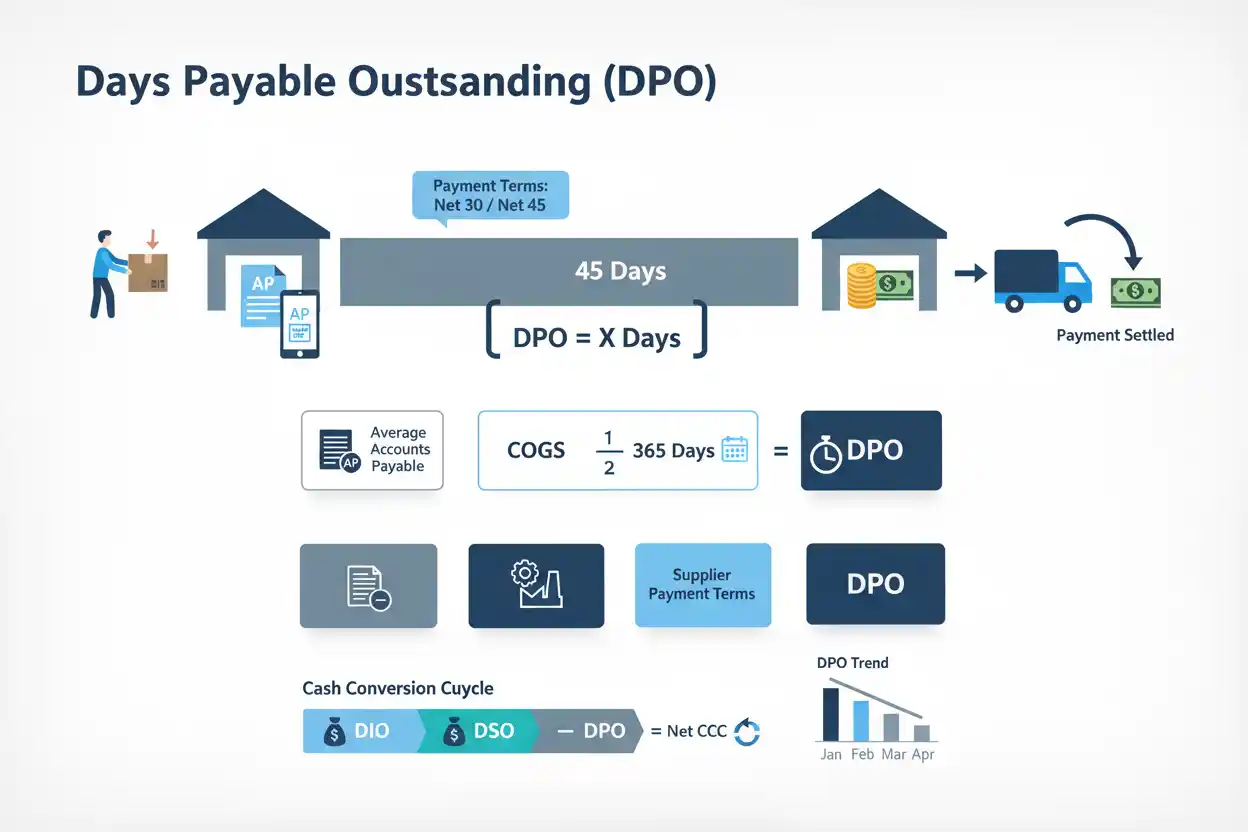

Days payable outstanding, commonly abbreviated DPO, estimates how long a company takes, on average, to pay suppliers and other trade obligations represented by the accounts payable balance.
A commonly used formula is:
Days Payable Outstanding = Average Accounts Payable ÷ Cost of Goods Sold × Number of Days
If average accounts payable is $600,000 and annual cost of goods sold is $4,380,000:
DPO = $600,000 ÷ $4,380,000 × 365
DPO = 50 days
The company therefore carries approximately 50 days of accounts payable relative to the cost flow used in the calculation.
A higher DPO generally means the company retains cash longer before paying suppliers. A lower DPO generally means suppliers are paid sooner. Neither direction is automatically better.
Payment terms, early-payment discounts, supplier relationships, purchasing volume, industry practices, bargaining power, liquidity, and overdue obligations all affect what a sustainable DPO looks like.
Within business finance, days payable outstanding is particularly useful because it connects supplier financing with working capital and the cash conversion cycle.
What Is Days Payable Outstanding?
Days payable outstanding measures the approximate length of time a company carries accounts payable before payment.
When a supplier provides goods or services on credit, the buyer can receive the economic benefit before cash leaves its bank account.
Suppose a supplier delivers inventory today and gives the buyer 45 days to pay.
During those 45 days, the supplier is effectively financing part of the buyer’s operating cycle.
DPO translates the company’s aggregate accounts payable relationship into an estimated number of days.
It does not mean every invoice is paid on exactly that day.
A company with 50-day DPO can have some suppliers paid in 10 days, others in 30 days, and others in 90 days. The ratio compresses those relationships into an average financial measure.
Days Payable Outstanding Formula
A common formula is:
DPO = Average Accounts Payable ÷ Cost of Goods Sold × Days in Period
For an annual calculation:
DPO = Average Accounts Payable ÷ Annual Cost of Goods Sold × 365
Average accounts payable can be calculated as:
Average Accounts Payable = (Beginning Accounts Payable + Ending Accounts Payable) ÷ 2
Suppose beginning accounts payable is $400,000 and ending accounts payable is $500,000.
Average Accounts Payable = ($400,000 + $500,000) ÷ 2
Average Accounts Payable = $450,000
If annual cost of goods sold is $3,650,000:
DPO = $450,000 ÷ $3,650,000 × 365
DPO = 45 days
Under this calculation, the business carries approximately 45 days of payables.
DPO Using Purchases Instead of Cost of Goods Sold
Conceptually, accounts payable arise from purchases made on credit rather than directly from cost of goods sold.
When reliable credit-purchase data are available, an analyst may therefore use purchases in the denominator.
A generalized version is:
DPO = Average Accounts Payable ÷ Credit Purchases × Days in Period
Suppose average accounts payable is $500,000 and annual credit purchases are $4 million.
DPO = $500,000 ÷ $4,000,000 × 365
DPO ≈ 45.6 days
In many financial analyses, cost of goods sold is used because purchasing data are less readily available in published financial statements.
The denominator should be understood and applied consistently when comparing periods or companies.
Why COGS and Purchases Can Produce Different DPO
Purchases and cost of goods sold are related, but they are not always identical.
A business can purchase more inventory than it sells during the period.
It can also sell inventory purchased in an earlier period.
Suppose annual purchases total $5 million while COGS is $4 million because inventory increased substantially.
If average accounts payable is $500,000:
Using purchases:
DPO = $500,000 ÷ $5,000,000 × 365
DPO = 36.5 days
Using COGS:
DPO = $500,000 ÷ $4,000,000 × 365
DPO ≈ 45.6 days
The choice of denominator materially changes the result.
For internal analysis, actual credit purchases can provide a closer conceptual match when reliable information exists.
For external benchmarking, analysts often need to work with the financial information companies disclose.
Why Use Average Accounts Payable?
Accounts payable is measured at a specific date.
Purchases and COGS cover a period.
Using average accounts payable helps align the balance-sheet numerator with the period represented by the denominator.
Suppose payable balances increase sharply during December because the business purchases inventory before a seasonal sales period.
Using only the year-end accounts payable balance could make the entire year’s DPO appear higher than the normal operating level.
A simple beginning-and-ending average reduces some of that distortion.
For volatile businesses, monthly or quarterly average payable balances can provide an even better representation.
Days Payable Outstanding Example
Consider a manufacturer with:
Beginning accounts payable = $700,000
Ending accounts payable = $900,000
Annual cost of goods sold = $5,840,000
Average accounts payable:
Average Accounts Payable = ($700,000 + $900,000) ÷ 2
Average Accounts Payable = $800,000
Calculate DPO:
DPO = $800,000 ÷ $5,840,000 × 365
DPO = 50 days
The manufacturer carries approximately 50 days of accounts payable.
If supplier terms are generally 60 days, the result may suggest the business typically pays before the full contractual period expires.
If suppliers generally require payment within 30 days, a 50-day DPO deserves closer investigation because some invoices may be overdue.
The ratio needs contractual context.
What Does a High DPO Mean?
A relatively high days payable outstanding means the business carries a larger payable balance relative to the purchasing or cost flow represented in the denominator.
This can occur because suppliers provide favorable payment terms.
It can also reflect strong bargaining power, deliberate working-capital management, seasonal purchasing, unusually large recent purchases, or delayed payments.
Some of those explanations are financially advantageous.
Others can signal liquidity stress.
The ratio alone cannot distinguish between negotiated 90-day terms and 30-day invoices being paid 90 days late.
That distinction is critical.
What Does a Low DPO Mean?
A relatively low DPO indicates suppliers are being paid quickly compared with the operating cost or purchasing flow.
This can happen because suppliers demand short payment terms, the company deliberately pays early, early-payment discounts are attractive, or management maintains a conservative payment policy.
Low DPO can strengthen supplier relationships and reduce the risk of late-payment problems.
However, paying significantly earlier than required without receiving an economic benefit can tie up cash unnecessarily.
The right payment timing depends on the terms and the company’s liquidity needs.
What Is a Good Days Payable Outstanding?
There is no universal good DPO.
A 30-day DPO could be appropriate for a business whose suppliers require payment in 30 days.
A 60-day DPO could be excellent when suppliers contractually allow 60 days.
The same 60-day result could signal serious payment problems when invoices are contractually due in 20 days.
Industry comparisons can provide context, but contractual supplier terms matter more than an arbitrary benchmark.
A sustainable DPO generally balances liquidity with commercial obligations.
Higher DPO Is Not Automatically Better
Increasing DPO can improve short-term cash retention because the business keeps money longer before paying suppliers.
However, maximizing DPO mechanically can create costs.
Late invoices can lead to fees.
Suppliers can reduce credit limits.
Future payment terms can become less favorable.
Important suppliers may prioritize other customers.
The business can also lose early-payment discounts.
Therefore, the goal should be economically optimal payment timing, not the highest possible days payable outstanding.
Lower DPO Is Not Automatically Better
Paying suppliers immediately may sound financially conservative, but early payment has an opportunity cost.
Suppose a supplier allows payment in 60 days with no discount for paying earlier.
If the business routinely pays on day 10, it gives up approximately 50 days of supplier financing.
That may be sensible if the relationship provides another benefit.
Otherwise, cash that could support payroll, inventory, investment, debt reduction, or reserves leaves unnecessarily early.
DPO helps make that trade-off visible.
DPO and Supplier Payment Terms
The most useful DPO interpretation compares actual payment behavior with agreed supplier terms.
Suppose a supplier offers net 45 terms.
That generally means payment is due according to the agreed 45-day schedule.
If a company’s supplier base broadly operates on similar terms and DPO is approximately 45 days, its aggregate result may align reasonably with those agreements.
If DPO moves to 70 days without renegotiated terms, management should determine whether invoices are being paid late.
If supplier terms improve from 45 to 60 days and DPO rises accordingly, the increase can reflect improved financing rather than financial distress.
DPO and Early-Payment Discounts
Some suppliers offer discounts for faster payment.
For example, terms might offer a discount when an invoice is paid within a shorter period.
The decision to take the discount should compare the economic benefit with the value of retaining cash longer.
Suppose an invoice is $100,000 and paying early reduces it by $2,000.
The business gives up additional supplier-financing days but saves $2,000.
Whether that is attractive depends on the time difference, financing alternatives, liquidity, risk, and other commercial considerations.
A lower DPO caused by economically attractive discounts can be a sign of good financial management rather than poor working-capital efficiency.
DPO and the Cash Conversion Cycle
Days payable outstanding is one of the three components of the cash conversion cycle.
Cash Conversion Cycle = DIO + DSO − DPO
Suppose:
Days inventory outstanding = 65 days
Days sales outstanding = 40 days
DPO = 45 days
Cash Conversion Cycle = 65 + 40 − 45
Cash Conversion Cycle = 60 days
If supplier agreements legitimately allow DPO to increase to 60 days while everything else remains unchanged:
New Cash Conversion Cycle = 65 + 40 − 60
New Cash Conversion Cycle = 45 days
The business reduces its modeled cash conversion period by 15 days.
That is why supplier terms can materially affect working-capital requirements.
DPO vs Days Inventory Outstanding
DPO and DIO describe different sides of the operating cycle.
DIO asks:
How long does inventory remain before sale?
DPO asks:
How long does the business take to pay the suppliers associated with its operating inputs?
Suppose DIO is 70 days and DPO is 45 days.
Before considering customer receivables, the company may need to finance approximately 25 days between the supplier-payment and inventory-sale timing represented by those averages.
If supplier terms extend to 60 days:
Inventory Period Less Payables Period = 70 − 60
= 10 days
The financing gap shrinks.
DPO vs Days Sales Outstanding
Days sales outstanding examines customer collections.
DPO examines supplier payments.
The comparison between them can reveal an important timing relationship.
Suppose DSO is 60 days and DPO is 30 days.
The company generally pays suppliers much earlier than customers pay the company.
That timing can create working-capital pressure.
If DSO is 15 days and DPO is 45 days, customer collections occur much faster relative to supplier payments.
However, inventory timing must still be included before drawing conclusions about the overall operating cycle.
DPO and Working Capital
Accounts payable belongs to current liabilities and therefore influences working capital.
Working Capital = Current Assets − Current Liabilities
If accounts payable rises while current assets remain unchanged, conventional working capital declines.
Yet the higher payable balance can preserve cash temporarily because the company has not paid suppliers yet.
This illustrates why a simple working-capital dollar amount and operating efficiency measures need to be considered together.
A lower working-capital balance is not always synonymous with weaker operating cash efficiency.
DPO and Current Ratio
Accounts payable is generally part of current liabilities, so an increase can lower the current ratio when current assets remain unchanged.
Suppose current assets are $1.2 million and current liabilities are $600,000.
Current Ratio = $1,200,000 ÷ $600,000 = 2.00
Accounts payable rises by $200,000 while current assets remain constant.
New Current Liabilities = $800,000
New Current Ratio = $1,200,000 ÷ $800,000 = 1.50
The current ratio declines.
However, if the additional payable results from a normal inventory purchase with favorable supplier terms, the financial interpretation differs from an increase caused by unpaid overdue invoices.
DPO and Quick Ratio
The quick ratio evaluates a narrower group of current assets relative to current liabilities.
An increase in accounts payable increases the denominator and can therefore lower the quick ratio.
A company might simultaneously improve its cash conversion cycle through longer supplier terms while reporting a lower quick ratio.
Neither calculation is necessarily wrong.
One measures balance-sheet coverage.
The other measures operating timing.
This is why financial ratios should be interpreted according to the question they answer rather than ranked against one another.
DPO and Cash Ratio
The cash ratio compares cash and cash equivalents with current liabilities.
Higher accounts payable can reduce the ratio mathematically.
Yet delaying payment according to negotiated terms also preserves cash, potentially increasing the numerator relative to what it would have been after payment.
The resulting effect depends on the entire balance sheet.
The cash ratio is a point-in-time liquidity measure.
DPO measures supplier-payment behavior over a period.
DPO and Cash Flow Forecasting
Cash flow forecasting converts supplier obligations into expected payment dates.
DPO provides a historical or aggregate measure of payment timing.
Suppose DPO is 50 days.
That does not tell management whether a specific $750,000 supplier payment falls due next Friday.
A forecast does.
Conversely, a cash forecast can contain thousands of invoice payments without revealing that supplier-payment behavior has systematically shifted from 40 to 60 days.
Both views are useful.
DPO and Free Cash Flow
Changes in accounts payable can affect operating cash flow and therefore influence free cash flow.
When payable balances rise because payments have not yet occurred, more cash remains within the company in the short term.
When accounts payable falls because suppliers are paid, cash leaves the business.
That benefit can reverse.
A company cannot indefinitely generate cash simply by allowing payables to increase unless suppliers continue extending additional credit.
Sustainable free cash flow must ultimately come from underlying business economics rather than permanent payment deferral.
DPO and Burn Rate
For businesses consuming cash, supplier terms can affect burn rate in individual periods.
Suppose a startup normally pays $200,000 of suppliers every month.
Renegotiated terms shift part of those payments into later months.
Immediate net cash burn can decline.
The company’s underlying cost of purchasing the goods has not necessarily changed.
Payment timing changed.
Management should therefore distinguish structural cost improvements from temporary working-capital benefits.
DPO and Cash Runway
Longer legitimate payment terms can extend near-term cash runway because cash remains available longer.
However, runway calculations that ignore payable due dates can become misleading.
Suppose a company has $1 million in cash and appears to burn $100,000 monthly.
It also has $500,000 of supplier invoices due over the next two months.
If those obligations are not reflected in the modeled burn or forecast, the reported runway can overstate practical financial flexibility.
Cash runway should therefore be tied to actual payment commitments.
DPO and Inventory Purchases
Inventory purchases can increase both inventory and accounts payable when suppliers provide credit.
Suppose a retailer purchases $300,000 of inventory on account.
Inventory rises $300,000.
Accounts payable rises $300,000.
No cash leaves immediately.
This transaction can support the current operating cycle without immediate cash consumption.
Eventually, however, the payable becomes due.
The value of supplier financing depends on whether the inventory can be sold and converted toward cash before payment must be made.
DPO and Inventory Turnover
Inventory turnover measures how frequently inventory moves through cost of goods sold.
DPO measures how long supplier financing remains outstanding.
Consider a company with 40 days of inventory and 60 days of payables.
Its inventory may move before suppliers are paid.
Another company can have 100 days of inventory and only 30 days of payables, requiring much more internal financing.
Comparing inventory days with DPO can therefore expose the working-capital implications of purchasing and sales patterns.
DPO and Supplier Concentration
A company relying heavily on one or two suppliers can face greater risk when extending payment timing.
A diversified supplier base may provide more negotiating flexibility, although this depends on the commercial relationships.
If a critical supplier tightens payment terms from 90 to 30 days, the buyer may need substantial additional working capital.
The change can reduce DPO and increase cash requirements even though the company’s sales and costs remain otherwise unchanged.
Supplier concentration therefore matters when evaluating how sustainable a particular DPO is.
DPO and Purchasing Power
Large customers can sometimes negotiate longer payment terms because suppliers value their purchasing volume.
Smaller businesses may have less bargaining power and receive shorter terms.
That structural difference can make industry DPO comparisons misleading.
Two companies buying similar products can have materially different payable periods because of size, creditworthiness, contract terms, geography, and supplier dependence.
DPO should therefore be compared with businesses whose procurement economics are genuinely similar.
DPO and Supplier Finance Programs
Some companies use structured supplier-finance or payable programs in which financial institutions participate in payments to suppliers.
These arrangements can change the timing and presentation of operating obligations depending on their specific terms.
They require more careful analysis than ordinary trade credit.
A high DPO associated with normal negotiated supplier terms may have different implications from a payable structure supported by external financing.
The economic substance of the arrangement matters more than the headline ratio.
DPO and Seasonality
Seasonal businesses can show large changes in accounts payable during the year.
A retailer may purchase substantial inventory ahead of a peak selling season.
Both inventory and accounts payable can increase rapidly.
Once the season ends, the company sells inventory and pays suppliers, reducing payable balances.
Calculating DPO from only one period-end balance can therefore produce an unrepresentative result.
For seasonal companies, comparing equivalent periods and using average payable balances can improve analysis.
DPO for Manufacturers
Manufacturers may owe suppliers for raw materials, components, packaging, contract production, and other operating inputs.
Their payment terms can vary across supplier categories.
A single DPO combines those relationships into one average.
If DPO rises, management should determine whether terms improved across the supplier base or whether one large balance distorted the total.
Detailed accounts payable aging remains important.
DPO for Retailers
Retailers often purchase inventory from many suppliers on credit.
The relationship among purchase timing, inventory turnover, and supplier payment terms can materially affect cash requirements.
A retailer that sells merchandise before supplier invoices are due can operate with favorable working-capital economics.
A retailer that holds inventory for months while paying suppliers quickly needs more capital to finance the gap.
DPO therefore becomes particularly informative when interpreted alongside DIO.
DPO for Service Businesses
Some service businesses carry little inventory, so the traditional inventory-focused cash conversion cycle may be less meaningful.
However, they can still have accounts payable for contractors, software, professional services, advertising, facilities, and other operating costs.
DPO can therefore still provide information about payment timing when the denominator properly reflects the expense or purchasing base associated with those payables.
Using COGS blindly can be inappropriate when the business does not have a conventional cost-of-goods structure.
DPO and Overdue Accounts Payable
A high DPO becomes concerning when it results from invoices that have passed their contractual due dates.
Accounts payable aging can separate current invoices from obligations that are 30, 60, 90, or more days overdue.
Two businesses can report the same 60-day DPO.
One may operate under legitimate 60-day terms.
The other may owe suppliers invoices that were due 30 days ago.
The aggregate ratio cannot distinguish the difference.
Aging schedules provide the necessary detail.
How Extending Supplier Terms Affects DPO
Suppose average accounts payable is initially $400,000 and annual purchases are $4 million.
DPO = $400,000 ÷ $4,000,000 × 365
DPO = 36.5 days
After supplier terms are renegotiated, average accounts payable rises to $600,000 while purchases remain unchanged.
New DPO = $600,000 ÷ $4,000,000 × 365
New DPO = 54.75 days
The company retains cash for approximately 18 additional days under the average relationship.
If the extension was contractually agreed without offsetting price increases or other economic costs, that can improve working-capital efficiency.
Estimating Cash Preserved From Higher DPO
DPO can be translated into an approximate payable balance using daily purchases or cost flow.
Suppose annual credit purchases equal $7.3 million.
Average daily purchases are:
Daily Purchases = $7,300,000 ÷ 365
Daily Purchases = $20,000
If negotiated DPO increases by 10 days:
Approximate Additional Payables = $20,000 × 10
Approximate Additional Payables = $200,000
The business may retain approximately $200,000 more cash at a typical point in the cycle under stable purchasing assumptions.
This is an approximation, not a guaranteed cash-flow result.
Actual payments, seasonality, purchase patterns, and supplier-specific terms matter.
DPO and Cost Increases
Longer supplier terms are not necessarily free.
A supplier may agree to extend payment from 30 days to 60 days but raise prices.
Suppose the working-capital benefit of longer terms is worth $20,000 to the buyer, but higher prices increase annual costs by $50,000.
The extended terms worsen total economics despite improving DPO.
Payment timing should therefore be negotiated alongside price, quality, reliability, minimum order quantity, lead time, and other commercial terms.
DPO and Early-Payment Discount Example
Suppose a $100,000 supplier invoice offers a $2,000 discount if paid 20 days earlier.
The business chooses between paying $98,000 earlier or $100,000 later.
The nominal savings are:
Discount Savings = $100,000 − $98,000
Discount Savings = $2,000
The business sacrifices 20 days of liquidity to save $2,000.
Whether taking the discount is financially attractive depends on the return or financing cost associated with that cash and the exact contract terms.
DPO alone cannot answer the decision.
How to Increase DPO Responsibly
DPO can increase through longer negotiated supplier terms, centralizing procurement, improving purchasing leverage, aligning payment schedules with cash collections, or using agreed payment dates more consistently.
The key word is negotiated.
Simply paying suppliers late is not a sound working-capital strategy.
A stronger process understands existing terms, pays according to agreements, negotiates changes before cash becomes tight, and evaluates discounts and supplier economics explicitly.
How to Reduce DPO
A company may intentionally reduce DPO when supplier relationships, discounts, credit access, or supply reliability make earlier payment economically attractive.
Suppose a critical supplier offers scarce inventory preferentially to customers that pay quickly.
Reducing DPO could improve product availability and ultimately generate more contribution than the lost financing benefit.
Financial ratios support decisions; they do not replace commercial judgment.
DPO Trend Analysis
Suppose a company’s DPO changes:
Year 1: 38 days
Year 2: 46 days
Year 3: 59 days
The upward trend deserves investigation.
If suppliers extended contractual terms from 30–45 days to 60 days, the change may reflect improved purchasing leverage.
If contractual terms remained at 30 days, the same trend may indicate increasing payment delays.
Now suppose DPO falls from 60 to 35 days.
Maybe management negotiated early-payment discounts.
Perhaps suppliers tightened terms.
Maybe the company intentionally strengthened vendor relationships.
Direction alone does not establish whether the change is good or bad.
Common Days Payable Outstanding Mistakes
A common calculation mistake is using ending accounts payable when balances vary materially.
Another is failing to understand whether COGS or purchases belong in the denominator for the intended analysis.
Comparing DPO across companies without checking their calculation methodologies can also mislead.
Seasonality can distort the result.
More importantly, analysts sometimes assume increasing DPO always creates value.
That ignores late-payment penalties, supplier relationships, discounts, pricing concessions, and supply risk.
Limitations of Days Payable Outstanding
DPO reduces complex supplier relationships to one average.
It does not show invoice-level due dates.
It cannot identify overdue balances.
It does not reveal supplier concentration.
It does not show early-payment discounts.
It cannot distinguish ordinary trade payables from every other liability unless the inputs are carefully defined.
Purchases and COGS can also diverge.
The metric should therefore be treated as a working-capital diagnostic rather than a complete accounts-payable management system.
How to Analyze DPO Properly
Begin by documenting the formula used.
Determine whether the denominator is purchases, credit purchases, COGS, or another relevant cost base.
Use representative average accounts payable where possible.
Compare DPO with contractual supplier terms.
Review accounts payable aging.
Then examine the historical trend and genuinely comparable companies.
Connect the result with DIO and DSO through the cash conversion cycle.
Finally, examine cash forecasts, discounts, supplier concentration, and operating requirements.
The purpose is not to maximize days payable outstanding.
It is to determine whether the business is using supplier credit efficiently without shifting hidden costs or unacceptable risk elsewhere.
Frequently Asked Questions
What is days payable outstanding?
Days payable outstanding estimates the average number of days a company carries trade accounts payable before payment relative to the purchasing or cost flow used in the calculation.
What does DPO stand for?
DPO stands for days payable outstanding.
What is the days payable outstanding formula?
A common formula is:
DPO = Average Accounts Payable ÷ Cost of Goods Sold × Number of Days
When reliable credit-purchase information exists, purchases may be used instead.
How do you calculate average accounts payable?
Average Accounts Payable = (Beginning Accounts Payable + Ending Accounts Payable) ÷ 2
More frequent averages may be preferable when balances fluctuate substantially.
What does a DPO of 45 mean?
It means the business carries approximately 45 days of accounts payable relative to the denominator used in the calculation.
Is a high DPO good?
Not automatically. It can reflect favorable negotiated payment terms or poor payment discipline. Supplier contracts and accounts payable aging determine the difference.
Is a low DPO good?
Not automatically. It may indicate strong supplier relationships or attractive early-payment discounts, but it can also mean the company gives up useful supplier financing.
What is a good DPO?
There is no universal target. DPO should be compared with contractual payment terms, industry economics, historical performance, supplier relationships, and liquidity needs.
Should DPO use COGS or purchases?
Purchases are conceptually closer to accounts payable when reliable credit-purchase data are available. COGS is commonly used in external analysis because it is more readily available. The methodology should be consistent.
Is DPO part of the cash conversion cycle?
Yes.
Cash Conversion Cycle = DIO + DSO − DPO
Does higher DPO improve cash flow?
Longer payment timing can preserve cash in the short term. However, the benefit can reverse when invoices are eventually paid, and late payment or unfavorable supplier concessions can create other costs.
Can a company increase DPO too much?
Yes. Stretching payments beyond agreed terms can damage supplier relationships, reduce credit availability, create penalties, or threaten supply continuity.
Final Perspective
Days payable outstanding measures how supplier credit interacts with operating cash:
DPO = Average Accounts Payable ÷ Relevant Purchasing or Cost Base × Days
A higher number means cash remains with the company longer before the represented supplier obligations are paid.
But DPO is not a competition to delay payment.
A company paying a contractual 60-day invoice on day 60 can have strong payment discipline and favorable working-capital economics.
A company paying a 30-day invoice on day 60 can show the same headline number while facing overdue obligations and deteriorating supplier relationships.
That distinction is the core of DPO analysis.
The useful question is not:
“How many days can we delay suppliers?”
It is:
“Are our supplier terms aligned with inventory movement, customer collections, liquidity, discounts, and the commercial relationships required to operate the business?”
When that question is answered properly, days payable outstanding becomes a meaningful measure of supplier financing and working-capital efficiency rather than simply another ratio to maximize.