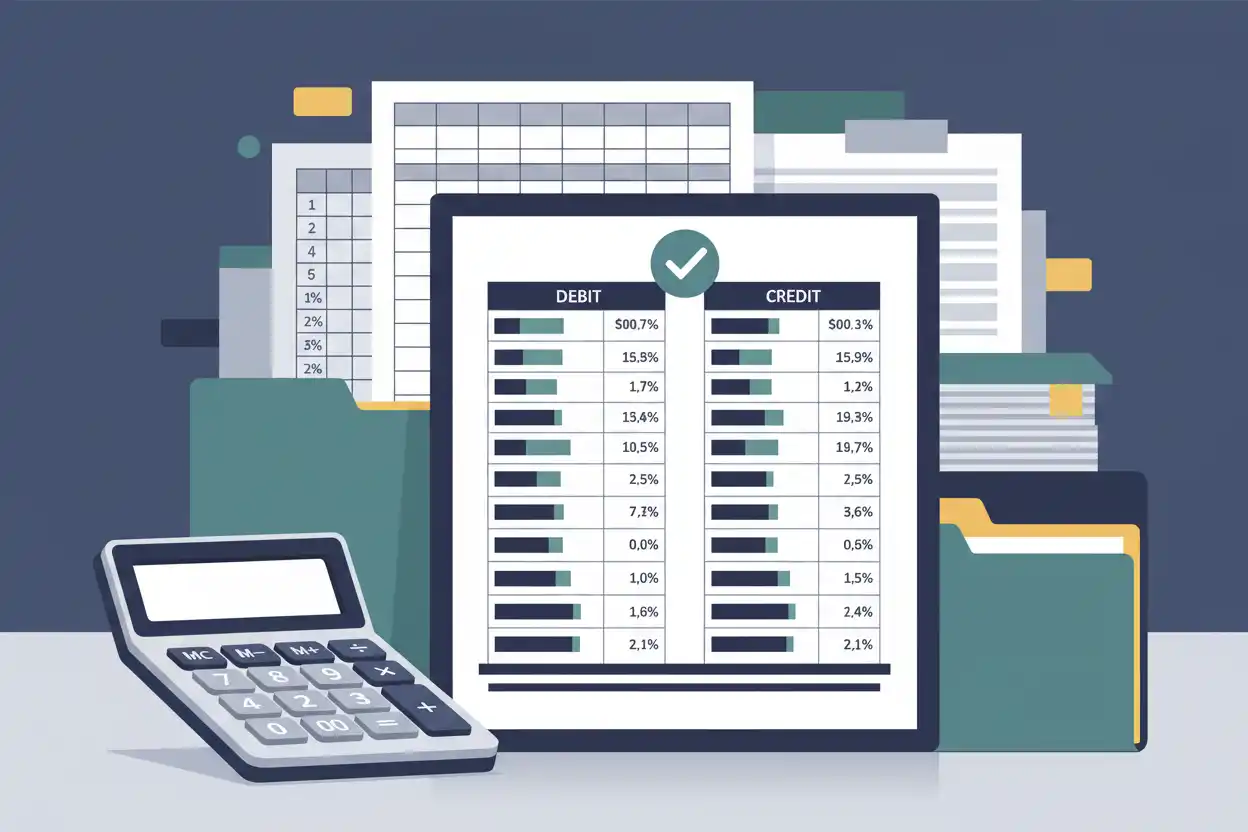

A trial balance is a list of general ledger account balances arranged into debit and credit columns to check whether total debits equal total credits at a particular point in the accounting process.
If the ledger contains $500,000 of debit balances and $500,000 of credit balances, the trial balance is mathematically in balance.
Total Debit Balances = Total Credit Balances
A balanced trial balance is an important bookkeeping check, but it does not prove that every transaction was recorded correctly. An incorrect entry can still preserve equal debits and credits.
What Is a Trial Balance?
A trial balance brings account balances from the ledger into one summarized accounting schedule.
Typical debit-balance accounts can include assets and expenses.
Typical credit-balance accounts can include liabilities, equity, and revenue.
The precise balance depends on the transactions recorded in each account.
The basic purpose is to verify that the debit and credit mechanics of the accounting records remain mathematically aligned before financial statements are prepared.
Under double-entry bookkeeping, every transaction affects at least two accounts, with total debits equaling total credits.
The trial balance tests whether that equality still exists at the account-balance level.
Trial Balance Formula
The essential relationship is:
Total Debits = Total Credits
A useful difference check is:
Trial Balance Difference = Total Debits − Total Credits
When the trial balance is balanced:
Trial Balance Difference = 0
Suppose:
Total Debits = $780,000
Total Credits = $780,000
Then:
Difference = $780,000 − $780,000 = $0
The schedule balances.
If credits instead total $775,000:
Difference = $780,000 − $775,000 = $5,000
The trial balance is out of balance by $5,000.
Trial Balance Example
Suppose a small business has the following ledger balances:
| Account | Debit | Credit |
|---|---|---|
| Cash | $40,000 | — |
| Accounts receivable | $25,000 | — |
| Inventory | $35,000 | — |
| Equipment | $80,000 | — |
| Accounts payable | — | $30,000 |
| Loan payable | — | $50,000 |
| Owner equity | — | $60,000 |
| Revenue | — | $100,000 |
| Cost of goods sold | $45,000 | — |
| Operating expenses | $15,000 | — |
| Totals | $240,000 | $240,000 |
Total debits are:
$40,000 + $25,000 + $35,000 + $80,000 + $45,000 + $15,000 = $240,000
Total credits are:
$30,000 + $50,000 + $60,000 + $100,000 = $240,000
Therefore:
Trial Balance Difference = $240,000 − $240,000 = $0
The trial balance is mathematically balanced.
How a Trial Balance Is Prepared
A trial balance is normally prepared after transactions have been recorded and posted to the general ledger.
The broad process is straightforward.
First, determine the ending balance of each ledger account.
Next, place each balance in either the debit or credit column according to the balance currently carried by that account.
Then total both columns.
Finally, compare the totals.
If debit and credit totals agree, the trial balance passes the basic equality test.
If they do not agree, the accounting records need to be investigated.
Why Debits and Credits Must Be Equal
The equality comes from double-entry accounting.
Suppose a business purchases $10,000 of equipment for cash.
The simplified entry is:
Debit Equipment = $10,000
Credit Cash = $10,000
The transaction changes the composition of assets but preserves equal debits and credits.
Now suppose the business earns $5,000 of cash revenue:
Debit Cash = $5,000
Credit Revenue = $5,000
Again, total debits equal total credits.
As many transactions accumulate, the trial balance tests whether the resulting ledger balances still preserve that equality.
Debit-Balance Accounts
Certain account types normally carry debit balances.
Common examples include:
- cash;
- accounts receivable;
- inventory;
- equipment and other assets;
- cost of goods sold; and
- many expense accounts.
For example, if inventory has a $70,000 debit balance, that amount appears in the debit column of the trial balance.
If operating expenses total $120,000 in their relevant expense accounts, those debit balances also contribute to the debit side.
This does not mean every asset or expense account can never have an unusual credit balance. The trial balance reflects the actual ledger balance rather than blindly forcing accounts into a predetermined column.
Credit-Balance Accounts
Common credit-balance accounts include:
- accounts payable;
- loans and other liabilities;
- owner or shareholder equity;
- retained earnings; and
- revenue.
Suppose revenue has a $500,000 credit balance.
That amount appears in the credit column.
If owner equity has a $200,000 credit balance, it also appears on that side.
The trial balance therefore combines balance-sheet and income-statement accounts in one accounting schedule before they are separated into formal financial statements.
Example With Revenue and Expenses
Suppose a company has:
Revenue = $300,000 Credit
Cost of Goods Sold = $180,000 Debit
Operating Expenses = $70,000 Debit
These three accounts do not balance one another by themselves.
Their net effect is:
$300,000 − $180,000 − $70,000 = $50,000 Profit
The other side of the accounting system contains asset, liability, and equity changes that preserve overall debit-credit equality.
A trial balance therefore should not be interpreted as an income statement.
It contains the ledger accounts needed to construct several financial statements.
Trial Balance vs. Balance Sheet
A trial balance is an internal accounting schedule.
A balance sheet is a financial statement that reports assets, liabilities, and equity at a specific date.
The trial balance can contain:
- assets;
- liabilities;
- equity;
- revenue;
- expenses; and
- other ledger accounts.
The balance sheet excludes current-period revenue and expense accounts as separate line items after the accounting process appropriately incorporates their effects into equity.
The trial balance is therefore an intermediate accounting tool rather than a replacement for the balance sheet.
Trial Balance vs. Income Statement
The income statement reports revenue, expenses, and profit or loss over a period.
The trial balance includes the underlying account balances from which those amounts can be drawn.
Suppose the trial balance includes:
Revenue = $500,000 Credit
COGS = $300,000 Debit
Operating Expenses = $120,000 Debit
A simplified income statement would use those accounts to calculate:
Net Operating Result Before Other Items = $500,000 − $300,000 − $120,000
= $80,000
The trial balance lists the accounts.
The income statement organizes applicable accounts into a performance report.
Trial Balance vs. General Ledger
The general ledger contains detailed account activity and balances.
The trial balance summarizes the resulting balances.
For example, the cash ledger may contain hundreds of individual debits and credits during the month.
The trial balance generally shows only the final cash balance for the reporting point.
This makes it much more compact than the ledger while still allowing the accountant to test whether the full set of debit and credit balances agrees.
Trial Balance and Double-Entry Bookkeeping
A trial balance is a direct consequence of double-entry bookkeeping.
If the system has been recorded correctly:
Total Debits Posted = Total Credits Posted
Therefore, after balances are accumulated:
Total Debit Balances = Total Credit Balances
A difference between the two sides indicates that something in the bookkeeping or extraction process needs attention.
Possible causes include an entry posted on only one side, an incorrect amount on one side, a balance copied incorrectly, or an account omitted from the trial balance.
Example of an Unbalanced Trial Balance
Suppose the correct debit and credit totals should each equal $400,000.
An accountant accidentally enters a $7,500 expense debit but omits the corresponding credit.
The trial balance becomes:
Debits = $407,500
Credits = $400,000
Difference:
$407,500 − $400,000 = $7,500
The $7,500 discrepancy provides a starting point for investigation.
Because only one side of the entry is missing, the difference equals the omitted credit amount.
Transposition Errors
A transposition error occurs when digits are reversed.
For example:
Correct Amount = $5,400
but:
Recorded Amount = $4,500
Difference:
$5,400 − $4,500 = $900
When one side of an entry contains such an error, the trial balance can be out by $900.
Some transposition differences are divisible by 9, which can provide a useful diagnostic clue.
That is a troubleshooting technique rather than proof of the specific error.
Errors a Trial Balance Can Detect
A trial balance can help reveal problems such as:
One-sided entries. A debit was recorded without the corresponding credit.
Unequal postings. The debit and credit sides were entered at different amounts.
Incorrect trial balance extraction. A ledger balance was copied incorrectly.
Omitted account balances. One side of an account or account itself may be missing from the schedule.
Arithmetic errors. Debit or credit columns may have been totaled incorrectly.
These problems disturb debit-credit equality.
Errors a Trial Balance Cannot Detect
A balanced trial balance does not prove the accounting records are correct.
Suppose the business buys equipment for $20,000 cash but records:
Debit Inventory = $20,000
Credit Cash = $20,000
Debits equal credits.
The trial balance remains balanced.
But the wrong asset account was used.
Other errors that can preserve equality include recording the wrong amount on both sides, omitting an entire transaction, recording the transaction twice, or using the wrong accounts while maintaining equal debits and credits.
This is one of the most important limitations of a trial balance.
Unadjusted Trial Balance
An unadjusted trial balance is prepared before period-end adjusting entries are incorporated.
It reflects the ledger balances produced by the transactions posted up to that stage.
Suppose insurance has been prepaid but one month’s expense has not yet been recognized.
The unadjusted trial balance can still balance perfectly.
An adjusting entry may then be required to recognize the appropriate expense for the period.
The unadjusted trial balance tests mathematical equality before those adjustments.
Adjusted Trial Balance
An adjusted trial balance is prepared after applicable adjusting entries have been recorded.
These can involve items such as:
- accrued expenses;
- accrued revenue;
- prepaid expense adjustments;
- depreciation; and
- other period-end entries.
Suppose the company records $5,000 of depreciation expense:
Debit Depreciation Expense = $5,000
Credit Accumulated Depreciation = $5,000
Both sides increase equally.
The adjusted trial balance remains in balance while now reflecting the period-end adjustment.
Post-Closing Trial Balance
A post-closing trial balance is prepared after temporary accounts have been closed according to the accounting process.
Revenue and expense accounts are generally temporary period accounts, while permanent balance-sheet accounts continue forward.
The post-closing trial balance therefore typically contains the continuing asset, liability, and equity accounts rather than the period’s closed revenue and expense balances.
Its purpose is to confirm that the ledger remains balanced as the next accounting period begins.
Trial Balance and Retained Earnings
Retained earnings can appear in the trial balance as part of shareholders’ equity.
Current-period revenue and expense accounts ultimately affect retained earnings through the closing process.
Suppose beginning retained earnings are $200,000, current net income is $70,000, and dividends are $20,000.
A simplified ending retained earnings balance is:
$200,000 + $70,000 − $20,000 = $250,000
After closing, the appropriate equity balances carry forward into the next period’s accounting records.
The trial balance helps verify the debit-credit mechanics behind that process but does not replace the retained-earnings reconciliation.
Trial Balance and Accounts Payable
Accounts payable normally carries a credit balance.
Suppose supplier invoices produce a $90,000 payable balance.
The trial balance shows:
Accounts Payable — Credit $90,000
If the company later pays $30,000:
Debit Accounts Payable = $30,000
Credit Cash = $30,000
The ending payable becomes $60,000, assuming no other changes.
That revised balance then appears in the next trial balance.
The separate payables turnover ratio uses payable balances to analyze supplier-payment behavior rather than bookkeeping equality.
Trial Balance and Inventory
Inventory normally appears as an asset debit balance.
Suppose a company purchases $50,000 of inventory on credit:
Debit Inventory = $50,000
Credit Accounts Payable = $50,000
The trial balance debit side gains $50,000 through inventory.
The credit side gains $50,000 through accounts payable.
When inventory is sold and its cost becomes cost of goods sold, another balanced entry transfers the applicable cost from inventory into expense.
The trial balance ultimately reflects the remaining inventory asset and accumulated COGS expense balances.
Trial Balance and Safety Stock
Operational inventory labels such as safety stock do not normally create separate debit-credit mechanics merely because management designates certain units as a buffer.
Suppose total inventory recorded in the ledger is $300,000.
Management may internally identify $50,000 of that inventory as safety stock for planning purposes.
The trial balance can still show one $300,000 inventory balance unless the company’s accounting structure separates the inventory into additional ledger accounts.
The operational designation and accounting balance therefore serve different purposes.
Trial Balance and Sales Per Square Foot
Sales per square foot is calculated from revenue and retail selling area.
The sales amount used in that ratio originates from accounting records, while square footage comes from operational or property data.
Suppose recorded store revenue is $2 million and the store contains 8,000 square feet of selling area:
Sales Per Square Foot = $2,000,000 ÷ 8,000 = $250
The trial balance can support the revenue side of that calculation by providing reliable underlying ledger balances.
It does not contain the store-area denominator unless management separately records that operational information.
Trial Balance and Revenue per Employee
The same principle applies to revenue per employee.
Suppose annual revenue is $10 million and average headcount is 100:
Revenue Per Employee = $100,000
Revenue originates from the accounting system.
Employee count usually comes from HR or payroll records.
The ratio combines the two data sources.
The trial balance ensures that the accounting revenue balances being used ultimately reconcile to the company’s ledger.
Trial Balance and Unit Cost
Unit cost is a management calculation that can draw on expense, inventory, or production cost information recorded in the accounting system.
Suppose qualifying total production cost is $500,000 and output is 100,000 units:
Unit Cost = $500,000 ÷ 100,000 = $5
The $500,000 cost may originate from several ledger accounts contained in the trial balance.
The 100,000-unit denominator comes from operating records.
A balanced trial balance therefore supports cost-data reliability but does not itself calculate unit cost.
Trial Balance and Volume Variance
A volume variance compares actual activity with a standard or budgeted activity level under its assigned cost or revenue framework.
The underlying actual financial amounts may be supported by ledger balances.
However, standards, budgeted quantities, or expected volumes usually come from planning systems rather than the trial balance.
Variance analysis and trial balance preparation therefore operate at different stages:
Trial balance: verify accounting ledger equality.
Volume variance: explain why actual activity differed from a benchmark.
Keeping these roles separate prevents management analysis from being confused with bookkeeping controls.
Finding a Trial Balance Difference
When a trial balance does not agree, a structured investigation is more efficient than randomly reviewing every account.
First, recalculate debit and credit column totals.
Then verify that every ledger account was included.
Check that each balance was placed in the correct debit or credit column.
Compare the difference with individual transaction amounts.
If the difference is divisible by two, consider whether an amount may have been placed on the wrong side. Moving a $500 balance from credit to debit changes the difference by $1,000.
If the difference is divisible by nine, inspect potential transposition errors.
Finally, trace suspicious balances back to ledger entries and source documents.
Example of a Wrong-Side Error
Suppose a $4,000 credit balance is accidentally entered in the trial balance’s debit column.
The correct presentation should add:
$4,000 to Credits
Instead, the incorrect schedule adds:
$4,000 to Debits
The resulting difference is:
$4,000 + $4,000 = $8,000
This is why a trial-balance discrepancy can sometimes be exactly twice the amount of a balance entered on the wrong side.
Trial Balance Reconciliation Example
Suppose the initial totals are:
Debits = $1,020,000
Credits = $1,000,000
Difference:
$20,000
Investigation finds that a $10,000 liability was accidentally placed in the debit column instead of the credit column.
Correcting it reduces debits by $10,000 and increases credits by $10,000:
Corrected Debits = $1,010,000
Corrected Credits = $1,010,000
The trial balance now agrees.
The $20,000 original discrepancy was twice the $10,000 misclassified balance.
Why a Balanced Trial Balance Still Needs Review
Consider an entry that should have been:
Debit Equipment = $50,000
Credit Cash = $50,000
But the accountant mistakenly records:
Debit Inventory = $50,000
Credit Cash = $50,000
The trial balance still balances.
Yet the financial statements overstate inventory and understate equipment.
The bookkeeping is mathematically balanced but economically incorrect.
Trial balance review should therefore be combined with reconciliations, account analysis, supporting documentation, and other accounting controls.
Common Trial Balance Mistakes
A common mistake is assuming equal debit and credit totals prove the accounts are correct.
Another is placing a balance on the wrong side.
Accounts can also be omitted or copied inaccurately from the ledger.
Businesses may prepare a trial balance before required adjusting entries and mistakenly treat it as final.
Another error is confusing the trial balance with a balance sheet.
The trial balance includes temporary revenue and expense accounts as well as permanent accounts at relevant stages of the accounting cycle.
Finally, management ratios should not be calculated blindly from trial-balance totals without confirming that the selected account balances match the metric’s intended definition.
Frequently Asked Questions
What is a trial balance in simple terms?
A trial balance is a list of ledger account balances used to check whether total debit balances equal total credit balances.
What is the trial balance formula?
The fundamental check is:
Total Debit Balances = Total Credit Balances
or:
Trial Balance Difference = Total Debits − Total Credits = 0
What does it mean when a trial balance balances?
It means the debit and credit totals are mathematically equal.
It does not prove that every transaction was recorded in the correct account or period.
Can a trial balance balance and still contain errors?
Yes.
A transaction can be recorded in the wrong accounts, omitted completely, duplicated, or recorded at the wrong equal amount while still preserving total debit-credit equality.
What causes an unbalanced trial balance?
Possible causes include one-sided entries, unequal debit and credit postings, omitted account balances, incorrect extraction from the ledger, arithmetic mistakes, or balances placed on the wrong side.
Is a trial balance the same as a balance sheet?
No.
A trial balance is an internal accounting schedule containing ledger balances.
A balance sheet is a formal financial statement reporting assets, liabilities, and equity at a specific date.
Is a trial balance the same as an income statement?
No.
The trial balance lists ledger accounts. The income statement organizes applicable revenue and expense accounts to show profit or loss.
What is an unadjusted trial balance?
It is a trial balance prepared before period-end adjusting entries have been recorded.
What is an adjusted trial balance?
It is prepared after applicable adjusting entries are posted and is commonly used as a basis for preparing financial statements.
What is a post-closing trial balance?
It is prepared after temporary accounts have been closed and generally contains the permanent accounts that carry into the next period.
Does a trial balance include revenue?
At applicable pre-closing stages, yes. Revenue accounts can appear as credit balances.
Does a trial balance include expenses?
Yes. Expense accounts generally appear as debit balances before they are closed.
Why is the trial balance important?
It provides a compact check that ledger debits and credits remain mathematically equal and gives accountants a structured set of balances from which financial statements and additional reviews can be prepared.
What is the biggest limitation of a trial balance?
Its equality test detects only errors that disturb debit-credit balance. Many accounting mistakes preserve equal debits and credits and therefore require other controls to identify.