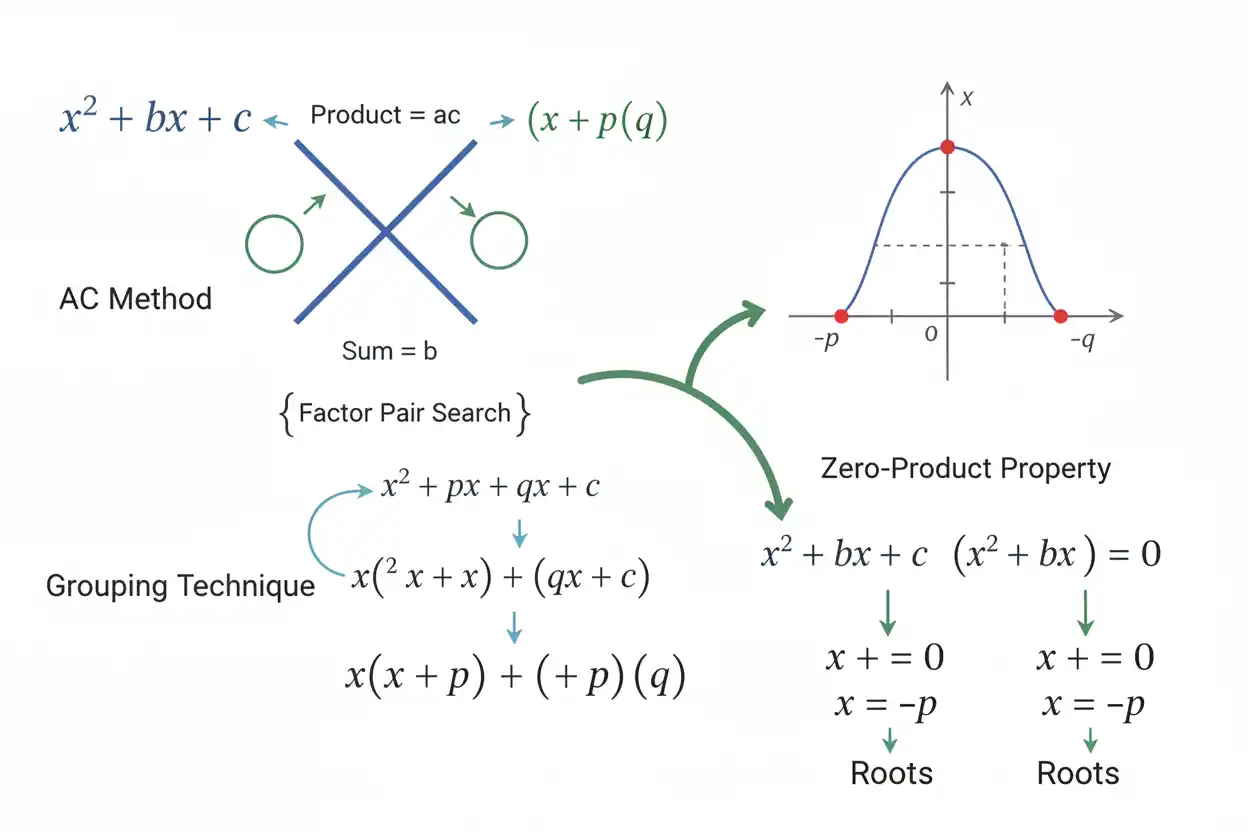
Factoring quadratics means rewriting a quadratic expression as a product of simpler factors.
For example:
x² + 5x + 6
can be factored as:
(x + 2)(x + 3)
because:
2 + 3 = 5
and:
2 × 3 = 6
Multiplying the factors confirms:
(x + 2)(x + 3) = x² + 5x + 6
Factoring is especially useful for solving equations such as:
x² + 5x + 6 = 0
because:
(x + 2)(x + 3) = 0
and the zero-product property gives:
x = -2 or x = -3
Different quadratic forms require different factoring strategies, so recognizing the structure is as important as carrying out the arithmetic.
What Is Factoring a Quadratic?
A quadratic expression generally has the form:
ax² + bx + c
where:
a ≠ 0
Factoring reverses multiplication.
Instead of expanding:
(px + q)(rx + s)
into a quadratic, we start with the quadratic and recover the factors.
In general:
(px + q)(rx + s) = prx² + (ps + qr)x + qs
Therefore, for:
ax² + bx + c
the factors must satisfy:
pr = a
qs = c
ps + qr = b
The complete method depends on whether a = 1, whether a common factor exists, and whether a recognizable special pattern is present.
Factoring is one of the central techniques in algebra.
Factoring Quadratics Formula for x² + bx + c
When the leading coefficient is 1:
x² + bx + c
find two numbers m and n such that:
m + n = b
and:
mn = c
Then:
x² + bx + c = (x + m)(x + n)
This is the simplest common quadratic-factoring pattern.
Example: x² + 7x + 12
Find two numbers that:
Add to 7
and:
Multiply to 12
The numbers are:
3 and 4
Therefore:
x² + 7x + 12 = (x + 3)(x + 4)
Check:
(x + 3)(x + 4)
= x² + 4x + 3x + 12
= x² + 7x + 12
Example: x² – 7x + 12
Now find two numbers that:
Add to -7
and:
Multiply to 12
The numbers are:
-3 and -4
Therefore:
x² – 7x + 12 = (x – 3)(x – 4)
The sign of the middle term determines that both factors are negative.
Example: x² + x – 12
Find two numbers that:
Add to 1
and:
Multiply to -12
The numbers are:
4 and -3
Therefore:
x² + x – 12 = (x + 4)(x – 3)
When c is negative, the two factor constants have opposite signs.
Sign Rules for Monic Quadratics
For:
x² + bx + c
if:
c > 0
the factor constants have the same sign.
If:
b > 0
both are positive.
If:
b < 0
both are negative.
If:
c < 0
the constants have opposite signs.
The sign of b tells you which magnitude must dominate.
These shortcuts reduce trial and error.
Factor the Greatest Common Factor First
Before using any quadratic-specific method, check for a common factor.
Consider:
3x² + 12x
Both terms contain:
3x
Factor it out:
3x(x + 4)
This is already fully factored.
Another example:
6x² + 18x + 12
First factor:
6
giving:
6(x² + 3x + 2)
Then factor the quadratic:
x² + 3x + 2 = (x + 1)(x + 2)
Final result:
6(x + 1)(x + 2)
Skipping the greatest common factor can leave the expression incompletely factored.
Factoring When a ≠ 1
For:
ax² + bx + c
with:
a ≠ 1
one useful method is the AC method.
Multiply:
a × c
Find two numbers that:
Multiply to ac
and:
Add to b
Then split the middle term and factor by grouping.
AC Method Example: 6x² + 11x + 3
Here:
a = 6
b = 11
c = 3
Calculate:
ac = 18
Find two numbers that multiply to 18 and add to 11:
9 and 2
Split the middle term:
6x² + 9x + 2x + 3
Group:
(6x² + 9x) + (2x + 3)
Factor each group:
3x(2x + 3) + 1(2x + 3)
Factor the common binomial:
(3x + 1)(2x + 3)
Therefore:
6x² + 11x + 3 = (3x + 1)(2x + 3)
AC Method Example With a Negative Constant
Factor:
12x² – 7x – 10
Calculate:
ac = 12 × -10 = -120
Find two numbers that:
Multiply to -120
and:
Add to -7
The numbers are:
8 and -15
Split:
12x² + 8x – 15x – 10
Group:
4x(3x + 2) – 5(3x + 2)
Factor:
(4x – 5)(3x + 2)
Check the middle term:
8x – 15x = -7x
so the factorization is correct.
Factoring by Grouping
The AC method works because the middle term is split to create two groups with a common binomial factor.
The general pattern is:
ax² + px + qx + c
Group:
(ax² + px) + (qx + c)
Factor each pair.
If the split was chosen correctly, both groups produce the same binomial factor.
That common factor can then be extracted.
Difference of Squares
A quadratic with no middle term may be a difference of squares.
The formula is:
a² – b² = (a – b)(a + b)
Example:
x² – 25
becomes:
(x – 5)(x + 5)
Another:
9x² – 16
becomes:
(3x – 4)(3x + 4)
This is faster than applying the general trinomial method.
Perfect Square Trinomials
Two important patterns are:
a² + 2ab + b² = (a + b)²
and:
a² – 2ab + b² = (a – b)²
For example:
x² + 10x + 25
has:
25 = 5²
and:
10x = 2(x)(5)
Therefore:
x² + 10x + 25 = (x + 5)²
Likewise:
x² – 12x + 36 = (x – 6)²
These identities are also visible from the binomial theorem.
Recognizing a Perfect Square Quadratic
For:
a² ± 2ab + b²
check whether:
- the first term is a square;
- the last term is a square;
- the middle term equals twice the product of their square roots.
For:
4x² + 20x + 25
the square roots are:
2x
and:
5
Twice their product:
2 × 2x × 5 = 20x
Therefore:
4x² + 20x + 25 = (2x + 5)²
Factoring a Quadratic Equation
Factoring becomes a solving method when the equation equals zero.
Consider:
x² – 5x + 6 = 0
Factor:
(x – 2)(x – 3) = 0
Use the zero-product property:
x – 2 = 0
or:
x – 3 = 0
Therefore:
x = 2 or x = 3
Factoring is one of several ways to solve a quadratic equation.
Zero-Product Property
The zero-product property is:
If AB = 0, then A = 0 or B = 0
It works only when the product equals zero.
For example:
(x – 4)(x + 2) = 0
gives:
x = 4
or:
x = -2
But if:
(x – 4)(x + 2) = 10
you cannot immediately set each factor equal to zero.
First rearrange the original equation into a suitable zero form.
Example With a Leading Coefficient
Solve:
6x² + 11x + 3 = 0
Factor:
(3x + 1)(2x + 3) = 0
Then:
3x + 1 = 0
gives:
x = -1/3
and:
2x + 3 = 0
gives:
x = -3/2
Solutions:
x = -1/3 or x = -3/2
Factoring From Known Roots
If a quadratic has roots:
r₁ and r₂
then its factored form can be written:
a(x – r₁)(x – r₂)
where a is the leading coefficient.
For a monic quadratic:
a = 1
so:
x² – (r₁ + r₂)x + r₁r₂
This directly connects roots with factors.
Example From Known Roots
Suppose the roots are:
3 and -5
Then:
(x – 3)(x + 5)
Expand:
x² + 5x – 3x – 15
x² + 2x – 15
Therefore:
x² + 2x – 15
has roots:
3 and -5
Sum and Product of Roots
For a monic quadratic:
x² + bx + c
if it factors as:
(x + m)(x + n)
then:
m + n = b
and:
mn = c
For a general quadratic:
ax² + bx + c = 0
with roots:
r₁ and r₂
we have:
r₁ + r₂ = -b/a
and:
r₁r₂ = c/a
These relationships explain why factor-finding depends on sums and products.
Discriminant and Factorability
The discriminant is:
D = b² – 4ac
It provides useful information before factoring.
For real coefficients:
D > 0 → Two distinct real roots
D = 0 → One repeated real root
D < 0 → No real linear factors
If coefficients are rational and D is a perfect square, rational factoring is often possible.
If D is positive but not a perfect square, the quadratic has real irrational roots and does not factor into rational linear factors.
Example With a Perfect-Square Discriminant
Consider:
2x² + 7x + 3
Calculate:
D = 7² – 4(2)(3)
D = 49 – 24
D = 25
Since:
√D = 5
rational roots are expected.
Indeed:
2x² + 7x + 3 = (2x + 1)(x + 3)
Example With a Positive Non-Square Discriminant
Consider:
x² + x – 1
Discriminant:
D = 1² – 4(1)(-1)
D = 5
The roots are real but irrational.
Therefore the expression does not factor into integer or rational linear factors.
Over the real numbers it can be written using its irrational roots, but the quadratic formula is generally more practical.
Example With a Negative Discriminant
Consider:
x² + 4x + 8
Discriminant:
D = 16 – 32
D = -16
There are no real roots, so the quadratic cannot be factored into real linear factors.
Its complex roots are:
-2 + 2i
and:
-2 – 2i
Over the complex numbers:
x² + 4x + 8 = [x – (-2 + 2i)][x – (-2 – 2i)]
Factoring Over Different Number Systems
Whether a quadratic is considered “factorable” depends on the allowed coefficients.
For example:
x² – 2
does not factor into rational linear factors.
Over the real numbers:
x² – 2 = (x – √2)(x + √2)
Likewise:
x² + 1
does not factor into real linear factors.
Over the complex numbers:
x² + 1 = (x – i)(x + i)
The intended number system matters.
Factoring Quadratics in Function Notation
Using function notation, suppose:
f(x) = x² – 5x + 6
Factor:
f(x) = (x – 2)(x – 3)
The zeros occur when:
f(x) = 0
Therefore:
x = 2
and:
x = 3
Factored form makes the x-intercepts immediately visible.
Factored Form and a Quadratic Graph
For:
f(x) = a(x – r₁)(x – r₂)
the values:
r₁ and r₂
are x-intercepts when they are real.
For example:
f(x) = 2(x – 1)(x + 4)
has zeros:
x = 1
and:
x = -4
Factored form is therefore useful not only for solving equations but also for interpreting quadratic graphs.
Factoring and Domain and Range
A quadratic polynomial itself has:
Domain = (-∞, ∞)
Factoring does not change that domain.
However, factoring a quadratic denominator can reveal excluded inputs in a rational function.
For example:
f(x) = 1/(x² – 5x + 6)
Factor:
x² – 5x + 6 = (x – 2)(x – 3)
Therefore:
x ≠ 2
and:
x ≠ 3
This makes factoring valuable in domain and range analysis as well as equation solving.
Factoring Rational Expressions
Consider:
(x² – 9)/(x² + 5x + 6)
Factor the numerator:
x² – 9 = (x – 3)(x + 3)
Factor the denominator:
x² + 5x + 6 = (x + 2)(x + 3)
Then:
[(x – 3)(x + 3)] / [(x + 2)(x + 3)]
For:
x ≠ -3
cancel:
x + 3
giving:
(x – 3)/(x + 2)
The original denominator also requires:
x ≠ -2
This application is developed more fully in rational expressions.
Factoring in a Rational Equation
A rational equation can require factoring denominators before finding a common denominator or identifying excluded values.
For example:
1/(x² – 9)
becomes:
1/[(x – 3)(x + 3)]
The factorization immediately reveals:
x ≠ 3
and:
x ≠ -3
Factorization therefore supports both simplification and domain control.
Factoring an Exponential Equation After Substitution
An exponential equation can transform into a quadratic.
Consider:
4ˣ – 5(2ˣ) + 4 = 0
Let:
u = 2ˣ
Then:
u² – 5u + 4 = 0
Factor:
(u – 1)(u – 4) = 0
so:
u = 1 or u = 4
Then:
2ˣ = 1 → x = 0
2ˣ = 4 → x = 2
Factoring solves the transformed quadratic without taking over the exponential equation’s primary intent.
Factoring in a Geometric Series Problem
A geometric series problem can sometimes create a quadratic equation in its common ratio.
Suppose algebraic rearrangement leads to:
r² + r – 6 = 0
Factor:
(r + 3)(r – 2) = 0
Therefore:
r = -3 or r = 2
The original series conditions determine whether both values are valid.
Factoring handles the resulting quadratic; the geometric-series formulas determine how the equation arose.
Factoring a Polynomial Quadratic in Another Variable
A quadratic does not have to use the letter x.
For example:
r² – 9r + 20
factors as:
(r – 4)(r – 5)
Likewise:
t² + 2t – 15
factors as:
(t + 5)(t – 3)
The variable name has no effect on the factoring rules.
Quadratic Form Hidden in Higher Powers
Some polynomial equations have quadratic form.
Consider:
x⁴ – 5x² + 4
Let:
u = x²
Then:
u² – 5u + 4
Factor:
(u – 1)(u – 4)
Return to x:
(x² – 1)(x² – 4)
Then use difference of squares:
(x – 1)(x + 1)(x – 2)(x + 2)
A higher-degree polynomial can therefore be solved through repeated quadratic-style factorization.
Factoring With Fractions
Consider:
x² + (3/2)x + 1/2
To avoid fraction arithmetic initially, multiply the expression by 2 for analysis:
2x² + 3x + 1
Factor:
(2x + 1)(x + 1)
Therefore:
x² + (3/2)x + 1/2 = (x + 1/2)(x + 1)
The exact factoring method can be adapted to fractional coefficients.
Checking a Factorization
Always multiply factors back together when uncertain.
Suppose:
6x² + 7x – 3
is proposed to factor as:
(3x – 1)(2x + 3)
Expand:
6x² + 9x – 2x – 3
= 6x² + 7x – 3
The proposed factorization is correct.
Checking takes only a few seconds and catches sign or coefficient errors.
When Factoring Is Not the Best Method
Factoring is excellent when factors are easy to recognize.
But consider:
x² + x – 1 = 0
No integer pair multiplies to -1 and adds to 1.
The quadratic still has real solutions, but they are irrational.
The quadratic formula gives:
x = (-1 ± √5) / 2
Forcing an integer-factoring strategy would waste time.
Use the method suited to the equation’s structure.
Factoring vs. Quadratic Formula
Factoring is often fastest when a quadratic has simple rational roots.
The quadratic formula:
x = (-b ± √(b² – 4ac)) / 2a
works for every quadratic equation.
A practical strategy is:
First simplify and factor any common factor.
Then look for special patterns.
Try straightforward factoring if the coefficients suggest it.
If no clean factorization appears, calculate the discriminant or use the quadratic formula.
This avoids unnecessary trial-and-error.
Factoring vs. Completing the Square
Completing the square rewrites a quadratic into vertex-style form.
Factoring rewrites it into a product.
For:
x² – 6x + 8
factored form is:
(x – 2)(x – 4)
A completed-square form is:
(x – 3)² – 1
Both are equivalent.
Factored form emphasizes roots.
Completed-square form emphasizes the vertex and minimum or maximum.
Common Factoring Quadratics Mistakes
A common mistake is forgetting to factor out the greatest common factor first.
Another is finding two numbers that multiply correctly but do not add to the middle coefficient.
Sign mistakes are especially common when c is negative.
When a ≠ 1, students may incorrectly factor as though the leading coefficient were 1.
Another error is confusing:
a² – b²
with:
(a – b)²
Students may also stop after one factoring step even though a factor can be reduced further.
When solving equations, the expression must equal zero before the zero-product property is applied.
Finally, not every quadratic factors over the integers or rational numbers. The discriminant or quadratic formula should be used when simple factoring is unavailable.
Factoring Quadratics Formulas
These formulas are:
Quadratic Form: ax² + bx + c
Monic Factoring Rule: x² + bx + c = (x + m)(x + n)
where:
m + n = b
mn = c
For the AC method:
Find p and q so that pq = ac and p + q = b
Then split:
ax² + px + qx + c
and factor by grouping.
Special patterns:
a² – b² = (a – b)(a + b)
a² + 2ab + b² = (a + b)²
a² – 2ab + b² = (a – b)²
Root form:
ax² + bx + c = a(x – r₁)(x – r₂)
No LaTeX or mathematics plugin is required.
Frequently Asked Questions
What does factoring quadratics mean?
It means rewriting a quadratic expression as a product of simpler factors.
What is the basic factoring quadratics formula?
For:
x² + bx + c
find m and n such that:
m + n = b
and:
mn = c
Then:
x² + bx + c = (x + m)(x + n)
How do you factor x² + 5x + 6?
Find two numbers that add to 5 and multiply to 6:
2 and 3
Therefore:
(x + 2)(x + 3)
How do you factor when the leading coefficient is not 1?
A common approach is the AC method:
Multiply a × c
find two numbers that multiply to ac and add to b, split the middle term, then factor by grouping.
What should you factor first?
Always check for a greatest common factor before applying another method.
What is the zero-product property?
If AB = 0, then A = 0 or B = 0
It allows a factored quadratic equation to be solved.
What is the difference-of-squares formula?
a² – b² = (a – b)(a + b)
What is a perfect square trinomial?
A quadratic matching:
a² + 2ab + b² = (a + b)²
or:
a² – 2ab + b² = (a – b)²
Can every quadratic be factored?
Every quadratic can be factored over a sufficiently broad number system, but not every quadratic factors into simple integer or rational linear factors.
How do you know if a quadratic factors over the real numbers?
Its discriminant must satisfy:
D ≥ 0
for real linear roots.
How do you know if it factors nicely over rational numbers?
For rational or integer coefficients, a nonnegative perfect-square discriminant is a strong indicator of rational roots and rational linear factors.
What if the discriminant is negative?
The quadratic has no real linear factors but can be factored over the complex numbers.
How are factors related to roots?
If:
x = r
is a root, then:
x – r
is a corresponding factor.
What is the factored form from two roots?
a(x – r₁)(x – r₂)
Why is factoring useful for graphs?
Factored form makes real zeros and x-intercepts immediately visible.
Can factoring help find domain?
Yes. Factoring a denominator reveals values that must be excluded from the domain of a rational function.
How is factoring used in exponential equations?
Some exponential equations become quadratic after a substitution such as:
u = aˣ
The resulting quadratic can then be factored.
Can a geometric-series problem require factoring?
Yes. Algebra involving a common ratio can sometimes produce a quadratic equation that is solved by factoring.
When should you use the quadratic formula instead?
Use it when a quadratic does not factor conveniently or when exact irrational or complex roots are required.
Why is factoring quadratics important?
Factoring connects quadratic expressions with their roots, graph intercepts, rational-expression simplification, domain restrictions, transformed exponential equations, and higher-degree polynomial problems. It is one of the most reusable techniques in algebra.