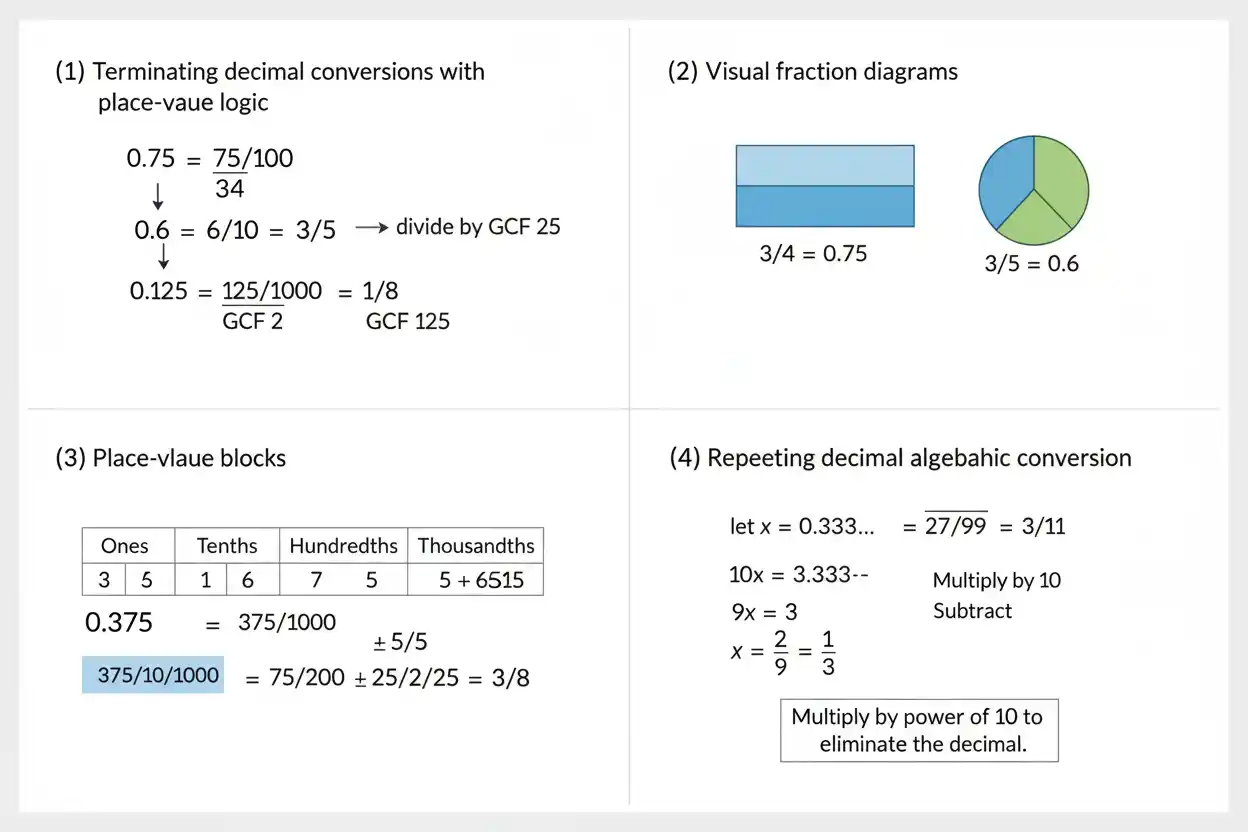

Converting a decimal to fraction form means expressing the same numerical value as a ratio of integers. For a terminating decimal, the method is based directly on place value. For a repeating decimal, algebra can be used to eliminate the repeating digits and produce an exact fraction.
For example:
0.75 = 75 / 100 = 3 / 4
A repeating decimal such as:
0.333…
has the exact fractional form:
1 / 3
The correct method depends on whether the decimal terminates or repeats.
Decimal to Fraction Formula
For a terminating decimal with n digits after the decimal point:
Fraction = integer formed by removing the decimal point / 10^n
Then simplify the fraction.
For example:
0.625
contains three decimal places, so:
0.625 = 625 / 1000
Simplify:
625 / 1000 = 5 / 8
Therefore:
0.625 = 5 / 8
The place-value logic behind this process comes from decimal arithmetic.
Why the Method Works
Each decimal place represents a power of 10.
For example:
0.4 = 4 / 10
0.04 = 4 / 100
0.004 = 4 / 1000
Therefore, a decimal with three places can be written over:
1000 = 10³
A decimal with four places can be written over:
10000 = 10⁴
Once written as a fraction with a power-of-10 denominator, it can be reduced to lowest terms.
How to Convert a Terminating Decimal to a Fraction
Use this sequence:
- Count the digits after the decimal point.
- Remove the decimal point to form the numerator.
- Use 1 followed by that many zeros as the denominator.
- Simplify.
For:
0.48
there are two decimal places.
Write:
0.48 = 48 / 100
Simplify by dividing numerator and denominator by 4:
48 / 100 = 12 / 25
Therefore:
0.48 = 12 / 25
The reduction step is the same process covered more fully under fraction simplification.
Example: Convert 0.6 to a Fraction
There is one decimal place.
Therefore:
0.6 = 6 / 10
Divide numerator and denominator by 2:
6 / 10 = 3 / 5
So:
0.6 = 3 / 5
Example: Convert 0.35 to a Fraction
There are two digits after the decimal:
0.35 = 35 / 100
Both values are divisible by 5:
35 ÷ 5 = 7
100 ÷ 5 = 20
Therefore:
0.35 = 7 / 20
Example: Convert 0.125 to a Fraction
There are three decimal places:
0.125 = 125 / 1000
Divide both by 125:
125 ÷ 125 = 1
1000 ÷ 125 = 8
Therefore:
0.125 = 1 / 8
Example: Convert 0.875 to a Fraction
Write:
0.875 = 875 / 1000
The greatest common factor is 125.
Divide:
875 ÷ 125 = 7
1000 ÷ 125 = 8
Therefore:
0.875 = 7 / 8
Finding common factors can help identify the value by which both numerator and denominator should be divided.
Converting a Decimal Greater Than 1
The same process works when the decimal has a whole-number part.
Consider:
2.75
There are two decimal places:
2.75 = 275 / 100
Simplify by dividing both values by 25:
275 / 100 = 11 / 4
Therefore:
2.75 = 11 / 4
This is an improper fraction.
It may also be written as the mixed number:
2 3/4
The value is the same in all three forms.
Another Decimal Greater Than 1
Convert:
4.125
Write:
4.125 = 4125 / 1000
Divide both values by 125:
4125 ÷ 125 = 33
1000 ÷ 125 = 8
Therefore:
4.125 = 33 / 8
As a mixed number:
33 / 8 = 4 1/8
Converting Negative Decimals
Keep the negative sign and convert the magnitude normally.
For example:
-0.45
Write:
-0.45 = -45 / 100
Simplify:
-45 / 100 = -9 / 20
Therefore:
-0.45 = -9 / 20
The sign may equivalently be placed before the entire fraction:
-(9 / 20)
Converting a Whole-Number Decimal
A decimal such as:
5.0
is simply:
5
As a fraction:
5 / 1
Likewise:
12.000 = 12 / 1
Trailing zeros do not change the numerical value.
What Is a Repeating Decimal?
A repeating decimal contains a digit or block of digits that repeats indefinitely.
Examples include:
0.333…
0.777…
0.121212…
0.583333…
A repeating decimal is not merely a rounded approximation. The dots indicate that the repeating pattern continues forever.
Every repeating decimal represents a rational number, meaning it can be written exactly as a ratio of integers.
Converting 0.333… to a Fraction
Let:
x = 0.333…
Multiply by 10:
10x = 3.333…
Subtract the original equation:
10x – x = 3.333… – 0.333…
The repeating portions cancel:
9x = 3
Divide by 9:
x = 3 / 9
Simplify:
x = 1 / 3
Therefore:
0.333… = 1 / 3
Why Subtraction Eliminates the Repetition
The key is to multiply by a power of 10 that shifts one full repeating block to the left of the decimal point.
For:
x = 0.333…
multiplying by 10 gives:
10x = 3.333…
Both numbers now contain the identical infinite decimal tail:
.333…
Subtracting removes that common tail exactly.
This is why the procedure yields an exact fraction rather than an approximation.
Converting 0.777… to a Fraction
Let:
x = 0.777…
Multiply by 10:
10x = 7.777…
Subtract:
10x – x = 7
9x = 7
Therefore:
x = 7 / 9
So:
0.777… = 7 / 9
Converting a Two-Digit Repeating Decimal
Consider:
0.121212…
The repeating block is:
12
It contains two digits, so multiply by:
100
Let:
x = 0.121212…
Then:
100x = 12.121212…
Subtract:
100x – x = 12
99x = 12
Therefore:
x = 12 / 99
Simplify by dividing by 3:
x = 4 / 33
So:
0.121212… = 4 / 33
Repeating-Decimal Formula for a Pure Repeating Block
If an n-digit block repeats immediately after the decimal point, the denominator initially contains n nines.
For example:
0.272727…
has repeating block 27.
Therefore:
0.272727… = 27 / 99
Simplify:
27 / 99 = 3 / 11
So:
0.272727… = 3 / 11
Similarly:
0.456456456… = 456 / 999
which can then be simplified.
Why the Denominator Contains Nines
For one repeating digit:
10 – 1 = 9
For two repeating digits:
100 – 1 = 99
For three:
1000 – 1 = 999
In general, shifting an n-digit repeating block requires multiplication by:
10^n
and subtraction produces:
10^n – 1
which is a number containing n nines.
Converting 0.454545… to a Fraction
The repeating block is 45.
Write:
x = 0.454545…
Multiply by 100:
100x = 45.454545…
Subtract:
99x = 45
Therefore:
x = 45 / 99
Divide numerator and denominator by 9:
x = 5 / 11
Therefore:
0.454545… = 5 / 11
Mixed Repeating Decimals
A mixed repeating decimal contains a nonrepeating part before the repeating pattern starts.
For example:
0.1666…
The digit 1 does not repeat, while 6 repeats indefinitely.
This requires an additional alignment step.
Converting 0.1666… to a Fraction
Let:
x = 0.1666…
First multiply by 10 to move past the nonrepeating digit:
10x = 1.666…
Now multiply that relationship by another 10:
100x = 16.666…
Subtract:
100x – 10x = 16.666… – 1.666…
Therefore:
90x = 15
Divide:
x = 15 / 90
Simplify:
x = 1 / 6
Therefore:
0.1666… = 1 / 6
Converting 0.58333… to a Fraction
Suppose only the 3 repeats:
x = 0.58333…
There are two nonrepeating decimal digits before the repeating portion effectively aligns after 0.58.
Multiply by 100:
100x = 58.333…
Then shift one repeating digit:
1000x = 583.333…
Subtract:
1000x – 100x = 583.333… – 58.333…
So:
900x = 525
Therefore:
x = 525 / 900
Simplify:
x = 7 / 12
Thus:
0.58333… = 7 / 12
Check:
7 ÷ 12 = 0.58333…
A General Mixed-Repeating Strategy
For a decimal containing both nonrepeating and repeating digits:
- Let
xequal the decimal. - Multiply by a power of 10 to move the nonrepeating portion left of the decimal.
- Multiply again by the power of 10 corresponding to the number of repeating digits.
- Subtract the two equations.
- Solve for
x. - Simplify the resulting fraction.
The goal is always to align identical infinite decimal tails so subtraction eliminates them.
The 0.999… Example
A famous repeating-decimal result is:
0.999… = 1
To see why, let:
x = 0.999…
Multiply by 10:
10x = 9.999…
Subtract:
10x – x = 9.999… – 0.999…
Therefore:
9x = 9
So:
x = 1
Thus:
0.999… = 1
It is not merely close to 1. It represents exactly the same real number.
Decimal to Fraction Using Place Value
A terminating decimal can also be decomposed by place value.
For example:
0.37
means:
3/10 + 7/100
Convert to a common denominator:
30/100 + 7/100
Therefore:
37/100
So:
0.37 = 37/100
This interpretation explains why the power-of-10 method works.
Simplifying the Result
A decimal-to-fraction conversion is generally considered complete when the fraction is in lowest terms.
For example:
0.24 = 24/100
This is correct but not simplified.
Both values are divisible by 4:
24 ÷ 4 = 6
100 ÷ 4 = 25
Therefore:
0.24 = 6/25
Divisibility rules can help identify common divisors quickly when reducing the fraction.
Using Prime Factorization to Simplify
For larger values, prime factorization can reveal common factors systematically.
Consider:
0.375 = 375/1000
Prime-factorize:
375 = 3 × 5³
1000 = 2³ × 5³
Cancel the shared factor 5³:
375/1000 = 3/8
Therefore:
0.375 = 3/8
The decimal conversion creates the fraction; prime factorization merely provides one way to reduce it.
Decimal to Fraction and Fraction Operations
Once a decimal has been converted, the result may be used in fraction operations.
For example:
0.25 + 2/3
Convert:
0.25 = 1/4
Then:
1/4 + 2/3
Use a common denominator:
3/12 + 8/12 = 11/12
Working in fractional form can preserve exact values that might otherwise produce long decimal expansions.
Decimal to Fraction and Percentages
A percentage can first be written as a decimal and then as a fraction.
For example:
35% = 0.35
Then:
0.35 = 35/100 = 7/20
Therefore:
35% = 7/20
The relationship between percent and decimal notation belongs to percentage, while the current conversion focuses on moving from decimal notation to fractional form.
Decimal to Fraction and Ratios
A fraction is closely related to a ratio.
For example:
0.6 = 3/5
The fraction:
3/5
corresponds to the ratio:
3:5
The forms communicate related relationships, although the way they are used depends on the problem.
Decimal to Fraction and Division
Every fraction represents division:
a/b = a ÷ b
So converting from decimal to fraction can be checked by performing division on the final numerator and denominator.
For example:
7/8
Check:
7 ÷ 8 = 0.875
Therefore:
0.875 = 7/8
Checking a Repeating Conversion
Suppose the result is:
0.272727… = 3/11
Check by division:
3 ÷ 11 = 0.272727…
The repeating pattern matches the original decimal.
This reverse check is useful because algebraic repeating-decimal conversions can involve several powers of 10.
Decimal Operations Before Conversion
Sometimes a decimal must first be calculated using decimal operations.
For example:
0.25 + 0.375 = 0.625
Then convert:
0.625 = 625/1000
Simplify:
0.625 = 5/8
However, when an exact fractional form is already available, calculating directly with fractions may avoid unnecessary conversions.
Repeating Decimals Are Exact
A repeating decimal such as:
0.181818…
is not an approximation when the repetition is indicated indefinitely.
It represents an exact rational number:
0.181818… = 2/11
By contrast:
0.18
is a terminating decimal and equals:
18/100 = 9/50
These are different numbers.
The ellipsis matters.
Terminating vs. Truncated Decimals
Suppose an exact value is:
1/7 = 0.142857142857…
Writing:
0.142857
without indicating repetition gives a terminating number equal to:
142857/1000000
That value is close to 1/7, but it is not exactly equal.
When converting a decimal to fraction form, first determine whether the supplied digits represent the entire decimal or only a rounded/truncated approximation.
Decimal to Fraction for Scientific Measurements
Measured values often contain decimals that represent limited precision.
For example:
2.50
can be converted numerically to:
5/2
but the trailing zero may carry measurement information involving significant figures.
Converting the numerical value to a fraction does not preserve every convention about measured precision.
Decimal to Fraction and Scientific Notation
A small decimal expressed in scientific notation can still be converted into a fraction.
For example:
2.5 × 10^-3 = 0.0025
Then:
0.0025 = 25/10000
Simplify:
25/10000 = 1/400
Therefore:
2.5 × 10^-3 = 1/400
Decimal Fractions and Real Numbers
Terminating and repeating decimals are rational and therefore belong to the real numbers.
Not every real decimal expansion can be converted to a ratio of integers.
For example, the decimal expansion of √2 is nonterminating and nonrepeating.
Such values are irrational rather than rational.
Cube Roots and Decimal-to-Fraction Conversion
Some cube roots produce exact rational values:
∛0.125 = 0.5
and:
0.5 = 1/2
Other cube roots, such as:
∛2
are irrational, so their exact value cannot be converted into a fraction of two integers.
A rounded decimal approximation of ∛2 can be converted into a fraction, but that fraction represents the rounded approximation rather than the exact cube root.
Decimal Values in Determinants
A determinant may contain decimal matrix entries.
If an exact fractional representation is useful, a terminating decimal entry such as:
0.75
may be replaced by:
3/4
without changing its numerical value.
The matrix calculation remains a separate topic; the conversion simply changes how the same number is represented.
Common Decimal-to-Fraction Mistakes
One frequent mistake is using the wrong denominator.
For:
0.37
the denominator is:
100
not 10, because there are two decimal places.
Another error is forgetting to simplify.
For example:
0.6 = 6/10
is correct, but:
3/5
is the reduced form.
For repeating decimals, a common mistake is treating the written repeating digits as though the decimal terminates.
For example:
0.333…
is not:
333/1000
Instead:
0.333… = 1/3
A fourth mistake is rounding a repeating decimal before conversion, which changes its value.
How to Check a Decimal-to-Fraction Answer
Divide the numerator by the denominator.
Suppose:
0.72 = 18/25
Check:
18 ÷ 25 = 0.72
The decimal is recovered exactly.
For repeating decimals, verify that the correct repeating pattern appears.
For:
5/6
division gives:
0.83333…
which confirms:
0.83333… = 5/6
Frequently Asked Questions
How do you convert a decimal to a fraction?
For a terminating decimal, remove the decimal point to create the numerator and use a power of 10 as the denominator based on the number of decimal places. Then simplify.
What is 0.5 as a fraction?
0.5 = 5/10 = 1/2
What is 0.25 as a fraction?
0.25 = 25/100 = 1/4
What is 0.75 as a fraction?
0.75 = 75/100 = 3/4
What is 0.125 as a fraction?
0.125 = 125/1000 = 1/8
How do you convert a repeating decimal to a fraction?
Assign the decimal to a variable, multiply by a suitable power of 10 so the repeating blocks align, subtract the equations to eliminate the repeating digits, solve for the variable, and simplify.
What is 0.333… as a fraction?
0.333… = 1/3
What is 0.666… as a fraction?
Let:
x = 0.666…
Then:
10x = 6.666…
Subtract:
9x = 6
Therefore:
x = 6/9 = 2/3
So:
0.666… = 2/3
What is 0.121212… as a fraction?
The repeating block has two digits:
0.121212… = 12/99 = 4/33
Can every decimal be converted into a fraction?
Every terminating or repeating decimal can be expressed exactly as a fraction of integers. A nonterminating, nonrepeating decimal represents an irrational number and cannot be expressed exactly as such a fraction.
Is 0.999… really equal to 1?
Yes.
0.999… = 1
The two expressions represent the same real number.
Does converting a rounded decimal give the original exact value?
Not necessarily. If the decimal is only an approximation, the resulting fraction represents that approximation, not necessarily the exact value from which it was rounded.
Final Example
Convert:
1.23333…
to a fraction, where only the 3 repeats.
Let:
x = 1.23333…
Move the nonrepeating decimal digit 2 past the decimal point by multiplying by 10:
10x = 12.3333…
Now shift one repeating digit by multiplying the original equation by 100:
100x = 123.3333…
Subtract:
100x – 10x = 123.3333… – 12.3333…
Therefore:
90x = 111
Divide:
x = 111 / 90
Simplify by 3:
x = 37 / 30
Therefore:
1.23333… = 37/30
A terminating decimal converts through place value; a repeating decimal converts by algebraically eliminating its repeating tail. In both cases, the final fraction represents exactly the same numerical value as the original decimal.