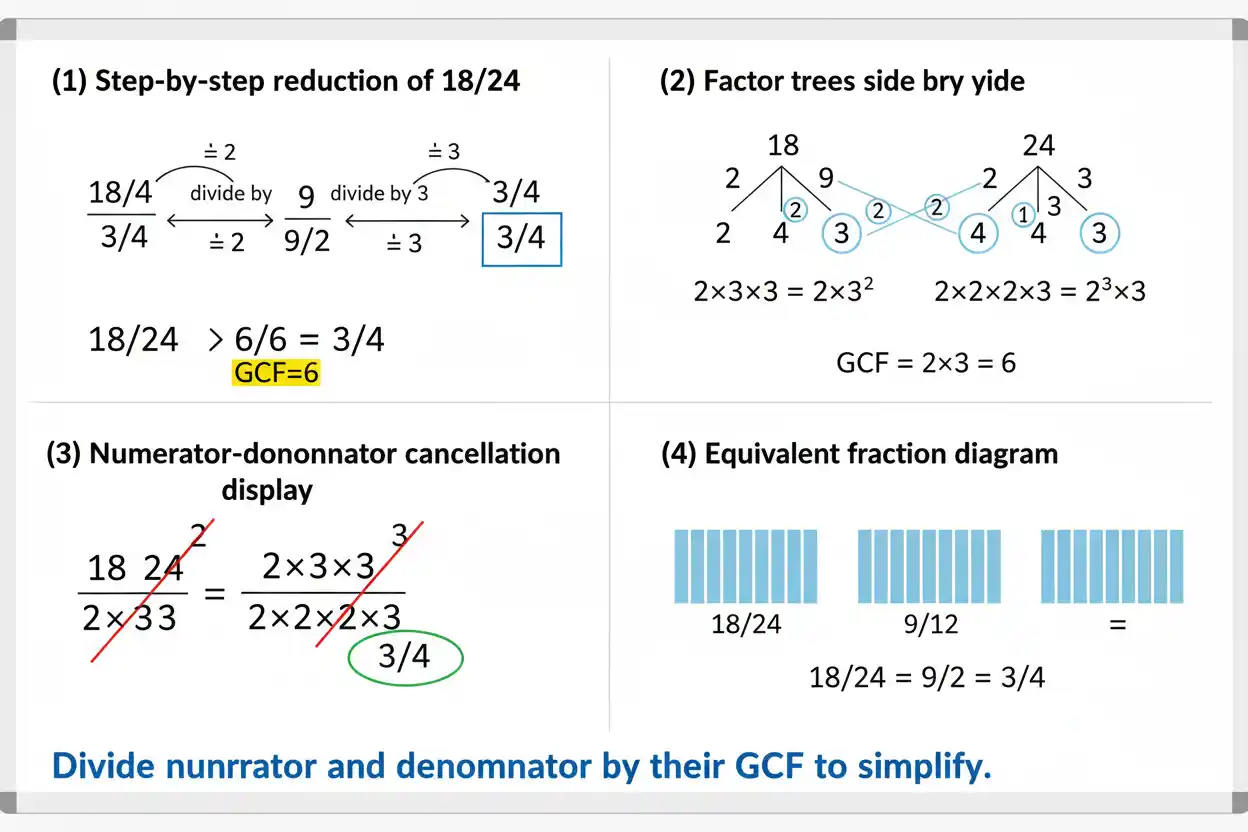
Fraction simplification means rewriting a fraction in an equivalent form whose numerator and denominator have no common positive factor greater than 1. The value of the fraction stays exactly the same; only its representation becomes simpler.
For example:
18 / 24
has a greatest common factor of 6. Divide both numerator and denominator by 6:
18 ÷ 6 = 3
24 ÷ 6 = 4
Therefore:
18 / 24 = 3 / 4
The fraction 3/4 is in lowest terms because 3 and 4 share no positive factor except 1.
Fraction simplification is a fundamental part of arithmetic and number theory and is especially useful before or after fraction calculations, comparisons, conversions, ratios, and algebraic work.
What Is Fraction Simplification?
A fraction has the form:
a / b
where:
b ≠ 0
The numerator a and denominator b may share one or more factors.
If both can be divided by the same nonzero integer k, then:
a / b = (a ÷ k) / (b ÷ k)
For example:
20 / 30
Both numbers are divisible by 10:
20 ÷ 10 = 2
30 ÷ 10 = 3
So:
20 / 30 = 2 / 3
The second fraction is simpler but represents exactly the same number.
Fraction Simplification Formula
For a fraction:
a / b
let:
g = GCF(|a|, |b|)
Then its reduced form is:
(a ÷ g) / (b ÷ g)
provided:
b ≠ 0
For example:
42 / 56
The greatest common factor is:
g = 14
Therefore:
42 / 56 = (42 ÷ 14) / (56 ÷ 14)
= 3 / 4
So:
42 / 56 = 3 / 4
Using the GCF gives the reduced form in one step.
What Does Lowest Terms Mean?
A fraction is in lowest terms when its numerator and denominator are relatively prime.
That means:
GCF(numerator, denominator) = 1
For example:
7 / 12
is already simplified because the factors of 7 are:
1, 7
while the positive factors of 12 are:
1, 2, 3, 4, 6, 12
Their only positive common factor is:
1
Therefore:
7/12 is in lowest terms
The common factors of the numerator and denominator determine whether further reduction is possible.
Why Simplifying a Fraction Does Not Change Its Value
Consider:
12 / 18
Divide both parts by 6:
(12 ÷ 6) / (18 ÷ 6) = 2 / 3
This is equivalent to dividing the original numerator and denominator by the same number.
Since:
6 / 6 = 1
the transformation effectively multiplies the fraction by a form of 1.
You can verify numerically:
12 ÷ 18 = 0.6666…
and:
2 ÷ 3 = 0.6666…
Both fractions represent the same rational number.
Method 1: Simplify Using the Greatest Common Factor
The fastest general method is to find the largest number that divides both numerator and denominator exactly.
Consider:
36 / 60
The positive common factors include:
1, 2, 3, 4, 6, 12
The greatest is:
12
Divide both terms:
36 ÷ 12 = 3
60 ÷ 12 = 5
Therefore:
36 / 60 = 3 / 5
Because the GCF was used, no further reduction is needed.
Example: Simplify 45/75
First determine:
GCF(45, 75) = 15
Then:
45 ÷ 15 = 3
75 ÷ 15 = 5
Therefore:
45 / 75 = 3 / 5
Check:
GCF(3, 5) = 1
so the fraction is fully simplified.
Example: Simplify 150/210
Find the greatest common factor:
GCF(150, 210) = 30
Divide:
150 ÷ 30 = 5
210 ÷ 30 = 7
Therefore:
150 / 210 = 5 / 7
Using the largest shared factor avoids several smaller reduction steps.
Method 2: Simplify in Several Steps
You do not have to identify the GCF immediately.
Consider:
48 / 72
Both numbers are even, so divide by 2:
48 / 72 = 24 / 36
Again divide by 2:
24 / 36 = 12 / 18
Again:
12 / 18 = 6 / 9
Now divide by 3:
6 / 9 = 2 / 3
Therefore:
48 / 72 = 2 / 3
This method is mathematically valid, although using the GCF:
GCF(48,72) = 24
would reach 2/3 immediately.
When Repeated Simplification Is Useful
Repeated reduction can be convenient when an obvious small divisor is visible.
For example:
280 / 420
Both are even:
280 / 420 = 140 / 210
Again:
= 70 / 105
Now both are divisible by 5:
= 14 / 21
Then divide by 7:
= 2 / 3
The answer is still:
2 / 3
The disadvantage is that it is easier to stop too early.
Method 3: Simplify With Prime Factorization
Prime factorization can reveal every common prime factor directly.
Consider:
84 / 126
Prime-factorize 84:
84 = 2² × 3 × 7
Prime-factorize 126:
126 = 2 × 3² × 7
Write the fraction:
(2² × 3 × 7) / (2 × 3² × 7)
Cancel common prime factors:
one factor of 2,
one factor of 3,
one factor of 7.
The remaining factors are:
2 / 3
Therefore:
84 / 126 = 2 / 3
Prime factorization is especially useful when the numerator and denominator are large and their shared structure is not immediately obvious.
Simplifying by Factor Lists
For smaller values, listing factors can work well.
Consider:
24 / 32
Factors of 24 include:
1, 2, 3, 4, 6, 8, 12, 24
Factors of 32 include:
1, 2, 4, 8, 16, 32
The greatest shared factor is:
8
Therefore:
24 / 32 = 3 / 4
This method is easy to understand but becomes cumbersome for large numbers.
Simplifying an Improper Fraction
Fraction simplification applies whether the numerator is smaller or larger than the denominator.
Consider:
42 / 18
The GCF is:
6
Divide:
42 ÷ 6 = 7
18 ÷ 6 = 3
Therefore:
42 / 18 = 7 / 3
The result is still an improper fraction because:
7 > 3
It can also be written as:
2 1/3
but conversion to a mixed number is separate from simplifying the fraction itself.
Simplifying a Negative Fraction
Consider:
-24 / 36
Ignore the sign temporarily and simplify:
24 / 36 = 2 / 3
Restore the negative sign:
-24 / 36 = -2 / 3
The negative sign may be written:
-2 / 3
or:
(-2) / 3
It is generally clearest to keep the denominator positive.
Negative Sign in the Denominator
Consider:
8 / -12
Move the sign to the front:
-8 / 12
Simplify by 4:
-8 / 12 = -2 / 3
Therefore:
8 / -12 = -2 / 3
A conventional simplified fraction normally uses a positive denominator.
Two Negative Signs
If both numerator and denominator are negative:
(-18) / (-24)
the signs cancel:
18 / 24
Then simplify:
18 / 24 = 3 / 4
Therefore:
(-18) / (-24) = 3 / 4
A negative divided by a negative produces a positive value.
Simplifying a Fraction With Zero Numerator
Consider:
0 / 15
The value is:
0
because:
0 ÷ 15 = 0
As a normalized fractional form, it may be represented as:
0 / 1
So:
0 / 15 = 0
Any fraction with zero numerator and a nonzero denominator represents zero.
Zero Cannot Be the Denominator
An expression such as:
5 / 0
cannot be simplified into an ordinary number.
It is undefined because division by zero is undefined.
Likewise:
0 / 0
does not have one ordinary fractional value.
Therefore, fraction simplification always assumes:
denominator ≠ 0
Simplification Before Fraction Addition
Suppose a calculation contains:
6/9 + 5/12
It can be useful to simplify the first fraction:
6/9 = 2/3
The expression becomes:
2/3 + 5/12
Use denominator 12:
2/3 = 8/12
Then:
8/12 + 5/12 = 13/12
The detailed rules for addition, subtraction, multiplication, and division belong to fraction operations. Fraction simplification can be used before, during, or after those operations when common factors are available.
Simplifying a Result After Addition
Consider:
1/8 + 3/8
Add:
4/8
Now simplify by 4:
4/8 = 1/2
Therefore:
1/8 + 3/8 = 1/2
The arithmetic produces an equivalent fraction that still requires reduction.
Simplification Before Multiplication
Fraction multiplication often provides opportunities to cancel common factors before multiplying.
Consider:
14/15 × 25/21
Cross-cancel:
14/21 = 2/3
and:
25/15 = 5/3
The multiplication becomes:
2/3 × 5/3
= 10/9
So:
14/15 × 25/21 = 10/9
This avoids calculating the larger intermediate fraction:
350/315
Simplification After Multiplication
If you multiply first:
6/7 × 14/15
you get:
84/105
The GCF of 84 and 105 is:
21
Therefore:
84 / 105 = 4 / 5
So:
6/7 × 14/15 = 4/5
Both early cancellation and post-calculation simplification produce the same result.
Simplifying Complex Fraction Results
Suppose an operation produces:
144 / 216
The GCF is:
72
Therefore:
144 ÷ 72 = 2
216 ÷ 72 = 3
So:
144 / 216 = 2 / 3
Checking the final numerator and denominator for common factors is a good habit after any fraction calculation.
Fraction Simplification Before Converting to Percent
Reducing a fraction can make a later conversion easier.
Suppose:
18 / 24
Simplify:
18/24 = 3/4
Now converting fractions to percent is immediate:
3/4 × 100% = 75%
You could convert 18/24 directly and obtain the same result, but the reduced fraction is easier to recognize and work with.
Example: Simplify Before Percentage Conversion
Consider:
45 / 60
Reduce:
45/60 = 3/4
Then:
3/4 = 75%
The simplified form reveals a familiar fraction-to-percentage relationship.
Fraction Simplification and GCF
The GCF provides the direct one-step simplification divisor.
For:
a / b
if:
g = GCF(a,b)
then:
a/b = (a/g)/(b/g)
When:
g = 1
the fraction is already in lowest terms.
This makes the GCF a precise test for whether further simplification is possible.
GCF vs. Greatest Common Factor Calculation
The phrase greatest common factor describes the largest positive integer dividing both values.
For:
63 and 84
that number is:
21
So:
63/84 = 3/4
The dedicated greatest common factor page develops that calculation as its own problem. In fraction simplification, the GCF is used specifically as the divisor that reduces numerator and denominator together.
Fraction Simplification and the Euclidean Algorithm
When numerator and denominator are large, the Euclidean algorithm can efficiently find their GCD.
Consider:
899 / 493
The Euclidean algorithm gives:
899 = 493 × 1 + 406
493 = 406 × 1 + 87
406 = 87 × 4 + 58
87 = 58 × 1 + 29
58 = 29 × 2 + 0
So:
GCD(899,493) = 29
Divide:
899 ÷ 29 = 31
493 ÷ 29 = 17
Therefore:
899 / 493 = 31 / 17
This avoids building complete factor lists for either large number.
Fractions From the Fibonacci Sequence
Ratios formed from terms in the Fibonacci sequence can also require simplification.
For example:
F₁₂ / F₈ = 144 / 21
The numerator and denominator share a factor of 3:
144 ÷ 3 = 48
21 ÷ 3 = 7
Therefore:
144 / 21 = 48 / 7
By contrast, consecutive Fibonacci numbers are coprime, so a ratio such as:
55 / 34
is already in lowest terms.
The sequence determines the values; fraction simplification determines whether their ratio can be reduced.
Fraction Simplification Before Floor and Ceiling
A fraction may appear inside floor and ceiling functions.
For example:
floor(84/36)
Simplify first:
84/36 = 7/3
Since:
2 < 7/3 < 3
we obtain:
floor(84/36) = 2
and:
ceiling(84/36) = 3
Simplification does not change the fraction’s value, so it cannot change its floor or ceiling.
Simplifying Fractions Containing Powers
Suppose:
2⁵ / 2³
Using exponents:
2⁵ / 2³ = 2^(5-3)
= 2²
= 4
The same expression as ordinary integers is:
32 / 8 = 4
Recognizing shared exponential factors is another form of cancellation.
Fraction Simplification and Rational Numbers
Every fraction:
a / b
where a and b are integers and b ≠ 0 represents a rational number.
A rational number can have many equivalent fractional representations.
For example:
2/3 = 4/6 = 20/30 = 200/300
Fraction simplification selects the representation in which numerator and denominator have no shared factor greater than 1.
Does Simplification Change a Decimal Value?
No.
Consider:
15 / 20
As a decimal:
15 ÷ 20 = 0.75
Simplify:
15/20 = 3/4
Then:
3 ÷ 4 = 0.75
The decimal value is unchanged because the two fractions are equivalent.
Simplification Is Not Rounding
Fraction simplification is exact.
For example:
2/6 = 1/3
No approximation has occurred.
By contrast:
1/3 ≈ 0.33
uses a rounded decimal approximation.
Reducing a fraction changes its form while preserving the precise value.
How to Know When a Fraction Is Fully Simplified
Check whether numerator and denominator still share any factor greater than 1.
For:
14 / 25
Factors of 14:
1, 2, 7, 14
Factors of 25:
1, 5, 25
Their only common factor is:
1
Therefore:
14/25 is fully simplified
An equivalent test is:
GCF(14,25) = 1
Common Fraction Simplification Mistake: Dividing Only One Part
Consider:
12 / 18
It is invalid to divide only the numerator by 6 and write:
2 / 18
That changes the numerical value.
Both numerator and denominator must be divided by the same nonzero factor:
12/18 = 2/3
Common Mistake: Subtracting a Common Number
Fraction reduction uses division, not subtraction.
For example:
8/12
cannot be simplified by subtracting 4:
(8 – 4)/(12 – 4) = 4/8
because:
8/12 = 2/3
while:
4/8 = 1/2
These are different values.
The correct method divides numerator and denominator by a common factor.
Common Mistake: Stopping Too Early
Consider:
24 / 36
Divide both by 2:
12 / 18
This is equivalent, but not fully simplified.
Divide again by 6:
12/18 = 2/3
The final answer is:
2/3
Using the GCF from the beginning helps prevent premature stopping.
Common Mistake: Canceling Across Addition
Cancellation applies to factors, not terms separated by addition or subtraction.
For example:
(6 + 3) / 3
You cannot simply cancel the 3 appearing inside 6 + 3.
First evaluate:
(6 + 3)/3 = 9/3
= 3
Alternatively, factor the numerator when possible:
(6 + 3)/3 = 3(2 + 1)/3
Then cancel the common factor 3:
= 2 + 1
= 3
The entire numerator structure matters.
How to Check a Simplified Fraction
Suppose:
28/42 = 2/3
Cross-multiply:
28 × 3 = 84
and:
42 × 2 = 84
Since the cross-products match:
28/42 = 2/3
Then check:
GCF(2,3) = 1
So the result is both equivalent and fully simplified.
Frequently Asked Questions
What is fraction simplification?
Fraction simplification rewrites a fraction in an equivalent form whose numerator and denominator share no positive common factor greater than 1.
What is the formula for simplifying a fraction?
If:
g = GCF(|a|,|b|)
then:
a/b = (a ÷ g)/(b ÷ g)
provided:
b ≠ 0
How do I know if a fraction is already simplified?
Find the GCF of its numerator and denominator. If:
GCF = 1
the fraction is already in lowest terms.
What is 12/18 simplified?
The GCF is 6:
12/18 = 2/3
What is 24/36 simplified?
The GCF is 12:
24/36 = 2/3
What is 45/60 simplified?
The GCF is 15:
45/60 = 3/4
Can an improper fraction be simplified?
Yes. For example:
20/12 = 5/3
It remains improper but is in lowest terms.
Can a negative fraction be simplified?
Yes.
-18/24 = -3/4
The sign does not change the factor-cancellation process.
Is 0/8 already simplified?
Its numerical value is 0. A normalized fractional representation is:
0/1
Can a denominator be zero?
No. A fraction with denominator zero is undefined.
Do I need the GCF to simplify a fraction?
No. You can repeatedly divide numerator and denominator by smaller common factors, but the GCF reduces the fraction in one step.
Does simplifying a fraction change its value?
No. The simplified and original fractions are exactly equivalent.
Final Example
Simplify:
378 / 630
Find the greatest common factor.
Using common factorization:
378 = 2 × 3³ × 7
630 = 2 × 3² × 5 × 7
The common prime structure is:
2 × 3² × 7
Calculate:
2 × 9 × 7 = 126
Therefore:
GCF(378,630) = 126
Divide:
378 ÷ 126 = 3
630 ÷ 126 = 5
So:
378 / 630 = 3 / 5
Check:
GCF(3,5) = 1
The fraction is now in lowest terms. The essential principle of fraction simplification is always the same: divide the numerator and denominator by the same common factor until no factor greater than 1 remains.