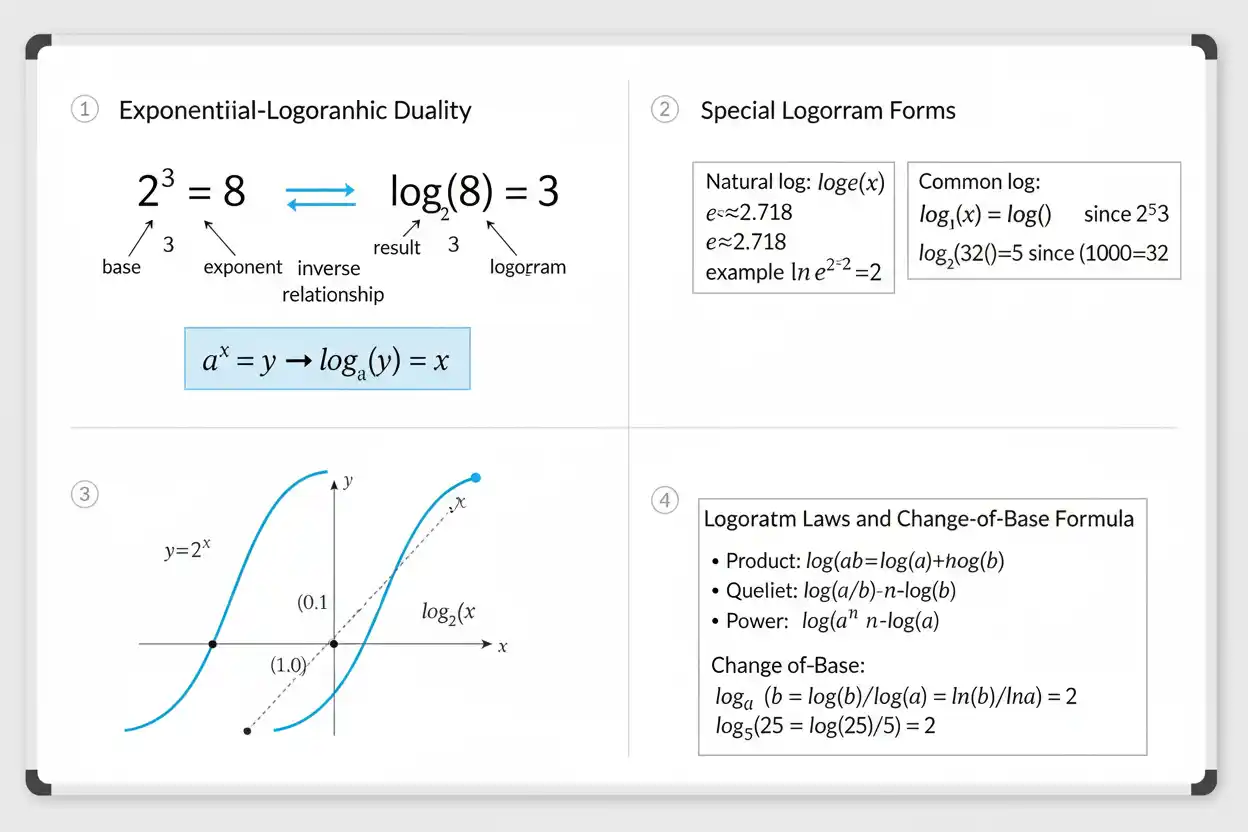

Logarithms answer a fundamental question: what exponent must a base be raised to in order to produce a given number?
For example:
2³ = 8
so:
log₂(8) = 3
Likewise:
10² = 100
so:
log₁₀(100) = 2
A logarithm is therefore the inverse operation of exponentiation.
The defining relationship is:
log_b(x) = y if and only if b^y = x
where:
b > 0
b ≠ 1
x > 0
The most common logarithm bases are base 10, base e, and base 2. Base-10 logarithms are often written log, natural logarithms are written ln, and base-2 logarithms appear frequently in computing and information theory.
What Is a Logarithm?
A logarithm converts an exponential relationship into an exponent.
Suppose:
5³ = 125
Then:
log₅(125) = 3
The base is:
5
The argument is:
125
The logarithm’s value is:
3
because 3 is the exponent needed on 5 to produce 125.
This direct inverse relationship connects logarithms with the rules of exponents.
Exponential Form and Logarithmic Form
The two equivalent forms are:
b^y = x
and:
log_b(x) = y
For example:
3⁴ = 81
is equivalent to:
log₃(81) = 4
Similarly:
10^-2 = 0.01
is equivalent to:
log₁₀(0.01) = -2
Converting between these forms is one of the most useful basic logarithm skills.
Conditions on a Real Logarithm
For an ordinary real logarithm:
log_b(x)
the base must satisfy:
b > 0
and:
b ≠ 1
The argument must satisfy:
x > 0
Therefore expressions such as:
log₂(8)
and:
ln(5)
are valid real logarithms.
But:
log₂(0)
and:
log₂(-4)
are not defined as real logarithms.
Why the Base Cannot Equal 1
Suppose:
b = 1
Then every power is:
1^y = 1
No exponent can produce values such as 2, 10, or 100.
Also, the output would not uniquely encode an exponent for the value 1.
Therefore:
base 1 is not a valid logarithm base
Why the Base Must Be Positive
Within real-number logarithms, a positive base ensures that:
b^x
is consistently defined as a positive real-valued exponential function for every real exponent x.
Negative bases create complications because many fractional exponents do not produce real values.
Therefore ordinary real logarithm bases satisfy:
b > 0
Why the Argument Must Be Positive
For any valid positive base:
b^y > 0
for every real y.
Therefore no real exponent produces:
0
or a negative value.
This is why:
log_b(x)
requires:
x > 0
Common Logarithm: log10
A base-10 logarithm is:
log₁₀(x)
It is commonly written simply as:
log(x)
when the context clearly uses base 10.
For example:
log(1000) = 3
because:
10³ = 1000
Similarly:
log(0.001) = -3
because:
10^-3 = 0.001
Powers of Ten and Common Logs
Common logarithms are especially simple for powers of ten.
log₁₀(10) = 1
log₁₀(100) = 2
log₁₀(1000) = 3
log₁₀(1) = 0
log₁₀(0.1) = -1
log₁₀(0.01) = -2
In general:
log₁₀(10^x) = x
This relationship is useful in scientific notation and orders-of-magnitude calculations.
Natural Logarithm: ln
The natural logarithm uses the base:
e ≈ 2.718281828…
It is written:
ln(x)
By definition:
ln(x) = log_e(x)
For example:
ln(e) = 1
because:
e¹ = e
Also:
ln(1) = 0
because:
e⁰ = 1
Natural logarithms are particularly important in exponential growth, calculus, continuous compounding, and differential equations.
Base-2 Logarithm
A base-2 logarithm is written:
log₂(x)
For example:
log₂(8) = 3
because:
2³ = 8
and:
log₂(32) = 5
because:
2⁵ = 32
Base 2 is especially natural when working with binary numbers because binary quantities are organized around powers of 2.
Logarithm of 1
For every valid logarithm base:
log_b(1) = 0
because:
b⁰ = 1
Examples:
log₂(1) = 0
log₁₀(1) = 0
ln(1) = 0
This identity follows directly from the zero-exponent rule.
Logarithm of the Base
For any valid base:
log_b(b) = 1
because:
b¹ = b
Examples:
log₂(2) = 1
log₅(5) = 1
log₁₀(10) = 1
ln(e) = 1
Logarithm of a Power of Its Base
The general identity is:
log_b(b^x) = x
For example:
log₃(3⁷) = 7
Similarly:
log₁₀(10^-4) = -4
This expresses the inverse relationship between logarithms and exponentiation.
Exponentiating a Logarithm
The reverse identity is:
b^(log_b(x)) = x
for:
x > 0
For example:
2^(log₂(7)) = 7
and:
e^(ln 5) = 5
These inverse identities are central to solving logarithmic and exponential equations.
Product Rule for Logarithms
For positive M and N:
log_b(MN) = log_b(M) + log_b(N)
Example:
log₁₀(100 × 1000)
Using the product rule:
log(100) + log(1000)
= 2 + 3
= 5
And:
100 × 1000 = 100000
so:
log(100000) = 5
The rule converts multiplication into addition.
Why the Product Rule Works
Let:
log_b(M) = m
and:
log_b(N) = n
Then:
M = b^m
and:
N = b^n
Multiply:
MN = b^m × b^n
Using exponent rules:
MN = b^(m+n)
Therefore:
log_b(MN) = m + n
So:
log_b(MN) = log_b(M) + log_b(N)
Quotient Rule
For positive M and N:
log_b(M/N) = log_b(M) – log_b(N)
For example:
log₁₀(1000/10)
Use:
log(1000) – log(10)
= 3 – 1
= 2
And:
1000/10 = 100
so:
log(100) = 2
The quotient rule converts division into subtraction.
Power Rule
For positive M:
log_b(M^k) = k log_b(M)
For example:
log₂(8²)
Since:
8 = 2³
we know:
8² = 2⁶
so:
log₂(8²) = 6
Using the power rule:
2 log₂(8)
= 2 × 3
= 6
The exponent moves in front as a multiplier.
Root Rule
Because a root can be represented by a fractional exponent:
ⁿ√M = M^(1/n)
the power rule gives:
log_b(ⁿ√M) = (1/n)log_b(M)
For example:
log₁₀(√100)
Since:
√100 = 10
the answer is:
1
Using the rule:
(1/2)log₁₀(100)
= (1/2)(2)
= 1
Logarithms Do Not Distribute Over Addition
A major mistake is assuming:
log(M + N) = log(M) + log(N)
This is false.
For example:
log₁₀(10 + 90)
= log₁₀(100)
= 2
But:
log₁₀(10) + log₁₀(90)
is not 2.
The product rule applies to multiplication:
log(MN)
not addition.
Logarithms Do Not Distribute Over Subtraction
Similarly:
log(M – N)
cannot generally be rewritten as:
log(M) – log(N)
The subtraction form corresponds to a quotient:
log(M/N)
not a difference inside the argument.
Change-of-Base Formula
A logarithm in any valid base can be rewritten using another base.
The formula is:
log_b(x) = log_k(x) / log_k(b)
where k is any valid logarithm base.
Commonly:
log_b(x) = ln(x) / ln(b)
or:
log_b(x) = log₁₀(x) / log₁₀(b)
This is useful when a calculator provides only ln and log.
Example: Calculate log₂(10)
Use natural logarithms:
log₂(10) = ln(10)/ln(2)
Using approximate values:
ln(10) ≈ 2.302585
ln(2) ≈ 0.693147
Therefore:
log₂(10) ≈ 3.321928
This makes sense because:
2³ = 8
and:
2⁴ = 16
so the required exponent must lie between 3 and 4.
Example: Calculate log₅(100)
Use:
log₅(100) = ln(100)/ln(5)
Approximate:
ln(100) ≈ 4.605170
ln(5) ≈ 1.609438
Therefore:
log₅(100) ≈ 2.861353
Check the range:
5² = 25
5³ = 125
So the exponent should indeed be between 2 and 3.
Solving a Basic Logarithmic Equation
Solve:
log₂(x) = 5
Convert to exponential form:
2⁵ = x
Therefore:
x = 32
This is the most direct kind of logarithmic equation.
Solve log₃(x) = 4
Convert:
x = 3⁴
Calculate:
x = 81
Therefore:
x = 81
Solve log₁₀(x) = -2
Convert:
x = 10^-2
Therefore:
x = 0.01
A negative logarithm does not mean the argument is negative. It means the positive argument lies between 0 and 1 when the base is greater than 1.
Logarithms of Numbers Between 0 and 1
For:
b > 1
if:
0 < x < 1
then:
log_b(x) < 0
For example:
log₁₀(0.1) = -1
and:
log₂(1/8) = -3
because:
2^-3 = 1/8
Negative logarithm values therefore naturally correspond to negative exponents.
Logarithms Greater Than Zero
For:
b > 1
if:
x > 1
then:
log_b(x) > 0
For example:
log₂(16) = 4
and:
log₁₀(500) > 0
because both arguments exceed 1.
Bases Between 0 and 1
A valid logarithm base may also satisfy:
0 < b < 1
For example:
b = 1/2
Then:
log_(1/2)(8) = -3
because:
(1/2)^-3 = 8
For such bases, the logarithmic function decreases rather than increases.
The basic inverse definition still applies.
Solving Exponential Equations With Logarithms
Logarithms become especially useful when an unknown appears in an exponent.
Suppose:
2^x = 10
There is no obvious integer exponent.
Take the natural logarithm:
ln(2^x) = ln(10)
Apply the power rule:
x ln(2) = ln(10)
Therefore:
x = ln(10)/ln(2)
x ≈ 3.321928
The separate exponential equation page focuses on equations of this type in greater depth.
Example: Solve 5^x = 200
Take natural logs:
ln(5^x) = ln(200)
Use the power rule:
x ln(5) = ln(200)
Therefore:
x = ln(200)/ln(5)
Approximate:
ln(200) ≈ 5.298317
ln(5) ≈ 1.609438
So:
x ≈ 3.291
Check:
5³ = 125
5⁴ = 625
so the exponent should lie between 3 and 4.
Solving a Log Equation With an Expression
Solve:
log₂(x – 1) = 3
Convert:
x – 1 = 2³
x – 1 = 8
Therefore:
x = 9
Check the domain:
x – 1 > 0
For:
x = 9
the argument is:
8
which is positive.
Therefore:
x = 9
Domain Checks Matter
Suppose an algebraic solution produces:
x = -2
for an equation containing:
log(x)
That value cannot be accepted in the real-number setting because:
x > 0
is required.
Every logarithmic equation should therefore be checked against the positivity of each logarithm argument.
Expanding Logarithmic Expressions
Use logarithm laws to expand:
log_b(x²y/z)
Assuming all required quantities are positive:
Apply the quotient rule:
log_b(x²y) – log_b(z)
Then the product rule:
log_b(x²) + log_b(y) – log_b(z)
Then the power rule:
2log_b(x) + log_b(y) – log_b(z)
This converts products, quotients, and powers into sums, differences, and coefficients.
Condensing Logarithmic Expressions
Reverse the rules.
Consider:
2log_b(x) + log_b(y) – log_b(z)
Move the coefficient into an exponent:
log_b(x²) + log_b(y) – log_b(z)
Combine addition:
log_b(x²y) – log_b(z)
Then combine subtraction:
log_b(x²y/z)
Condensing can simplify equations or reveal the structure of a logarithmic expression.
Natural Logarithm and Exponential Growth
Suppose:
A = A₀e^(kt)
If A, A₀, and k are known and t is unknown:
A/A₀ = e^(kt)
Take natural logarithms:
ln(A/A₀) = kt
Therefore:
t = ln(A/A₀)/k
Natural logarithms are particularly convenient because they directly invert powers of e.
Logarithms and Geometric Sequences
A geometric sequence has:
aₙ = a₁r^(n-1)
If the term value is known and you need the index n, logarithms can isolate the exponent.
Suppose:
a₁ = 5
r = 2
and:
aₙ = 500
Then:
500 = 5 × 2^(n-1)
Divide:
100 = 2^(n-1)
Take logs:
n – 1 = log₂(100)
Therefore:
n = 1 + log₂(100)
Since this is not an integer, 500 does not occur exactly at an integer position in that geometric sequence.
Logarithms and Scientific Notation
A positive number written in scientific notation has the form:
N = a × 10^n
with:
1 ≤ a < 10
Taking a base-10 logarithm:
log₁₀(N) = log₁₀(a) + n
This separates the logarithm into a decimal part and an integer power-of-ten component.
For example:
N = 3.2 × 10⁵
Then:
log₁₀(N) = log₁₀(3.2) + 5
Since:
log₁₀(3.2) ≈ 0.50515
we get:
log₁₀(N) ≈ 5.50515
Logarithms and Orders of Magnitude
Base-10 logarithms make multiplicative scale differences easy to compare.
For example:
10³ = 1,000
10⁶ = 1,000,000
The logarithms are:
3 and 6
The second number is therefore:
10^(6-3) = 10³
or:
1,000 times
the first.
Logarithms turn multiplicative ratios into additive differences.
Logarithms in Information Theory
The entropy of a discrete distribution commonly uses:
H(X) = -Σ p(x)log₂(p(x))
The base-2 logarithm measures information in bits.
For an event with probability:
p = 1/8
its self-information is:
-log₂(1/8)
Since:
1/8 = 2^-3
we get:
-(-3) = 3 bits
The logarithm converts probability scale into an additive information measure.
Why Logarithms Make Multiplication Additive
Suppose:
M = b^m
and:
N = b^n
Then:
MN = b^(m+n)
Taking logarithms gives:
log_b(MN) = m+n
But:
m = log_b(M)
and:
n = log_b(N)
Therefore:
log_b(MN) = log_b(M) + log_b(N)
This transformation is why logarithms historically made large multiplication and division problems easier to manage.
Logarithms and Binary Scale
Because:
log₂(2^n) = n
base-2 logarithms naturally measure how many binary powers are needed to reach a value.
For example:
log₂(1024) = 10
because:
2¹⁰ = 1024
This relationship appears frequently alongside binary numbers and digital quantities.
Logarithms and Irrational Numbers
A logarithm can be rational or irrational depending on its inputs.
For example:
log₂(8) = 3
which is rational.
But:
log₂(10) ≈ 3.321928…
is irrational.
The dedicated irrational numbers page focuses on whether a real value can be expressed as a ratio of integers; logarithms focus instead on finding exponents.
Logarithms and Rational Numbers
A logarithm’s argument may be a rational number.
For example:
log₂(1/8) = -3
The argument 1/8 is rational, and the logarithm happens to be an integer.
But a rational argument does not guarantee a rational logarithm.
For example:
log₂(3)
is irrational.
The classifications of the input and output are separate questions.
Logarithms and Real Numbers
Within ordinary real logarithms, the argument belongs to the positive portion of the real numbers:
x > 0
The function:
log_b(x)
then produces a real output for every valid positive x.
For bases greater than 1, the output ranges across all real numbers as the argument moves from values near zero through arbitrarily large positive values.
Logarithm Graph
For:
y = log_b(x)
the graph has several key features.
It passes through:
(1,0)
because:
log_b(1) = 0
It also passes through:
(b,1)
because:
log_b(b) = 1
The vertical line:
x = 0
acts as an asymptote in the real-number graph because logarithms are not defined for:
x ≤ 0
When:
b > 1
the graph increases.
When:
0 < b < 1
the graph decreases.
Logarithms Are Inverses of Exponential Functions
If:
f(x) = b^x
then its inverse is:
f^-1(x) = log_b(x)
Their graphs are reflections across:
y = x
For example:
y = 2^x
and:
y = log₂(x)
are inverse functions.
This is why applying one after the other returns the original permitted value.
Order of Operations With Logarithms
Logarithms are functions, so the expression inside the logarithm must be interpreted correctly.
Consider:
log₂(4 × 8)
Evaluate the argument:
4 × 8 = 32
Then:
log₂(32) = 5
Alternatively use the product rule:
log₂(4) + log₂(8)
= 2 + 3
= 5
The standard order of operations still governs the arithmetic inside logarithm arguments.
Logarithms and Long Division
long division and logarithms solve different kinds of problems.
Long division determines quotients directly, while a logarithm determines an exponent.
However, division appears inside the change-of-base formula:
log_b(x) = ln(x)/ln(b)
If a numerical approximation is needed, the quotient of the two logarithm values must be calculated accurately.
The long-division method itself is not a logarithm rule.
Logarithms and Least Common Multiple
The least common multiple is an integer-divisibility concept, while logarithms concern exponents.
For example:
LCM(12,18) = 36
is found through multiples, prime factors, or GCF relationships.
By contrast:
log₂(32) = 5
asks which exponent of 2 equals 32.
Both are mathematical tools, but they solve different problem classes and should not be substituted for one another.
LCM and Logarithms Have Different Domains
The shorter LCM page deals with the smallest positive common multiple of integers.
A logarithm such as:
ln(7)
does not answer a divisibility question.
Likewise, an LCM calculation does not invert an exponential relationship.
Keeping those roles distinct prevents formula-selection errors.
Lattice Points and Logarithms
Lattice points require integer coordinates.
A point such as:
(log₂8, 5)
simplifies to:
(3,5)
and therefore is a lattice point.
But:
(log₂10,5)
is not, because:
log₂10 ≈ 3.321928
is not an integer.
The logarithm determines the coordinate value; lattice-point classification then asks whether that value is an integer.
Common Logarithm Mistake: Confusing Base and Argument
In:
log₂(8) = 3
the base is:
2
the argument is:
8
and the result is:
3
This means:
2³ = 8
It does not mean:
8³ = 2
Common Mistake: Forgetting the Base
Expressions such as:
log(x)
may depend on context.
In many elementary and scientific contexts:
log(x)
means:
log₁₀(x)
while:
ln(x)
always means:
log_e(x)
When a base other than 10 or e matters, it should be specified explicitly:
log₂(x)
log₅(x)
Common Mistake: log(a + b)
The product law:
log(ab) = log(a) + log(b)
does not imply:
log(a+b) = log(a)+log(b)
For example:
log₁₀(1+9)
= log₁₀(10)
= 1
But:
log₁₀(1) + log₁₀(9)
= 0 + log₁₀(9)
which is not 1.
Common Mistake: log(a – b)
Similarly:
log(a-b)
cannot generally be separated.
The valid quotient law is:
log(a/b) = log(a) – log(b)
The operations inside the logarithm determine which identities apply.
Common Mistake: Dropping the Power Coefficient
For:
log_b(x³)
the correct rule is:
3log_b(x)
not:
log_b(x)³
and not:
log_b(3x)
The exponent becomes a multiplier outside the logarithm.
Common Mistake: Allowing Zero or Negative Arguments
For real logarithms:
log_b(0)
is undefined.
Likewise:
log_b(-5)
is not a real number.
If solving an equation produces a candidate that makes a logarithm argument zero or negative, that candidate must be rejected in the real-number setting.
Common Mistake: Treating ln and log as Identical Bases
ln means:
base e
while common log often means:
base 10
For example:
ln(10) ≈ 2.302585
but:
log₁₀(10) = 1
The functions are related through change of base, but their numerical values generally differ.
How to Estimate a Logarithm
Suppose you need:
log₂(20)
Recognize:
2⁴ = 16
2⁵ = 32
Since:
16 < 20 < 32
we know:
4 < log₂(20) < 5
A calculator gives approximately:
log₂(20) ≈ 4.321928
The power comparison provides a useful reasonableness check.
How to Check a Logarithm Answer
Suppose:
log₃(243) = 5
Check by exponentiating:
3⁵ = 243
The equality holds.
For an approximate result such as:
log₂(10) ≈ 3.321928
check:
2^3.321928 ≈ 10
Reversing the logarithm through exponentiation is the most direct verification.
Frequently Asked Questions
What is a logarithm?
A logarithm tells you the exponent required on a base to produce a particular positive number.
What is the main logarithm formula?
log_b(x) = y if and only if b^y = x
What is log10?
log10 is the base-10 logarithm:
log₁₀(x)
It is often written simply as:
log(x)
What is ln?
ln(x) is the natural logarithm:
ln(x) = log_e(x)
where:
e ≈ 2.71828
What is log₂(8)?
3
because:
2³ = 8
What is log₁₀(1000)?
3
because:
10³ = 1000
What is ln(e)?
1
because:
e¹ = e
What is log_b(1)?
0
for every valid base b, because:
b⁰ = 1
Can a logarithm have a negative result?
Yes.
For example:
log₁₀(0.01) = -2
Can the argument of a real logarithm be negative?
No. For real logarithms:
x > 0
What is the product rule?
log_b(MN) = log_b(M) + log_b(N)
What is the quotient rule?
log_b(M/N) = log_b(M) – log_b(N)
What is the power rule?
log_b(M^k) = klog_b(M)
What is the change-of-base formula?
log_b(x) = ln(x)/ln(b)
or:
log_b(x) = log₁₀(x)/log₁₀(b)
Why are logarithms useful?
They invert exponentiation, solve exponential equations, transform multiplication into addition, compare multiplicative scales, and appear in information theory, scientific measurement, growth models, and many other mathematical applications.
Final Example
Solve:
3^(2x – 1) = 50
Take natural logarithms:
ln(3^(2x – 1)) = ln(50)
Apply the power rule:
(2x – 1)ln(3) = ln(50)
Divide by ln(3):
2x – 1 = ln(50)/ln(3)
Therefore:
2x = 1 + ln(50)/ln(3)
and:
x = [1 + ln(50)/ln(3)] / 2
Using approximate values:
ln(50) ≈ 3.912023
ln(3) ≈ 1.098612
So:
ln(50)/ln(3) ≈ 3.560877
Then:
x ≈ (1 + 3.560877)/2
x ≈ 2.280439
Therefore:
x ≈ 2.2804
Check:
2x – 1 ≈ 3.5609
and:
3^3.5609 ≈ 50
The defining idea behind logarithms remains:
log_b(x) = y ⇔ b^y = x
Once that inverse relationship is clear, base-10 logs, natural logs, change of base, logarithm laws, and exponential equations all follow from the same structure.