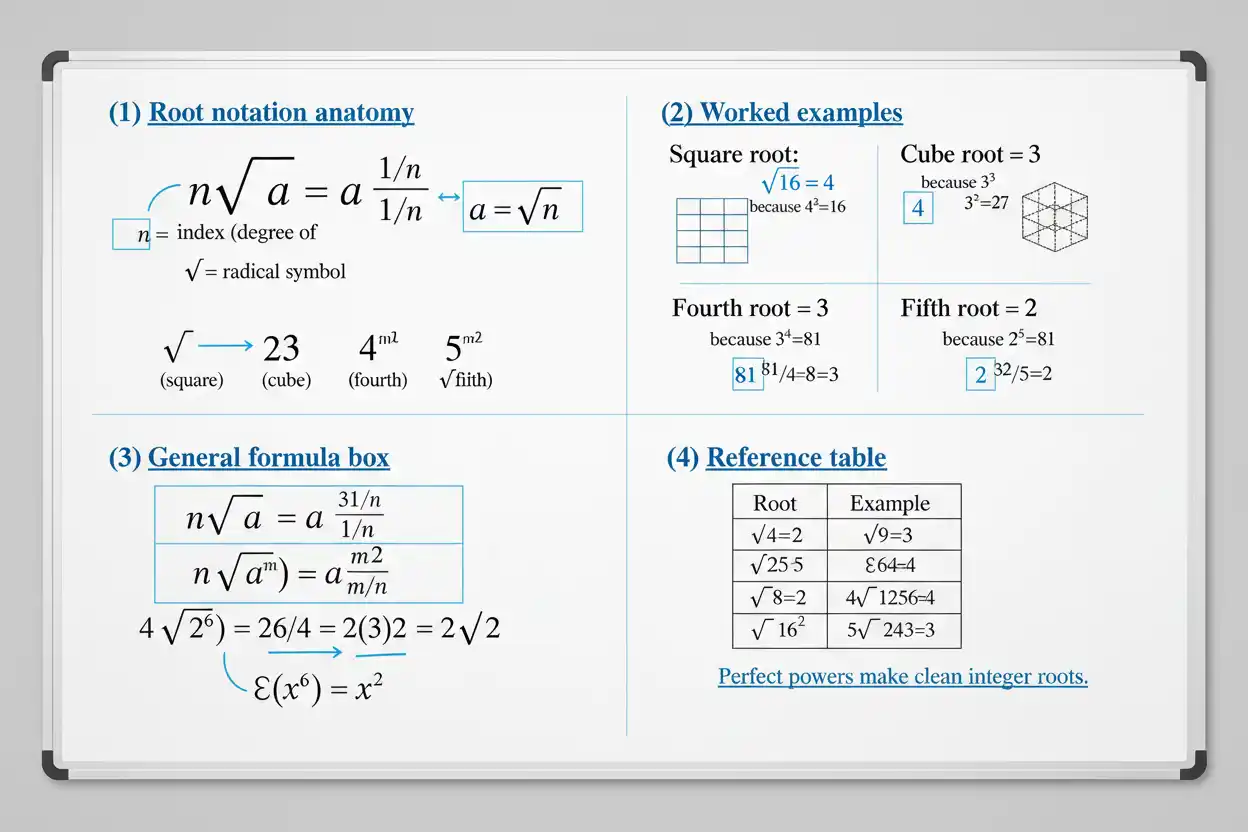

Nth roots generalize square roots and cube roots. The nth root of a number a is a value that produces a when raised to the nth power.
The defining relationship is:
xⁿ = a
if and only if:
x = ⁿ√a
For example:
3⁴ = 81
so:
⁴√81 = 3
Likewise:
2⁵ = 32
so:
⁵√32 = 2
Nth roots can also be written using fractional exponents:
ⁿ√a = a^(1/n)
This connection makes nth roots part of the same mathematical structure as exponents.
What Is an Nth Root?
For positive integer n, an nth root of a is a number x satisfying:
xⁿ = a
The value n is called the index or degree of the root.
Examples:
For:
n = 2
we have a square root.
For:
n = 3
we have a cube root.
For:
n = 4
we have a fourth root.
For:
n = 5
we have a fifth root.
The general notation:
ⁿ√a
allows the same idea to be extended to any positive integer root index.
Nth Root Formula
The basic conversion between radical and exponent notation is:
ⁿ√a = a^(1/n)
For example:
⁴√16 = 16^(1/4)
Since:
2⁴ = 16
we get:
⁴√16 = 2
Similarly:
³√125 = 125^(1/3)
and because:
5³ = 125
we obtain:
∛125 = 5
Nth Powers and Nth Roots Are Inverse Operations
Exponentiation and root extraction reverse each other under appropriate domain conditions.
If:
xⁿ = a
then:
ⁿ√a = x
For example:
7³ = 343
so:
∛343 = 7
And:
4⁵ = 1,024
so:
⁵√1024 = 4
This inverse relationship is the central idea behind nth roots.
Square Roots as Second Roots
A square root is simply an nth root with:
n = 2
The index 2 is normally omitted:
²√a = √a
For example:
√49 = 7
because:
7² = 49
The number 49 is a perfect square, so its principal square root is an integer.
Cube Roots as Third Roots
A cube root has:
n = 3
For example:
∛64 = 4
because:
4³ = 64
Likewise:
∛(-27) = -3
because:
(-3)³ = -27
The detailed third-root calculations belong to cube roots, while nth roots provide the general rule that includes every root degree.
Fourth Root Example
Find:
⁴√81
We need a number whose fourth power equals 81.
Since:
3⁴ = 81
we have:
⁴√81 = 3
In fractional-exponent notation:
81^(1/4) = 3
Fifth Root Example
Find:
⁵√243
Since:
3⁵ = 243
we obtain:
⁵√243 = 3
The index tells us exactly which power must be reversed.
Even vs. Odd Nth Roots
The parity of the root index matters greatly in real-number arithmetic.
For an odd index, positive and negative radicands can both have real roots.
For example:
∛(-8) = -2
and:
⁵√(-32) = -2
because odd powers preserve the sign.
For an even index, a negative radicand does not have a real nth root.
For example:
√(-4)
and:
⁴√(-16)
are not real numbers.
Within the real numbers, even roots therefore require nonnegative radicands.
Why Odd Roots Can Be Negative
Consider:
(-2)³ = -8
and:
(-2)⁵ = -32
Odd powers of negative numbers remain negative.
Therefore:
∛(-8) = -2
and:
⁵√(-32) = -2
The sign passes naturally through odd roots.
Why Even Roots of Negative Numbers Are Not Real
For every real number x:
x² ≥ 0
Likewise, any positive even power satisfies:
x^(2k) ≥ 0
Therefore there is no real x satisfying:
x⁴ = -16
So:
⁴√(-16)
has no real value.
Complex-number methods can extend the idea further, but they lie outside the ordinary real-number nth-root rules used here.
Principal Nth Root
For an even root of a nonnegative real number, radical notation refers to the principal nonnegative root.
For example:
√25 = 5
not:
±5
Both:
5² = 25
and:
(-5)² = 25
but the radical:
√25
specifically means:
5
If solving:
x² = 25
then the equation has two real solutions:
x = ±5
This distinction between a radical value and an equation’s solutions is essential.
Principal Fourth Root
Similarly:
⁴√16 = 2
because 2 is the nonnegative fourth root.
The equation:
x⁴ = 16
has real solutions:
x = 2
and:
x = -2
because:
(-2)⁴ = 16
But the radical itself remains:
⁴√16 = 2
Nth Roots and Fractional Exponents
Radicals can be rewritten as fractional powers:
ⁿ√a = a^(1/n)
More generally:
ⁿ√(a^m) = a^(m/n)
where the required domain conditions are satisfied.
For example:
³√(2²) = 2^(2/3)
and:
⁴√(5³) = 5^(3/4)
This notation is especially useful when combining roots with exponent rules.
Example: 27^(2/3)
Evaluate:
27^(2/3)
One method is to take the cube root first:
27^(1/3) = 3
Then square:
3² = 9
Therefore:
27^(2/3) = 9
Equivalently:
³√(27²) = 9
Example: 16^(3/4)
Take the fourth root:
16^(1/4) = 2
Then cube:
2³ = 8
Therefore:
16^(3/4) = 8
Product Rule for Nth Roots
When the relevant real roots are defined:
ⁿ√(ab) = ⁿ√a × ⁿ√b
For example:
√(9 × 5)
can be written:
√9 × √5
= 3√5
So:
√45 = 3√5
For an odd root:
∛(8 × 7)
= ∛8 × ∛7
= 2∛7
Quotient Rule for Nth Roots
When the denominator is valid:
ⁿ√(a/b) = ⁿ√a / ⁿ√b
For example:
√(25/49)
= √25 / √49
= 5/7
Therefore:
√(25/49) = 5/7
The denominator must not create an undefined expression.
Root of a Power
For odd n:
ⁿ√(aⁿ) = a
for real a.
For example:
∛((-4)³) = -4
For even n, the principal-root rule gives:
ⁿ√(aⁿ) = |a|
For example:
√((-5)²)
= √25
= 5
not -5.
Likewise:
⁴√((-3)⁴) = 3
The absolute value is required because an even-index principal root is nonnegative.
Power of an Nth Root
For an appropriate real radicand:
(ⁿ√a)ⁿ = a
For example:
(∛11)³ = 11
and:
(⁴√81)⁴ = 81
This expresses the inverse relationship in the opposite direction.
Simplifying Nth Roots
Nth roots can often be simplified by factoring out perfect nth powers.
Consider:
³√54
Factor:
54 = 27 × 2
Since:
27 = 3³
we get:
∛54 = ∛27 × ∛2
= 3∛2
Therefore:
∛54 = 3∛2
Simplifying a Fourth Root
Simplify:
⁴√162
Factor:
162 = 81 × 2
Since:
81 = 3⁴
we obtain:
⁴√162 = ⁴√81 × ⁴√2
= 3⁴√2
Therefore:
⁴√162 = 3⁴√2
Prime Factorization Method
Prime factorization provides a systematic way to simplify nth roots.
Consider:
³√432
Factor:
432 = 2⁴ × 3³
Separate complete groups of three equal prime factors:
2⁴ = 2³ × 2
So:
432 = 2³ × 3³ × 2
Take the cube root:
∛432 = 2 × 3 × ∛2
Therefore:
∛432 = 6∛2
General Prime-Exponent Rule
Suppose:
a = p₁^e₁ × p₂^e₂ × …
To simplify:
ⁿ√a
split each exponent into:
e = nq + r
where:
0 ≤ r < n
Then:
p^e = p^(nq+r)
= (p^q)^n × p^r
and:
ⁿ√(p^e) = p^q × ⁿ√(p^r)
This is the systematic reason complete groups of n prime factors can leave the radical.
Perfect Nth Powers
A number is a perfect nth power if it can be expressed as:
kⁿ
for an integer k.
Examples of perfect fourth powers include:
1 = 1⁴
16 = 2⁴
81 = 3⁴
256 = 4⁴
625 = 5⁴
Therefore:
⁴√256 = 4
A perfect nth power has an integer nth root.
Perfect Cubes as a Special Case
The perfect cubes include:
1, 8, 27, 64, 125, 216, …
because they are:
1³, 2³, 3³, 4³, 5³, 6³, …
Thus:
∛216 = 6
Perfect cubes are simply perfect nth powers with:
n = 3
Nth Roots That Are Irrational
If an integer radicand is not an exact nth power after simplification, its nth root may be irrational.
For example:
√2
is irrational.
Likewise:
∛2
and:
⁴√3
are irrational.
These values cannot be written exactly as ratios of integers.
The distinction is developed further under irrational numbers.
Rational Nth Roots
Some fractions have rational nth roots.
For example:
√(9/16)
= 3/4
because both numerator and denominator are perfect squares.
Similarly:
∛(8/125)
= 2/5
because:
∛8 = 2
and:
∛125 = 5
Therefore:
∛(8/125) = 2/5
Nth Roots of Fractions
If the relevant roots are defined:
ⁿ√(a/b) = ⁿ√a / ⁿ√b
For example:
⁴√(16/81)
= ⁴√16 / ⁴√81
= 2/3
Therefore:
⁴√(16/81) = 2/3
The result is a rational number.
Decimal Nth Roots
Nth roots do not have to produce integers or simple fractions.
For example:
⁴√10 ≈ 1.77828
because:
1.77828⁴ ≈ 10
The decimal is an approximation to the exact value:
⁴√10
When the exact radical form is useful, it should be preserved rather than prematurely rounded.
Estimating an Nth Root
Suppose you need:
³√50
Nearby perfect cubes are:
3³ = 27
4³ = 64
Therefore:
3 < ∛50 < 4
Since 50 is closer to 64 than 27, the root should be closer to 4 than 3.
Numerically:
∛50 ≈ 3.684
The bounding powers provide a useful reasonableness check.
Estimating a Fourth Root
Consider:
⁴√100
Nearby fourth powers are:
3⁴ = 81
4⁴ = 256
Therefore:
3 < ⁴√100 < 4
Since 100 is only moderately above 81:
⁴√100 ≈ 3.1623
Solving xⁿ = a
To solve a basic power equation:
xⁿ = a
take the nth root.
If n is odd:
x = ⁿ√a
For example:
x³ = 125
gives:
x = 5
If n is even and a > 0, the real equation generally has:
x = ±ⁿ√a
For example:
x⁴ = 81
gives:
x = ±3
because:
3⁴ = 81
and:
(-3)⁴ = 81
Equation vs. Principal Root
This distinction is worth emphasizing.
The expression:
⁴√81
equals:
3
But the equation:
x⁴ = 81
has two real solutions:
x = 3
and:
x = -3
The radical symbol gives the principal root; solving the equation requires finding every value satisfying the power relationship.
Nth Roots and Order of Operations
Expressions containing roots follow the standard order of operations.
Consider:
3 + √16 × 2
Evaluate the root:
√16 = 4
Then multiply:
4 × 2 = 8
Then add:
3 + 8 = 11
Therefore:
3 + √16 × 2 = 11
The expression should not be interpreted as:
√(16 × 2 + 3)
unless grouping symbols explicitly place those terms inside the radical.
Parentheses Inside Nth Roots
Consider:
∛(8 + 19)
Evaluate inside the radical:
8 + 19 = 27
Then:
∛27 = 3
Therefore:
∛(8 + 19) = 3
Compare with:
∛8 + 19
which equals:
2 + 19
= 21
Grouping changes the result.
Nth Roots and Multiples
The mapped multiples concept can help recognize perfect powers, but being a multiple is not enough to guarantee an exact nth root.
For example:
64
is a multiple of 8 and is also a perfect cube:
64 = 4³
So:
∛64 = 4
But:
40
is also a multiple of 8:
40 = 8 × 5
yet:
∛40
is not an integer.
Nth-root structure depends on power factorization rather than ordinary multiplicity alone.
Nth Roots in Number Sequences
Numerical sequences may be generated using nth-root operations.
For example:
1, √4, ∛27, ⁴√256, …
simplifies to:
1, 2, 3, 4, …
because each radicand is chosen as the corresponding perfect power.
Conversely, sequences of perfect powers:
1, 16, 81, 256, …
can be transformed by fourth roots into:
1, 2, 3, 4, …
The root operation changes the values but does not itself define a standard sequence family unless a consistent generation rule is specified.
Nth Roots and Modular Arithmetic
Ordinary modular arithmetic reduces integers by remainder classes.
A modular-root problem asks for values such as:
x² ≡ a (mod n)
or more generally:
x^k ≡ a (mod n)
This is different from ordinary real nth-root extraction.
For example:
x² ≡ 1 (mod 8)
has several modular solutions:
x ≡ 1,3,5,7 (mod 8)
while the ordinary real equation:
x² = 1
has only:
x = ±1
The domain changes the meaning of “root.”
Nth Roots and Modular Inverse
A modular inverse solves:
ax ≡ 1 (mod n)
This should not be confused with an nth root.
A root reverses exponentiation:
xⁿ = a
A modular inverse reverses multiplication within a congruence:
ax ≡ 1 (mod n)
For example:
∛8 = 2
but:
3⁻¹ ≡ 5 (mod 7)
These are entirely different inverse relationships.
Nth Roots and Exponent Laws
Because:
ⁿ√a = a^(1/n)
the laws of exponents apply naturally.
For example:
⁴√(x⁸)
may be represented as:
(x⁸)^(1/4)
= x^(8/4)
= x²
for real x.
Likewise:
³√(x⁶) = x²
The details require appropriate sign and domain care, especially for even root indices.
Nested Roots
A root of a root can often be combined through fractional exponents.
For positive a:
√(∛a)
becomes:
(a^(1/3))^(1/2)
Multiply exponents:
a^(1/6)
Therefore:
√(∛a) = ⁶√a
for the relevant real domain.
More generally:
ᵐ√(ⁿ√a) = ᵐⁿ√a
under appropriate conditions.
Example of Nested Roots
Evaluate:
√(∛64)
First:
∛64 = 4
Then:
√4 = 2
Using the combined rule:
⁶√64
Since:
2⁶ = 64
we also get:
2
Therefore:
√(∛64) = 2
Common Mistake: Forgetting the Principal Root
The expression:
√36
equals:
6
not:
±6
The notation ±6 appears when solving:
x² = 36
The same distinction applies to higher even roots.
Common Mistake: Applying ⁿ√(a+b) Separately
In general:
ⁿ√(a+b) ≠ ⁿ√a + ⁿ√b
For example:
√(9+16)
= √25
= 5
But:
√9 + √16
= 3 + 4
= 7
Therefore roots do not distribute over addition.
Common Mistake: Applying Roots Separately Over Subtraction
Likewise:
√(a-b)
cannot generally be rewritten as:
√a – √b
For example:
√(25-9)
= √16
= 4
while:
√25 – √9
= 5 – 3
= 2
The two expressions differ.
Common Mistake: Treating Negative Even Roots as Real
The expression:
⁴√(-16)
does not have a real value.
The fact that:
(-2)⁴ = 16
does not help because even powers eliminate the negative sign.
Odd roots, by contrast, can accept negative radicands.
Common Mistake: Confusing ⁴√16 With 16/4
A fourth root is not ordinary division.
⁴√16 = 2
because:
2⁴ = 16
But:
16/4 = 4
The root index describes an exponent relationship, not a divisor.
How to Check an Nth Root
Suppose:
⁵√243 = 3
Raise the answer to the fifth power:
3⁵ = 243
The original radicand is recovered.
For an approximate value such as:
³√10 ≈ 2.1544
check:
2.1544³ ≈ 10
Re-exponentiating is the most direct verification.
Frequently Asked Questions
What is an nth root?
The nth root of a is a number that produces a when raised to the nth power.
What is the nth-root formula?
ⁿ√a = a^(1/n)
What is the fourth root of 81?
3
because:
3⁴ = 81
What is the fifth root of 32?
2
because:
2⁵ = 32
Is a square root an nth root?
Yes. A square root is the case:
n = 2
Is a cube root an nth root?
Yes. A cube root is the case:
n = 3
Can an odd root have a negative radicand?
Yes.
For example:
∛(-27) = -3
Can an even root of a negative number be real?
No, not in the ordinary real-number system.
What is ⁴√16?
2
Does ⁴√16 equal ±2?
The radical itself equals 2. The equation:
x⁴ = 16
has real solutions:
x = ±2
How do you simplify an nth root?
Factor out complete nth powers from the radicand.
Are nth roots the same as fractional exponents?
They are equivalent representations:
ⁿ√a = a^(1/n)
Final Example
Simplify:
⁴√1296
Prime-factorize:
1296 = 6⁴
You can verify:
6² = 36
6⁴ = 36²
= 1,296
Therefore:
⁴√1296 = 6
Now consider:
⁴√2592
Factor:
2592 = 1296 × 2
So:
⁴√2592 = ⁴√1296 × ⁴√2
= 6⁴√2
Therefore:
⁴√2592 = 6⁴√2
The core nth-root relationship is:
xⁿ = a ⇔ x = ⁿ√a
with the radical interpreted according to its domain and principal-root conventions. Square roots, cube roots, fourth roots, and every higher root are all specific cases of this same inverse power relationship.