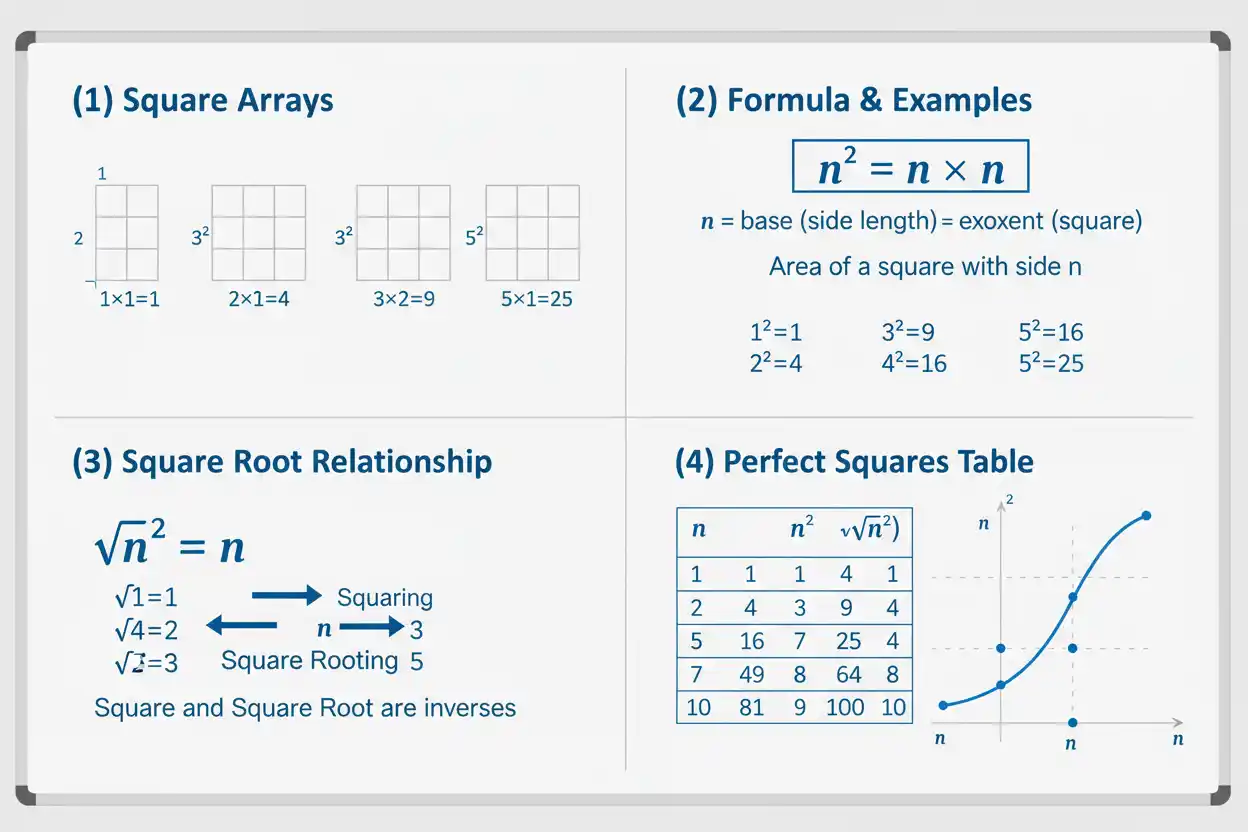
Perfect squares are numbers obtained by multiplying an integer by itself.
The defining formula is:
S = n² = n × n
For example:
7² = 7 × 7
= 49
Therefore:
49 is a perfect square
because its principal square root is the integer:
√49 = 7
The nonnegative perfect squares begin:
0, 1, 4, 9, 16, 25, 36, 49, 64, 81, 100, …
Perfect squares appear throughout arithmetic, algebra, geometry, number theory, sequences, roots, factoring, and many other mathematical topics.
What Is a Perfect Square?
A nonnegative integer S is a perfect square if there is an integer n such that:
S = n²
Since:
(-n)² = n²
positive and negative integers with the same magnitude generate the same square.
For example:
6² = 36
and:
(-6)² = 36
Therefore:
36 is a perfect square
Perfect Square Formula
The formula is:
n² = n × n
Examples:
2² = 4
5² = 25
10² = 100
25² = 625
The exponent 2 indicates two equal factors and follows the ordinary rules of exponents.
First Perfect Squares
| n | n² |
|---|---|
| 0 | 0 |
| 1 | 1 |
| 2 | 4 |
| 3 | 9 |
| 4 | 16 |
| 5 | 25 |
| 6 | 36 |
| 7 | 49 |
| 8 | 64 |
| 9 | 81 |
| 10 | 100 |
| 11 | 121 |
| 12 | 144 |
The sequence continues indefinitely.
Is 0 a Perfect Square?
Yes.
Since:
0² = 0
we have:
0 is a perfect square
Some lists begin with 1, but the standard nonnegative integer-square sequence includes zero.
Can a Perfect Square Be Negative?
No integer square is negative.
For every integer n:
n² ≥ 0
For example:
(-5)² = 25
not -25.
Therefore:
negative integers are not perfect squares of integers
This differs from perfect cubes, which may be negative because odd powers preserve sign.
Perfect Squares and Square Roots
If:
S = n²
then the principal square root satisfies:
√S = |n|
For a nonnegative integer index n, this is simply:
√(n²) = n
For example:
√144 = 12
because:
12² = 144
The detailed root calculations belong to square roots.
Principal Square Root vs. Equation Solutions
The expression:
√49
has the principal value:
7
But the equation:
x² = 49
has two solutions:
x = ±7
because both:
7² = 49
and:
(-7)² = 49
The radical symbol itself denotes the nonnegative square root.
How to Check Whether a Number Is a Perfect Square
A simple test is to find its exact square root.
For example:
√225 = 15
Since 15 is an integer:
225 is a perfect square
Now consider:
√200 ≈ 14.142
Since the square root is not an integer:
200 is not a perfect square
Prime Factorization Test
A positive integer is a perfect square exactly when every exponent in its prime factorization is even.
For example:
144 = 2⁴ × 3²
The exponents:
4 and 2
are both even.
Therefore:
144 is a perfect square
Indeed:
144 = (2² × 3)²
= 12²
Example: Is 900 a Perfect Square?
Prime-factorize:
900 = 2² × 3² × 5²
Every exponent equals:
2
and is therefore even.
Take half of each exponent:
√900 = 2 × 3 × 5
= 30
Therefore:
900 = 30²
and 900 is a perfect square.
Example: Is 180 a Perfect Square?
Prime-factorize:
180 = 2² × 3² × 5
The exponent of 5 is:
1
which is odd.
Therefore:
180 is not a perfect square
Its square root simplifies to:
√180 = √(36 × 5)
= 6√5
but it is not an integer.
General Prime-Exponent Rule
Suppose:
N = p₁^a₁p₂^a₂…pₖ^aₖ
Then:
N is a perfect square ⇔ every exponent aᵢ is even
For example:
2⁶ × 3⁴ × 7²
is a perfect square.
Its square root is:
2³ × 3² × 7
= 8 × 9 × 7
= 504
Why Prime Exponents Must Be Even
If:
n = p₁^b₁p₂^b₂…pₖ^bₖ
then:
n² = p₁^(2b₁)p₂^(2b₂)…pₖ^(2bₖ)
Every exponent has been doubled.
Therefore every prime exponent in a perfect square must be even.
Conversely, if every exponent is even, halving those exponents produces an integer square root.
Geometric Meaning of a Perfect Square
The name square comes directly from geometry.
A square with side length:
n
has area:
A = n²
For example, a square measuring:
8 units × 8 units
has area:
8² = 64
square units.
So 64 can be visualized as a square array containing:
8 rows × 8 columns
of unit squares.
Perfect Squares as Square Arrays
Consider:
1 = 1 × 1
4 = 2 × 2
9 = 3 × 3
16 = 4 × 4
25 = 5 × 5
Each value can be arranged into a square with the same number of rows and columns.
That geometric interpretation is why these numbers are called perfect squares.
Difference Between Consecutive Perfect Squares
Consecutive squares satisfy:
(n+1)² – n²
Expand:
n² + 2n + 1 – n²
Therefore:
(n+1)² – n² = 2n + 1
The difference between consecutive perfect squares is always an odd number.
For example:
6² = 36
7² = 49
Difference:
49 – 36 = 13
Formula:
2(6) + 1 = 13
Perfect Squares From Odd Numbers
The sequence:
1, 4, 9, 16, 25, 36, …
has consecutive differences:
3, 5, 7, 9, 11, …
The first square:
1
can be followed by successive odd-number additions:
1 + 3 = 4
4 + 5 = 9
9 + 7 = 16
16 + 9 = 25
This creates a powerful square-number identity.
Sum of the First n Odd Numbers
The sum of the first n positive odd integers equals:
n²
That is:
1 + 3 + 5 + … + (2n-1) = n²
For example:
1 + 3 + 5 + 7 + 9
= 25
and:
5² = 25
Therefore:
the sum of the first five odd numbers is 25
Example: Sum of First 10 Odd Numbers
Use:
n²
with:
n = 10
Then:
10² = 100
Therefore:
1 + 3 + 5 + … + 19 = 100
No term-by-term addition is required once the identity is recognized.
Perfect Squares as a Number Sequence
Positive squares form the sequence:
1, 4, 9, 16, 25, 36, …
with nth-term formula:
aₙ = n²
This is an important example within number sequences.
The first differences are not constant, so the sequence is not arithmetic.
However, its second differences are constant.
First and Second Differences
Perfect squares:
1, 4, 9, 16, 25, …
First differences:
3, 5, 7, 9, …
Second differences:
2, 2, 2, …
A constant second difference is characteristic of a quadratic sequence.
This reflects the quadratic formula:
aₙ = n²
Perfect Squares Are Not an Arithmetic Sequence
An arithmetic sequence requires a constant first difference.
For perfect squares:
4 – 1 = 3
9 – 4 = 5
16 – 9 = 7
Since the difference changes:
perfect squares do not form an arithmetic sequence
Perfect Squares Are Not a Geometric Sequence
A geometric sequence requires a constant ratio.
For:
1, 4, 9, 16, …
the ratios are:
4/1 = 4
9/4 = 2.25
16/9 ≈ 1.778
They are not equal.
Therefore perfect squares are not geometric either.
Last Digits of Perfect Squares
In base 10, an integer square can end only in:
0, 1, 4, 5, 6, or 9
It cannot end in:
2, 3, 7, or 8
This provides a quick elimination test.
For example:
123
ends in 3.
Therefore:
123 cannot be a perfect square
No square-root calculation is necessary.
Why Those Last Digits Occur
Check the squares of the decimal digits:
0² = 0
1² = 1
2² = 4
3² = 9
4² = 16 → ends in 6
5² = 25 → ends in 5
6² = 36 → ends in 6
7² = 49 → ends in 9
8² = 64 → ends in 4
9² = 81 → ends in 1
Only:
0,1,4,5,6,9
appear.
Perfect Squares Modulo 4
Every integer is either even or odd.
If:
n = 2k
then:
n² = 4k²
so:
n² ≡ 0 (mod 4)
If:
n = 2k+1
then:
n² = 4k² + 4k + 1
so:
n² ≡ 1 (mod 4)
Therefore every perfect square satisfies:
n² ≡ 0 or 1 (mod 4)
A number congruent to 2 or 3 modulo 4 cannot be a perfect square.
Perfect Squares Modulo 3
Squares modulo 3 can only be:
0 or 1
Check residues:
0² ≡ 0
1² ≡ 1
2² = 4 ≡ 1
Therefore a number congruent to:
2 mod 3
cannot be a perfect square.
Again, this is an elimination test rather than a complete proof that a candidate is square.
Perfect Squares Modulo 8
Integer squares modulo 8 can only be:
0, 1, or 4
For example:
2² = 4
3² = 9 ≡ 1
4² = 16 ≡ 0
Therefore a number with residue:
2, 3, 5, 6, or 7 modulo 8
cannot be a perfect square.
Perfect Squares and Factors
A positive integer is a perfect square if and only if it has an odd number of positive factors.
Why?
Factors normally come in pairs:
d and N/d
For a nonsquare these partners are different.
For a perfect square, the square root pairs with itself:
√N × √N = N
This creates one unpaired central divisor and makes the total factor count odd.
The general factors framework explains divisor pairs in more detail.
Example: Factor Count of 36
Positive factors of 36 are:
1, 2, 3, 4, 6, 9, 12, 18, 36
There are:
9
factors.
Since:
9
is odd, this is consistent with:
36 = 6²
Example: Factor Count of 24
Positive factors:
1, 2, 3, 4, 6, 8, 12, 24
There are:
8
factors.
The count is even.
Therefore 24 is not a perfect square.
Indeed:
√24
is not an integer.
Perfect Squares and Divisibility
If a perfect square is divisible by a prime p, its prime factorization contains p to at least the second power.
For example, if a square is even, its factorization contains:
2²
so every even perfect square is divisible by:
4
An even number such as:
18
is not divisible by 4 and therefore cannot be a perfect square.
This provides a useful connection to divisibility rules.
If a Square Is Divisible by 3
If a perfect square is divisible by 3, its factorization contains at least:
3² = 9
Therefore every perfect square divisible by 3 is divisible by 9.
For example:
144
is divisible by 3 and also:
144 ÷ 9 = 16
exactly.
Square of an Even Integer
Let:
n = 2k
Then:
n² = (2k)²
= 4k²
Therefore:
the square of every even integer is even and divisible by 4
Square of an Odd Integer
Let:
n = 2k+1
Then:
n² = (2k+1)²
= 4k² + 4k + 1
= 2(2k²+2k) + 1
Therefore:
the square of every odd integer is odd
This also proves that square parity matches the parity of its base.
Product of Perfect Squares
The product of two perfect squares is another perfect square.
Suppose:
a = m²
and:
b = n²
Then:
ab = m²n²
= (mn)²
Therefore:
perfect square × perfect square = perfect square
Example:
9 × 25 = 225
and:
225 = 15²
Quotient of Perfect Squares
If two perfect squares divide exactly in a way that produces an integer, the quotient is also a perfect square.
For:
144/9
we have:
12²/3²
= (12/3)²
= 4²
= 16
Therefore:
144 ÷ 9 = 16
and 16 is a perfect square.
Sum of Perfect Squares
The sum of two perfect squares does not have to be a perfect square.
For example:
4 + 9 = 13
and 13 is not a square.
But some sums are squares:
9 + 16 = 25
because:
3² + 4² = 5²
Therefore no general rule says that adding two perfect squares preserves perfect-square status.
Difference of Squares
An important algebraic identity is:
a² – b² = (a-b)(a+b)
For example:
10² – 6²
= 100 – 36
= 64
Using the factorization:
(10-6)(10+6)
= 4 × 16
= 64
This identity connects square numbers with factorization.
Consecutive Square Difference
Using:
(n+1)² – n² = 2n+1
shows immediately that consecutive squares differ by consecutive odd numbers.
For example:
20² = 400
The next square:
21²
is:
400 + 41
because:
2(20)+1 = 41
Therefore:
21² = 441
This gives a useful mental calculation method.
Square a Number Ending in 5
A convenient pattern applies to integers ending in 5.
Suppose:
n = 10a + 5
Then:
n² = 100a(a+1) + 25
For example:
35²
Take:
3 × 4 = 12
append:
25
giving:
35² = 1,225
Likewise:
85²
uses:
8 × 9 = 72
so:
85² = 7,225
Why the Ending-in-5 Rule Works
Expand:
(10a+5)²
= 100a² + 100a + 25
Factor:
= 100a(a+1) + 25
Therefore the digits before the final 25 come from:
a(a+1)
This is an exact algebraic identity rather than a coincidence.
Perfect Squares and Perfect Cubes
Some numbers are both perfect cubes and perfect squares.
A positive integer has both properties when every prime exponent is divisible by both:
2 and 3
Therefore each exponent must be divisible by:
6
Such numbers are perfect sixth powers.
For example:
64 = 2⁶
and:
64 = 8² = 4³
Perfect Squares and Percentage Growth
Percentage growth can compare successive square values.
For example:
4² = 16
5² = 25
Growth:
(25-16)/16 × 100%
= 9/16 × 100%
= 56.25%
Now compare:
100² = 10,000
and:
101² = 10,201
Growth:
201/10,000 × 100%
= 2.01%
The absolute difference grows with n, while the relative percentage growth between consecutive squares becomes smaller.
Percentage Difference Between Perfect Squares
If two square values are peers, percentage difference uses their average.
Compare:
25 and 36
Difference:
11
Average:
30.5
Then:
11/30.5 × 100%
≈ 36.07%
This is different from percentage growth from 25 to 36 because the reference denominator is different.
Perfect Squares and Permutations
The mapped permutations topic counts ordered arrangements, while perfect squares arise from:
n²
The two concepts are mathematically distinct, though permutation counts can sometimes happen to equal square numbers.
For example:
4P2 = 4 × 3 = 12
is not a perfect square.
By contrast, a combinatorial count equal to 36 would numerically be:
6²
Whether a result is a square is a property of the resulting integer, not of the counting method that produced it.
Perfect Squares and Permutation Rank
A permutation rank is an ordering index assigned to a permutation under a specified ranking convention.
If a permutation happens to have rank:
81
then that rank value is also:
9²
This does not change the ranking procedure; it simply classifies the resulting integer as a perfect square.
Square Numbers and Pythagorean Relationships
Perfect squares often appear in relationships such as:
3² + 4² = 5²
which gives:
9 + 16 = 25
Another example:
5² + 12² = 13²
25 + 144 = 169
Such equations show how sums of particular perfect squares can produce another perfect square.
Finding the Next Perfect Square
Suppose the sequence is:
64, 81, 100, 121, …
Recognize:
64 = 8²
81 = 9²
100 = 10²
121 = 11²
The next value is:
12² = 144
Therefore:
Next perfect square = 144
Finding the nth Positive Perfect Square
If positive perfect squares are indexed from:
1²
then:
Sₙ = n²
For example, the 30th positive perfect square is:
30²
= 900
Therefore:
S₃₀ = 900
Which Square Is 1,024?
Find:
√1,024
Since:
32² = 1,024
we have:
1,024 is the 32nd positive perfect square
Perfect Squares Between Two Numbers
Find perfect squares between:
50 and 150
Nearby values are:
7² = 49
8² = 64
9² = 81
10² = 100
11² = 121
12² = 144
13² = 169
Therefore the squares between 50 and 150 are:
64, 81, 100, 121, 144
Counting Positive Perfect Squares Up to N
The number of positive perfect squares less than or equal to positive N is:
floor(√N)
For example, how many positive squares are at most:
500?
Calculate:
√500 ≈ 22.36
Take the floor:
22
Therefore:
22 positive perfect squares are ≤ 500
The largest is:
22² = 484
while:
23² = 529
exceeds 500.
Common Mistake: Multiplying by 2 Instead of Squaring
For:
7²
the correct calculation is:
7 × 7 = 49
not:
7 × 2 = 14
An exponent of 2 means two copies of the base are multiplied.
Common Mistake: Thinking -25 Is a Perfect Square
Although:
(-5)² = 25
there is no real integer n satisfying:
n² = -25
Therefore:
-25 is not a perfect square
Common Mistake: Assuming Every Even Number Is a Square
Many even integers are not squares.
For example:
18
is even but:
√18
is not an integer.
Every even perfect square is divisible by 4, which immediately rules out many even numbers.
Common Mistake: Treating Every Number Ending in 1 as a Square
A perfect square may end in 1, but not every number ending in 1 is a square.
For example:
21
ends in 1 but:
√21
is not an integer.
A final-digit test can eliminate impossible candidates but usually cannot confirm a square by itself.
Common Mistake: Using Odd Factor Count as a Cube Test
An odd number of positive factors identifies a perfect square, not a general perfect cube.
For example:
8
is a perfect cube but has four positive factors.
Do not transfer factor-count rules from squares to cubes.
How to Check a Perfect Square
Suppose someone claims:
1,849
is a perfect square.
Check a nearby integer:
43²
Calculate:
43 × 43
= 1,849
Therefore:
1,849 is a perfect square
and:
√1,849 = 43
Frequently Asked Questions
What is a perfect square?
A perfect square is a nonnegative integer that can be written:
n²
for some integer n.
What is the perfect-square formula?
S = n² = n × n
What are the first ten positive perfect squares?
1, 4, 9, 16, 25, 36, 49, 64, 81, 100
Is 0 a perfect square?
Yes.
0 = 0²
Is 25 a perfect square?
Yes.
25 = 5²
Is 50 a perfect square?
No. Its square root is not an integer.
Is 100 a perfect square?
Yes.
100 = 10²
Can a perfect square be negative?
No integer perfect square is negative.
How can prime factorization identify a square?
Every prime exponent must be even.
Why do perfect squares have an odd number of factors?
Their square root pairs with itself in the factor-pair structure, creating one unpaired divisor.
What digits can a perfect square end in?
In decimal notation:
0, 1, 4, 5, 6, or 9
Can a number be both a perfect square and perfect cube?
Yes. Such a positive number is a perfect sixth power.
Final Example
Determine whether:
17,424
is a perfect square.
Prime-factorize:
17,424 = 2⁴ × 3² × 11²
Every prime exponent is even:
4, 2, 2
Take half of each exponent:
√17,424 = 2² × 3 × 11
= 4 × 3 × 11
= 132
Therefore:
17,424 = 132²
Check:
132 × 132
= 17,424
So:
17,424 is a perfect square
The defining rule is:
N is a perfect square ⇔ N = n² for some integer n
For positive integers, the prime-factor equivalent is equally useful:
every prime exponent in N must be even.