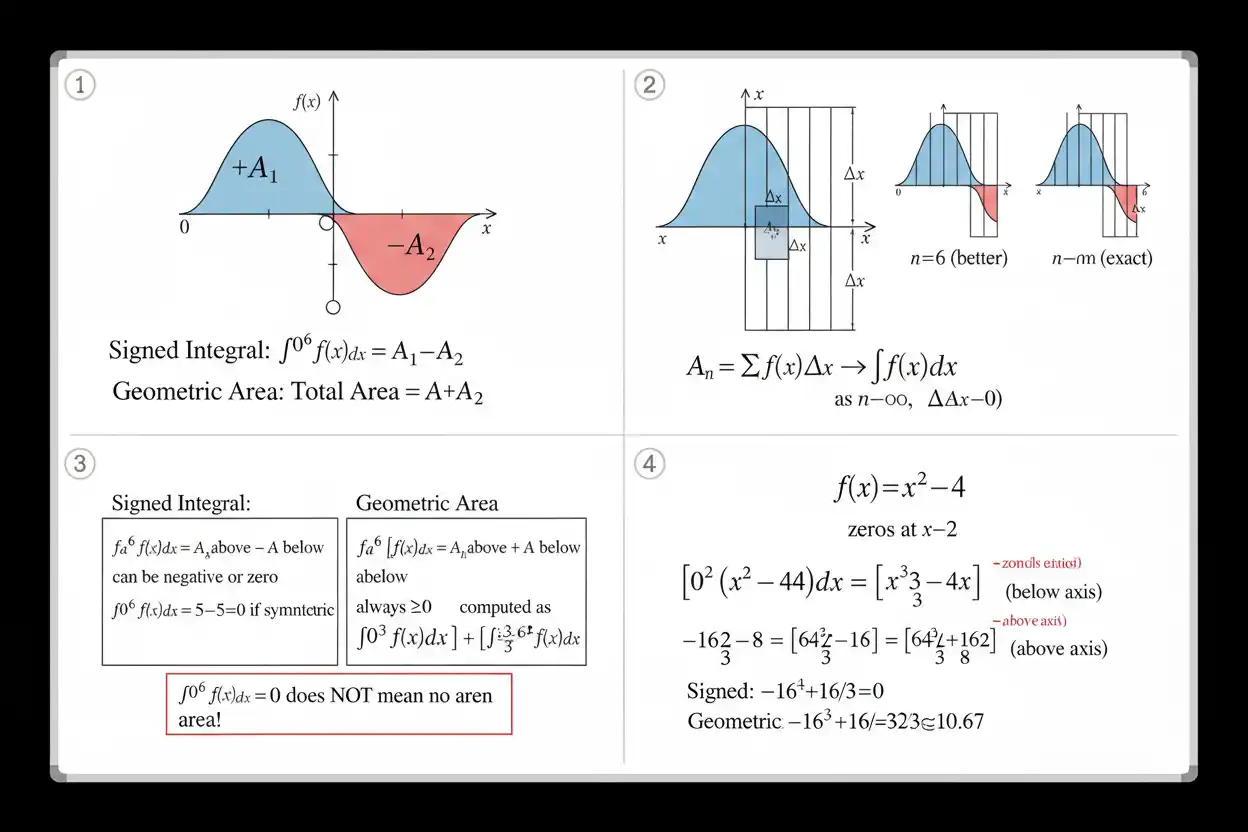

The area under a curve is calculated with a definite integral.
If:
f(x) ≥ 0
for:
a ≤ x ≤ b
then the area between:
y=f(x)
and the x-axis is:
A = ∫ₐᵇ f(x) dx
For example, find the area under:
y = x²
from:
x = 0
to:
x = 3
An antiderivative is:
x³/3
Therefore:
A = [x³/3]₀³
= 27/3
= 9
So:
Area = 9 square units
When a curve lies below the x-axis, however, the definite integral is negative. Geometric area remains positive, so intervals where the function changes sign must be treated appropriately.
What Does Area Under a Curve Mean?
For a nonnegative function, imagine dividing the interval:
[a,b]
into many narrow vertical strips.
Each strip has approximate width:
Δx
and height:
f(x)
So its area is approximately:
f(x)Δx
Adding the strips gives a Riemann sum:
Σf(xᵢ*)Δx
As the widths become arbitrarily small, the limiting sum becomes:
∫ₐᵇf(x)dx
This is the fundamental connection between geometric area and integration.
Area Under a Curve Formula
When:
f(x) ≥ 0
throughout:
[a,b]
the geometric area is:
A = ∫ₐᵇf(x)dx
The boundaries are:
top:
y=f(x)
bottom:
y=0
left:
x=a
right:
x=b
The x-axis is therefore the second boundary.
This is the key distinction from area between curves, where another function supplies the comparison boundary.
Area and Signed Integral Are Not Always the Same
The definite integral:
∫ₐᵇf(x)dx
calculates signed area.
Regions above the x-axis contribute positively.
Regions below the x-axis contribute negatively.
So:
Definite Integral = Positive Area − Negative-Side Area Magnitudes
Geometric total area instead adds all region magnitudes.
Example: Area Above the x-Axis
Find the area under:
y = 2x+1
from:
x=0
to:
x=4
The function is positive throughout this interval.
Set up:
A = ∫₀⁴(2x+1)dx
Antiderivative:
x²+x
Evaluate:
[x²+x]₀⁴
=16+4
=20
Therefore:
Area = 20 square units
Geometry Check
The same region is a trapezoid.
At:
x=0
height:
1
At:
x=4
height:
9
Width:
4
Trapezoid area:
(1/2)(1+9)(4)
=20
The integral and elementary geometry agree.
The Definite Integral
The underlying computational object is the definite integral:
∫ₐᵇf(x)dx
A definite integral has:
lower bound
a
upper bound
b
integrand
f(x)
integration variable
x
Unlike an indefinite integral, its final value does not contain:
+C
because constants cancel during endpoint evaluation.
Fundamental Theorem of Calculus
If:
F′(x)=f(x)
then the fundamental theorem of calculus gives:
∫ₐᵇf(x)dx = F(b)−F(a)
This is the main computational bridge between antiderivatives and accumulated area.
Example Using the Fundamental Theorem
Evaluate the area under:
y=3x²
from:
x=1
to:
x=2
Because the function is positive:
A=∫₁²3x²dx
An antiderivative is:
x³
Therefore:
A=2³−1³
=8−1
=7
So:
Area = 7 square units
Area Below the x-Axis
Consider:
f(x) = -2
from:
x=0
to:
x=3
The definite integral is:
∫₀³(-2)dx
= -6
But the geometric region is a rectangle with:
width = 3
height = 2
so its area is:
6 square units
Thus:
signed integral = -6
while:
geometric area = 6
Geometric Area Below the Axis
If:
f(x) ≤ 0
throughout:
[a,b]
then:
Geometric Area = -∫ₐᵇf(x)dx
because the integral itself is nonpositive.
Equivalently:
Area = ∫ₐᵇ|f(x)|dx
Curve Crossing the x-Axis
If a function changes sign inside the interval, first find its zeros.
Then split the interval at those points.
For example:
f(x)=x−1
from:
x=0
to:
x=3
The x-intercept is:
x=1
The curve is below the axis on:
[0,1]
and above on:
[1,3]
Therefore total geometric area must be calculated in two pieces.
Example: Total Area for y = x−1
From:
0 to 1
geometric area:
-∫₀¹(x−1)dx
From:
1 to 3
area:
∫₁³(x−1)dx
First antiderivative:
x²/2−x
At 1:
1/2−1=-1/2
At 0:
0
Signed integral over [0,1]:
-1/2
Geometric area:
1/2
Second interval:
[x²/2−x]₁³
At 3:
9/2−3
=3/2
At 1:
-1/2
Difference:
2
Total area:
1/2+2
=5/2
Therefore:
Total geometric area = 5/2 square units
Signed Integral for the Same Example
Without splitting for geometric magnitude:
∫₀³(x−1)dx
Evaluate:
[x²/2−x]₀³
=9/2−3
=3/2
So:
Signed integral = 3/2
but:
Geometric area = 5/2
The difference is caused by cancellation of the portion below the axis.
Area Using Absolute Value
The total geometric area can be represented conceptually as:
A = ∫ₐᵇ |f(x)|dx
For:
f(x)=x−1
from:
0 to 3
the absolute value changes formula at:
x=1
Therefore:
|x−1| = 1−x
for:
0≤x≤1
and:
|x−1| = x−1
for:
1≤x≤3
The absolute-value form still requires identifying the sign-change point.
Riemann Sums
The broader integrals concept begins with sums such as:
Σf(xᵢ)Δx*
Each term represents a rectangular approximation.
If:
Δx = (b−a)/n
then increasing n creates narrower strips.
Under appropriate conditions:
lim Σf(xᵢ)Δx = ∫ₐᵇf(x)dx*
This explains why integration represents continuous accumulation.
Left, Right, and Midpoint Approximations
Before finding an exact definite integral, area can be approximated using sample heights.
A left-endpoint sum uses the left side of each interval.
A right-endpoint sum uses the right side.
A midpoint sum uses the interval midpoint.
For a monotonic function, left and right sums may naturally give lower and upper approximations.
As partitions become finer, these approximations approach the integral.
Example With Rectangles
Estimate the area under:
y=x
from:
0 to 2
using two right-endpoint rectangles.
Interval width:
Δx=(2−0)/2
=1
Right endpoints:
1 and 2
Heights:
1 and 2
Approximate area:
1(1)+2(1)
=3
Exact area:
∫₀²x dx
= [x²/2]₀²
=2
The coarse right sum overestimates because the function is increasing.
Exact Geometric Interpretation
The graph:
y=x
from:
0 to 2
forms a right triangle.
Base:
2
Height:
2
Area:
2×2/2
=2
The definite integral gives exactly the same result:
2
Area Under a Constant Function
For:
f(x)=c
with:
c≥0
from:
a to b
we have:
A=∫ₐᵇc dx
=c(b−a)
This is exactly the rectangle formula:
Area = Height × Width
Integration therefore generalizes ordinary geometric area.
Area Under a Linear Function
For:
f(x)=mx+c
that remains nonnegative on:
[a,b]
the integral gives the same area as the corresponding trapezoid.
The heights are:
f(a)
and:
f(b)
So geometric area is:
A = (b−a)[f(a)+f(b)]/2
This agrees with integrating the linear function directly.
Area Under x²
For:
y=x²
from:
x=0
to:
x=a
with:
a≥0
we get:
A=∫₀ᵃx²dx
= [x³/3]₀ᵃ
Therefore:
A = a³/3
For:
a=6
the area is:
216/3
=72
Area Under xⁿ
For:
n>-1
and:
a≥0
the area under:
y=xⁿ
from:
0 to a
is:
A = a^(n+1)/(n+1)
because:
∫xⁿdx = x^(n+1)/(n+1)
For example:
n=3
gives:
A=a⁴/4
Area Under an Exponential Curve
Consider:
y=eˣ
from:
x=0
to:
x=1
The function is positive.
Since:
∫eˣdx=eˣ
we have:
A=e¹−e⁰
=e−1
Therefore:
Area = e−1
Approximately:
1.71828
Area Under 1/x
For:
y=1/x
from:
x=1
to:
x=e
the function is positive.
Antiderivative:
ln x
Therefore:
A=ln(e)−ln(1)
=1−0
=1
So:
Area = 1 square unit
This is one geometric interpretation of the natural logarithm.
Integration by Substitution in Area Problems
A geometric area setup can lead to an integral that needs integration by substitution.
Suppose:
A = ∫₀¹2x(x²+1)³dx
with a nonnegative integrand.
Let:
u=x²+1
Then:
du=2x dx
The bounds can be converted:
When:
x=0
u=1
When:
x=1
u=2
So:
A=∫₁²u³du
= [u⁴/4]₁²
= (16−1)/4
=15/4
Therefore:
Area = 15/4 square units
The substitution technique evaluates the integral; the nonnegative function and interval establish the area interpretation.
Chain Rule Connection
The chain rule and substitution are inverse-pattern partners.
For example:
d/dx[(x²+1)⁴]
=4(x²+1)³(2x)
Recognizing the inner derivative:
2x
helps identify antiderivatives in area calculations containing composite functions.
Area vs. Arc Length
The mapped arc length calculus formula is:
L = ∫ₐᵇ√[1+(f′(x))²]dx
Area under a curve instead uses:
A = ∫ₐᵇf(x)dx
The two quantities are fundamentally different.
Area measures a two-dimensional region.
Arc length measures one-dimensional distance along the curve.
Their integrands and units differ accordingly.
Area vs. Area Between Curves
If the second boundary is:
y=g(x)
instead of the x-axis:
y=0
then the vertical strip height becomes:
f(x)−g(x)
and the calculation becomes an area-between-curves problem.
So:
area under a curve
is effectively a special case where:
lower boundary = 0
provided the curve stays above the x-axis.
Area and Derivatives
The ordinary area formula does not contain f′(x) directly.
However, the derivatives framework can help analyze where functions increase, decrease, attain extrema, or cross related boundaries.
That information can be useful when understanding the shape of a region before integrating.
Accumulation Function
Define:
A(x)=∫ₐˣf(t)dt
This function measures accumulated signed area from fixed starting point a to variable endpoint x.
Under suitable continuity conditions:
A′(x)=f(x)
This is a central statement of the fundamental theorem.
It means the instantaneous rate at which accumulated area changes equals the current height of the curve.
Example of an Accumulation Function
Let:
A(x)=∫₀ˣt²dt
Evaluate:
A(x)=x³/3
Differentiate:
A′(x)=x²
which is exactly the original integrand.
This demonstrates the derivative-integral inverse relationship.
Continuity and Area
If a function is continuous on a closed interval:
[a,b]
then it is integrable there in the ordinary elementary-calculus setting.
Continuity also makes the geometric region easier to interpret because there are no jumps or undefined gaps.
Functions can be integrable under broader conditions, but continuity provides a strong standard case.
Improper Area
Some areas extend to infinity or approach unbounded curves.
These require an improper integral.
For example:
∫₁^∞1/x²dx
is interpreted as:
lim as b→∞ of ∫₁ᵇ1/x²dx
An antiderivative is:
-1/x
So:
lim [−1/b +1]
=1
Therefore the infinite region has finite area:
1 square unit
An unbounded region can therefore have finite area.
Area in Two Dimensions
The ordinary one-variable area formula can be generalized with a double integral:
Area(R)=∬ᴿ1 dA
For a vertically simple region:
g₁(x)≤y≤g₂(x)
we can write:
∫ₐᵇ∫g₁(x)^g₂(x)1 dy dx
Performing the inner integral gives:
∫ₐᵇ[g₂(x)−g₁(x)]dx
This shows how the familiar area-between-curves formula emerges from multivariable integration.
Basis and Dimension Context
The mapped basis and dimension concept describes the underlying coordinate space.
An ordinary graph:
y=f(x)
lies in a two-dimensional coordinate space.
Area is a two-dimensional measure within that space, while arc length is one-dimensional.
In higher dimensions, analogous integration ideas measure volume and other multidimensional quantities.
Area Under a Probability Density Curve
When a nonnegative probability density function satisfies:
∫₋∞^∞f(x)dx=1
area under the curve corresponds to total probability.
Probability over an interval:
[a,b]
is:
P(a≤X≤b)=∫ₐᵇf(x)dx
This is an important application of the same area-under-a-curve mathematics.
The interpretation changes from square geometric units to probability, but the accumulation principle is the same.
Average Value of a Function
The average height of a function on:
[a,b]
is:
f_avg = 1/(b−a) ∫ₐᵇf(x)dx
Rearranging:
∫ₐᵇf(x)dx = f_avg(b−a)
Thus the area under a nonnegative curve equals the area of a rectangle having:
width = b−a
and:
height = average function value.
This gives another geometric interpretation of definite integration.
Example: Average Height
For:
f(x)=x²
on:
[0,3]
the integral is:
9
Interval width:
3
Average value:
9/3
=3
Therefore a rectangle with:
width 3
and:
height 3
has the same area:
9
as the region under the parabola on that interval.
Net Change Interpretation
A definite integral does not have to represent literal geometric area.
If:
v(t)
is velocity, then:
∫v(t)dt
gives net displacement.
Positive and negative velocity contributions can cancel.
If instead total distance is needed, integrate:
|v(t)|
after locating sign changes.
This is mathematically analogous to the distinction between signed integral and total geometric area.
Units
If:
x
is measured in meters
and:
f(x)
is also measured in meters,
then:
f(x)dx
has units:
m×m
=m²
So the integral represents geometric area.
In other applications, units follow the product:
vertical quantity × horizontal quantity.
For example:
velocity × time
produces distance.
Common Mistake: Assuming Every Definite Integral Is Geometric Area
A definite integral is signed accumulation.
It equals ordinary geometric area only when the interpretation and signs justify it.
If the function is negative, the integral is negative even though geometric area cannot be.
Common Mistake: Ignoring x-Axis Crossings
If the function crosses:
y=0
inside the interval, split at each zero before calculating total geometric area.
Otherwise positive and negative regions may cancel.
Common Mistake: Adding +C
For:
∫ₐᵇf(x)dx
do not report:
F(b)−F(a)+C
The constant cancels.
+C belongs to indefinite antiderivatives, not the final definite-integral value.
Common Mistake: Using the Arc-Length Formula
Area under a curve uses:
∫f(x)dx
not:
∫√[1+(f′(x))²]dx
The latter measures path length.
Common Mistake: Forgetting Units Are Squared
If both axes measure length, the result should be reported in:
square units
not ordinary linear units.
Common Mistake: Reversing Bounds
For:
b>a
we have:
∫ᵇₐf(x)dx = -∫ₐᵇf(x)dx
Reversed integration bounds change the sign.
Geometric area should still be reported nonnegatively.
Common Mistake: Rounding Before Endpoint Evaluation
If an antiderivative contains irrational or transcendental quantities, keep exact values through endpoint substitution when practical.
Round only the final numerical result if an approximation is required.
This reduces accumulated error.
How to Check an Area Under a Curve Answer
First determine whether the curve is:
above,
below,
or:
crossing
the axis.
For geometric area, verify:
A≥0
Check the bounds.
Check the antiderivative by differentiation.
Check units.
For lines, rectangles, triangles, or other recognizable regions, compare against elementary geometry.
Frequently Asked Questions
What is the area under a curve formula?
If:
f(x)≥0
on:
[a,b]
then:
A=∫ₐᵇf(x)dx
What does a definite integral represent?
It represents signed accumulation. In a geometric graph setting, regions above the x-axis contribute positively and regions below contribute negatively.
Is a negative integral a negative area?
It is a negative signed integral. Geometric area itself is nonnegative.
How do you find total area when a graph crosses the x-axis?
Find the zeros, split the interval, and add the magnitudes of the individual integrals.
Why do you use an antiderivative?
The fundamental theorem converts a definite integral into:
F(b)−F(a)
when:
F′=f
What is the difference between area under and area between curves?
Area under a curve usually uses the x-axis as one boundary. Area between curves uses another function as a boundary.
Is area under a curve the same as arc length?
No. Area measures a region; arc length measures distance along the curve.
What units does geometric area use?
Square units when both coordinate axes represent lengths.
What is the area under y=x from 0 to 2?
2 square units
What is the area under y=x² from 0 to 3?
9 square units
Can an infinite region have finite area?
Yes. Some improper integrals converge to finite values.
Can area be calculated with a double integral?
Yes:
Area(R)=∬ᴿ1dA
What is an accumulation function?
A function such as:
A(x)=∫ₐˣf(t)dt
that records accumulated signed area from a fixed starting point.
Final Example
Find the total geometric area between:
y=x²−4
and the x-axis from:
x=-3
to:
x=3
First find the x-intercepts:
x²−4=0
x²=4
x=±2
The function is positive on:
[-3,-2]
and:
[2,3]
It is negative on:
[-2,2]
Because the function is even, use symmetry:
A = 2∫₂³(x²−4)dx − ∫₋₂²(x²−4)dx
Alternatively, use symmetry on the central region too:
A = 2∫₂³(x²−4)dx + 2∫₀²(4−x²)dx
Calculate the outer piece:
∫₂³(x²−4)dx
Antiderivative:
x³/3−4x
At 3:
9−12
= -3
At 2:
8/3−8
= -16/3
Difference:
-3−(-16/3)
=7/3
Double it:
14/3
Now central half:
∫₀²(4−x²)dx
Antiderivative:
4x−x³/3
At 2:
8−8/3
=16/3
Double:
32/3
Total:
14/3+32/3
=46/3
Therefore:
Total geometric area = 46/3 square units
or approximately:
15.333 square units
The central distinction is:
Signed accumulation: ∫ₐᵇf(x)dx
Geometric total area: split at sign changes and add the positive region magnitudes
When the function remains nonnegative, these two quantities are the same. When it crosses below the axis, separating signed integration from geometric area becomes essential.