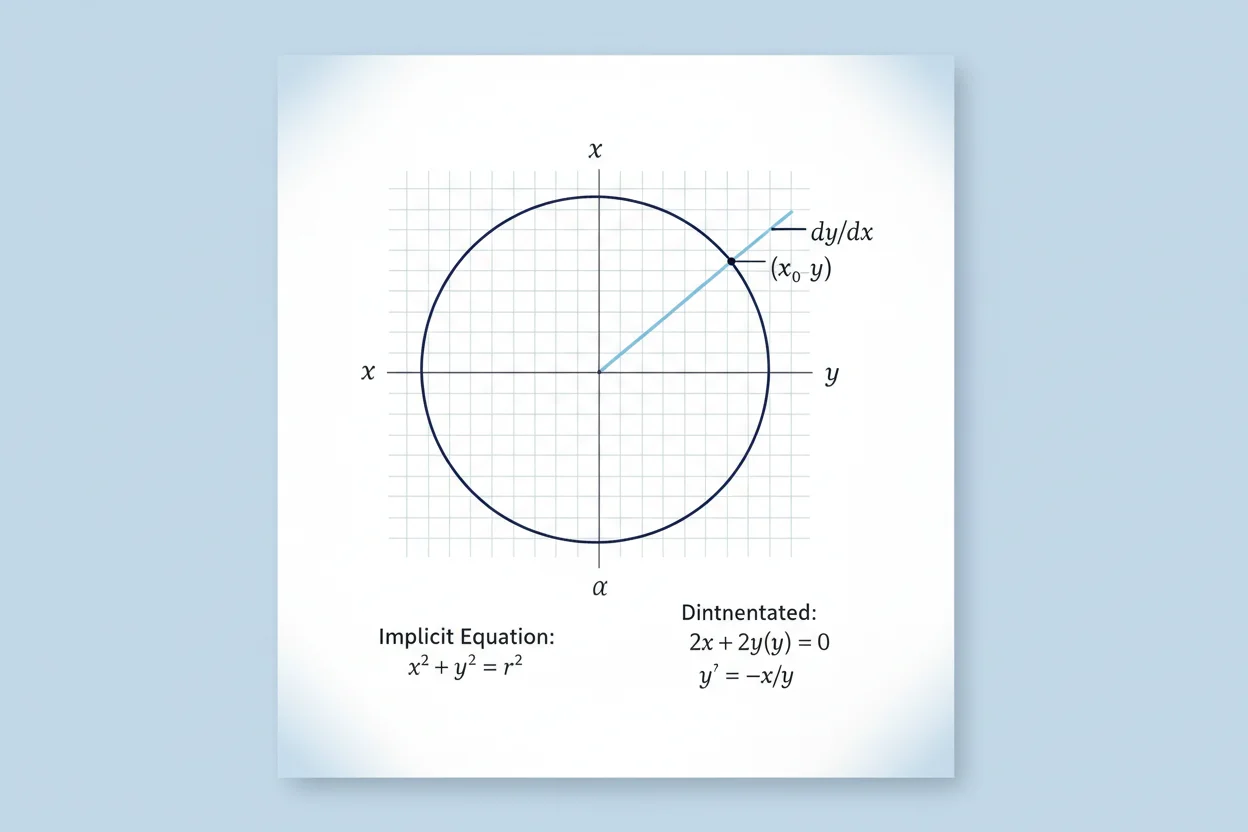

Implicit differentiation is a method for finding dy/dx when x and y are related by an equation but y is not conveniently isolated as an explicit function of x. Instead of solving for y first, differentiate both sides of the equation with respect to x while treating y as a function of x. Whenever a term involving y is differentiated, the chain rule introduces a factor of dy/dx. After differentiating every term, collect the dy/dx terms and solve algebraically for the derivative. For example, differentiating x² + y² = 25 gives 2x + 2y(dy/dx) = 0, so dy/dx = −x/y. The method works especially well for circles, algebraic curves, equations containing products of x and y, and relations involving trigonometric, exponential, or logarithmic functions. It also provides tangent slopes without requiring an explicit formula for y. The central skill is recognizing that y changes with x, so its derivative cannot be treated as zero.
What Is Implicit Differentiation?
An explicit function writes the dependent variable directly in terms of the independent variable:
y = f(x)
For example:
y = x² + 3x
A relation is implicit when x and y appear together:
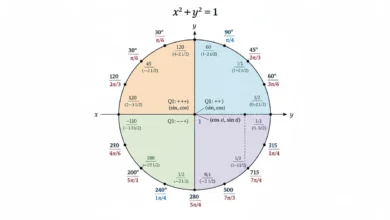
x² + y² = 25
The equation describes a circle, and solving explicitly for y produces two branches:
y = ±√(25 − x²)
Rather than choosing and differentiating each branch separately, implicit differentiation works directly with:
x² + y² = 25
The ordinary derivative still represents the local slope dy/dx. Only the route used to obtain it changes.
Implicit Differentiation Formula
If a relation can be written:
F(x, y) = 0
and the required derivatives exist, then differentiating with respect to x gives:
Fₓ + Fᵧ(dy/dx) = 0
Solving for dy/dx:
dy/dx = −Fₓ/Fᵧ
provided:
Fᵧ ≠ 0
Here Fₓ and Fᵧ are partial derivatives.
This compact formula connects implicit differentiation with the gradient, since:
∇F = (Fₓ, Fᵧ)
For elementary problems, however, you usually differentiate the original equation term by term rather than calculate Fₓ and Fᵧ separately.
The Main Rule
Whenever you differentiate a term containing y, remember that:
y = y(x)
So:
d/dx[y] = dy/dx
and:
d/dx[y²] = 2y(dy/dx)
Similarly:
d/dx[y³] = 3y²(dy/dx)
This extra factor comes from the chain rule.
For a general differentiable function g(y):
d/dx[g(y)] = g′(y)(dy/dx)
This is the central rule behind implicit differentiation.
How to Do Implicit Differentiation
Start with the original relation and differentiate both sides with respect to x. Treat x normally, but treat y as a function of x.
After differentiation, collect all terms containing:
dy/dx
on one side.
Move the remaining terms to the other side, factor out dy/dx, and divide.
Only after obtaining the derivative formula should you substitute a specific point if the problem asks for a numerical slope.
Basic Example: Circle
Find dy/dx for:
x² + y² = 25
Differentiate both sides:
2x + 2y(dy/dx) = 0
Move 2x:
2y(dy/dx) = −2x
Divide by 2y:
dy/dx = −x/y
This derivative gives the slope of the circle wherever y ≠ 0.
At the point:
(3, 4)
the slope is:
dy/dx = −3/4
So the tangent line has slope:
−0.75
Tangent Line Example
For:
x² + y² = 25
find the tangent line at:
(3, 4)
We already know:
dy/dx = −x/y
At (3, 4):
m = −3/4
Using point-slope form:
y − 4 = (−3/4)(x − 3)
This equation describes the tangent line at the specified point.
The derivative supplies the local slope without requiring either branch of the circle to be solved explicitly.
Why y² Produces 2y(dy/dx)
A common mistake is writing:
d/dx[y²] = 2y
That would be correct only if y itself were the independent differentiation variable.
Because y depends on x, apply the chain rule:
d/dx[y²] = 2y · dy/dx
The same principle gives:
d/dx[y⁵] = 5y⁴(dy/dx)
and:
d/dx[√y] = 1/(2√y) · dy/dx
The relevant exponent calculation follows the same structure as the power rule, with the additional derivative of the inner function y(x).
Example With x and y Mixed
Find dy/dx for:
x² + xy + y² = 7
Differentiate:
2x + d/dx[xy] + 2y(dy/dx) = 0
The xy term requires the product rule:
d/dx[xy] = x(dy/dx) + y
So:
2x + x(dy/dx) + y + 2y(dy/dx) = 0
Collect derivative terms:
x(dy/dx) + 2y(dy/dx) = −2x − y
Factor:
(x + 2y)(dy/dx) = −2x − y
Therefore:
dy/dx = −(2x + y)/(x + 2y)
provided:
x + 2y ≠ 0
Product of Two Variable Expressions
Suppose:
x²y + xy² = 6
Differentiate the first term:
d/dx[x²y] = 2xy + x²(dy/dx)
Differentiate the second:
d/dx[xy²] = y² + 2xy(dy/dx)
So:
2xy + x²(dy/dx) + y² + 2xy(dy/dx) = 0
Collect the derivative terms:
x² + 2xy = −2xy − y²
Thus:
dy/dx = −(2xy + y²)/(x² + 2xy)
where the denominator is nonzero.
The essential point is that every product containing y must account for both the product rule and the dependence of y on x.
Example With a Quotient
Suppose:
x/y + y = 4
Differentiate:
d/dx[x/y] + dy/dx = 0
Using the quotient rule:
d/dx[x/y] = [y − x(dy/dx)]/y²
Therefore:
[y − x(dy/dx)]/y² + dy/dx = 0
Multiply by y²:
y − x(dy/dx) + y²(dy/dx) = 0
Collect:
(y² − x)(dy/dx) = −y
Therefore:
dy/dx = −y/(y² − x)
Equivalently:
dy/dx = y/(x − y²)
Trigonometric Example
Find dy/dx if:
x² + sin y = 4
Differentiate:
2x + cos y(dy/dx) = 0
Therefore:
cos y(dy/dx) = −2x
and:
dy/dx = −2x/cos y
provided:
cos y ≠ 0
The trigonometric derivative is evaluated with respect to y first, then multiplied by dy/dx.
Trigonometric Example With x and y Inside the Same Function
Suppose:
sin(xy) = x
Differentiate both sides.
The outer derivative gives:
cos(xy)
The inner expression xy requires the product rule:
d/dx[xy] = y + x(dy/dx)
Therefore:
cos(xy)[y + x(dy/dx)] = 1
Expand:
y cos(xy) + x cos(xy)(dy/dx) = 1
So:
x cos(xy)(dy/dx) = 1 − y cos(xy)
Therefore:
dy/dx = [1 − y cos(xy)]/[x cos(xy)]
where the denominator is nonzero.
Exponential Example
Suppose:
eʸ + x² = 5
Differentiate:
eʸ(dy/dx) + 2x = 0
Therefore:
eʸ(dy/dx) = −2x
and:
dy/dx = −2x/eʸ
The factor dy/dx appears because the exponent is y(x).
Logarithmic Example
Suppose:
ln y + x³ = 4
Differentiate:
(1/y)(dy/dx) + 3x² = 0
Therefore:
(1/y)(dy/dx) = −3x²
Multiply by y:
dy/dx = −3x²y
This result is valid where y > 0, as required by the real logarithm.
Implicit Differentiation With Several y Terms
Consider:
x³ + y³ = 6xy
Differentiate:
3x² + 3y²(dy/dx) = 6[y + x(dy/dx)]
Expand:
3x² + 3y²(dy/dx) = 6y + 6x(dy/dx)
Collect derivative terms:
3y²(dy/dx) − 6x(dy/dx) = 6y − 3x²
Factor:
(3y² − 6x)(dy/dx) = 6y − 3x²
Divide by 3:
(y² − 2x)(dy/dx) = 2y − x²
Therefore:
dy/dx = (2y − x²)/(y² − 2x)
This is a standard example where solving explicitly for y first would be unnecessarily difficult.
Finding a Derivative at a Point
Suppose:
x² + xy + y² = 7
and we want the slope at:
(1, 2)
The derivative is:
dy/dx = −(2x + y)/(x + 2y)
Substitute:
dy/dx = −[2(1) + 2]/[1 + 2(2)]
= −4/5
Therefore the slope at (1, 2) is:
−4/5
Checking that the point lies on the curve first is useful:
1² + 1(2) + 2² = 1 + 2 + 4 = 7
So the point is valid.
Horizontal Tangents
A horizontal tangent occurs where:
dy/dx = 0
For a derivative written as:
dy/dx = N(x, y)/D(x, y)
a horizontal tangent commonly occurs where:
N(x, y) = 0
while:
D(x, y) ≠ 0
The point must also satisfy the original implicit equation.
For the circle:
dy/dx = −x/y
horizontal tangents occur when:
x = 0
and y ≠ 0.
On:
x² + y² = 25
this gives:
(0, 5)
and:
(0, −5)
Vertical Tangents
A vertical tangent can occur where the denominator of dy/dx is zero while the numerator is nonzero.
For the circle:
dy/dx = −x/y
the denominator is zero when:
y = 0
The points on the circle are:
(5, 0)
and:
(−5, 0)
At these points the ordinary slope dy/dx is undefined and the tangent line is vertical.
The distinction between an undefined derivative and a discontinuity of the underlying curve should be made carefully; these are not the same situation.
Second Derivatives With Implicit Equations
Implicit differentiation can also be applied repeatedly.
For:
x² + y² = 25
the first derivative is:
y′ = −x/y
Differentiate again:
y″ = d/dx[−x/y]
Using the quotient rule:
y″ = −[y − xy′]/y²
Substitute:
y′ = −x/y
Then:
y − x(−x/y) = y + x²/y
Combine:
y + x²/y = (y² + x²)/y
Because:
x² + y² = 25
we obtain:
y″ = −25/y³
This second derivative describes how the tangent slope changes along the circle where y ≠ 0.
Implicit Differentiation and Related Rates
Implicit equations also appear naturally in related rates problems.
Suppose:
x² + y² = 100
where both x and y change with time t.
Differentiate with respect to t:
2x(dx/dt) + 2y(dy/dt) = 0
Therefore:
y(dy/dt) = −x(dx/dt)
and:
dy/dt = −x/y
This resembles the implicit derivative:
dy/dx = −x/y
but the variables are now changing with respect to time.
The relation between the two is:
dy/dt = (dy/dx)(dx/dt)
when the relevant derivatives exist.
Implicit Differentiation and Partial Derivatives
For:
F(x, y) = 0
the compact implicit derivative formula is:
dy/dx = −Fₓ/Fᵧ
This uses a partial derivative with respect to each variable.
For:
F(x, y) = x² + xy + y² − 7
we have:
Fₓ = 2x + y
and:
Fᵧ = x + 2y
Therefore:
dy/dx = −(2x + y)/(x + 2y)
This matches the result obtained by differentiating the equation directly.
Why the Gradient Is Normal to an Implicit Curve
For the level curve:
F(x, y) = c
the gradient is:
∇F = (Fₓ, Fᵧ)
At regular points, this vector is perpendicular to the curve.
A tangent vector can be represented by:
(1, dy/dx)
Using:
dy/dx = −Fₓ/Fᵧ
the dot product is:
(Fₓ, Fᵧ) · (1, −Fₓ/Fᵧ)
= Fₓ − Fₓ
= 0
So the implicit derivative and gradient geometry are consistent descriptions of the same local curve.
Implicit Differentiation and Continuity
Implicit differentiation requires more than simply having an equation containing x and y.
Locally treating y as a differentiable function of x requires suitable regularity. In the common formula:
dy/dx = −Fₓ/Fᵧ
the condition:
Fᵧ ≠ 0
is particularly important.
If Fᵧ = 0, the formula for dy/dx may break down, possibly corresponding to a vertical tangent or a point requiring further analysis.
The broader idea of continuity helps describe local function behavior, but continuity alone does not guarantee differentiability.
Implicit Versus Explicit Differentiation
If y is already isolated:
y = f(x)
ordinary differentiation is usually simplest.
If the equation is:
x² + y² = 25
solving for y first gives:
y = ±√(25 − x²)
This introduces separate upper and lower branches.
Implicit differentiation instead produces one relation:
dy/dx = −x/y
that applies to both branches wherever y ≠ 0.
Thus the implicit method can preserve the symmetry and structure of the original equation.
When Solving for y First Is Better
Implicit differentiation is not mandatory merely because x and y appear together.
If an equation isolates easily, an explicit form can be simpler.
For example:
2x + y = 7
immediately gives:
y = 7 − 2x
and:
dy/dx = −2
Implicit differentiation also works:
2 + dy/dx = 0
dy/dx = −2
Both approaches are valid.
The better method is usually the one requiring less algebra.
Implicit Differentiation and Linear Approximation
Once dy/dx is known at a point, the local tangent line can provide a linear approximation to the implicit curve.
At:
(x₀, y₀)
with slope:
m = (dy/dx)|(x₀,y₀)
the approximation is:
y − y₀ ≈ m(x − x₀)
For the circle x² + y² = 25 at (3, 4):
m = −3/4
so near that point:
y − 4 ≈ (−3/4)(x − 3)
This gives a convenient local approximation to the upper circle branch.
Implicit Differentiation and Differential Equations
A first-order linear differential equation starts with an equation involving an unknown function and its derivative and seeks the function itself.
Implicit differentiation goes in the opposite direction: it begins with a relationship between variables and derives the local rate dy/dx.
Both use derivative notation, but their objectives are different.
This distinction prevents an algebraic implicit relation from being mistaken for a differential equation that must be solved for a family of functions.
Implicit Differentiation and Integration
Implicit differentiation is fundamentally a differentiation technique.
An indefinite integral reverses differentiation by seeking antiderivatives, while the Fundamental Theorem Of Calculus connects derivatives with accumulated definite integrals.
A problem may involve both ideas, but differentiating an implicit equation does not by itself require integrating anything.
Likewise, an improper integral concerns convergence at infinite bounds or singularities rather than the implicit derivative of a relation.
Implicit Differentiation in Multivariable Calculus
The method extends naturally into multivariable calculus.
For a surface:
F(x, y, z) = c
the gradient:
∇F = (Fₓ, Fᵧ, F_z)
provides a normal vector.
If one variable can locally be regarded as a function of the others, partial derivative relationships can be obtained by differentiating the constraint.
The two-variable formula:
dy/dx = −Fₓ/Fᵧ
is therefore the simplest version of a broader implicit-function idea.
Implicit Differentiation Within Calculus
The Calculus & Linear Algebra framework contains many differentiation rules, but implicit differentiation has a specific role: it finds derivatives from equations where the dependent variable has not been isolated.
The method does not replace the product, quotient, power, or chain rules. Instead, it uses those rules wherever the corresponding structures occur inside the implicit equation.
Recognizing the correct rule term by term is what makes the method reliable.
Common Mistakes
The most common mistake is forgetting dy/dx when differentiating a y-term.
For example:
d/dx[y²]
must be:
2y(dy/dx)
not simply:
2y
Another error is treating y as a constant. In implicit differentiation, y is understood to depend on x.
Products such as:
xy
require differentiation of both factors:
d/dx[xy] = y + x(dy/dx)
Students also sometimes substitute the requested point too early. It is usually safer to derive the general slope formula first and then substitute coordinates.
When identifying vertical or horizontal tangents, the point must satisfy both the derivative condition and the original relation.
Finally, dividing by an expression that may equal zero can discard important exceptional cases. If the denominator in the final derivative is zero, inspect the original equation rather than assuming the point simply has no geometric meaning.
Frequently Asked Questions
What is implicit differentiation?
Implicit differentiation finds derivatives when x and y are linked by an equation and y is not isolated. Differentiate both sides with respect to x while treating y as a function of x.
What is the main implicit differentiation rule?
Whenever a function of y is differentiated, multiply by:
dy/dx
For example:
d/dx[y²] = 2y(dy/dx)
What is the formula for F(x, y) = 0?
When the relevant derivatives exist and Fᵧ ≠ 0:
dy/dx = −Fₓ/Fᵧ
Why does dy/dx appear after differentiating y?
Because y changes with x. The chain rule gives:
d/dx[y] = dy/dx
How do you implicitly differentiate x² + y² = 25?
Differentiate:
2x + 2y(dy/dx) = 0
Then solve:
dy/dx = −x/y
Can implicit differentiation be used for products of x and y?
Yes. A term such as xy requires the product rule:
d/dx[xy] = y + x(dy/dx)
Can implicit differentiation handle trigonometric functions of y?
Yes. For example:
d/dx[sin y] = cos y(dy/dx)
How do you find a tangent line after implicit differentiation?
Evaluate dy/dx at the specified point to obtain the slope, then use the point-slope equation:
y − y₀ = m(x − x₀)
How do you identify a horizontal tangent?
For a derivative written as a fraction, a horizontal tangent commonly occurs where the numerator is zero and the denominator is nonzero, provided the point lies on the original curve.
How do you identify a vertical tangent?
A vertical tangent may occur where the denominator of dy/dx is zero while the numerator is nonzero. The original relation must still be checked.
Can you find second derivatives implicitly?
Yes. After finding y′, differentiate the relation or the y′ expression again, remembering that y and y′ both depend on x.
Is implicit differentiation only for equations that cannot be solved for y?
No. It can be used even when y can be isolated, but it is most useful when explicit isolation would be difficult, cumbersome, or would split the relation into multiple branches.