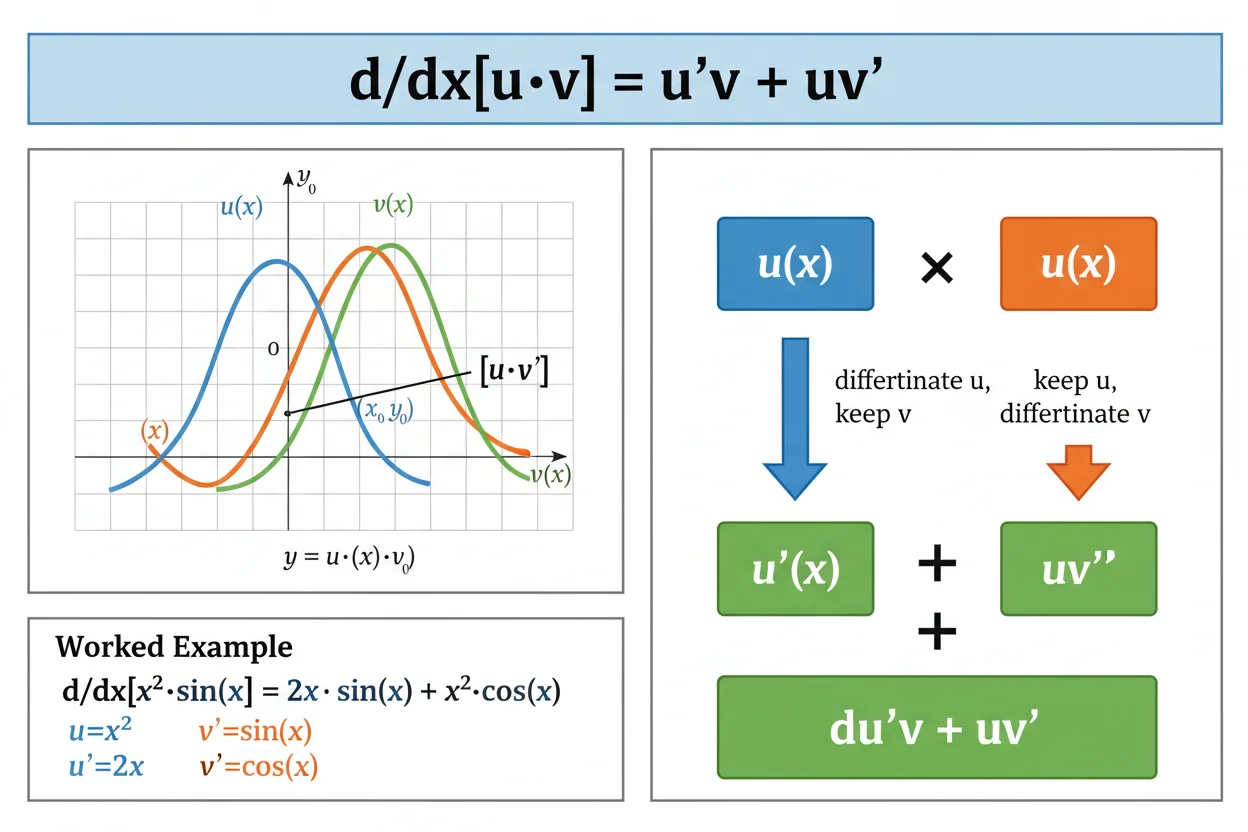

The product rule is a differentiation formula used when a function is formed by multiplying two differentiable functions. If y = u(x)v(x), then the derivative is not generally u′(x)v′(x). Instead, the product rule gives y′ = u′v + uv′. In words, differentiate the first factor and leave the second unchanged, then leave the first unchanged and differentiate the second, and add the two results. The rule is essential for expressions such as x²eˣ, x sin x, polynomial-logarithmic products, and many functions containing several multiplied factors. It can be combined with the power rule, chain rule, and other derivative rules when individual factors require additional differentiation steps. The product rule also extends naturally to three or more factors and to partial derivatives in multivariable calculus. Recognizing whether an expression is truly a product—or can be simplified first—is an important part of using the rule efficiently.
What Is the Product Rule?
Suppose:
y = u(x)v(x)
where both u and v depend on x.
The product rule states:
y′ = u′v + uv′
or equivalently:
d/dx[u(x)v(x)] = u′(x)v(x) + u(x)v′(x)
This formula contains two terms because both factors can change as x changes.
Differentiating only one factor ignores part of the total change.
Multiplying the derivatives:
u′v′
is also generally incorrect.
Product Rule Formula
The standard formula is:
(uv)′ = u′v + uv′
A useful verbal form is:
derivative of first × second + first × derivative of second
For:
f(x) = g(x)h(x)
we can write:
f′(x) = g′(x)h(x) + g(x)h′(x)
The names of the functions do not matter. The structure is the same whenever two differentiable factors are multiplied.
Basic Product Rule Example
Differentiate:
f(x) = x²eˣ
Let:
u = x²
and:
v = eˣ
Differentiate the factors:
u′ = 2x
v′ = eˣ
Apply the product rule:
f′(x) = (2x)eˣ + x²eˣ
Factor eˣ:
f′(x) = eˣ(x² + 2x)
or:
f′(x) = xeˣ(x + 2)
Either form is correct.
Why You Cannot Multiply the Derivatives
For:
f(x) = x²x³
incorrectly multiplying the derivatives would give:
(2x)(3x²) = 6x³
But the original function simplifies to:
x⁵
so the power rule gives:
f′(x) = 5x⁴
The product rule confirms this:
f′(x) = (2x)(x³) + (x²)(3x²)
= 2x⁴ + 3x⁴
= 5x⁴
Therefore:
(uv)′ ≠ u′v′
in general.
Product Rule From the Limit Definition
The product rule can be derived from the derivative definition.
Let:
f(x) = u(x)v(x)
Then:
f′(x) = lim [u(x+h)v(x+h) − u(x)v(x)]/h as h → 0
Add and subtract:
u(x+h)v(x)
inside the numerator:
u(x+h)v(x+h) − u(x+h)v(x) + u(x+h)v(x) − u(x)v(x)
Group the terms:
u(x+h)[v(x+h) − v(x)] + v(x)[u(x+h) − u(x)]
Divide by h and take the limit.
Under the usual differentiability conditions:
u(x+h) → u(x)
and the two difference quotients approach v′(x) and u′(x).
The result is:
f′(x) = u(x)v′(x) + v(x)u′(x)
which is the product rule.
The underlying limiting argument connects the rule to the broader theory of limits.
Polynomial Times Exponential
Differentiate:
f(x) = x³eˣ
Choose:
u = x³
v = eˣ
Then:
u′ = 3x²
v′ = eˣ
Apply:
f′(x) = 3x²eˣ + x³eˣ
Factor:
f′(x) = x²eˣ(x + 3)
This pattern appears frequently because eˣ remains unchanged when differentiated.
Polynomial Times Sine
Differentiate:
f(x) = x² sin x
Let:
u = x²
v = sin x
Then:
u′ = 2x
v′ = cos x
Therefore:
f′(x) = 2x sin x + x² cos x
Both terms are necessary.
The first represents change in the polynomial factor, while the second represents change in the trigonometric factor.
Polynomial Times Cosine
For:
f(x) = x³ cos x
we have:
u′ = 3x²
and:
v′ = −sin x
Therefore:
f′(x) = 3x² cos x − x³ sin x
The negative sign comes from differentiating cosine, not from the product rule itself.
Product With a Logarithm
Differentiate:
f(x) = x² ln x
for:
x > 0
Let:
u = x²
v = ln x
Then:
u′ = 2x
v′ = 1/x
Apply:
f′(x) = 2x ln x + x²(1/x)
Simplify:
f′(x) = 2x ln x + x
Factor:
f′(x) = x(2ln x + 1)
The product rule handles the multiplication while the individual derivative rules handle x² and ln x.
Product of Two Polynomial Expressions
Differentiate:
f(x) = (x² + 1)(x³ − 2x)
Let:
u = x² + 1
and:
v = x³ − 2x
Then:
u′ = 2x
v′ = 3x² − 2
Therefore:
f′(x) = 2x(x³ − 2x) + (x² + 1)(3x² − 2)
This answer can be left factored or expanded.
Expanding:
2x⁴ − 4x² + 3x⁴ + x² − 2
gives:
f′(x) = 5x⁴ − 3x² − 2
You could also expand the original function first and apply the power rule. Both methods agree.
When Simplifying First Is Easier
Consider:
f(x) = x³x⁴
Using the product rule works, but the expression simplifies immediately:
x³x⁴ = x⁷
Then:
f′(x) = 7x⁶
This is shorter than:
3x²x⁴ + x³4x³
= 3x⁶ + 4x⁶
= 7x⁶
The product rule should not be used mechanically when algebra can eliminate the product first.
Product Rule With the Chain Rule
A factor may itself be a composite function.
Differentiate:
f(x) = x²(x³ + 1)⁵
Let:
u = x²
v = (x³ + 1)⁵
Then:
u′ = 2x
To find v′, use the chain rule:
v′ = 5(x³ + 1)⁴(3x²)
= 15x²(x³ + 1)⁴
Now apply the product rule:
f′(x) = 2x(x³ + 1)⁵ + x²[15x²(x³ + 1)⁴]
A useful factored form is:
f′(x) = x(x³ + 1)⁴[2(x³ + 1) + 15x³]
Simplify inside:
f′(x) = x(x³ + 1)⁴(17x³ + 2)
The product rule identifies the outer product structure; the chain rule differentiates the composite factor.
Product Rule With Two Composite Factors
Differentiate:
f(x) = sin(x²)e^(3x)
Let:
u = sin(x²)
v = e^(3x)
Then:
u′ = 2x cos(x²)
and:
v′ = 3e^(3x)
Therefore:
f′(x) = 2x cos(x²)e^(3x) + 3sin(x²)e^(3x)
Factor:
f′(x) = e^(3x)[2x cos(x²) + 3sin(x²)]
Each factor requires the chain rule before the product rule combines the results.
Product Rule With Three Factors
If:
y = uvw
differentiate by treating uv as one factor:
y′ = (uv)′w + uvw′
Apply the two-factor rule to uv:
(uv)′ = u′v + uv′
Therefore:
y′ = u′vw + uv′w + uvw′
So for three factors:
d/dx[uvw] = u′vw + uv′w + uvw′
Each term differentiates exactly one factor while leaving the others unchanged.
Three-Factor Example
Differentiate:
f(x) = x²eˣ sin x
Using the three-factor formula:
f′(x) = (2x)eˣ sin x + x²eˣ sin x + x²eˣ cos x
Factor:
f′(x) = xeˣ[2sin x + x sin x + x cos x]
Another correct form is:
f′(x) = eˣ[2x sin x + x² sin x + x² cos x]
Product Rule for n Factors
For:
f(x) = u₁u₂…uₙ
the derivative is the sum of n terms.
Each term differentiates one factor and leaves all others unchanged:
f′ = u₁′u₂…uₙ + u₁u₂′…uₙ + … + u₁u₂…uₙ′
This generalized rule is useful when several factors cannot be simplified into a more convenient expression.
Repeated Product Factors
Suppose:
f(x) = [g(x)]²
You could view this as:
g(x)g(x)
and apply the product rule:
f′(x) = g′(x)g(x) + g(x)g′(x)
= 2g(x)g′(x)
This agrees with the power-and-chain formula:
d/dx[g(x)]² = 2g(x)g′(x)
The two derivative rules are consistent because they describe the same function structure from different viewpoints.
Product Rule and the Quotient Rule
The quotient rule can be derived from the product rule.
Suppose:
y = u/v
Rewrite:
yv = u
Differentiate both sides:
y′v + yv′ = u′
Solve for y′:
y′v = u′ − yv′
Substitute:
y = u/v
Then:
y′ = [u′v − uv′]/v²
This is the quotient rule.
The relationship shows that the product rule is structurally fundamental even for differentiation of ratios.
Product Rule Versus Quotient Rule
Use the product rule for:
u(x)v(x)
Use the quotient rule for:
u(x)/v(x)
where the denominator depends on x and rewriting does not offer a simpler alternative.
For example:
x²eˣ
naturally uses the product rule.
But:
x²/(x + 1)
is naturally a quotient.
Some quotients can instead be rewritten using negative powers and then handled with the product and chain rules.
Product Rule With Negative Powers
Consider:
f(x) = x²(x + 1)⁻¹
This is mathematically the same as:
x²/(x + 1)
Using the product rule:
f′(x) = 2x(x + 1)⁻¹ + x²[−(x + 1)⁻²]
Therefore:
f′(x) = 2x/(x + 1) − x²/(x + 1)²
Put over a common denominator:
f′(x) = [2x(x + 1) − x²]/(x + 1)²
Simplify:
f′(x) = x(x + 2)/(x + 1)²
The quotient rule gives the same result directly.
Product Rule and Partial Derivatives
The product rule also applies to a partial derivative.
Suppose:
f(x, y) = x²y e^(xy)
Find:
∂f/∂x
Treat y as constant.
View the expression as:
u = x²y
v = e^(xy)
Then:
uₓ = 2xy
and:
vₓ = ye^(xy)
Therefore:
fₓ = 2xy e^(xy) + x²y²e^(xy)
Factor:
fₓ = xy e^(xy)(2 + xy)
The ordinary product rule remains valid; only the active differentiation variable changes.
Partial Derivative With Respect to y
Using the same function:
f(x, y) = x²y e^(xy)
treat x as constant.
Then:
u = x²y
gives:
uᵧ = x²
and:
v = e^(xy)
gives:
vᵧ = xe^(xy)
Therefore:
fᵧ = x²e^(xy) + x³y e^(xy)
Factor:
fᵧ = x²e^(xy)(1 + xy)
These partial derivatives can later become components of a gradient.
Product Rule in Multivariable Calculus
In multivariable calculus, products occur between scalar fields, vector fields, and coordinate-dependent expressions.
For two scalar fields f and g:
∇(fg) = f∇g + g∇f
This is the gradient version of the product rule.
Each coordinate component follows the ordinary partial-derivative product formula.
The idea remains the same: both factors can vary with position.
Product Rule and the Gradient
Suppose:
h(x, y) = f(x, y)g(x, y)
Then:
hₓ = fₓg + fgₓ
and:
hᵧ = fᵧg + fgᵧ
Therefore:
∇h = g∇f + f∇g
The gradient packages these coordinate-wise product-rule calculations into one vector formula.
Product Rule in Implicit Differentiation
The implicit differentiation method frequently requires the product rule when x and y appear multiplied.
Consider:
xy = 6
Differentiate with respect to x.
Since both x and y depend on x in the differentiation process:
d/dx[xy] = x dy/dx + y
Therefore:
x dy/dx + y = 0
So:
dy/dx = −y/x
Treating y as a constant would be incorrect because y is implicitly a function of x.
Implicit Example With Multiple Product Terms
Differentiate:
x²y + xy² = 6
First:
d/dx[x²y] = 2xy + x² dy/dx
For:
xy²
use the product rule plus chain rule:
d/dx[xy²] = y² + x(2y dy/dx)
So:
2xy + x² dy/dx + y² + 2xy dy/dx = 0
Group derivative terms:
(x² + 2xy)dy/dx = −(2xy + y²)
Therefore:
dy/dx = −(2xy + y²)/(x² + 2xy)
The product rule is essential because both x- and y-dependent factors vary.
Product Rule in Related Rates
A related rates problem may involve quantities multiplied together.
Suppose:
A = xy
where x and y both vary with time.
Differentiate with respect to t:
dA/dt = x dy/dt + y dx/dt
This is the product rule with time as the independent variable.
For example, if:
x = 4
y = 3
dx/dt = 2
dy/dt = −1
then:
dA/dt = 4(−1) + 3(2)
= −4 + 6
= 2
The product A is increasing at 2 square units per time unit at that instant.
Product Rule and Linear Approximation
A linear approximation uses derivatives to estimate nearby function values.
If:
f(x) = u(x)v(x)
then:
f′(a) = u′(a)v(a) + u(a)v′(a)
and the local approximation is:
f(x) ≈ f(a) + f′(a)(x − a)
The product rule therefore supplies the tangent slope whenever the target function is built from two changing factors.
Product Rule and Differentials
If:
z = uv
then the differential form of the product rule is:
dz = u dv + v du
The differentials expression gives a particularly intuitive interpretation.
For small changes:
Δz ≈ uΔv + vΔu
The very small cross-product term:
ΔuΔv
is second order and is omitted in the linear differential approximation.
This helps explain why the product rule has two first-order terms.
Small-Change Interpretation
Suppose u changes by Δu and v changes by Δv.
Then:
(u + Δu)(v + Δv)
expands to:
uv + uΔv + vΔu + ΔuΔv
The change in the product is:
Δ(uv) = uΔv + vΔu + ΔuΔv
For sufficiently small changes, the final term is second order.
The derivative captures the first-order part:
d(uv) = u dv + v du
This provides another intuitive derivation of the product rule.
Product Rule in Optimization
In optimization, objective functions sometimes contain products.
For example:
A(x) = x(20 − x)
Differentiate using the product rule:
A′(x) = 1(20 − x) + x(−1)
= 20 − 2x
Setting:
A′(x) = 0
gives:
x = 10
You could also expand first:
A(x) = 20x − x²
and use the power rule.
Both methods produce the same optimization condition.
Product Rule and Integration by Parts
Integration by parts is derived by reversing the product rule.
Start with:
d(uv) = u dv + v du
Rearrange:
u dv = d(uv) − v du
Integrate:
∫u dv = uv − ∫v du
Thus the product rule in differentiation directly produces one of the most important techniques in integration.
The two procedures should still be kept conceptually distinct: one differentiates products, while the other transforms certain integrals.
Product Rule Versus Partial Fraction Integration
Partial fraction integration handles rational functions by decomposing denominators into simpler fractions before integration.
It is not a differentiation version of the product rule.
A rational expression may contain products of denominator factors, but its integration method is algebraic decomposition.
If the resulting antiderivative is later differentiated for verification, product, quotient, or chain-rule calculations may appear depending on how the answer is written.
Product Rule Versus Reduced Row Echelon Form
Reduced row echelon form belongs to linear algebra and solves matrix and system structure through row operations.
The product rule belongs to differential calculus and computes the derivative of multiplied functions.
The two procedures share no direct calculation rule. Their appearance within the same mathematics cluster reflects the broader calculus-and-linear-algebra framework rather than a common formula.
Product Rule and Matrix-Valued Functions
If A(x) and B(x) are differentiable matrix-valued functions with compatible dimensions, a matrix version of the product rule is:
d/dx[A(x)B(x)] = A′(x)B(x) + A(x)B′(x)
The order must be preserved because matrix multiplication is generally not commutative.
You cannot normally rearrange the terms to:
B′A + BA′
This is an important difference from scalar multiplication.
Product Rule and Continuity
Differentiability of the factors at a point implies their continuity there.
Therefore, when u and v are differentiable, their product is differentiable and the product rule applies.
The broader concept of continuity helps explain why the limiting derivation behaves correctly.
However, continuity alone is not sufficient to guarantee that either factor has a derivative.
Domain Restrictions
The product rule applies at points where both relevant factors are differentiable.
For:
f(x) = √x ln x
the real domain requires:
x > 0
because ln x requires positive x.
Although √x exists at zero, the product as written does not.
The derivative calculation must therefore remain within the common domain of the factors.
Common Product Rule Mistakes
A common mistake is writing:
(uv)′ = u′v′
The correct formula is:
(uv)′ = u′v + uv′
Another error is differentiating the same factor in both terms. Each product-rule term differentiates one factor while leaving the other unchanged.
Students may also forget an inner chain-rule factor when one part is composite.
For three or more factors, every factor must receive one derivative term.
Another mistake is applying the product rule when simple algebra could combine powers or otherwise simplify the expression first.
Finally, signs from trigonometric or other individual derivative formulas must be preserved carefully. The product rule adds the two product-rule terms, but one term may itself be negative because of the derivative of a factor.
Frequently Asked Questions
What is the product rule?
For:
y = uv
the product rule is:
y′ = u′v + uv′
When should I use the product rule?
Use it when a function is a product of two or more x-dependent factors that cannot be simplified conveniently before differentiation.
Is the derivative of uv equal to u′v′?
No. In general:
(uv)′ ≠ u′v′
The correct derivative is:
u′v + uv′
What is the product rule for three functions?
For:
y = uvw
the derivative is:
y′ = u′vw + uv′w + uvw′
Can the product rule be combined with the chain rule?
Yes. If either factor is composite, differentiate that factor with the chain rule inside the product-rule calculation.
Can the product rule be used with partial derivatives?
Yes. Differentiate with respect to the chosen variable and treat other independent variables as constants.
How is the product rule related to integration by parts?
Integration by parts is derived by rearranging and integrating the differential form of the product rule.
How is the product rule related to the quotient rule?
The quotient rule can be derived from the product rule by differentiating an identity such as:
yv = u
where y = u/v.
Does product order matter for ordinary scalar functions?
No. Scalar multiplication is commutative, so uv = vu. For matrix-valued functions, order must be preserved.
Should I always use the product rule when I see multiplication?
No. Simplify first when possible. For example:
x³x⁴ = x⁷
is easier to differentiate with the power rule.
How can I check a product-rule derivative?
Expand or simplify the original expression when possible and differentiate another way, or substitute the derivative into a numerical difference quotient near a test point to confirm the local slope.