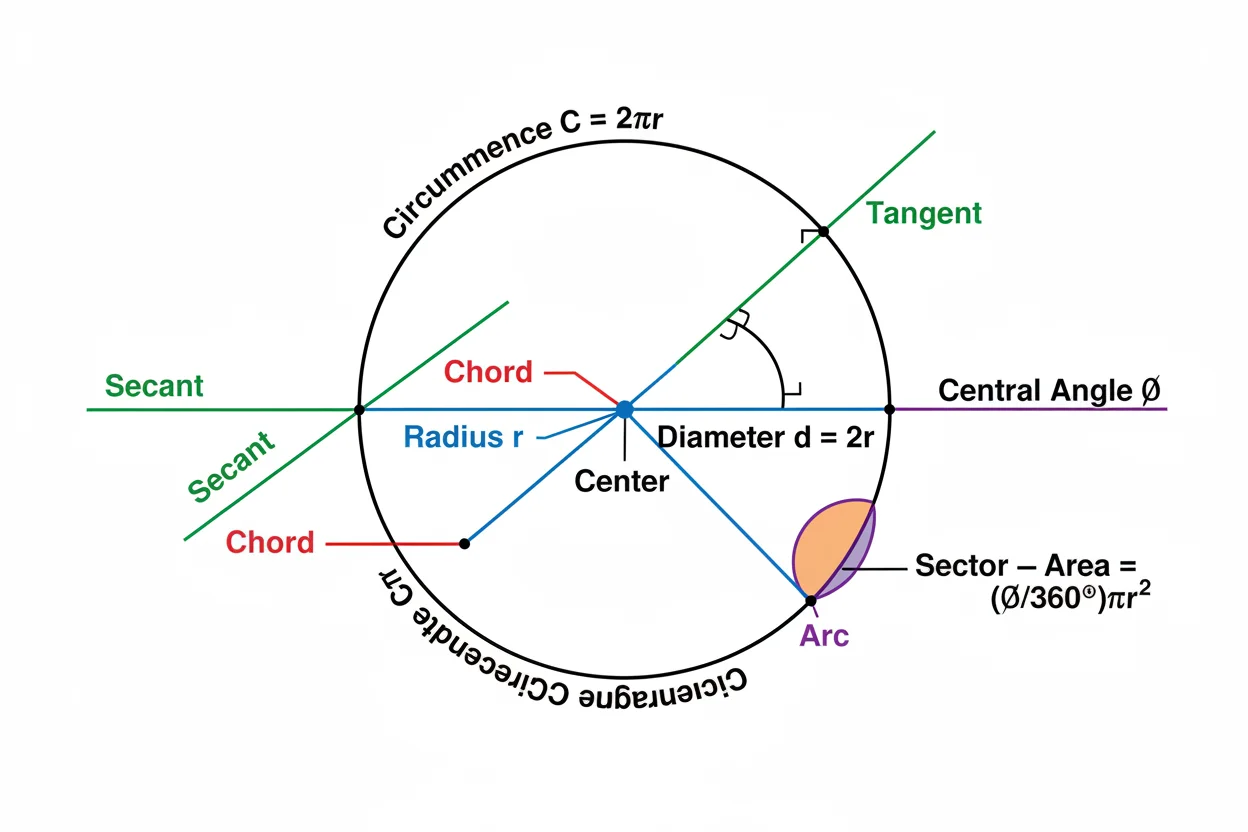

Circles are plane figures formed by all points that lie the same distance from a fixed center. That fixed distance is the radius, and many other circle measurements follow directly from it. The diameter is twice the radius, the circumference is 2πr, and the area is πr². Circles also contain chords, arcs, sectors, central angles, tangents, and secants, each describing a different part of the same geometry. In coordinate geometry, a circle with center (h, k) and radius r is represented by (x − h)² + (y − k)² = r². Because all circles have the same basic shape, enlarging a circle changes every linear measurement by the same scale factor while its area changes by the square of that factor. These relationships make circles central to geometry, trigonometry, coordinate systems, solid geometry, and rotational measurement.
What Is a Circle?
A circle is the set of all points in a plane that are exactly r units from one fixed point.
The fixed point is the:
center
The fixed distance is the:
radius
If the center is O and P is any point on the circle:
OP = r
Every point on the circumference satisfies this same distance condition.
This definition distinguishes the circle itself—the boundary—from the circular region enclosed inside it.
The wider Geometry & Trigonometry framework uses circles in angle measurement, trigonometric functions, coordinate geometry, and solid measurement.
Radius
The radius is a line segment from the center to any point on the circle.
It is normally represented by:
r
Because every point on the circle is equally distant from the center, all radii of the same circle have equal length.
If:
r = 7 cm
then every boundary point is:
7 cm
from the center.
Radius is the fundamental size measurement because circumference, area, diameter, chord formulas, sector measurements, and circle equations can all be expressed using r.
Diameter
A diameter is a chord that passes through the center.
Its length is twice the radius:
d = 2r
Therefore:
r = d/2
If:
r = 9
then:
d = 18
If:
d = 30
then:
r = 15
The diameter is the longest possible chord in a circle.
Radius and Diameter Example
Suppose a circle has diameter:
d = 24 cm
Then:
r = 24/2
= 12 cm
Once the radius is known, other measurements follow.
Circumference:
C = 2π(12)
= 24π cm
Area:
A = π(12²)
= 144π cm²
This illustrates why converting between radius and diameter correctly is important.
Circumference
The circumference is the total distance around a circle.
Its formulas are:
C = 2πr
and:
C = πd
The specialist Circle Circumference calculation uses these relationships for direct and inverse problems.
For:
r = 5
the circumference is:
C = 10π
Approximately:
C ≈ 31.42
Circumference is measured in linear units.
Why π Appears in Circles
For every circle:
C/d = π
The value of this ratio is approximately:
π ≈ 3.14159
Therefore:
C = πd
Since:
d = 2r
we also get:
C = 2πr
This constant ratio is independent of circle size.
A circle with diameter 1 has circumference π, while a circle with diameter 10 has circumference 10π.
Circle Area
The area inside a circle is:
A = πr²
The dedicated Circle Area page handles radius, diameter, circumference, inverse area, scaling, sectors, and annular calculations in detail.
For:
r = 6
we have:
A = π(6²)
= 36π
Approximately:
A ≈ 113.10
Area is measured in square units.
Circle Area From Diameter
Because:
r = d/2
the area formula can be written:
A = π(d/2)²
Therefore:
A = πd²/4
If:
d = 14
then:
A = π(14²)/4
= 49π
This is equivalent to first finding:
r = 7
and then using πr².
Area and Circumference Are Different
Circumference measures the boundary:
C = 2πr
Area measures the interior:
A = πr²
For:
r = 4 m
circumference is:
8π m
while area is:
16π m²
The different units show that the quantities should not be interchanged.
The general distinction between boundary length and enclosed region also appears in Perimeter and Area.
Find Radius From Circumference
Starting with:
C = 2πr
solve:
r = C/(2π)
If:
C = 30π
then:
r = 30π/(2π)
= 15
The diameter is:
30
Find Radius From Area
Starting with:
A = πr²
divide by π:
r² = A/π
Then:
r = √(A/π)
If:
A = 64π
then:
r = 8
and:
d = 16
Only the nonnegative square root represents a geometric radius.
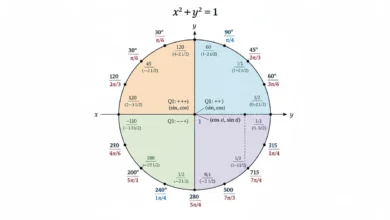
Circle Equation
In coordinate geometry, the Circle Equation with center:
(h, k)
and radius r is:
(x − h)² + (y − k)² = r²
For a circle centered at the origin:
x² + y² = r²
For example:
(x − 3)² + (y + 2)² = 25
has:
center = (3, −2)
radius = 5
The equation describes exactly the set of points 5 units from the center.
Why the Circle Equation Works
The Distance Formula between:
(x, y)
and:
(h, k)
is:
√[(x − h)² + (y − k)²]
Every point on a circle is distance r from its center.
Therefore:
√[(x − h)² + (y − k)²] = r
Squaring both sides gives:
(x − h)² + (y − k)² = r²
The coordinate equation is therefore simply the geometric definition of a circle written algebraically.
Chords
A chord joins two points on a circle.
The diameter is a special chord passing through the center.
If a chord subtends central angle θ, its Chord Length is:
c = 2r sin(θ/2)
For:
r = 10
θ = 60°
we get:
c = 20sin30°
= 10
Chords are straight segments, unlike arcs.
Chord Distance From the Center
If a chord lies perpendicular distance d from the center:
c = 2√(r² − d²)
This follows from the Pythagorean theorem.
The perpendicular line from the center to a chord bisects that chord.
As d decreases, the chord gets longer.
At:
d = 0
the chord passes through the center and becomes the diameter:
c = 2r
Arcs
An arc is part of the circumference.
For central angle θ in radians, Arc Length is:
s = rθ
If θ is measured in degrees:
s = (θ/360°)2πr
For:
θ = 90°
the arc represents one quarter of the full circle:
s = πr/2
The corresponding chord is shorter because it takes a straight path between the same endpoints.
Minor and Major Arcs
Two points on a circle normally divide its circumference into:
a minor arc
and:
a major arc
The minor arc corresponds to the smaller central angle.
The major arc is the remaining portion of the circle.
If the minor central angle is θ degrees:
major angle = 360° − θ
The two arc lengths add to:
2πr
the full circumference.
Central Angles
A central angle has its vertex at the center of the circle.
Its sides are radii.
A complete revolution is:
360°
or:
2π radians
A semicircle corresponds to:
180° = π radians
A quarter circle corresponds to:
90° = π/2 radians
The relationship between Degrees and Radians is:
radians = degrees × π/180
and:
degrees = radians × 180/π
Sectors
A sector is the region bounded by:
two radii
and:
their connecting arc
For central angle θ measured in radians:
A_sector = r²θ/2
For degrees:
A_sector = (θ/360°)πr²
The specialist Sector Area calculation uses the same angular fraction that determines arc length.
A 60° sector contains:
60/360 = 1/6
of both the circle’s area and circumference.
Sector Example
Suppose:
r = 12
θ = 60°
Then:
A_sector = (60/360)π(12²)
= 24π
The corresponding arc is:
s = (60/360)2π(12)
= 4π
Both are one-sixth of their respective full-circle quantities.
Tangents
A tangent line touches a circle at exactly one point.
A radius drawn to the point of tangency is perpendicular to the tangent:
radius ⟂ tangent
This creates right-triangle relationships that can be solved with the Pythagorean Theorem.
If an external point P has tangent point T and center O, then:
OT ⟂ PT
So triangle OPT is a right triangle.
Secants
A secant line intersects a circle at two points.
Unlike a chord, which is only the segment between two points on the circle, a secant extends beyond the circle.
Thus:
chord → segment with endpoints on circle
secant → full line crossing circle twice
tangent → line touching circle once
These distinctions are important in circle-angle and length theorems.
Diameter and Semicircles
A diameter divides a circle into two equal semicircles.
Each semicircle has curved arc length:
πr
and area:
πr²/2
The diameter itself has length:
2r
If a problem asks for a semicircular region’s perimeter:
P = πr + 2r
because both the curved arc and straight diameter belong to the boundary.
Quarter Circles
A quarter circle represents:
1/4
of a complete circle.
Its area is:
A = πr²/4
Its curved arc length is:
s = πr/2
If the perimeter of the quarter-circle region is required, add both radii:
P = πr/2 + 2r
The curved arc alone is not the entire perimeter.
Annulus
An annulus is the region between two concentric circles.
If:
R = outer radius
r = inner radius
then:
A_annulus = π(R² − r²)
For:
R = 8
r = 5
we have:
A = π(64 − 25)
= 39π
The Area Formulas framework uses the same outer-area-minus-inner-area principle in many composite shapes.
Equal Chords and Equal Arcs
Within the same circle, equal chords subtend equal central angles.
Equal central angles in turn produce equal minor arcs.
Therefore:
equal chords ↔ equal corresponding minor arcs
for a fixed circle.
Similarly, equal chords lie the same perpendicular distance from the center.
These symmetry relationships are useful when a diagram contains repeated lengths or angles.
Diameter Is the Longest Chord
Any chord at center distance d has:
c = 2√(r² − d²)
The maximum occurs when:
d = 0
giving:
c = 2r
Therefore the diameter is the longest chord.
Every other chord lies some positive distance from the center and is shorter.
Circles and Right Triangles
Many circle problems reduce to Right Triangles.
A radius perpendicular to a chord creates a right triangle.
A radius to a tangent point creates a right triangle.
Coordinate distances from the center also use a Pythagorean relationship.
These constructions make right-triangle geometry one of the most useful tools for finding circle lengths.
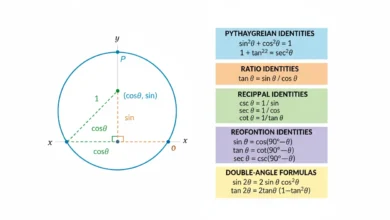
Circles and Trigonometry
Trigonometric functions relate chords, central angles, and radii.
For example:
c = 2r sin(θ/2)
uses Sine.
The Cosine form derived from the Law of Cosines is:
c² = 2r²(1 − cosθ)
These equations connect circle geometry with triangle trigonometry.
Polar Coordinates
Circles centered at the origin are especially simple in Polar and Rectangular Form.
A circle of radius R becomes:
r = R
because every point on the circle has the same radial distance from the origin.
The Cartesian equation:
x² + y² = R²
and polar equation:
r = R
describe the same circle.
Circles and Regular Polygons
A regular polygon can be inscribed in a circle so that every vertex lies on the circumference.
Its center is also the center of the circumscribed circle.
Increasing the number of sides makes the polygon approximate the circular boundary more closely.
The Regular Polygon Area relationship:
A = aP/2
also resembles circle area in a limiting sense, with apothem approaching r and polygon perimeter approaching 2πr.
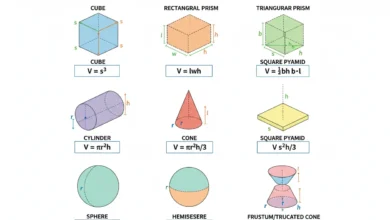
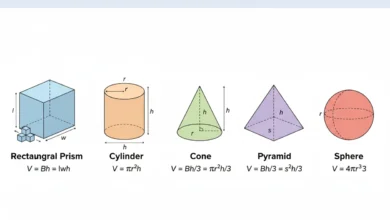
Circles and Cones
A right circular cone has a circular base.
The radius of that base appears in both Cone Surface Area and Cone Volume.
Cone volume:
V = πr²h/3
contains:
πr²
which is exactly the base circle’s area.
Cone surface area additionally uses the base circumference through the geometry of its lateral sector.
Circles and Cylinders
A cylinder also uses circular bases.
Its volume is:
V = πr²h
and its lateral area is:
2πrh
The first formula uses circle area.
The second uses circumference:
2πr
multiplied by height.
This illustrates how basic circle formulas extend directly into three-dimensional geometry.
Scaling Circles
If all linear dimensions of a circle are multiplied by factor:
k
then:
radius → kr
diameter → kd
circumference → kC
chord lengths → kc
arc lengths → ks
but:
area → k²A
For example, doubling the radius doubles circumference but quadruples area.
Example of Circle Scaling
Suppose a circle has:
r = 5
Then:
C = 10π
A = 25π
Double the radius:
r = 10
Now:
C = 20π
which is twice as large.
Area becomes:
A = 100π
which is four times as large.
The difference comes from linear versus two-dimensional scaling.
Circle Units
Radius, diameter, circumference, chord length, and arc length use linear units:
cm, m, ft, in
Area and sector area use square units:
cm², m², ft², in²
Angles use:
degrees
or:
radians
Checking units is one of the simplest ways to distinguish the quantity being calculated.
Common Circle Mistakes
One frequent mistake is confusing radius and diameter.
Remember:
d = 2r
Circumference uses:
2πr
while area uses:
πr²
Arc length should not be confused with chord length.
A tangent touches once; a secant intersects twice.
When reading a circle equation, the signs of the center coordinates are opposite the signs shown inside:
(x − h)²
and:
(y − k)²
The right side of a circle equation is r², not r.
Finally, distinguish the boundary called the circle from the filled region whose size is measured by area.
Frequently Asked Questions
What is a circle?
A circle is the set of all points in a plane that are the same distance from one fixed center.
What is the radius of a circle?
The radius is the distance from the center to any point on the circle.
What is the diameter?
The diameter is a chord passing through the center:
d = 2r
What is the circumference formula?
C = 2πr
or:
C = πd
What is the area formula?
A = πr²
How do you find radius from diameter?
r = d/2
How do you find radius from circumference?
r = C/(2π)
How do you find radius from area?
r = √(A/π)
What is the standard circle equation?
(x − h)² + (y − k)² = r²
What is a chord?
A chord is a segment joining two points on the circle.
What is the longest chord?
The diameter.
What is an arc?
An arc is a portion of the circle’s circumference.
What is a sector?
A sector is the region bounded by two radii and the arc connecting them.
What is a tangent?
A tangent is a line that touches a circle at exactly one point.
What is a secant?
A secant is a line that intersects a circle at two points.
How do circle measurements scale?
Linear measurements scale by k when radius scales by k, while area scales by k².
How can I check a circle calculation?
Verify the radius-diameter relationship, check whether the requested quantity uses linear or square units, and use an equivalent formula—such as C = πd instead of 2πr—when available.